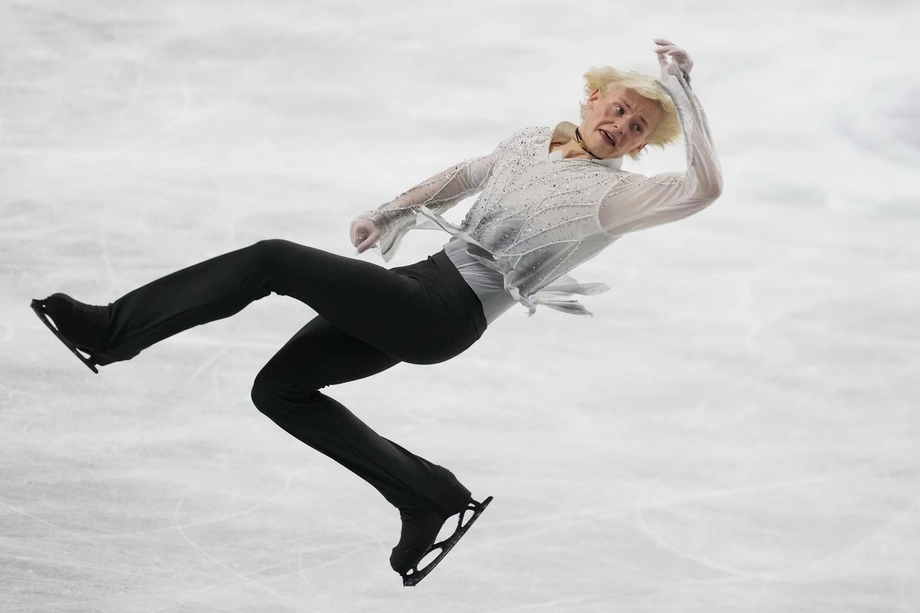
A Record Night in Tokyo
Ilia Malinin scored 114.81 points in the men's short program at the NHK Trophy on Friday, Nov. 27, 2026, setting a world record and opening an 18.03 point lead over Japan's Shun Sato. Performing at Keio Arena Tokyo in Chofu, the American landed a quad flip, a triple Axel and a combination of a quad Lutz and triple toe loop. Sato scored 96.78, while France's Kévin Aymoz was third on 94.15.
Contents
- A Record Night in Tokyo
- The Scoring Behind 114.81
- A Program of Remembrance and a Personal Reset
- How the Record Fits Into Skating History
- Sato Leads a Closely Packed Chase
- Chiba and Japan's Bid for a Women's Sweep
- Russian Skaters Return as Neutral Athletes
- German Pair Leads as Nagaoka Continues Her Comeback
- Americans Turn an Ice Dance Lead Into Victory
- What Happens Next in Tokyo and Chongqing
- Key Points
Malinin's score surpassed the 113.97 recorded by Nathan Chen at the 2022 Beijing Olympics. It also gave the 21 year old American a commanding advantage before Saturday's free skate at the sixth and final qualifying event of the Grand Prix season. The competition runs through Nov. 29, with the leading skaters across the series advancing to the Grand Prix Final in Chongqing, China, from Dec. 10 to 13.
There was success for the host country elsewhere on Friday. Mone Chiba led the women's short program with 77.12 points, the best score of her season. Germany's Minerva Fabienne Hase and Nikita Volodin led the pairs on 75.21, while Americans Emilea Zingas and Vadym Kolesnik set the early pace in ice dance before going on to win that event.
The Scoring Behind 114.81
Malinin's three jumping passes combined difficulty with unusually large execution bonuses. A quad requires four rotations in the air, while the triple Axel is especially demanding because its forward takeoff means the skater actually completes three and a half rotations.
- The opening quad flip had a base value of 11.00 points and received 4.71 points for execution, bringing its value to 15.71.
- The triple Axel started at 8.00 points and gained 3.09, for a total of 11.09.
- The quad Lutz and triple toe loop combination earned 20.88 points, including a base value of 17.27 and an execution bonus of 3.61.
Malinin placed the Lutz combination in the second half of the program, where jumping elements receive a 10 percent increase to their base value. Its 20.88 points were the highest awarded to any element in the men's competition and supplied about 18 percent of his entire score.
The rest of the performance left little unused scoring territory. His three spins and step sequence all received level 4, the highest difficulty designation, and all seven elements earned positive execution marks. His elements had a combined base value of 51.97 points, with another 16.43 added for their quality.
The detailed scoresheet gave him 68.40 points for technical elements and 46.41 for program components, with no deductions. Components cover areas such as composition, performance and skating skills. Malinin received 9.39 for composition, 9.36 for presentation and 9.04 for skating skills, giving him the highest component score among the 12 men as well as the highest technical score.
A Program of Remembrance and a Personal Reset
Malinin skated to Cantata Memoria: For the Children, music originally written to honor the victims of the 1966 Aberfan disaster in Wales, when a coal waste tip collapsed. He has dedicated his program to members of the American figure skating community and the other people killed in the January 2025 collision involving American Airlines Flight 5342 and a military Black Hawk helicopter near Washington, D.C. The victims included 28 people connected to figure skating.
The record therefore carried an emotional meaning beyond its technical difficulty. Malinin covered his mouth when the score appeared and later described his surprise, while also crediting the audience in Tokyo.
Malinin, who has won three consecutive world titles, explained how the Japanese crowd helped him approach the performance.
I was not expecting to get such a high score. But I think being in Japan and having the Japanese crowd ignite the fire in me to put out my best really helped me deliver that score.
His season follows a difficult individual experience at the Milan Cortina Olympics in February. Malinin won a team gold medal but had been favored for the individual title before a poor free skate left him eighth. He subsequently chose later Grand Prix assignments, explaining that he wanted a longer break after the Olympics to reset away from the ice. He said he returned with more energy and greater excitement about competing.
The change has produced encouraging results. Malinin won Skate America two weeks before Tokyo with 284.31 points, and his NHK Trophy short program was almost 20 points higher than his short program at that season debut. His previous personal best had been 111.29 at the 2026 World Championships, meaning he added 3.52 points to that mark in Tokyo.
The NHK Trophy also has a family connection. His mother, Tatiana Malinina, won the event in 1998 and 2001 while representing Uzbekistan and accompanied him to Japan for his first appearance in the competition. Both of his parents are former Olympians and now coach him. Malinin said he would like to continue his mother's tradition of winning in Japan.
How the Record Fits Into Skating History
The detailed record list uses Chen's 113.97 as the previous mark, making Malinin's improvement 0.84 point. An early summary of Friday's event gave Chen's score as 113.87, but 113.97 is the figure used in the record list and the detailed scoring comparison.
Malinin gained his advantage through technical content. His technical score of 68.40 was 2.42 points above Chen's 65.98 from Beijing, even though both men used a quad flip, a triple Axel and a quad Lutz combined with a triple toe loop. Chen's component score was 47.99, compared with Malinin's 46.41.
Those artistic scores were produced under different arrangements. Component judging used five categories during the Beijing Olympics and has since been consolidated into three. Other scoring changes also allow higher short program scores in the current Olympic cycle. The International Skating Union record list nevertheless recognizes 114.81 as the new highest number.
The updated list of the five highest men's short program scores is:
- Ilia Malinin, United States: 114.81 at the 2026 NHK Trophy.
- Nathan Chen, United States: 113.97 at the 2022 Beijing Olympics.
- Yuzuru Hanyu, Japan: 111.82 at the 2020 Four Continents Championships.
- Shoma Uno, Japan: 109.63 at the 2022 World Championships.
- Yuma Kagiyama, Japan: 108.77 at the 2025 Grand Prix Final.
Malinin already held the free skate record of 238.24, established at the Grand Prix Final in December 2025. His Tokyo performance means he now holds the highest recorded scores for both individual segments.
Sato Leads a Closely Packed Chase
Sato, the Olympic bronze medalist who represents Aim Services and Meiji University, did not fully rotate his opening quad Lutz. The landing was judged a quarter of a rotation short. He recovered to complete a quad toe loop and triple toe loop combination, finish with a triple Axel and earn level 4 assessments for his spins.
The Japanese skater said the performance gave him something to develop in the free skate, where he plans to replace this season's Poeta music with Four Seasons, a program he used three seasons ago.
I was able to put the whole program together. I didn't fall and it's something I can build on for tomorrow.
Sato finished fourth at the Cup of China and needs a victory and a high score to keep his Grand Prix Final qualification hopes alive. Aymoz also has a Final place at stake. The Frenchman thanked the Japan Skating Federation for staging the event and said jet lag had left him tired and stressed during his short program. His plan for the free skate was to concentrate on what he could do rather than the qualification arithmetic.
Italy's Daniel Grassl was fourth on 91.66, followed by Switzerland's Lukas Britschgi on 90.81 and Petr Gumennik on 90.60. Vladimir Samoilov of Poland scored 86.72, American Jason Brown 85.89 and Vladislav Dikidzhi 85.46. Only 8.69 points separated Aymoz in third from Dikidzhi in ninth, leaving considerable room for movement in the free skate.
Japan's Rio Nakata was 10th on 82.62 in his first senior Grand Prix season, and Nozomu Yoshioka was 11th on 79.40. France's François Pitot completed the field with 78.06.
Chiba and Japan's Bid for a Women's Sweep
Chiba, 21, has won two world championship medals and arrived in Tokyo after winning the Cup of China earlier in November. She landed all three jumps in her short program, including a triple Lutz midway through. Her only notable flaw was a slight edge error on the opening combination of a triple flip and triple toe loop.
South Korea's Shin Ji-a was second on 75.31, followed by Alina Gorbacheva on 71.48. South Korea's You Young was just 0.06 point behind Gorbacheva on 71.42. Japan's Mako Yamashita placed fifth with 69.34, Yuna Aoki was sixth on 69.17 and Canada's Madeline Schizas seventh on 68.36.
Chiba said she had been extremely nervous and credited coach Mie Hamada with helping her find the necessary energy. A victory would also complete a Japanese sweep of the women's titles at all six qualifying events. Ami Nakai won in France and the United States, while Mao Shimada won in Canada and Finland. Nakai and Shimada have already qualified for the Final, and Chiba supplied Japan's fifth victory at the Cup of China.
Russia is the only other country to have swept the six women's qualifying titles, achieving that feat in 2019. Asked about completing Japan's sweep, Chiba gave a concise answer.
I just have to push forward with all my strength.
Russian Skaters Return as Neutral Athletes
Gorbacheva, Adeliia Petrosian and the other entered Russians are appearing in the Grand Prix series for the first time since Russia was excluded from international competition following its 2022 invasion of Ukraine. Skaters cleared to participate must compete as individual neutral athletes, without Russian national symbols.
Petrosian, the winner of the last three Russian national championships, landed a double Axel and a triple flip combined with a triple toe loop. A fall on her triple Lutz contributed to her eighth place score of 65.28. Viktoriia Safonova was ninth on 63.11. In the men's event, Gumennik stood sixth and Dikidzhi ninth after the short program.
The Tokyo entry list had also changed before competition. Amber Glenn, Cha Jun-hwan, Adam Hagara and Kim Chae-yeon withdrew, while Petrosian, Gorbacheva, Gumennik and Safonova were added.
German Pair Leads as Nagaoka Continues Her Comeback
World champions Hase and Volodin scored 75.21 to lead the pairs short program. Japan's Yuna Nagaoka and Sumitada Moriguchi followed with 69.78 in the detailed standings; the initial summary had listed them on 69.51. Armenia's Karina Akopova and Nikita Rakhmanin were third on 66.95. The leading German and Japanese teams were both in position to secure the remaining Grand Prix Final places.
Nagaoka's appearance continues a demanding return from injury. She sustained a fatigue fracture in her right heel in April and then fractured her left foot in a traffic accident in August. She and Moriguchi recovered sufficiently to finish third at the Cup of China before improving their short program score in Tokyo.
Nagaoka focused on that progress after the performance.
I'm happy we've improved our short program score from the Cup of China.
Americans Turn an Ice Dance Lead Into Victory
Zingas and Kolesnik, who have won world championship bronze medals, led the rhythm dance with 83.16 points. Christina Carreira and Anthony Ponomarenko, also representing the United States, were 2.34 points behind on 80.82. Finland's Juulia Turkkila and Matthias Versluis were third at that stage on 77.01 and were competing with Carreira and Ponomarenko for a remaining Final place.
The free dance confirmed Zingas and Kolesnik as champions. They scored 120.13 for that segment and finished with 203.29 points, winning by 6.41 over Carreira and Ponomarenko. The runners up earned 116.06 in the free dance for a total of 196.88.
Spain's Olivia Smart and Tim Dieck took third with 186.47 after scoring 110.76 in the free dance. Turkkila and Versluis dropped to fourth on 182.73 after receiving 105.72. Zingas and Kolesnik completed victories in both of their regular season Grand Prix appearances and have assumed a leading American role following the retirement of Madison Chock and Evan Bates.
Two teams withdrew from the ice dance competition. Japan's Utana Yoshida and Masaya Morita pulled out after Morita suffered a ligament injury in his left knee during practice. France's Loïcia Demougeot and Théo le Mercier also withdrew, with no reason given.
What Happens Next in Tokyo and Chongqing
Malinin's free skate uses music from Blue Eye Samurai. He said he chose it after enjoying the Netflix anime and wanting to try a Japanese style program. His jumping plan remains flexible: he joked about attempting 10, 15 or 20 quads before making clear that the realistic number had not been decided. An attempt at the quad Axel will depend on how he feels.
The remaining schedule and qualification stakes are:
- Nov. 27: The short programs and rhythm dance opened competition at Keio Arena Tokyo.
- Nov. 28 at 19:30: The men's free program is scheduled to begin. Any podium finish will qualify Malinin for the Grand Prix Final.
- Nov. 29: The NHK Trophy is scheduled to conclude.
- Dec. 10 to 13: The Grand Prix Final takes place in Chongqing.
Malinin is pursuing a fifth consecutive appearance at the Final. A victory on Saturday would also be his ninth consecutive Grand Prix win, a streak dating to 2023. Sato, Aymoz and the tightly grouped skaters behind them still have places and medals to contest, while Chiba carries both her own qualification hopes and Japan's sweep bid into the women's free program.
Key Points
- Ilia Malinin set a men's short program record of 114.81 at the NHK Trophy in Tokyo.
- His technical score was 68.40 and his component score was 46.41, with no deductions.
- Malinin leads Shun Sato by 18.03 points and needs a podium finish to reach the Grand Prix Final.
- Mone Chiba leads the women on 77.12 and can complete Japan's sweep of all six qualifying titles.
- Hase and Volodin lead the pairs, with Japan's Nagaoka and Moriguchi second after Nagaoka's injury comeback.
- Zingas and Kolesnik won the ice dance with 203.29 points, ahead of fellow Americans Carreira and Ponomarenko.
- Russian skaters returned to the Grand Prix series as individual neutral athletes.