A Shop Built From Family Recipes
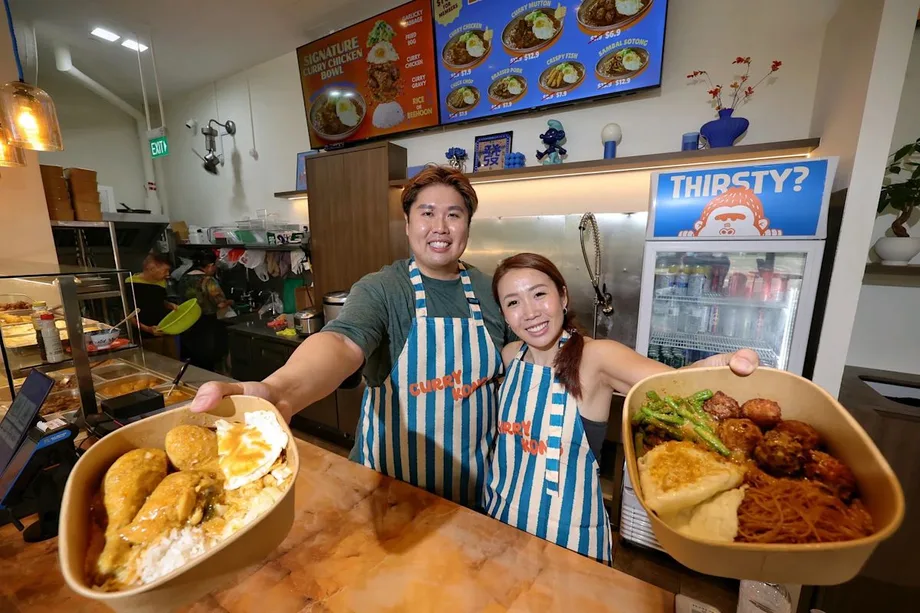
Tay Jia Ling and Tay Jia Han gave up monthly pay of about $14,000 and $20,000 to bring back a curry rice business their parents ran for 19 years. In May 2025, the siblings started Curry Kong from the family's HDB flat in Pasir Ris with $14,000. One year later, they put $100,000 into a shop with 34 seats at Plaza 8 in Changi Business Park. The eatery opened on Aug 11.
Contents
- A Shop Built From Family Recipes
- What the Tampines Stall Meant
- Why Did Two Careers End in 2024?
- A $14,000 Dry Run in Pasir Ris
- When Family Recipes Met Business Rules
- From Home Orders to a Shop in Changi
- What Can Customers Order?
- How Is the Business Performing?
- What Changed for the Parents
- Why the Heritage Wall Matters
- Can Curry Kong Grow Again?
- Key Points
The siblings, aged 36 and 38, are not chasing a trend. They are trying to rebuild a family food memory in a form that can be measured, packed and sold every day. Curry Kong serves seven dishes drawn from the menu once used by Tay Hui Chay, 75, and Lee Gaik Kin, 69, at a stall in Tampines. A bowl costs $6.90 or $7.90 for the two named dishes, and includes rice or beehoon, an egg and cabbage cooked in a wok.
The new shop also marks a hard calculation. For a year, the siblings took no salary, paid their own way and learned that family recipes can be both an inheritance and a demanding production schedule. Their story is about careful risk: debt cut, savings spent, long days worked, and a family learning to run meetings before it could run a second outlet.
Singapore's food scene gives Curry Kong a familiar setting, yet the business model is modern. Repeat customers matter, delivery orders add pressure, and short videos help tell the story. The family is using corporate tools to protect a meal that began with two people cooking roughly 30 dishes a day.
What the Tampines Stall Meant
Tay Hui Chay and Lee Gaik Kin ran a stall without a signboard at Block 280 Tampines Street 22 from 1995 to 2014. It sold cai png, a meal of rice with side dishes known in Singapore as economy rice. The couple cooked around 30 dishes daily and served rice with one meat dish and two vegetable dishes, with prices starting at $2.50.
Their children were old enough to help but too young to learn the craft. Jia Ling removed dark husks from bean sprouts and peeled boiled eggs. Jia Han stacked takeaway boxes, peeled garlic and cut chilli with scissors. Those small jobs later became a bridge back to a kitchen the siblings once knew from the customer side.
The parents worked six days a week and rarely took holidays because a day off meant lost income. In 2014, the coffee shop operator raised the rent to an amount the couple could not justify, so they closed the stall and retired. After 19 years, some customers cried when the stall shut. Lee Gaik Kin, mother of Tay Jia Ling and Tay Jia Han, later recalled the reaction in a video.
I had no idea we meant so much to our customers.
Old customers returned when Curry Kong began at home, giving the new business a base of people who already knew the family's cooking.
Why Did Two Careers End in 2024?
Jia Ling resigned in March 2024 from her role as head of product at a fashion retail company, earning about $14,000 a month. Jia Han quit two months later, while working as a branch manager for the hotpot restaurant chain Haidilao in London on about $20,000 a month. He returned to Singapore in September 2024. Together, the two salaries came to about $408,000 a year.
Jia Han had joined Haidilao as a management trainee in 2017 and later worked in London and Birmingham, handling business development and restaurant operations. Jia Ling had spent 12 years in product management, moving through fintech and fashion retail. Both had graduated from RMIT University at the Singapore Institute of Management in a business degree programme with a marketing major, Jia Ling a year before Jia Han.
Jia Han, who had worked on staffing, sourcing, inventory, kitchen work and customer service operations in restaurants, said the family idea made sense once he wanted a project of his own.
I always had this intention to do something for myself and it made sense to build something on our family's food heritage.
Jia Ling wanted a connection with the food her parents had made and was willing to accept years without pay. In 2021, she and her then boyfriend bought a condominium with three bedrooms in Tampines for $1.2 million. They separated in 2022. She sold the property in August 2024 and paid off her car loan so monthly repayments would not weigh on the new business.
A $14,000 Dry Run in Pasir Ris
In May 2025, the siblings put $7,000 each into a business run from home. They spent $14,000 setting up Curry Kong in the HDB flat with four bedrooms in Pasir Ris where they live. HDB flats are Singapore public housing apartments. The flat became a test kitchen, packing station and delivery hub.
Their parents were initially shocked by the plan to enter the food business. After the siblings had committed their own money, the parents supported them. Curry Kong also drew customers who had eaten at the family stall years earlier, so the home launch carried recognition as well as risk.
To keep savings intact, neither sibling drew a salary for a year. Jia Han drove passengers for hire from about 7.30am to 11am, went home to pack orders and check supplies, then drove again in the late afternoon. Jia Ling drove three or four mornings a week. After cleaning the kitchen, they often finished at 11pm.
The dry run worked faster than expected. Curry Kong received 15 to 20 orders a day when it began in May 2025. Orders doubled by July, when a $20 to $25 order could mean about $600 to $1,000 a day at that rate. The siblings recovered the $14,000 they had put into the home business within four months.
When Family Recipes Met Business Rules
The siblings had helped at the stall as children but had never cooked the dishes themselves. In the Pasir Ris kitchen, they started with the basics: identifying spices, making curry paste from dried chillies and spices, and making chilli paste from scratch. Their parents, tired of retirement, joined the cooking from the first day.
The flat soon filled with stock. Takeaway boxes, disposable cutlery and cartons of canned drinks reached the ceiling in the living room. Bedrooms held rice cookers and blenders the siblings had bought and found unsuitable. A home kitchen can handle a family meal; a food business has to handle repetition, storage and timing.
Recipes caused the first serious clash. Tay Hui Chay and Lee Gaik Kin cooked by instinct and rarely measured ingredients. Their children wanted precise quantities so curry would taste the same whoever made it. The parents resisted until customers complained that the chicken curry varied in thickness and seasoning.
Arguments also broke out over presentation, hygiene and working styles. Jia Ling wanted regular updates and careful plans. Jia Han preferred to work first and discuss problems when needed. She handled marketing and business development while he spent more time driving passengers; they argued several times a week at the start, and she considered giving up.
In October 2025, the family agreed on a system. They began holding monthly business meetings that could last up to five hours, covering problems, finances and customer feedback. The parents took a food hygiene course to update their knowledge. Jia Han now handles cooking, purchasing and daily operations. Jia Ling covers design, data analysis, marketing and finance and works in the shop several days a week. The siblings say the friction brought them closer because each role became clearer.
From Home Orders to a Shop in Changi
Growth created a practical problem. As orders rose, the home kitchen struggled and the electricity started tripping. The siblings began looking for a shop in December 2025. Because about 70 per cent of customers came from the east of Singapore, Plaza 8 at Changi Business Park fitted the business better than a site elsewhere.
They chose a unit of 645 sq ft with rent under $4,000 a month, using savings and earnings from the home business to prepare it. The shop has 34 seats. It was planned to welcome customers in July, then opened on Aug 11. The $100,000 spent on the shop was more than seven times the $14,000 used for the home trial.
The key dates show how quickly the idea moved from a family conversation to a shop.
- 1995 to 2014: Tay Hui Chay and Lee Gaik Kin run the Tampines economy rice stall.
- March 2024: Jia Ling resigns from her fashion retail job.
- May 2024: Jia Han leaves Haidilao and returns to Singapore in September.
- May 2025: Curry Kong starts from home with $14,000.
- October 2025: the family starts monthly business meetings.
- December 2025: the search for a shop begins.
- April 2026: the siblings stop driving passengers for hire as the business grows.
- Aug 11: the Plaza 8 eatery opens.
- Late September: the shop hires its first employee.
What Can Customers Order?
The menu has seven curry rice dishes based on what the Tampines stall once sold. The Curry Chicken Bowl With Rice costs $7.90, and Kong's Pork Meatball Bowl With Beehoon costs $6.90. Beehoon means thin rice noodles. Each bowl comes with rice or beehoon, a sunny side up egg and cabbage cooked in a wok.
Jia Han prepares curry chicken with the family rempah, a spice paste made from dried chillies and spices. The pork meatballs are small and adapted from the large lion's head meatballs once served by the stall. Braised pork belly is among the meat choices, while sambal sotong, squid in chilli sauce, appears as an optional extra for $3.50.
Spicy Hae Bee Long Bean costs $1.50 as an optional extra. Customers can ask for more curry or gravy at no extra charge. Breakfast, served from 8am to 11am on weekdays, includes Mum's Traditional Yam Cake at $2.50. Lunch starts at 11am on weekdays and 11.30am on weekends.
How Is the Business Performing?
On weekdays, the shop sells about 90 rice bowls and 40 beehoon bowls, not counting deliveries. That is about 130 bowls a day before delivery orders. Weekend sales are about a fifth of that, roughly 26 bowls a day. The business has also reached a customer retention rate of 50 to 60 per cent, meaning that about half or more of customers come back.
The siblings aim to recover the $100,000 shop investment within 18 months and start paying themselves modest salaries by the first quarter of 2027. Their timeline would end a stretch of two years in which they supported themselves through savings, driving work and the home business. Curry Kong's early numbers suggest demand exists, but rent, staffing and ingredient costs will decide how quickly the investment is repaid.
The family did not give a monthly revenue figure that includes deliveries. No exact opening date has been set for a second outlet beyond the early 2028 target. The goal of three outlets is set for within five years.
What Changed for the Parents
At the start, Jia Han and his parents worked the wok at the shop from 7am until closing. He cooked beside his father, while Lee Gaik Kin prepared ingredients. Jia Ling split her time between the shop, social media and data analysis. The work was physically demanding, much like the old stall that kept her parents away from holidays for 19 years.
The first employee was hired in late September. Since then, Tay Hui Chay and Lee Gaik Kin leave work at about 2pm. Their father has time to exercise, and their mother can play mahjong with friends. The change may look small on a balance sheet, but it marks the reason the siblings took the risk: their parents no longer have to carry the longest shifts.
Jia Ling, who oversees design, data analysis, marketing and finance, said the experience changed how she understood the work done by her parents. She described the discipline needed to keep a hawker business running and linked it to the long hours she saw as a child.
I really grew a different level of respect for them. It is really hard work and I could only truly empathise how hard it was when I experienced it myself. It takes a lot of discipline and grit to be a hawker.
The remark connects the expansion plan to daily life at home.
Why the Heritage Wall Matters
A heritage wall inside the eatery tells the story of the family's hawker history. Jia Ling recalled photographing her father looking thoughtfully at that wall. For customers who ate at the Tampines stall, the wall and the recipes are a way to recognise a business that closed more than a decade ago.
Lee Gaik Kin's quote about customers after closure shows why the return carries weight. Curry Kong attracted former stall customers when it began at home, and the 50 to 60 per cent repeat rate suggests the new shop is not relying only on curiosity. The family has turned nostalgia into a service that has to be consistent each day.
Jia Ling, the sibling leading marketing and finance, spoke about the recipes as a gift rather than a set of instructions.
More than anything, we'd like them to know that the recipes they've passed down to us are one of the most priceless gifts they could have given us.
Jia Ling, a former head of product, said she enjoyed corporate life, yet it "felt like a constant chase for the next high" and "something deeper was missing." She called Curry Kong "a bigger mission to preserve our local flavours." In a video, she described the pull of a different kind of work and said the new path felt right.
I don't know where this will lead me, but for the first time in a long while, this feels right.
Can Curry Kong Grow Again?
The siblings want to open a second outlet by early 2028 and reach three outlets within five years. Jia Han's experience with restaurant operations gives the business a practical base for expansion, while Jia Ling's product and data work gives it a way to track demand and adjust the menu.
Growth will depend on whether the Changi shop can repeat the early success of the home business at a larger scale. The home operation recovered its initial costs in four months; the shop must recover $100,000 in 18 months. The shop also has staff wages and rent, while the home kitchen had family labour and lower overheads.
For now, the family has changed the daily routine in a concrete way. The father can exercise in the afternoon, the mother can play mahjong, the first employee has a job, and customers in east Singapore have a curry rice shop built from dishes that once cost from $2.50 at a stall without a signboard.
Key Points
- Tay Jia Ling and Tay Jia Han left jobs paying about $14,000 and $20,000 a month to revive dishes from a Tampines economy rice stall.
- Their parents ran the stall at Block 280 Tampines Street 22 from 1995 to 2014, cooking around 30 dishes daily.
- Curry Kong began from home in May 2025 with $14,000 and recovered those costs within four months.
- An eatery with 34 seats opened at Plaza 8 in Changi Business Park on Aug 11 after a $100,000 investment.
- The shop sells about 130 rice and beehoon bowls on weekdays, excluding deliveries, and aims to repay the investment in 18 months.
- The family plans modest salaries by the first quarter of 2027, a second outlet by early 2028 and three outlets within five years.