A List of 62 Bills, and a Target Cut to About 50
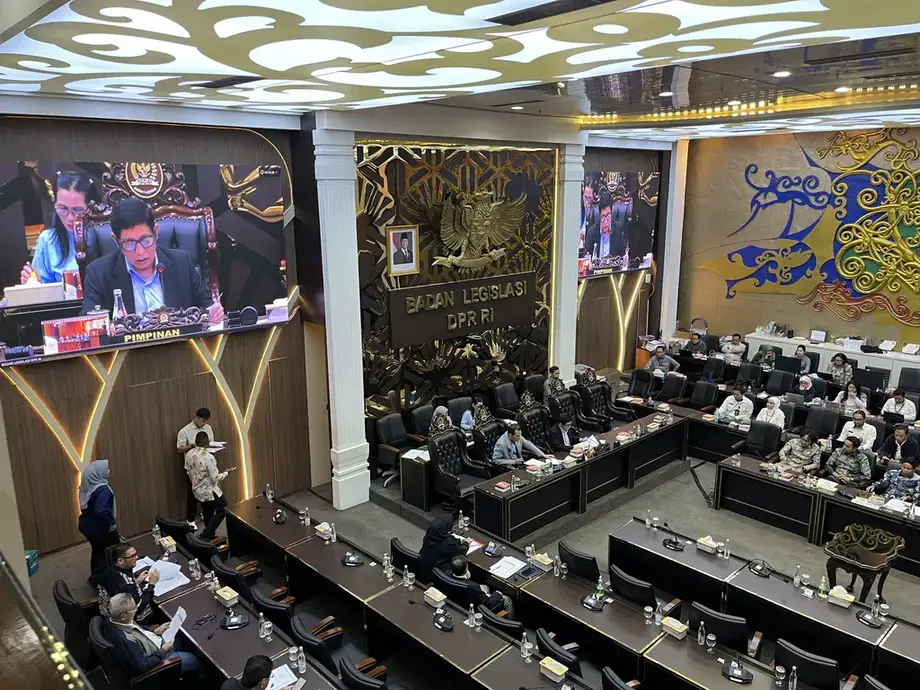
Indonesia's Legislative Body (Baleg) of the House of Representatives agreed on Wednesday 25 November 2026 that 62 bills will form the 2027 priority national legislation programme, the Prolegnas Prioritas. The decision was taken at a working meeting with the bill drafting committee of the Regional Representatives Council (PPUU DPD) and the government in the Parliament complex at Senayan, Jakarta. It fixes which laws the chamber has committed to drafting next year.
Contents
- A List of 62 Bills, and a Target Cut to About 50
- Why a Smaller List Is Meant to Deliver More
- Ten New Bills Join the Long List
- Six Late Changes: Swaps, Mergers and a New Sponsor
- What the 62 Bills Actually Cover
- The Sharia Economy Bill Arrives Two Years Early
- Small Business Rules Move Up, but Not Into the Priority List
- The Government's Side of the Deal
- What Happens Next
- Key Points
The 62 divide into 45 bills proposed by the House, 15 from the government and two from the regional council, the DPD. The same meeting lifted the total number of bills in the sixth amendment to the 2025-2029 medium term Prolegnas to 210, a figure read out by the working committee that screened every proposal.
Behind the arithmetic sits a change of method. Baleg chair Bob Hasan wants the annual target trimmed to somewhere in the 50s, after a 2026 list of more than 70 bills produced about 30 finished laws. A smaller list, in his account, turns a respectable output into a completion rate that shows it.
Why a Smaller List Is Meant to Deliver More
Bob Hasan set out the reasoning at the plenary, as recorded in the DPR's plenary readout. Of the priority list that ran beyond 70 bills in 2026, roughly 30 were completed. He called that result close to half and strong on its own terms, while arguing the ratio misleads when the denominator is large.
"Previously it went up to 70 or more, but the result was about 30. That was in fact already extraordinary, it had almost reached 50 percent. But if we change the composition, when the priority list is below 70, say around 50, it means that if the achievement can reach 30 again in 2027 or even more, then the percentage will be high," he said.
He rejected the idea that bills left off the annual list would be dropped. Baleg will keep a mechanism for harmonising bills across commissions and for shifting items from the longer programme into the yearly priority list. Some commissions already hold two slots, others hold one and can request another once the first has been drafted and accepted as a House initiative.
"Trimming is entirely possible in the context of the number of targets. It does not mean that when we do not place some bills on the Prolegnas agenda we will not deal with them, no. What I mean is that we at Baleg will try to harmonise how the position of the bills for 2027 stands," he said.
The stakes are visible in the arithmetic. Finishing 30 bills from a list of about 50 would give a completion rate near 60 percent. Reaching 35 would put the House at 70 percent, the realisation level it has set itself for the 2027 programme. From a list of more than 70, the same 30 laws amount to well under half. Bob Hasan, a Gerindra politician, made the same case in Gerindra's statement on the target: the point of the cut is a target that can be measured honestly.
Ten New Bills Join the Long List
Martin Manurung, a Baleg deputy chair who headed the working committee (Panja), reported that the panel inventoried every proposal sent in by commissions, individual members, Baleg itself and the government. It then screened the government's submissions for both the 2027 priority list and the longer 2025-2029 programme.
"In general, what the working committee has done is inventory all the bill proposals submitted, from the House, in this case the commissions, also from members, and those prepared by the Legislative Body," Martin said.
The screening produced ten new bills for the sixth amendment of the 2025-2029 programme, six from the House and four from the government. Together they reach into artificial intelligence, land records, aviation, human trafficking, the Jakarta capital region, sharia insolvency, defence, small business, immigration and espionage.
- Artificial intelligence, proposed by the House
- Land administration, proposed by the House
- Third amendment to the 2009 aviation law (Law 1/2009), proposed by the House
- Amendment to the 2007 law on trafficking in persons (Law 21/2007), proposed by the House
- Second amendment to the 2024 Jakarta special region law (Law 2/2024), proposed by the House
- Sharia bankruptcy and suspension of debt payment obligations, proposed by the House
- Amendment to the 2002 defence law (Law 3/2002), proposed by the government
- Amendment to the 2008 micro, small and medium enterprise law (Law 20/2008), proposed by the government
- Fourth amendment to the 2011 immigration law (Law 6/2011), proposed by the government
- Antispionage, proposed by the government
Government representatives at the meeting put the inventory at 210 bills in the amended medium term programme. The working document tabled on 25 November, before the final vote, listed 61 bills for 2027: 44 House proposals, 15 from the government and two from the DPD. The approved list counts 62, with the extra seat attributed to the House in the breakdown read out at the meeting.
Six Late Changes: Swaps, Mergers and a New Sponsor
The working committee rewrote parts of the draft before the vote. A bill on public procurement of goods and services moved from the government's column to the House's and will be drafted by Commission XI. The food bank bill was replaced by a sharia economy bill put forward by members of the Prosperous Justice Party (PKS). The regional languages bill gave way to a bill on regionally owned enterprises (BUMD) proposed by the DPD.
- Public procurement of goods and services: switched from a government bill to a House bill under Commission XI
- Food bank: replaced by the sharia economy bill, proposed by PKS members
- Regional languages: replaced by the regionally owned enterprises bill, proposed by the DPD
- Traditional markets: merged with the modern retail market bill into one text
- Online transport: merged with bills on freelance and platform workers, including a gig economy protection bill
- Animal protection and welfare: merged with the veterinary medicine bill
Martin said the merged texts will be reviewed at the regular evaluation of the Prolegnas according to how far each has progressed. Requests from the DPD about scheduling, the choice of a lead sector and bills initiated by the regions were accepted, as were the government's title changes. The DPR's announcement of the list confirms that the three mergers were agreed to prevent two competing texts from covering the same ground.
What the 62 Bills Actually Cover
The 2027 list reaches into election rules, broadcasting, wiretapping and the judiciary, and it carries a heavy load of economic and social housekeeping. Commissions hold most of the seats, with Baleg sponsoring a dozen items and the DPD holding two.
Politics and security items include a revision of the 2017 election law, a broadcasting bill, a wiretapping bill, a bill on the office of judges, cyber security and resilience, antispionage, changes to the defence laws, and a bill setting procedures for carrying out the death penalty.
- Economy: new and renewable energy, industrial estates, strategic commodities, public procurement, the competition law (Law 5/1999), the chamber of commerce law (Law 1/1987), hajj fund management (Law 34/2014), a bill on business entities, and a sharia economy bill
- Rights and welfare: child protection (Law 23/2002), juvenile criminal justice (Law 11/2012), the human rights law (Law 39/1999), protection of migrant workers (Law 18/2017), disaster management (Law 24/2007), occupational safety (Law 1/1970), the national education system (Law 20/2003), customary communities, drinking water and sanitation, and housing
- State structure and territory: a new North Papua province, amendments to the laws on West Nusa Tenggara and East Nusa Tenggara, Aceh, Jakarta and regional government, plus statistics, copyright, industrial design, nuclear energy, transfer of prisoners between countries, and private international law
Four of the listed items are rewrites of laws passed within the past three years, including the 2024 Jakarta law and the 2024 provincial laws for West Nusa Tenggara and East Nusa Tenggara, both passed in 2022. The document also carries five lists of bills designated as kumulatif terbuka, a category that lets the House debate certain texts without them being on the programme, typically treaty ratifications and budget related laws.
The Sharia Economy Bill Arrives Two Years Early
One switch has an audience outside Parliament. The sharia economy bill had sat on the long list, and the National Committee on Sharia Economy and Finance (KNEKS) had aimed for 2028. Priority status brings it forward to 2027.
Thank God, the sharia economy bill is in the 2027 priority Prolegnas. This makes us more optimistic about the sharia economy," Sutan Emir Hidayat, KNEKS director of sharia ecosystem infrastructure, said. "This is faster than the target set at KNEKS, which was 2028, but thank God it is already in for 2027. If it is already a priority, it means the chance of being discussed is higher than those that are not priority.
Emir pointed to sharia banking assets passing Rp 1,000 trillion in 2026 as evidence of the sector's size, with state sukuk bonds still one of the main engines of sharia finance. He listed BP Tapera, the sharia savings and loan cooperatives, the hajj fund board BPKH and sharia services at the health insurance agency BPJS Kesehatan as parts of the ecosystem. Sharia economy policy has been written into the national medium term development plan and into regional plans, he said.
Small Business Rules Move Up, but Not Into the Priority List
I Nyoman Parta, a Baleg member from the Indonesian Democratic Party of Struggle (PDI Perjuangan), used the meeting to press for the revision of the micro, small and medium enterprise law. He filed no bill of his own and instead asked that the government's proposal be lifted from the medium term programme into the annual priority list.
"I did not propose any member bill. We are just strengthening what the government proposed, which was previously in the medium term, so it becomes a priority bill on micro, small and medium enterprises. First because the Indonesian economy is dominated by MSMEs, more than 72 percent. Its position does need protection. Why does it need protection? Because it is competing with large capital," Nyoman said.
He flagged licensing costs as the burden small firms carry. A food or drink business needs a business identification number, known as NIB, and registration of each product with the food and drug agency BPOM, which charges per item. Access to capital rounded out his list of demands.
The revision did not land among the 62 priority bills. It sits seventh on the nine bill list proposed for the sixth amendment of the 2025-2029 programme, alongside the immigration and antispionage bills, which means its fate depends on a later shift into a yearly priority list.
The Government's Side of the Deal
Deputy Law Minister Edward Omar Sharif Hiariej, known as Eddy Hiariej, represented the government and accepted the working committee's report. Of the 15 government bills on the 2027 list, five have reached the first stage of deliberation (Pembicaraan Tingkat I), eight are 2026 carryovers still being drafted inside ministries, and two are new proposals for 2027.
"The government states that it accepts and approves the results of today's working committee meeting. We also express appreciation for the approval of 15 government bills for the 2027 priority Prolegnas and four government bills for the 2025-2029 medium term Prolegnas," Eddy said.
He thanked members for a discussion he described as effective and efficient from morning to midday, and set the government's own benchmark for the year.
We hope that the 2027 Prolegnas can achieve a better realisation target than the realisation of the 2026 priority Prolegnas.
After the government spoke, Bob Hasan put the report to the room and closed the meeting with the signing of its conclusions by House representatives, the step that turns the list into a working document for the commissions.
What Happens Next
No date has been set for the first debates on any of the 62 bills, and the list does not bind the commissions to a timetable. Baleg will run periodic evaluations and harmonise overlapping texts across commissions, and it can add bills during the year through the kumulatif terbuka route. The merged bills on traditional markets, platform workers and veterinary medicine will be reassessed at those evaluations, which is when a proposal can be split again or folded into another.
For the House, the test comes at the end of 2027, when the completion rate against the list is counted. With about 50 priority bills, the 30 laws it passed in 2026 would already look like a majority of the programme, and 35 would clear the 70 percent mark it has set. The 210 bills in the medium term programme, including the small business, immigration and antispionage revisions, wait for their own slot in a yearly list.
Key Points
- Baleg DPR approved 62 bills for the 2027 priority Prolegnas at a working meeting on Wednesday 25 November 2026 in Senayan, Jakarta
- The list holds 45 House proposals, 15 from the government and two from the DPD, the regional council
- The sixth amendment to the 2025-2029 Prolegnas now totals 210 bills
- Bob Hasan wants the annual target cut to about 50 bills, after 2026 finished roughly 30 of more than 70
- Ten new bills were added, including artificial intelligence, land administration, antispionage and an immigration revision
- Six changes were made, among them moving the public procurement bill to the House and merging the transport, retail market and veterinary texts
- The sharia economy bill replaces the food bank bill and arrives two years earlier than KNEKS had planned
- The small business revision was not placed on the priority list and sits seventh of nine bills on the medium term amendment list
- Deputy Law Minister Eddy Hiariej accepted the report and cited 15 government bills on the priority list and four on the medium term list