A December 2030 deadline as Lower Arun enters implementation
Nepal has set December 4, 2030 as the target date for starting electricity generation at the 669 MW Lower Arun Hydropower Project. The Office of the Prime Minister and Council of Ministers announced the date at its regular press briefing on Friday, November 27, 2026, saying the project had entered the implementation phase. A tender worth approximately INR 11.4921 billion has also been called under Package 1, which covers major access and tunnelling works.
Contents
- A December 2030 deadline as Lower Arun enters implementation
- How Nepal chose the developer
- How one river will supply two power stations
- What the first construction contracts cover
- The investment approved and the financing still unfinished
- What Nepal receives under the transfer agreement
- What changes for families at the project site
- Where the electricity will go
- Beyond hydropower: implementing the India visit agreements
- Procurement action and Hello Sarkar complaints
- Disaster funds and other government checks
- Key Points
Prime Minister Balendra Shah and Indian Prime Minister Narendra Modi jointly laid the foundation stone on November 23 during Shah's visit to India on November 22 and 23. The leaders unveiled the commemorative plaque virtually from Hyderabad House in New Delhi. Investment Board Nepal chief executive Yanki Ukhyab said a physical ceremony would follow in Nepal and described the launch as a move towards construction.
The physical ceremony will take place from Nepal. Lower Arun has now moved forward towards the construction phase.
Hem Raj Aryal, identified in the Nepali briefing as a joint secretary and spokesperson at the Prime Minister's Office, said construction would be pursued with the generation date in view. The English summary of the briefing rendered his name as Hriday Raj Aryal. Aryal stated the schedule in these terms:
The target is to generate electricity from this project from December 4, 2030.
The date gives the project a more precise public timetable than the developer's earlier commissioning window of the 2030 to 2031 financial year. It also turns attention to the work still outstanding: financial closure had not been completed at the time of the launch, and the final contractual position of Package 2 remains to be settled publicly.
How Nepal chose the developer
Lower Arun was presented as a showcase project at Nepal's 2019 investment summit. Three groups initially expressed interest: SJVN, a joint venture involving Power Construction Corporation of China and Hydroelectricity Investment and Development Company, and a group involving Green Resources and Japan's Electric Power Development Company. Only SJVN and the PowerChina venture subsequently submitted proposals. Both offered Nepal more than 20 percent of the electricity without charge.
- 2019: Nepal presented Lower Arun at its investment summit to attract a developer.
- January 29, 2021: The Investment Board's 46th meeting, chaired by then Prime Minister KP Sharma Oli, selected SJVN for the 669 MW project. The Nepali date was 16 Magh 2077.
- 27 Asar 2078: The two sides signed a memorandum of understanding.
- June 1, 2023: Investment Board Nepal and SJVN signed the Project Development Agreement during then Prime Minister Pushpa Kamal Dahal's visit to India. The Nepali date was 18 Jestha 2080.
- November 22 and 23, 2026: Shah made a state visit to India at Modi's invitation, and the two prime ministers jointly laid the foundation stone on November 23.
- November 27, 2026: The Prime Minister's Office announced the Package 1 tender and the December 4, 2030 generation target while reviewing government work performed between Mangsir 1 and Mangsir 11.
Implementation rests with SJVN Lower Arun Power Development Company Private Limited, a wholly owned subsidiary incorporated in Nepal by India's SJVN Limited. SJVN is owned by the Indian government and secured the project through international competitive bidding. The development agreement uses the build, own, operate and transfer model, under which the developer finances and operates the plant for an agreed period before transferring it to Nepal.
How one river will supply two power stations
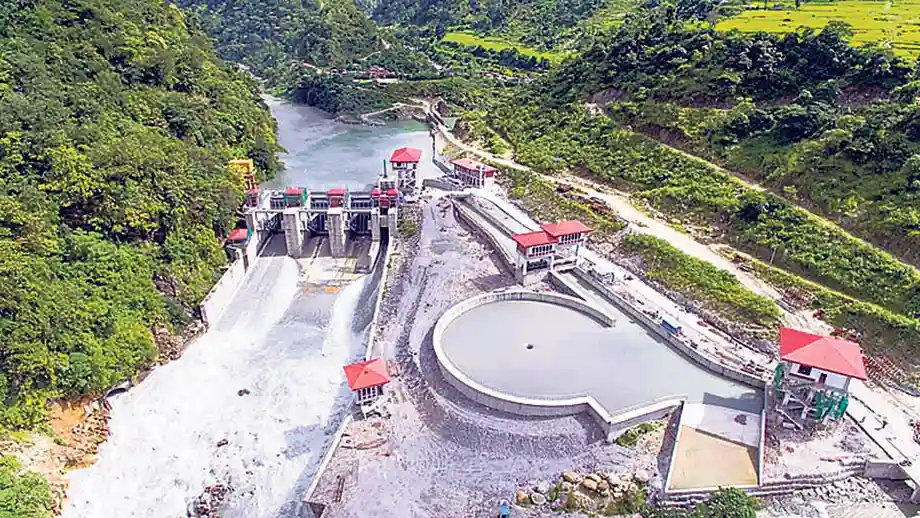
Lower Arun is designed as a tailrace development of the 900 MW Arun-3 project, which is under construction about 35 kilometres upstream on the same river. Water discharged after generating electricity at Arun-3 will be collected near Chewabesi in Khandbari Municipality ward 2 and carried through a tunnel approximately 17.3 kilometres long to the Lower Arun powerhouse. The arrangement allows the same flow to generate electricity twice.
Because Lower Arun will use water leaving Arun-3, it does not require a separate storage reservoir or dam. Its main structures include a headrace tunnel, which carries water towards the turbines, and a surface powerhouse. SJVN explained the purpose of the shared water arrangement in its project statement:
This arrangement will ensure optimum utilisation of available water resources, enabling additional renewable energy generation without constructing a separate storage reservoir.
The plant will contain four generating units of 167.25 MW each. Its planned capacity was increased from 474.25 MW to 669 MW during design work, an addition of 194.75 MW, or about 41 percent. Expected annual production is approximately 2,901 million units of electricity. One unit is a kilowatt hour, equivalent to the energy consumed by a 1,000 watt appliance operating for one hour.
Project infrastructure is concentrated in Chichila Rural Municipality and Khandbari Municipality in Sankhuwasabha district, in what approval documents called Province 1 and is now Koshi Province. The developer's broader location description also includes Bhojpur district. The construction area near Tumlingtar is approximately 264 kilometres from Siliguri in India, giving contractors an important reference point for transporting equipment and materials.
What the first construction contracts cover
Package 1 covers the main tunnel, spill tunnel, access tunnels known as adits, and an access road. Its stated value is NPR 18.3873 billion, equivalent in the contract announcement to INR 11.4921 billion. The Prime Minister's Office described the contract as having been tendered. Dineshchandra R. Agrawal Infracon, commonly called DRA Infracon, is identified as its contractor in project and company information. DRA has also publicised two civil contracts worth about US$310 million combined, including more than 17 kilometres of headrace tunnelling.
Patel Engineering separately announced that it had been declared the lowest bidder for Package 2. Its bid is valued at INR 1,593.08 crore, or INR 15.9308 billion, including value added tax, with a completion period of 54 months from award. The work includes Adit 5 and Adit 6, excavation of a 5.41 kilometre section of the headrace tunnel with a diameter of 10.5 metres, a surge shaft, pressure shafts, a butterfly valve chamber, the powerhouse, switchyard and tailrace channel. Adits provide side access for workers and equipment, while the tailrace returns water to the river after it passes through the turbines.
The contractual position requires clarification. The project promoter's website listed DRA Infracon as receiving Package 2 as well, even though Patel Engineering announced its lowest bidder status. Signing Package 2 therefore remains one of the next milestones, alongside tunnel excavation and powerhouse construction.
Patel Engineering already works on the nearby Arun-3 project. Managing Director Kavita Shirvairkar described the Lower Arun order as a positive start to Q1 FY27 and connected it with the company's support for regional energy independence. The company says it has completed more than 85 dams and 40 hydroelectric projects during its 77-year history.
The investment approved and the financing still unfinished
India's Cabinet Committee on Economic Affairs, chaired by Modi, approved an investment of INR 5,792.36 crore, equivalent to INR 57.9236 billion and approximately US$650 million. Nepal's project estimate is NPR 92.67 billion. The Indian committee also approved equity investment of INR 1,737.70 crore, or INR 17.377 billion, in the project company and gave approval after the fact for the subsidiary already incorporated in Nepal.
The approved levelized tariff is INR 4.99 per unit. A levelized tariff is an average price used to assess a project's revenue over its operating life, rather than a promise that every consumer bill will use that rate. The Indian approval called for completion within 60 months of investment approval, while Nepal's development agreement describes a construction target of five years.
Financial closure, the point at which the required loans and equity are fully committed, had not been completed when the project was launched. Investment Board spokesperson and joint secretary Bhupendra Thapa said land acquisition and construction tendering were moving ahead while financing work continued.
The company has acquired the land required for Lower Arun with its own equity. Financial arrangements on one side and tender invitations for construction on the other are being taken forward together.
An SJVN representative said at the time that tender work was being supported from company equity and that the aim was to complete financial closure within a month. The subsequent government briefing did not announce that financing had been completed or provide a new date for it.
What Nepal receives under the transfer agreement
Nepal will receive 21 percent of all electricity generated by Lower Arun without charge. If annual production matches the expected 2,901 million units, that share would amount to roughly 609 million units in such a year. The actual free allocation will vary with generation, which depends on water conditions and plant operations.
The government will also receive royalties. For the first 15 years after commercial production begins, the capacity royalty is NPR 400 per kilowatt and the energy royalty is 7.5 percent. After those 15 years, the rates rise to NPR 1,800 per kilowatt and 12 percent respectively. Capacity royalty relates to installed generating capability, while energy royalty relates to electricity produced.
The developer will operate the project under the build, own, operate and transfer agreement for 25 years after commercial operation starts. It must then hand the project over to the Government of Nepal without charge and in operational condition. For Nepal, the immediate gains are free electricity, royalty and tax revenue, employment and local infrastructure. For the developer and its lenders, the operating period provides the opportunity to recover construction and financing costs.
What changes for families at the project site
Compensation payments have begun, but the process is not finished. Approximately NPR 999.839 million had been distributed to about 253 families by the time of the foundation stone. The total compensation allocation is NPR 1.4 billion, meaning the payments made so far equal about 71 percent of that allocation.
Project records identify 656 landowners eligible for compensation and 268 households directly affected by construction. Those categories serve different purposes: a landowner may receive payment for acquired land, while an affected household can face disruption to housing, access or livelihoods. Completing the remaining payments and maintaining access during tunnelling and powerhouse work will directly affect how quickly communities experience the project's promised benefits.
The government expects construction and subsequent operation to support economic activity in Sankhuwasabha and the wider Koshi Province. SJVN also expects work for contractors, suppliers of construction materials and equipment, and employees from both Nepal and India.
Where the electricity will go
A transmission line approximately 217 kilometres long is under construction to carry power through a 400 kilovolt connection with two circuits to Sitamarhi in Bihar, India. A line with two circuits provides two separate electrical paths on the same transmission system. Electricity from Lower Arun is intended for use in both the Nepali and Indian grids.
The developer estimates that the project will reduce carbon emissions by about 26 lakh tons annually, equivalent to approximately 2.6 million tons. That estimate rests on renewable generation displacing electricity that would otherwise produce emissions.
Lower Arun is one of three SJVN hydropower projects in Nepal. Together with the 900 MW Arun-3 and the 630 MW Arun-4, they total 2,199 MW. Lower Arun's dependence on water released by Arun-3 also means that coordination between the two plants will be central to achieving the expected output.
Beyond hydropower: implementing the India visit agreements
Lower Arun was one of four infrastructure and energy initiatives for which Shah and Modi virtually laid foundation stones after their bilateral meeting. The others were an integrated check post at Banbasa, the second phase of the Motihari to Amlekhgunj petroleum pipeline and an oil storage terminal in Jhapa. The leaders also inaugurated a motorable bridge connecting Dharchula in India with Darchula in Nepal and a railway service linking Ayodhya with Janakpur. Several memoranda of understanding covering other areas of cooperation were exchanged.
The Prime Minister's Office has begun coordinating implementation with the ministries responsible for each agreement. Aryal said those ministries would carry the main responsibility for meeting deadlines, while his office would coordinate, remove administrative obstacles and monitor progress regularly.
Domestic policy work announced alongside the visit includes a comparative study of programmes across three fiscal years. Its purpose is to identify duplicate or triplicate investment by federal, provincial and local governments. The government is also studying faster approvals for foreign technology companies as part of a plan to attract information technology outsourcing and software development work.
Procurement action and Hello Sarkar complaints
The Public Procurement Monitoring Office decided to blacklist 29 firms and companies following recommendations from various public entities and under prevailing laws, according to the office's detailed Nepali briefing. The English summary put the figure at 20. The office also advised 23 public entities on procurement involving construction and consultancy services.
The government approved and brought into operation the Procedure on Remuneration and Social Security of Workers Engaged in Public Procurement, 2083. The procedure is intended to improve workers' income and welfare. Consultants have also been commissioned to prepare four procurement documents covering standard bids for other services, identification of large and complex projects, evaluation criteria for such projects, and procurement of goods through framework contracts.
Nepal's new electronic government procurement system has operated since Kartik 17. By the end of Kartik, 1,452 bidders and 495 public entities had registered, while 17 public entities received technical assistance with system operation and bidding.
Hello Sarkar, the government's public grievance system, received 3,051 complaints during the reporting period, of which 2,754 were settled. The Nepali briefing listed 2,349 complaints as resolved, while the English summary said 234 had been addressed. The briefing did not explain whether those figures represented different stages of complaint handling.
Disaster funds and other government checks
The Prime Minister's Disaster Relief Fund held NPR 18,628,911,742, approximately NPR 18.63 billion, as of 9 am on Mangsir 11 following the Bhotekoshi flood. Under a decision taken by the fund's operating committee on Bhadra 16, NPR 1 billion was released to the Disaster Management Fund under the National Disaster Risk Reduction and Management Authority.
The disclosure comes as Nepal confronts a much larger reconstruction burden. A preliminary National Planning Commission assessment put flood recovery needs at Rs 706.65 billion after the August 26 disaster, including Rs 382.83 billion for infrastructure such as roads, bridges, public buildings and damaged hydropower facilities.
A coordination committee met on Mangsir 8 to review the rehabilitation, livelihood and social protection package for people injured in the Gen Z movement and families of those killed. Representatives of the injured and affected families participated. A draft order to establish and operate a Nepal Gen Z Council was sent to the Finance, Home and Law ministries for comment; the government said Finance and Home had responded and their views would be incorporated before further consultation with Law.
Other monitoring work included National Vigilance Centre teams in Chitwan, Makwanpur and Sindhuli, checks on official conduct in Kavre, and service and integrity programmes in districts including Morang, Sankhuwasabha, Taplejung, Ilam, Khotang and Ramechhap. Nepal Trust inspected approximately 15,000 ropani of land at Chhatre Deurali in Dhading while studying its protection and possible commercial use. The Singh Durbar gate pass system was restored after technical updates, and the National Cyber Security Centre held a workshop on sensitive information infrastructure with financial, telecommunications, insurance and police officials.
Key Points
- Nepal targets electricity generation from the 669 MW Lower Arun project on December 4, 2030.
- Package 1, valued at approximately INR 11.4921 billion, covers major tunnels, adits and access works.
- Four units of 167.25 MW each are expected to generate about 2,901 million units annually using water discharged from Arun-3.
- The approved Indian investment is INR 57.9236 billion, while Nepal's estimated project cost is NPR 92.67 billion; financial closure remains unfinished.
- Nepal receives 21 percent of generation free, royalty payments and ownership after 25 years of commercial operation.
- Patel Engineering announced lowest bidder status for Package 2, but the promoter's website listed DRA Infracon, leaving the final signing position to be clarified.
- About NPR 999.839 million in compensation had reached approximately 253 families, out of a NPR 1.4 billion allocation.
- The same government briefing reported procurement action, disaster fund balances, rehabilitation work and measures to implement agreements reached during Shah's India visit.