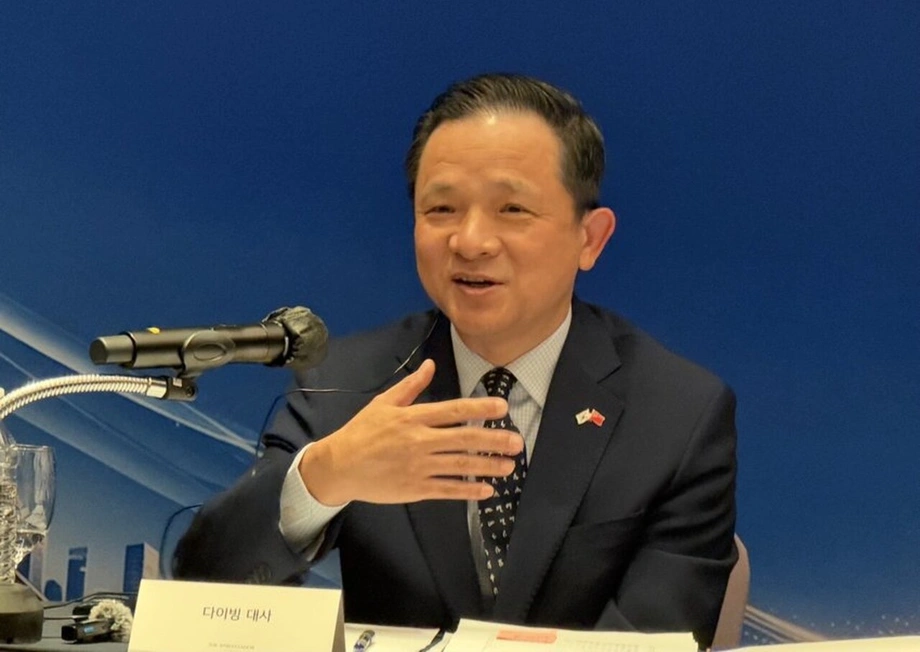
Dai Bing names the alliance policies worrying China
Chinese Ambassador to South Korea Dai Bing used a press conference at the Ambassador Seoul Pullman Hotel in Seoul's Jung district on Nov. 26, 2026, to warn that modernization of South Korea's alliance with the United States and greater strategic flexibility for American forces appear directed at China. He said Beijing respects the alliance's long history but does not want it to become a tool against China or an obstacle to relations between Seoul and Beijing.
Contents
- Dai Bing names the alliance policies worrying China
- Pyongyang's nuclear advances meet a narrow treaty answer
- What Lee and Xi discussed in Shenzhen
- Why Dai rejected comparisons with Yalta
- A Taiwan Pavilion dispute reaches a panda request
- Visas and K-pop reveal the limits of a thaw
- Trade friction accompanies a possible Xi visit
- The dates behind the dispute
- What to Know
Dai said China had never demanded that South Korea choose between Washington and Beijing. He urged Seoul to preserve its autonomy, manage both relationships according to its national interests and keep outside parties from interfering in bilateral ties. The briefing marked his second anniversary in the South Korean posting and was also arranged to explain the outcomes of the Asia-Pacific Economic Cooperation meetings in Shenzhen.
Modernization refers in this dispute to updating the alliance's missions and capabilities. Strategic flexibility concerns how freely American troops and military assets based in South Korea could be used beyond their established focus on deterring North Korea. Beijing fears that a broader regional role could eventually include operations involving China.
Dai framed his appeal as a request for Seoul to make its own decisions rather than abandon Washington.
We hope the Korean side will maintain its strategic autonomy and manage its relations with both the U.S. and China well.
Gen. Xavier Brunson, commander of US Forces Korea (USFK), supplied part of the background to Dai's concern. In May, Brunson described Korea as a dagger in the heart of Asia when viewed from China's east coast. Dai did not name Brunson at the briefing, but the remark he cited matched those comments. The Chinese Embassy in Seoul said at the time that Brunson had crossed the line.
Dai's language has become more specific since November of the previous year, when he said China's attitude could change if the alliance's strategic goals changed. He also cautioned then against adding fuel to the fire over Taiwan. His underlying message was that an alliance centred on North Korea should not expand into one intended to contain China.
Pyongyang's nuclear advances meet a narrow treaty answer
North Korea supplied the immediate backdrop. North Korean state media said leader Kim Jong Un inspected a nuclear material production base and a nuclear weapons research institute on Nov. 25 and declared the country's status as a nuclear power inviolable. Dai was asked the following day how China would respond to Pyongyang's advancing capabilities.
The ambassador called the nuclear question a longstanding and complex issue at the centre of Korean Peninsula security. He said China took it seriously as a permanent member of the United Nations Security Council, but his answer concentrated on international rules rather than announcing any new action toward Pyongyang.
As a permanent member of the U.N. Security Council, China's position on nuclear issues is very strict and serious. We must uphold the authority and integrity of the Treaty on the Non-Proliferation of Nuclear Weapons (NPT), and there has been no change in our position.
The NPT is the principal global agreement intended to prevent the spread of nuclear weapons. It recognizes the United States, Russia, Britain, France and China as nuclear weapon states. North Korea withdrew from the treaty in 2003 and expelled inspectors from the International Atomic Energy Agency, the UN nuclear watchdog, in 2009. The agency has since been unable to verify North Korea's nuclear activities inside the country.
Dai did not use the word denuclearization. China has recently avoided that formulation, and there was no reference to it during Xi's visit to North Korea in June. The treaty categories cited by Dai do not include North Korea, even while Pyongyang presents its nuclear status as permanent.
For Seoul, the answer combined reassurance about China's formal position with little indication of fresh pressure on its northern neighbour. Dai said both capitals were following regional developments closely and presented stability on the peninsula as a shared Chinese and South Korean interest.
What Lee and Xi discussed in Shenzhen
President Lee Jae Myung and President Xi Jinping met in Shenzhen on Nov. 18 during the APEC gathering. According to Dai, Lee asked China to play a more active role on Korean Peninsula issues. Xi explained recent exchanges between Beijing and Pyongyang and said China would maintain continuity and stability in its peninsula policy while playing an active and constructive role in its own way.
Xi also urged strategic independence during the meeting. That phrase closely matched Dai's subsequent appeal to Seoul, linking China's message about the American alliance with its wider effort to shape relations with South Korea.
APEC itself met in Shenzhen on Nov. 18 and 19. Dai identified the Shenzhen Vision as its main outcome, describing four major pillars and eight supporting beams for an Asia-Pacific community. He associated that framework with freer economic and trade cooperation, innovation and stronger connections among members in both infrastructure and institutional rules.
The architectural language was Dai's way of presenting the vision as a structure for regional cooperation rather than a single trade commitment. His account did not provide a list of individual projects or deadlines attached to the pillars.
Why Dai rejected comparisons with Yalta
Dai also described a Nov. 19 meeting in Shenzhen involving the leaders of China, the United States and Russia as the first summit of its kind. He said the leaders met in a sincere and friendly atmosphere, reached a series of agreements and issued a peace declaration. Their discussions covered the war in Ukraine, the Korean Peninsula and the Middle East, although he gave no detailed account of the agreements.
Comparisons with the 1945 Yalta Conference had prompted suggestions that the three powers were attempting to divide influence among themselves. Dai rejected both the Yalta 2.0 label and the idea of a new Group of Three.
I do not agree with such assessments. This was, in essence, a peace summit.
The Yalta Conference brought together American, Soviet and British leaders to negotiate arrangements for the postwar order. Dai argued that it had been marked by great power politics and said China and Korea were among those that suffered. He presented the Shenzhen meeting instead as an attempt to slow an unstable and turbulent international situation.
Dai said international questions should be addressed through consultation among all countries rather than monopolized by a small group. He acknowledged that one meeting could not settle every dispute, but repeated Xi's metaphor that Shenzhen had planted a seed capable of sprouting, blossoming and bearing fruit.
A Taiwan Pavilion dispute reaches a panda request
The Gwangju Biennale Foundation changed an exhibition by the National Taiwan Museum of Fine Arts from an institutional pavilion to a national pavilion called the Taiwan Pavilion, following a request from Taiwan. China protested and withdrew its exhibition team. The distinction matters to Beijing because an institutional name presents a museum, while a national pavilion can be read as presenting Taiwan as a separate country.
Dai called Taiwan a core Chinese interest and an untouchable red line. He urged South Korea to recognize the sensitivity of the issue and abide by the One China principle, Beijing's position that Taiwan is part of China. Dai later visited the Jeonnam-Gwangju Integrated Special City to express regret, while China's Ministry of Foreign Affairs also called for adherence to that principle.
The dispute has complicated a request for giant pandas. Lee asked Xi during a January visit to China for a pair for a zoo in Gwangju, and Xi initially responded positively. Dai now says approving the loan would be difficult under current circumstances, citing Chinese public opinion after the Biennale controversy. He asked South Korea to help create conditions that would allow pandas to come in the future.
Language about territory and statehood has caused friction in the opposite direction as well. South Korea protested in August after Chinese Foreign Minister Wang Yi used wording describing the two Koreas as two countries in a joint statement following meetings with Foreign Minister Cho Hyun and National Security Adviser Wi Sung-lac. Together, the episodes show how a single official label can affect diplomacy, cultural events and even a proposed animal loan.
Visas and K-pop reveal the limits of a thaw
Expectations had risen after the Shenzhen summit that China might ease Hanhanryeong, the informal restrictions on South Korean cultural content. Dai instead described a cautious process. He said the two leaders had agreed to promote healthy and beneficial cultural exchanges gradually, with mutual respect as the guiding principle.
Asked about major K-pop concerts in China, Dai called the concert question minor and said it was too narrow to judge bilateral exchanges through K-pop alone. He wants a broader range of events that people in both countries can enjoy, proceeding systematically and gradually. He identified the 35th anniversary of diplomatic relations in 2027 as an opportunity for such activities.
Travel policy offered a more immediate possibility. China's current arrangement allowing South Korean nationals to enter without visas expires at the end of the year. Dai suggested an extension was likely, but said Beijing would review South Korea's measures and China's policies toward other countries before announcing a decision.
South Korea has already extended entry without visas for Chinese group tourists through 2027. The two arrangements are not identical: China's measure concerns South Korean nationals generally, while Seoul's extension applies to Chinese group tourists. For travellers and tourism businesses, Dai's comments raised expectations without providing a final Chinese announcement.
Trade friction accompanies a possible Xi visit
Trade formed another part of Dai's message. He opposed the Trump administration's Section 301 trade actions concerning alleged industrial overcapacity in 16 economies, including China and South Korea. Section 301 of US trade law allows Washington to investigate foreign practices it considers unfair and respond with measures that can include tariffs. Industrial overcapacity refers to production capacity exceeding demand, which Washington argues can distort trade.
Dai said Beijing would negotiate with Washington and warned against treating tariffs as a route to victory.
We all know that there are no winners in a tariff war. China is firmly opposed to the U.S. policy and will continue to engage in negotiations with Washington to reach an agreement.
The trade actions place China and South Korea within the same American measure even as Beijing presses Seoul over its security ties with Washington. Dai nevertheless expressed optimism about relations between China and the United States, saying mutual respect, fairness and reciprocity remained in place and that a constructive, strategically stable relationship was gradually taking shape.
Dai also said Xi was highly likely to travel to the United States the following month at President Donald Trump's invitation for the Group of 20 summit. He presented that possible trip as another opportunity for engagement between the two largest economies.
The dates behind the dispute
The confrontation developed through a series of diplomatic, military and cultural events during 2026.
- January: Lee requested a pair of pandas for Gwangju during his visit to China, and Xi responded positively.
- May: Brunson made the remark about Korea's geographic position that China later cited as evidence for its concerns.
- June: Xi visited North Korea without referring to denuclearization.
- Nov. 18 and 19: APEC met in Shenzhen, with Lee and Xi holding their summit on Nov. 18.
- Nov. 19: The Chinese, American and Russian leaders held the meeting that Dai called a peace summit.
- Nov. 25 and 26: Kim inspected nuclear facilities, and Dai delivered his warning and answered questions the next day.
- End of the year: China's current arrangement for South Koreans to enter without visas is due to expire.
No final visa extension, approval for a major K-pop concert, panda loan or detailed itinerary for Xi's possible American trip was announced at the briefing.
What to Know
- Dai Bing said alliance modernization and USFK strategic flexibility appear directed at China.
- He said Beijing respects the alliance and has never asked Seoul to choose between China and the United States.
- On North Korea, Dai restated support for the NPT but did not use the word denuclearization.
- Lee asked Xi in Shenzhen for a more active Chinese role on Korean Peninsula issues.
- The Taiwan Pavilion dispute has made a panda loan to Gwangju difficult and prompted China to withdraw from the Biennale.
- China is considering extending entry without visas for South Koreans, while major K-pop concerts remain part of a gradual cultural process.
- Dai rejected the Yalta 2.0 comparison, opposed Section 301 trade actions and said Xi was highly likely to attend the Group of 20 summit in the United States.