A Laboratory for a Flavor Eaten by Millions
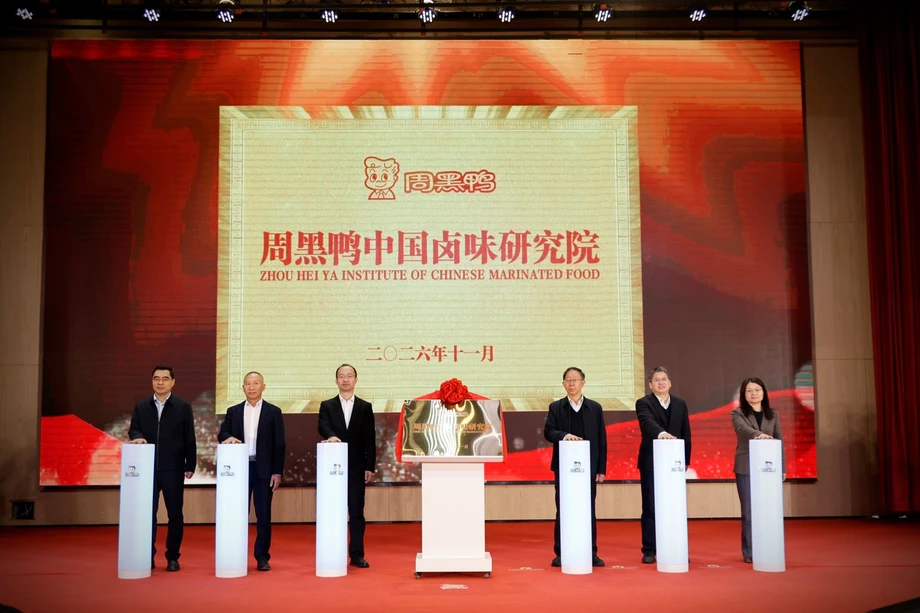
On Nov 23 in the Dongxihu district of Wuhan, the Zhou Hei Ya China Braised Flavor Research Institute was unveiled, bringing a committee led by academicians, a strategic agreement with Hefei University of Technology and a plan to turn one of China's most familiar snack categories into a field that can be measured, repeated and taught. Luwei, the Chinese braised foods simmered in seasoned broth, is sold through street shops, mall stores and packaged products. The new institute wants to make its flavors less dependent on the experience of individual cooks and more grounded in data.
Contents
- A Laboratory for a Flavor Eaten by Millions
- What Is at Stake in China's Braised Food Market
- From Kitchen Craft to Measurable Science
- The Committee and the People Running the Institute
- Why Zhou Hei Ya Became the Base
- The Company's Promise: Resources, Real Problems and Time
- What Local Officials and Universities See in the Project
- What the Research Could Change for Consumers and Workers
- What Has Been Announced and What Remains Open
- Key Points
The ceremony brought together Sun Baoguo and Huang He, both academicians of the Chinese Academy of Engineering; Xu Baocai, vice president of Hefei University of Technology; Lu Peng, deputy secretary of the Dongxihu district Party committee and acting district head; Zhou Fuyu, founder and chairman of Zhou Hei Ya, and university experts. Zhang Bao, dean of the School of Food Science and Bioengineering at Hefei University of Technology, and Gu Qianhui, the product research and development director at Zhou Hei Ya, signed a strategic cooperation agreement on behalf of the two sides.
The agreement says the two sides will connect university research resources with company production demand, work jointly on shared technical problems and speed the use of research results in production. Rules of the institute place Gu Qianhui in the director role under a director responsibility system. He is a senior engineer and a Changjiang Scholar jointly appointed through a Ministry of Education program linking universities and companies.
The first expert committee has 12 members, including two academicians, and will advise on building the institute and on technical innovation in the wider braised food industry.
What Is at Stake in China's Braised Food Market
Sun Baoguo, an academician known for work in spice and food flavor chemistry and chair of the new committee, placed the research effort against a market that is still huge but growing more slowly. He shared figures showing the braised food category at about 157.3 billion yuan in 2024, up 3.7%. For 2025, the market was expected to be about 162 billion yuan, with growth below 3%.
The same figures pointed to pressure on stores. The category had more than 240,000 outlets, and the closing rate across the sector over the past year was close to 30%. Sun said the industry has moved past rapid expansion. Growth now depends more on the performance of each store and on technical strength, while the scientific study of traditional craft and the move to standardized industrial production have become central questions.
- 2024: braised food market about 157.3 billion yuan, growth 3.7%.
- 2025: market expected about 162 billion yuan, growth below 3%.
- Nov 23: the institute was unveiled in Wuhan and the Hefei University of Technology agreement was signed.
- Nov 26: details of the ceremony were made public.
The arithmetic helps explain the mood. If the market rises from 157.3 billion yuan to about 162 billion yuan, that is an increase of roughly 4.7 billion yuan, less than the 3.7% gain recorded in 2024. For a shop owner, slower growth and a closing rate near 30% mean that a better product and steadier operations matter more than simply opening another branch.
From Kitchen Craft to Measurable Science
The institute's work will cover the whole chain, from evaluation and control of raw and auxiliary materials to processing innovation and the creation of intelligent equipment. In plain language, that means starting with the ingredients that go into a braising broth, testing how they change the final taste and smell, improving the cooking process, and building machines that can reproduce good results at scale. The stated aim is to raise the technology level and brand competitiveness of the whole category.
Two scientific ideas sit at the center. Flavor chemistry identifies the compounds that create aroma and taste. Sensory science measures how people perceive food, using controlled tasting and scoring so that positive flavor descriptions can become a set of recorded observations. Together, those tools can turn a cook's judgment about color, smell, texture and timing into information that another factory can use.
Sun set out three tasks for the institute. It should use flavor chemistry to explain the makeup of braised flavor, use sensory science to quantify quality and turn hidden experience into visible knowledge, and give traditional food industrialization a technical model that can be copied while laying a base for standards and talent.
Sun Baoguo, chair of the expert committee and an academician of the Chinese Academy of Engineering, said China's braised food carries thousands of years of craft but modern scientific research started late. He described the institute's core task as translating hidden experience into visible knowledge that can be copied, building standards and talent, and helping Chinese braised food reach the world. He gave that purpose in one sentence.
We must establish a scientific language for Chinese braised food.
Sun Baoguo, the committee chair, then turned from mission to method. He wanted projects rooted in production lines, data that other researchers can trace and repeat, and results that can become shared rules and trained people. He summarized those expectations in six short words.
Real problems, solid data, open results.
That standard makes the institute's work easier to judge. A project that begins with a real line problem can be tested against factory conditions. Data that can be traced and repeated can be checked by other researchers. Results that become standards or training materials can outlast one company's product cycle.
The Committee and the People Running the Institute
The first expert committee has a clear hierarchy. Sun Baoguo serves as chair. Huang He, an academician of the Chinese Academy of Engineering, and Xu Baocai, vice president of Hefei University of Technology, serve as deputy chairs. Nine professors serve as members, giving the institute a broad base of university research.
- Zou Xiaobo of Jiangsu University; Fan Daming of Southwest University; Sang Yaxin of Hebei Agricultural University.
- Ai Lianzhong of Shanghai Jiao Tong University; Qin Lei of Dalian Polytechnic University; Yin Junyi of Nanchang University.
- Xu Xiaoyun of Huazhong Agricultural University; Hu Qiuhui of Nanjing University of Finance and Economics; Guo Huiyuan of China Agricultural University.
The committee's job is to gather research strength from relevant fields and support the institute as it is built. The institute itself will operate under a director responsible for daily leadership, known as a director responsibility system. Gu Qianhui, the senior engineer who signed the Hefei University of Technology agreement for Zhou Hei Ya, was named director.
Why Zhou Hei Ya Became the Base
Sun said the choice of Zhou Hei Ya grew from his long observation of the use of technology by the company. The company, known for creating the black duck flavor, built a hundred thousand level cleanroom when much of the industry still relied on workshops. A cleanroom of that kind is a controlled production space that limits dust and microbes in the air.
Zhou Hei Ya also developed its own modified atmosphere freshness locking technology. Modified atmosphere packaging replaces the air around food with a controlled gas mixture, which can slow spoilage and help keep flavor. Sun said the technology addressed problems of flavor preservation and standardized production at a time when the industry needed both.
The company has spent 31 years in the braised food business. It has built a Hubei provincial enterprise technology center and a Hubei provincial joint innovation center for quality control and processing technology for healthy sauced and braised meat products. It has obtained more than 130 authorized patents and has led or taken part in the drafting or revision of 11 industry standards.
Sun described Zhou Hei Ya as a vivid sample of a traditional craft embracing modern industry, food science, standardization and brand building. In his account, the company has grown beyond its own business and now carries an example for the wider craft of Chinese braising.
The Company's Promise: Resources, Real Problems and Time
Zhou Fuyu, founder and chairman of Zhou Hei Ya, said the institute exists to turn what experienced workers know by feel into rules that people can see and follow. He said the company would support the research with resources and with access to its hardest production questions, and he asked for patience because food research does not deliver useful answers on a fixed commercial clock.
Give resources, whatever is needed in people, money, equipment and production lines, give it. Give real problems, lay out the hardest problems on the production line. Give patience, research cannot mean investing this year and demanding results next year.
The promise matters because a research institute can easily remain a name on a wall. By saying that production lines will supply the questions, Zhou tied the institute to daily manufacturing rather than to topics chosen only in laboratories. The reference to patience also acknowledges that tests of flavor, shelf life and equipment can take repeated trials before a result is reliable.
What Local Officials and Universities See in the Project
Lu Peng, deputy secretary of the Dongxihu district Party committee and acting district head of the Dongxihu district of Wuhan, said the institute carries meaning for companies, the industry and Wuhan. He framed it as a way for a company to protect its core skills through science, for the industry to test a new model of cooperation and for the city to add a concrete project to its science and technology ambitions.
For enterprises, it turns experience into science and turns core skills into sustainable core competitiveness; for industry, the model of enterprises setting questions, institutes answering them and the market grading the answers offers a sample for transforming and upgrading the traditional food industry; for the city, it is a concrete footnote in the effort of Wuhan to build a nationally influential science and technology innovation center.
The universities involved are not limited to the agreement with Hefei University of Technology. Zhou Hei Ya also signed an agreement with Huazhong Agricultural University to build a graduate student joint training practice base. Such a base places students closer to company production and gives researchers access to questions that arise outside a classroom.
What the Research Could Change for Consumers and Workers
Consistency is the practical change. A traditional food can be loved for its variation, but a company selling the same snack in many cities has to make each batch close to the last one. When flavor is described with measured data, workers can be trained with clearer instructions, quality teams can compare batches, and managers can see where a problem begins.
This is where sensory science and flavor chemistry meet ordinary life. A trained tasting panel can record whether a product tastes spicy, sweet, salty or numbing and how strong those feelings are. Laboratory work can then connect those observations to ingredients, cooking time and temperature. The result gives skilled workers a shared vocabulary and makes their knowledge easier to pass on.
For workers, the change could be visible in training and equipment. The institute's plan includes intelligent equipment, meaning machines that can help control steps that once depended on human judgment. For consumers, the stated goal is food that can be analyzed, controlled and steadily reproduced, so a product bought in one city tastes close to one bought in another. The longer term direction is to move braised food production from experience based work to intelligent manufacturing while preserving craft.
What Has Been Announced and What Remains Open
The ceremony created the structure: an institute, a 12 member expert committee, a director, agreements with Hefei University of Technology and Huazhong Agricultural University, and a research program stretching from raw materials to intelligent equipment. It also set a method: start from real production problems, keep data traceable and repeatable, and turn useful results into standards and trained people.
Several details were absent. No budget, project list, research timetable, patent target, publication schedule or first graduate intake date was given. The announcement also did not say which braised products will be studied first or how the institute will measure success. Those questions will shape whether the institute becomes a working research platform for the wider industry.
Key Points
- On Nov 23, the institute was unveiled in the Dongxihu district of Wuhan.
- Hefei University of Technology and Zhou Hei Ya signed a strategic cooperation agreement, while Huazhong Agricultural University signed a graduate training base agreement.
- Sun Baoguo chairs a 12 member expert committee that includes two academicians.
- The research program covers raw materials, processing technology and intelligent equipment.
- Zhou Hei Ya pledged people, money, equipment, production lines, real problems and patience.
- The market was about 157.3 billion yuan in 2024 and was expected to reach about 162 billion yuan in 2025, with the closing rate near 30%.