One Move From the End
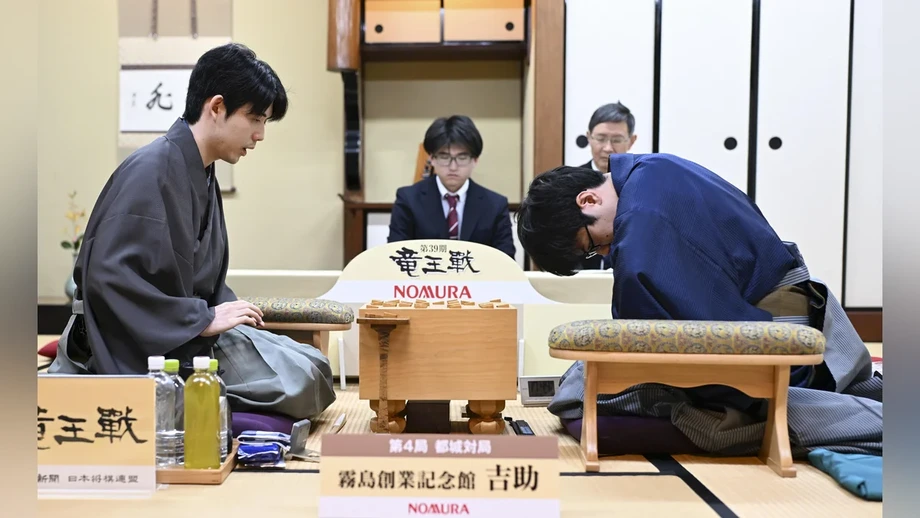
The 39th Ryuo title match ended at 5:44 pm on November 21, 2026, when Shinichiro Hattori, a 27 year old seven dan challenger, placed his teacup on the table, wiped his mouth and resigned Game 4. Sota Fujii, the 24 year old Ryuo title holder, had won as the second player in 94 moves and completed a 4-0 sweep. The venue was the Kirishima Founding Memorial Hall Yoshisuke in Miyakonojo City, Miyazaki Prefecture, after a two day game that began on November 20; a single listing of the game details named Takachiho City.
Contents
At the public large board commentary session, Tatsuma Tonari, a seven dan professional, and Matsushita, a women's professional first dan, watched the position together. When Fujii played △6二歩, a quiet but decisive pawn move in shogi notation, Tonari saw the end coming.
Maybe.
The Japan Shogi Association's 39th Ryuo match page records the 5:44 pm resignation time, the commentators, the move △6二歩 and the 4-0 series score. Those details turned a tense endgame into a clear result: Fujii had defended the Ryuo title for the sixth straight time.
In Japanese shogi notation, the triangle marks moves by the player who moves second, while 6二歩 means the pawn goes to square 6 two. A reader does not need to follow the board to understand why it mattered: the commentary hall had reached the point where a single move could end a title match.
The Result in Numbers
Fujii won four games without a loss, so no fifth game was needed. The score added a sixth Ryuo title to his career and kept six major titles in his hands: Ryuo, Meijin, Oi, Kisei, Kio and Osho. A single summary named Oza in that list, while the detailed title breakdowns name Oi and place Oza among titles Fujii had held.
Japanese major title matches work like a best of seven contest in many sports. The first player to win four games takes the title or keeps it. In shogi, the title holder faces one challenger chosen through a long league and knockout route, so a 4-0 result means the challenger never reached a single title match win.
The Sota Fujii entry records that he had qualified for Lifetime Ryuo status in November 2025, meaning he had met the conditions for a permanent honor connected with the title. His 2026 result added another current Ryuo crown to that record and helped carry his career total to 38 major titles.
Hattori, who turned 27, was making his first Ryuo challenge and his second major title challenge overall. He had already faced Fujii in the Kisei title match in June and July. Across both series, he found strong positions but could not take a game.
How Game 4 Took Shape
Game 4 opened with a Bishop Exchange, an opening in which both players trade bishops early. That removes powerful long range pieces and makes the balance between attack and defense harder to judge. Fujii, playing second, chose a Right King formation, placing his king on the right side of his camp. Hattori aimed for Anaguma, a tight shelter where the king is tucked deep into a corner.
Hattori arrived for the final game with three straight losses behind him and no room for a slow start. He spent nearly an hour on a bishop move meant to break the stalemate. Fujii answered with a deliberation of more than an hour. On the second day, Hattori's sealed move came into view. A sealed move is written down at the end of the first day and revealed the next morning, so the opponent cannot study it overnight.
Fujii thought for a long time again and then pushed the game toward Hattori's king. He sent his bishop into the opposing camp and kept the pressure there. The result was not a quick collapse by the challenger. It was a two day contest of patience, with both players spending heavy time on choices that would shape the king safety of both sides.
The Move That Turned the Game
At the entrance to the endgame, Fujii played △3七角, a bishop move aimed at taking a silver, a piece valued in both attack and defense. The move had been expected by people studying the game away from the board because it was a natural way to answer Hattori's setup.
Aiko Kagawa, a Japan Shogi Association women's professional explaining the turning point in broadcast commentary, said the reply chosen by Hattori became the losing move.
Against that, Hattori played 4六歩 to accept the silver threat in the actual game, and this move ended up being the losing move. At first glance it looks like a natural move protecting the silver, but Fujii showed a flowing attack, advanced his attack by more than one move, and quickly broke through Hattori's king.
Hattori, speaking after the game as the challenger, gave his own explanation of why the moment slipped away.
I overlooked the natural △3七角 during the game. I became unsettled and did not reach the thought that an attacking race would be difficult.
Those two descriptions fit the same sequence: Fujii's bishop move created a threat, Hattori chose a natural defense, and Fujii's attack arrived faster than the defense could settle. By the time △6二歩 appeared, the commentary session was already watching for resignation.
A Pause Near the Board
The endgame also included an unusual interruption. On the evening of November 21, at a decisive moment, the apprentice school member serving as record keeper developed a nosebleed. The record keeper writes each move down as it is played and keeps the official game record, so the role sits close to the players. A Japan Shogi Association staff member took the seat temporarily.
Fujii had already decided his move and paused while the replacement came to the board. He then played △6八馬 as the staff member sat down. The original record keeper left the playing room, treated the bleeding himself and spoke before returning.
I am sorry. The bleeding will stop soon.
A staff member stayed near the playing room as a precaution. The game continued, and Fujii still had enough composure to finish the sequence that led to Hattori's resignation less than two hours after the game's public drama reached its peak.
Rare Company in Shogi History
Akira Watanabe, a nine dan, won nine straight Ryuo titles from the 17th through the 25th series. Fujii's six straight titles now sit second in that history. That comparison matters because the Ryuo is one of the most demanding events in Japanese shogi, with a long qualifying path before the seven game final series even begins.
Back to back straight title defenses were rarer still. Fujii had also swept the previous Ryuo series, so this was the first time in Ryuo history that a title holder won two straight series without dropping a game. In seven game matches, Yoshiharu Habu won straight Osho series at the 45th and 46th editions, and Michio Takahashi did the same in the 26th and 27th Oi series. For Fujii himself, this was the first time he had achieved two straight wins in seven game title matches. His five game Kisei run is different: he has completed three straight defenses there, and that run continues.
The winning run also stretched across series. Fujii's ten straight Ryuo game wins covered Games 5 and 6 of the 37th series, all four games of the 38th and all four games of the 39th. Ten straight games in a seven game title match ties the highest total listed for that format, alongside runs by Watanabe in the Ryuo, Habu and Koji Tanigawa in the Osho, and others in the record tables. A win in the opening game of the next Ryuo series would give him sole possession of that run.
Those numbers explain why the 4-0 result drew attention beyond the playing room. Fujii did not merely win a title match. He closed a series in the cleanest possible way, then placed himself next to, and in one category ahead of, players whose records are used as markers in shogi history.
A Year of Comebacks Before the Sweep
Fujii began 2026 with six titles, but keeping them did not follow one easy pattern. The Osho seven game series against Takuya Nagase, a nine dan, pushed him to 1 win and 3 losses. That position is called kadoban, a match point state in which one more loss would cost the title holder the crown. Fujii won three games in a row to keep the Osho.
The Kio five game series against Yasuhiro Masuda, an eight dan, also went to a dangerous place. Fujii fell to 1 win and 2 losses, one loss from losing the title, before winning two straight games to defend it.
Fujii, reflecting after the Ryuo series as its champion, said those earlier matches had tested him.
The Osho match and the Kio match both put me in kadoban and were difficult series. I was lucky to defend the titles.
He also said the absence of a new title challenge left him with some regret and that he wanted to pursue one in the coming years. That detail changes the picture of 2026. The Ryuo sweep was the final line in a year that included two comebacks from the edge and no fresh crown.
Fujii's Own Explanation
At the press conference after the postgame review, Fujii spoke about the weight of the series and the difficulty of the positions.
Difficult shogi continued. I feel very happy to have produced the result of six consecutive titles.
Fujii also explained why the Bishop Exchange with a second player Right King appeared in Games 2, 3 and 4. He said the opening became the main shape of the match and that he had seen its strength when Ito, then a two crown holder and now the Eiou title holder, used a Right King formation against him in an Oi title match.
Because the Bishop Exchange became the main opening, and in the Oi match Ito, who was a two crown holder at the time, played a Right King formation when I was first player. I felt its quality. When the game became a Bishop Exchange, I thought I would try a Right King in Game 2 and Game 4.
Fujii said he had no stubborn attachment to repeating the formation. He was choosing a shape that fit the opening and the opponent, not protecting a habit. He also described a growing skill from his first years as a professional: forming a picture of the position he wanted, then guiding the game toward it rather than relying only on memorized opening knowledge.
The day after the win, Fujii held another press conference in Miyakonojo. He had written the characters 遼遠 on a signature board, a phrase he explained as meaning far away. He linked it to shogi's small details, including a lance placed on square nine eight rather than nine nine, and to his larger goal.
It means far away. The goal is a distant thing, but I would like to keep moving forward little by little.
He said the goal in shogi was simple: become stronger. He also said Watanabe's nine straight titles were not yet a level he was consciously chasing. Miyakonojo left its own marks on the visit: Fujii praised the historic playing venue, enjoyed local meat and kaminari ramen, laughed at the impact of local mascot Bonchi kun, and accepted shochu from Kirishima Shuzo for his family, noting that he does not drink alcohol.
Hattori's Unplayed Game 5
Shinichiro Hattori had prepared for a long series. Before the match, he said the opponent was an absolute champion but that he wanted to approach the series with the mind of someone winning it. He studied Zojoji Temple in Tokyo, the venue planned for Game 5, and was impressed by its connection to Tokugawa Ieyasu. A shop, Shirataki, tailored a special Tokugawa style kimono for him to wear there. The series ended in four games, so the kimono stayed unworn.
Hattori said after the loss that the stage had taught him a great deal, but he wanted one win. That wish remained unfulfilled in both the Kisei and Ryuo title matches against Fujii in 2026. His first Ryuo challenge ended with four defeats, but the preparation for a possible fifth game showed how far he had tried to push the series.
Koji Tanigawa, the 17th lifetime Meijin, offered Hattori a phrase about steady forward movement after the series. He chose an image of a clear stream that keeps running.
Clear flow without interruption.
Tanigawa's words spoke to a player still seeking a first title. Fujii's former master, Masataka Sugimoto, an eight dan, also marked the result from far away. Sugimoto sent congratulations from Hokkaido, where he was giving a lecture in Morimachi on November 20 near Mount Komagata and Uchiura Bay. Fujii replied from Miyazaki. The short exchange crossed the country from north to south, linking the teacher who guided him as a child to the player who had just completed six straight Ryuo wins.
What Changes Now
Fujii ends the 2026 title schedule with six of the eight major titles. The full career count is 38: Ryuo 6, Meijin 4, Eiou 3, Oi 7, Oza 2, Kisei 7, Kio 4 and Osho 5. The two titles he does not currently hold belong to Takumi Ito, the 24 year old Eiou, and Masahito Hirose, the 39 year old Oza. Those three players share the eight major titles.
The next title event is the Osho seven game series, set to open on January 11 as the 76th ALSOK Cup Osho match. As of the day after the Ryuo final, the challenger had not been settled; the Osho League final round was set for November 24. Fujii will begin that series trying to defend the seventh crown in his current set.
- November 20: Game 4 began in Miyakonojo City.
- November 21: Fujii won in 94 moves and Hattori resigned at 5:44 pm.
- November 22: Fujii held a day after press conference in Miyakonojo.
- November 24: The Osho League final round was set to decide the next challenger.
- January 11: The 76th ALSOK Cup Osho seven game series was set to open.
Key Points
- Sota Fujii beat Shinichiro Hattori in 94 moves in Game 4 of the 39th Ryuo series.
- Hattori resigned at 5:44 pm on November 21, giving Fujii a 4-0 series win.
- The result gave Fujii a sixth straight Ryuo title and 38 career major titles.
- Two straight undefeated Ryuo defenses are a first in the event's history.
- Fujii kept six major titles and ended the 2026 title schedule with a sweep.
- The next title match is the Osho series, set to start on January 11.