The pay line that divides Hong Kong workers
Hong Kong's median monthly employment income reached HK$23,000 in July to September 2026, the Census and Statistics Department said in figures released on November 17. The figure covers people at work and excludes foreign domestic helpers. Put simply, a worker earning more than HK$23,000 a month is above the middle of the city's workforce. A worker earning less is below that middle point.
Contents
- The pay line that divides Hong Kong workers
- What the official figures actually measure
- Key dates behind the pay snapshot
- Finance and insurance stands far above the rest
- Which industries rose and which fell
- The gender gap remains wide in every industry
- Managerial pay sits more than twice the city median
- Age and experience shape the earning peak
- What HK$23,000 means in daily life
- Workers weigh pay, stability and job moves
- Key Points
The median rose by HK$700 from July to September 2025, when it was HK$22,300. It stayed level with the June to August 2026 period. The numbers are based on a moving three month period, meaning the department groups three neighbouring months together to reduce sudden swings. Changes are estimated from figures rounded to the nearest hundred, so very small shifts may appear flat.
Median is the middle value, not the mathematical average. If all workers are lined up from lowest pay to highest, the person in the middle earns the median. Hong Kong often uses this measure because a small number of very highly paid people can pull an average upward and make typical pay look higher than it is.
The HK$23,000 mark matters because it gives households a simple benchmark. It does not describe what every worker gets, and it does not include foreign domestic helpers. It does show the midpoint around which pay negotiations, job offers and arguments about living costs now sit.
What the official figures actually measure
The Census and Statistics Department regularly samples Hong Kong's employment situation. The department's government employment statistics are published in the Quarterly Report on General Household Survey, the Quarterly Report of Employment and Vacancies Statistics and the Quarterly Report of Wage and Payroll Statistics. The same official channel provides the latest labour force, unemployment and underemployment figures.
The July to September number comes from the broader employment income measure used in household surveys. That measure is wider than salary alone. It can include income linked to work beyond basic wages, which is why readers may see different pay numbers in the same year.
Another official series, the Annual Earnings and Hours Survey, put the median monthly salary at HK$21,200 for May to June 2025 and released that result in March 2026. It put the median hourly wage at HK$85.70, up 3.4% from a year earlier. That survey is the benchmark used by economists and the Statutory Minimum Wage Commission.
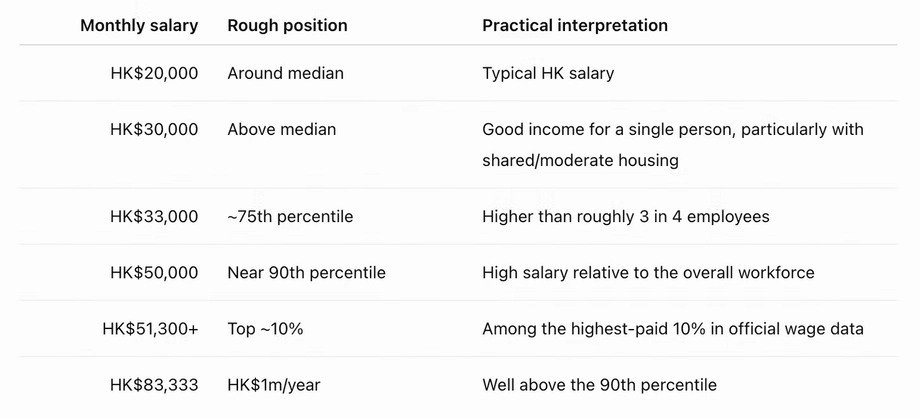
The salary distribution gives useful landmarks. The 10th percentile was HK$11,000, the 25th percentile HK$15,300, the 75th percentile HK$33,000 and the 90th percentile HK$51,300. A percentile is a way of ranking pay. At the 90th percentile, 10% of employees earn more and 90% earn less.
A third figure often seen in pay discussions is about HK$22,000 for median monthly employment income from the General Household Survey. The July to September 2026 reading of HK$23,000 is newer. Together, the figures show why the wording matters: salary, employment income and hourly wage describe related but different things.
Key dates behind the pay snapshot
Several dates shape the picture. Readers who want to compare like with like need to know which period each figure covers.
- May 1, 2026: the statutory minimum wage took effect at HK$43.10 an hour, about HK$8,750 a month for a 48 hour week.
- May to June 2025: the Annual Earnings and Hours Survey recorded a median monthly salary of HK$21,200 and a median hourly wage of HK$85.70.
- July to September 2025: the household employment income measure used for comparison stood at HK$22,300.
- June to August 2026: the rolling three month median was still HK$23,000.
- July to September 2026: the latest median employment income reached HK$23,000.
- November 17, 2026: the Census and Statistics Department released the latest pay figures.
- November 25, 2026: findings from a first quarter 2026 salary and job trends survey were published.
The timeline shows a city where headline pay moved only slightly over the year, even though individual industries moved in different directions. The full time minimum wage gives a floor for hourly work, while the median shows where the middle of the workforce sits.
Finance and insurance stands far above the rest
Finance and insurance had the highest median monthly employment income among the industry categories, at HK$40,000. That is HK$24,000 a month, or 2.5 times, above retail, the lowest category at HK$16,000. Public administration, social and personal services came second at HK$27,400. Other industries ranked third at HK$27,000.
The full industry table shows how wide the spread is.
- Finance and insurance: HK$40,000
- Public administration, social and personal services: HK$27,400
- Other industries: HK$27,000
- Import and export trade and wholesale: HK$25,000
- Construction: HK$23,400
- Transport, warehouses, postal and courier services, information and communications: HK$23,000
- Real estate, professional and business services: HK$21,000
- Manufacturing: HK$19,900
- Accommodation and food services: HK$17,700
- Retail: HK$16,000
Other pay measures put finance and insurance closer to HK$38,500 a month. A job trends survey of employees and managers put finance employee pay at HK$28,510 and finance management pay at HK$45,000. Those numbers use different groups of workers, so the household employment income figure of HK$40,000 remains the main measure for the July to September period.
Industry shapes pay because some jobs need licences, advanced degrees or specialist skills. Finance also includes roles tied to sales and bonuses, such as insurance work and securities dealing, along with technical posts such as risk management and actuarial work. Retail and accommodation often have more entry level and service roles, which pulls the median down.
Which industries rose and which fell
The median for all sectors combined did not change from June to August to July to September, but the industry table moved. Five categories fell between the two rolling periods: manufacturing by HK$100, construction by HK$400, retail by HK$400, accommodation and food services by HK$100, and public administration, social and personal services by HK$500.
Transport, warehouses, postal and courier services, information and communications rose by HK$200 to HK$23,000. Other industries rose by HK$1,600 to HK$27,000, the largest period to period gain in the table. Import and export trade and wholesale, finance and insurance, and real estate, professional and business services were flat.
Year on year, six of the ten categories rose. Construction added HK$400, import and export trade and wholesale added HK$1,200, accommodation and food services added HK$600, transport and communications added HK$1,000, public administration and personal services added HK$800, and other industries added HK$2,000. Retail, finance and insurance, and real estate services were flat.
Manufacturing was the only industry category that fell over the year. The comparison table shows HK$21,000 in July to September 2025 and HK$19,900 in July to September 2026, a drop of HK$1,100. One line in the pay breakdown described a HK$100 fall; the table figures show HK$1,100.
These movements describe the middle income in each category, while job counts and total payrolls are separate measures. A category can see its median fall even if some workers in it receive raises, because the mix of jobs, hours and workers can shift. Small changes should be read alongside the rounding note attached to the figures.
The gender gap remains wide in every industry
Men had a median monthly employment income of HK$25,000 in July to September 2026. Women had HK$20,100. The gap was HK$4,900 a month. In simple terms, the typical man in the data earned about 24% more than the typical woman, and the typical woman earned about 80% of the typical man's income.
- Finance and insurance: men HK$46,100, women HK$35,000, gap HK$11,100
- Import and export trade and wholesale: men HK$30,000, women HK$21,100, gap HK$8,900
- Public administration, social and personal services: men HK$31,400, women HK$24,000, gap HK$7,400
- Retail: men HK$19,700, women HK$15,000, gap HK$4,700
- Accommodation and food services: men HK$20,000, women HK$15,500, gap HK$4,500
- Construction: men HK$24,100, women HK$20,000, gap HK$4,100
- Real estate, professional and business services: men HK$23,500, women HK$19,700, gap HK$3,800
- Manufacturing: men HK$20,000, women HK$16,500, gap HK$3,500
- Other industries: men HK$27,100, women HK$26,000, gap HK$1,100
- Transport, warehouses, postal and courier services, information and communications: men HK$23,000, women HK$22,200, gap HK$800
Finance and insurance had the largest gap in dollars. Import and export trade and wholesale had the largest gap in percentage terms, with men earning 42.2% more than women at the median. The smallest gap was in transport, warehouses, postal and courier services, information and communications, at HK$800 a month.
Industry mix, part time work patterns and the distribution of senior roles can all widen a median gender gap. The July to September figures do not say how much of each gap came from those factors. No date for the next median pay release was given on the department's employment statistics page.
Managerial pay sits more than twice the city median
Managers had the highest median monthly employment income among occupation groups, at HK$50,000. Professionals were close behind at HK$47,600. Both groups sit far above the all worker median of HK$23,000. Managers earned about 2.2 times that median, while professionals earned about 2.1 times.
- Managers: HK$50,000
- Professionals: HK$47,600
- Associate professionals: HK$27,100
- Craft and related workers: HK$21,500
- Clerical support workers: HK$20,000
- Machine operators and assemblers: HK$20,000
- Service and sales workers: HK$17,000
- Non technical workers: HK$14,500
- Other occupations: HK$12,000
The bottom of the occupation table is much lower than the top. Other occupations had a median of HK$12,000, about a quarter of the managerial figure. Non technical workers had HK$14,500, just above half of the all worker median. Service and sales workers, a large group in retail and hospitality, had HK$17,000.
A recruitment survey put management pay at HK$40,000, with the figure rising from HK$35,000 in 2024 and HK$38,000 in 2025. It also put ordinary employee pay at HK$23,000, unchanged from 2025 after HK$22,000 in 2024. About 48.0% of employees and 45.3% of managers in that survey faced frozen pay.
Age and experience shape the earning peak
Workers aged 35 to 44 had the highest monthly median among age groups, at HK$29,000. That was HK$700, or 2.9%, higher than a year earlier. Workers aged 15 to 24 had a median of HK$15,000, less than half the 35 to 44 figure.
Hourly pay data tells a similar story. In the Annual Earnings and Hours Survey, workers below 25 earned about HK$58 an hour, those aged 25 to 34 earned HK$90, and those aged 35 to 44 earned HK$100. The figure fell to HK$86.40 for ages 45 to 54, about HK$70 for ages 55 to 64 and about HK$52 for people aged 65 or above.
A job trends survey gave a different age pattern. It put the highest median pay among people aged 41 to 50, while people aged 21 to 25 and people aged 61 or above both had HK$20,220. That survey used its own respondents and bands, while the government figures cover a wider household sample.
Experience bands help explain why pay rises and then levels off. Typical base pay was described as HK$18,000 to HK$25,000 for fresh graduates, HK$25,000 to HK$40,000 for junior staff, HK$40,000 to HK$70,000 for mid level staff and HK$70,000 to HK$120,000 for senior managers. Director level pay was listed at HK$120,000 to HK$250,000, with chief executive and partner roles above HK$300,000.
What HK$23,000 means in daily life
Housing is the main reason a median income can feel very different from one household to another. A rough monthly budget for a single person on median pay puts rent for a private studio or a room in a shared flat at HK$8,000 to HK$14,000. That alone can absorb from about 35% to 60% of HK$23,000.
Transport on the MTR, Hong Kong's rail system, was listed at HK$700 to HK$1,500 a month. Groceries for cooking at home were HK$2,500 to HK$4,000. Eating at mid range restaurants was about HK$2,000 to HK$4,000. A person with those costs has less room for savings than the gross pay figure suggests.
Hong Kong's tax system softens the gap between gross and take home pay for many workers. Salaries Tax uses progressive rates from 2% to 17%. Taxpayers pay whichever is lower, the progressive calculation or the standard rate. The standard rate is 15% on the first HK$5 million of net income and 16% above that from the 2024 to 2025 tax year.
The city has no capital gains tax, no dividend tax and no estate tax. Personal, married, child and dependent parent allowances can reduce tax further. A person earning HK$60,000 a month could take home roughly HK$54,000 to HK$57,000, depending on allowances. A year end bonus is common in finance, legal and corporate jobs, but it is not guaranteed by law.
A HK$1 million annual income is about HK$83,333 a month before tax, well above the 90th percentile mark of HK$51,300. Currency conversion alone does not show living standards, because rent, tax and benefits differ across cities.
Workers weigh pay, stability and job moves
A first quarter 2026 salary and job trends survey found a labour market full of caution. The confidence score was 2.7 on a scale from 1, meaning very hopeless, to 5, meaning very optimistic. Some 49.4% of respondents planned to change jobs in 2026, down 12.1% from the previous year.
Pay and benefits drove job moves for 48.8% of respondents. Personal growth and long term planning motivated 18.0%, while work environment and culture motivated 13.8%. The industries workers most wanted to enter were education, government and nonprofit work, professional and administrative support, and finance and insurance.
Promotion was uneven. In late 2025, 7.0% of respondents said they had been promoted. Managers were promoted at 11.1%, compared with 5.8% of employees. Government was the most wanted employer at 19.9%, followed by the MTR, the Hospital Authority, HSBC Hong Kong and Google.
The same survey found that 48.2% of workers faced frozen pay. It put the highest employee median pay in information and communications technology at HK$30,000, followed by finance and insurance at HK$28,510 and building, engineering and property at HK$24,320. For managers, building, engineering and property led at HK$45,675, followed by health care at HK$45,500 and finance and insurance at HK$45,000.
These findings sit beside the official medians rather than replacing them. They show what workers feel and plan, while the household data shows where income levels actually sit. For employers, the message is practical: pay remains a major reason people move, and access to promotion is split unevenly between managers and staff.
Key Points
- Hong Kong's median monthly employment income was HK$23,000 in July to September 2026, up HK$700 from a year earlier and flat from June to August.
- Finance and insurance led industries at HK$40,000; retail was lowest at HK$16,000.
- Men earned HK$25,000 at the median, against HK$20,100 for women, a HK$4,900 gap.
- Managers earned HK$50,000 at the median, while workers in other occupations earned HK$12,000.
- Workers aged 35 to 44 earned HK$29,000, the highest age group figure.
- A job trends survey found 49.4% planned to change jobs in 2026, with pay and benefits the top reason.