A Small Handheld With Desktop Ambitions
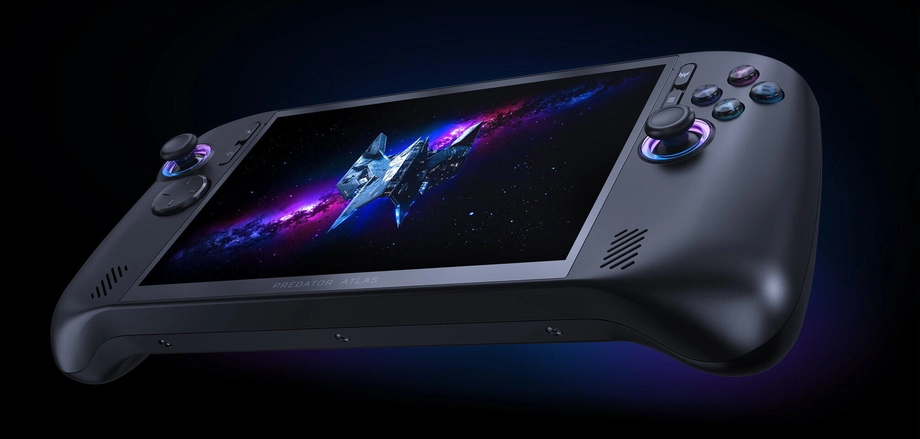
Acer through Predator Gaming Indonesia introduced the Predator Atlas 8 in Indonesia on Thursday, Nov. 19, 2026, with an official price of Rp34,999,000 and a launch price of Rp31,999,000. The launch offer also includes 0 percent installments from Rp3.1 million a month. The device runs Windows 11 Home, uses Intel Arc G3 Extreme with Intel Arc B390 graphics, carries an 8 inch 1920 by 1200 touchscreen and has an 80 Wh battery in the Indonesian configuration.
Contents
- A Small Handheld With Desktop Ambitions
- How the Launch Unfolded
- What the Price Buys Against a Rival
- Inside the Intel Chip
- How It Performed in Games
- Screen, Touch and Sound Choices
- Keeping a Powerful Chip Cool
- Battery Life and the Desk Setup
- Controls Built Around Drift and Genre
- Acer's Wider Gaming Push
- Checks Before Buying
- What to Know
Think of the Atlas 8 as a small Windows PC with controls attached. A traditional handheld console usually plays games from one closed shop. This machine opens the wider PC world, including Steam, the Xbox app, Epic Games Store and Battle.net. An Xbox mode gives a controller friendly menu before dropping back to normal Windows. It can also run ordinary Windows apps, and two Thunderbolt 4 ports let a user connect a monitor, keyboard and mouse when a bigger workspace is available.
Acer Indonesia's Predator Atlas 8 page describes the device as its first Predator gaming handheld. The page lists up to Intel Arc G3 Extreme, up to 12 Xe cores, Windows 11 Home, memory up to 32 GB LPDDR5x at 7467 MT/s and storage up to 1 TB PCIe Gen 4 NVMe. The Indonesian launch package named in the launch material is 24 GB RAM, 1 TB SSD and an 80 Wh battery, so buyers need to match the exact model on the box.
How the Launch Unfolded
The Atlas 8 first appeared at Computex 2026, when Acer showed the hardware before full benchmark access was available. A global launch notice set availability in North America, EMEA and Australia from October 2026, with specifications and prices varying by region. Indonesia received its own launch on Nov. 19, 2026. Sam Rutherford dated his performance testing Nov. 25, 2026.
- Computex 2026: Acer shows the Predator Atlas 8.
- October 2026: North America, EMEA, which means Europe, Middle East and Africa, and Australia are set to receive the device.
- Nov. 19, 2026: Acer launches the handheld in Indonesia.
- Nov. 25, 2026: Sam Rutherford publishes performance testing.
Acer did not give an end date for the Rp31,999,000 launch price or the 0 percent installment plan. The exact regional memory and battery choices also vary: Acer's page lists a 60 Wh option on some models, while the Indonesian launch configuration is 80 Wh.
What the Price Buys Against a Rival
The premium handheld market now has machines that cost as much as some laptops. The Atlas 8 was priced at $1,450 in one market, $350 below the MSI Claw 8 EX AI+ at $1,800. The two systems use the same Intel Arc G3 Extreme processor. The tested Atlas 8 unit had 512 GB of storage and 24 GB of shared memory, while the rival unit had 1 TB and 32 GB. Indonesia's launch unit has 1 TB and 24 GB.
The Indonesian discount is exactly Rp3,000,000 below the normal price, from Rp34,999,000 to Rp31,999,000. Acer also bundles three years of parts and service warranty, five years of Predator Service Spa, a three month Game Pass subscription, a Predator Cestus 350 gaming mouse and a Protective Kit. Predator Service Spa is the periodic care service at Acer Customer Service Centers, including cleaning, diagnosis and BIOS or firmware updates. Acer's page names the subscription PC Game Pass with EA Play, while Indonesian launch material calls it Xbox Game Pass.
Inside the Intel Chip
The Intel Arc G3 Extreme processor is the main reason Acer is calling this a desktop inspired handheld. It uses 14 cores, made up of 2 performance cores, 8 efficient cores and 4 low power efficient cores. A core is a small part of a processor that handles work. The chip can reach 4.7 GHz, and its base power is 25 watts. Its Intel Arc B390 graphics have up to 12 Xe cores built on the Xe3 design.
Games ask a graphics chip to draw the same scene again and again. The frame rate is the number of those scenes shown each second. XeSS 3 uses AI to make a lower resolution image look sharper and can add frames in supported games, helping motion stay smooth when the graphics chip is busy. Ray tracing support makes light and shadows more realistic, but it also asks more of the chip.
Acer's page calls the Atlas 8 a Copilot+ PC, a Windows label for machines with a neural processing unit, or NPU, for AI tasks. A detailed hardware description gives the NPU 46 TOPS, or 46 trillion operations a second, while an Indonesian specification table gives 50 TOPS. Acer's page omits that figure.
Jerry Kao, Acer's chief operating officer, said the handheld is meant to give players more control over where they play. He framed the device as a blend of Predator laptop design and new Intel processors.
With the Predator Atlas 8, we are combining the Predator design philosophy with the power of the new Intel Arc G-Series processors to blur the lines between gaming PC and handheld performance. From the Predator AeroBlade cooling system to PredatorSense to the adaptive trigger controls, every element of this handheld is curated to give gamers maximum control over their own experiences, wherever they choose to play.
Jim Johnson, Intel's senior vice president and general manager of its Client Computing Group, focused on the same goal from the chip side: PC class play away from a desk or charger. He pointed to XeSS 3 and battery life as the tools making that possible.
Handheld gamers want PC-class performance without being tied to a desktop or charger. With Intel Arc G-Series processors and Acer's Predator Atlas 8, we deliver smooth, high-fidelity gameplay with exceptional battery life in a form factor you can take anywhere. By combining console-like accessibility with innovative technologies like AI-powered XeSS 3 upscaling, we maximize performance and efficiency on the go.
The two statements place the Atlas 8 in a market where speed, battery life and control shape the buying decision as much as the processor name.
How It Performed in Games
Sam Rutherford's Nov. 25 testing gave the Atlas 8 an 8.2 out of 10 score. In Cyberpunk 2077 at 35 watts, Full HD resolution, medium graphics and XeSS set to Performance, the handheld reached 88 frames per second. The MSI Claw 8 EX AI+ reached 95 frames per second in the same comparison. The Acer result was 7 frames per second lower in that demanding test.
The gap nearly disappeared at a lower power setting. In Returnal at 15 watts, Full HD resolution and medium graphics, the Atlas 8 recorded 60 frames per second and the MSI Claw 8 EX AI+ recorded 59. A 15 watt setting is the kind of mode a player might use on battery, while 35 watts is a performance setting that uses more power and produces more heat.
A local hands-on description said Spider-Man 2 ran at a stable 60 frames per second. That figure came from a shorter play session, while the Cyberpunk 2077 and Returnal numbers came from measured comparisons.
Sam Rutherford also found limits. The circular D pad felt less precise than a traditional cross shaped pad, the screen colors were less rich than the rival panel when viewed side by side, the two 2 watt speakers distorted at high volume and there was no USB A port. He still found the device strong for players who value speed and portability at a lower price than the closest competitor.
Screen, Touch and Sound Choices
The Atlas 8 uses an 8 inch IPS touchscreen with 1920 by 1200 pixels in a 16:10 shape. Acer's official page calls this WUXGA. The 120 Hz refresh rate means the image can update up to 120 times a second. Variable Refresh Rate, or VRR, lets the screen match a game's changing frame rate when supported, which can reduce visible tearing.
The panel reaches 500 nits of brightness and covers 100 percent of the sRGB color range. Nits measure screen brightness. sRGB is a common color standard, so 100 percent coverage means the display can show the full range of colors in that standard. The 16:10 shape gives more height than a 16:9 screen, a useful change from the earlier Atlas 7, which had a 7 inch 1920 by 1080 panel.
Acer put Corning Gorilla Glass Victus over the display and added DXC to reduce reflections. A matte screen protector 0.45 mm thick with 9H hardness is included to cut glare and fingerprints while keeping touch response. The screen supports 10 point multitouch, which matters for Windows menus, launchers and games that accept touch input.
For scale, a detailed local listing gives the body as 299 by 126 by 24 mm and the weight as 795 g, while another launch note puts it under 810 g. Audio comes from two 2 watt speakers with DTS:X Ultra, and dual microphones use Acer PurifiedVoice to reduce background noise during chat. Sam Rutherford found the speakers loud but noted distortion at high volume, so voice chat and headphones remain useful in noisy places.
Keeping a Powerful Chip Cool
A handheld has little room for heat to escape. If a chip gets too hot, the system may slow down so it can protect itself. Acer's answer is Predator AeroBlade, a dual fan cooling system that the company says debuts a metal fan in a handheld. One fan has 89 metal blades, each 0.1 mm thick. A second plastic fan uses Vortex Flow channels to guide air through the body and push hot air out faster.
Acer says this setup improves airflow by 10 percent or more compared with an ordinary plastic fan. The design was borrowed from Predator laptops, where high performance cooling has long been used to keep frame rates steadier during long play sessions. A thin metal blade can move air in a tighter pattern, while the second fan and shaped channels decide where that air goes.
Matius Tirtawirya, Product Manager at Acer Indonesia, said buyers were asking for devices that stay stable while gaming, working and creating for long periods, rather than devices focused on high peak numbers. He linked the AeroBlade system, the Intel chip and the 80 Wh battery to that goal.
PredatorSense gives users a button and app for live system checks, performance modes, fan settings and RGB lighting. Published device settings include Quiet, Balanced, Turbo and Manual modes, letting a player trade noise and heat for speed. On a hot day or a long bus ride, that control matters as much as the processor name.
Battery Life and the Desk Setup
The Indonesian model carries an 80 Wh battery. Wh means watt hours, a measure of how much energy the battery stores. A bigger number can support longer use, but the result depends on the game, screen brightness and performance mode. Acer also lists a 60 Wh option on some models, so the battery marking should be checked on the exact unit.
Acer says tuned graphics settings can stretch play to about five hours with Intel Endurance Gaming, a feature that balances frame rate and power draw. Sam Rutherford's tests used the 30 watt Balanced mode. World of Warcraft: Forever ran for 1 hour 45 minutes with frame rates above 90, while Warhammer Survivors lasted more than three hours. Those are different workloads: the first game asked more from the chip, and the second was lighter.
Two Thunderbolt 4 ports give the Atlas 8 a path back to desk computing. Thunderbolt 4 can carry data, video and power through one connector, so the handheld can run from a dock, drive an external monitor and use desktop accessories. A microSD UHS II reader adds storage. Acer's page lists Wi-Fi 7 and Bluetooth 5.4; one hardware description lists Bluetooth 6, so the wireless spec on the local box is worth checking. There is no USB A port in the tested design.
The fingerprint reader in the power button supports quick sign in, which matters if the device is used for work as well as games. This is the practical change Acer is pitching: one machine for a game on a train, a video call in a cafe and a larger monitor at home.
Controls Built Around Drift and Genre
The controls are where the Atlas 8 tries to separate itself from ordinary Windows handhelds. Its full size joysticks use TMR sensors. TMR stands for tunneling magnetoresistance. In plain terms, the stick is read by a magnetic sensor instead of a part that rubs and wears. That design is meant to reduce drift, the annoying problem where a character or camera moves even though the player is not touching the stick.
The triggers can switch between two modes. Micro switch mode gives a short click response for shooter games, where a fast shot matters. Hall Effect analog mode reads how far the trigger is pressed, which suits racing games and flight simulators because acceleration can be gradual. The change is made with a physical switch, so no software setup is needed in the middle of play.
Rear macro buttons let players map common actions without moving a thumb from the stick. The body includes contoured grips, a larger palm area, hidden buttons and textured surfaces for long sessions. A dedicated PredatorSense button opens performance controls, and the power button includes the fingerprint reader.
Acer's Wider Gaming Push
The Atlas 8 launch sits inside a larger gaming plan in Indonesia. Acer Indonesia is running the Predator League 2027 Indonesian Series with six teams competing for a Rp147.5 million prize pool. The winner gets a place at the APAC Predator League 2027 Grand Final in Vietnam. That gives Acer a way to connect hardware sales with competitive play and community events.
Leny Ng, President Director of Acer Indonesia, said Predator League has supported gaming and esports across Asia Pacific since its first event in 2018. She described the tournament as part of the company's long term work with the gaming community. No exact date for the Vietnam final was given.
The global rollout also shows how regional releases can differ. North America, EMEA, which means Europe, Middle East and Africa, and Australia were set for October 2026. Indonesia's formal local launch came on Nov. 19, 2026. Acer said exact specifications, prices and availability vary by region, so the Indonesian bundle is not identical to every market.
Checks Before Buying
Buyers looking at the Rp31,999,000 price should match the device details before paying. Acer's official page lists ranges, while the Indonesian launch material names one bundle. A few differences in published details are worth confirming at the counter.
- Confirm 24 GB RAM, 1 TB SSD and 80 Wh battery on the exact Indonesian unit; Acer's page also lists up to 32 GB memory and a 60 Wh option on some models.
- Check memory speed on the box; Acer's page gives 7467 MT/s and one Indonesian spec table gives 8533 MHz.
- Look for the 8 inch WUXGA 1920 by 1200 display in a 16:10 shape; a stray specification table listed 1920 by 1080 and 16:9.
- Check whether the wireless chip is listed as Bluetooth 5.4 or Bluetooth 6.
- Plan storage around the microSD reader because the tested unit has no USB A port.
- Ask whether the launch price, 0 percent installments, Game Pass access, mouse, Protective Kit and service package are still included.
These checks are practical because the Atlas 8 is sold as both a gaming machine and a working PC. A gamer may accept 512 GB or 1 TB depending on game size. A student or office user may care more about the monitor hookup, battery marking and warranty. The same handheld can serve both groups, but the small print decides which setup each buyer actually gets.
What to Know
- Acer launched the Predator Atlas 8 in Indonesia on Nov. 19, 2026, at Rp34,999,000, with a Rp31,999,000 launch price.
- The Indonesian configuration uses Intel Arc G3 Extreme, Intel Arc B390 graphics, 24 GB RAM, 1 TB storage, an 80 Wh battery and Windows 11 Home.
- The 8 inch 120 Hz WUXGA touchscreen, VRR and 500 nits brightness aim at smooth, clear play.
- AeroBlade cooling uses an 89 blade metal fan, a second fan and Vortex Flow to control heat.
- Testing recorded 88 fps in Cyberpunk 2077 at 35 watts and 60 fps in Returnal at 15 watts.
- TMR sticks, dual mode triggers, Thunderbolt 4 ports and PredatorSense make the device usable as both handheld and desk PC.