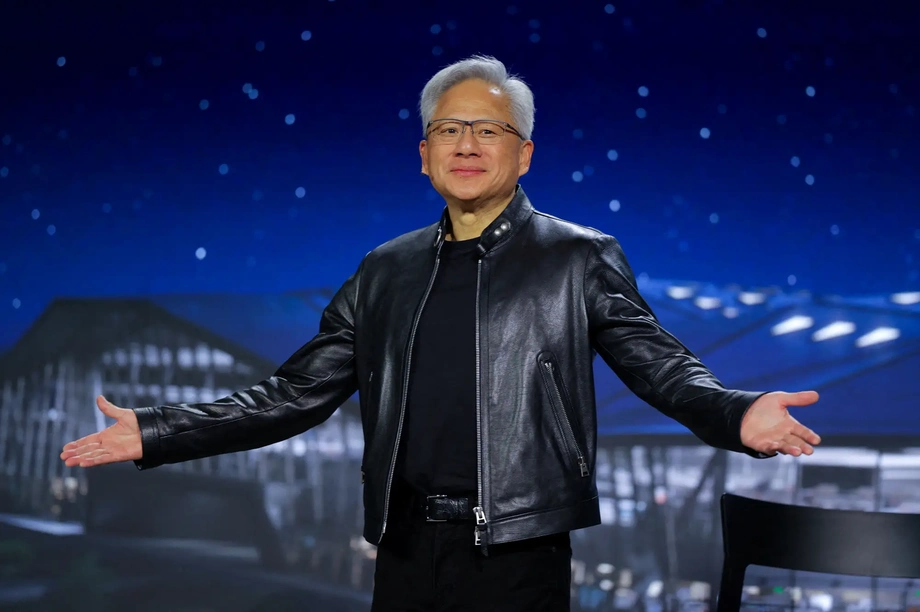
A family photograph becomes the latest sign of support
Photographs taken at Nvidia headquarters on November 24, 2026, showed Elon Musk standing beside Jensen Huang in the building's atrium, surrounded by Nvidia employees. Musk wore a black T-shirt, and two children stood close to him. A social media user posted the group picture with the caption, "Elon Musk and Jensen Huang together at Nvidia." Musk then reposted it, confirming his presence without adding an explanation.
Contents
- A family photograph becomes the latest sign of support
- How the board reversed course after 11 days
- The assurances sought from Washington
- The affair, Megaspeed and the unfinished investigations
- Why Musk campaigned so publicly for Huang
- A friendship built around AI machines
- Why the leadership drama moved so much money
- Celebration in Silicon Valley, alarm in Congress
- Key Points
The visit came the day after Huang returned as Nvidia's president, chief executive and board director. His reinstatement ended a resignation that had lasted just 11 days but had shaken employees, customers and investors. Nvidia lost about $1 trillion in market value after his departure, while its shares jumped approximately 30 percent when his return was announced.
Neither Nvidia nor Musk disclosed an agenda for the visit. Nvidia had not issued a formal statement about the meeting, Musk had not discussed what he and Huang talked about, and no chip order, investment or supply agreement accompanied the photographs. The commercial setting was still unmistakable. Tesla and xAI depend heavily on Nvidia processors, making Huang the leader of a crucial supplier to businesses overseen by one of his most vocal supporters.
How the board reversed course after 11 days
Nvidia announced on Monday, November 23, that its board had voted unanimously to restore Huang to all three positions with immediate effect. The board said its decision followed a series of meetings with him and that it was satisfied with his candor and ability to lead. Only days earlier, the board chair had told investors that the company did not intend to bring him back.
- November 12: Huang resigned as president, CEO and director following an extramarital affair scandal and concerns examined by the board about a possible foreign intelligence effort.
- November 17: Huang's X account lost its blue verification mark and Nvidia identification. Musk said the badge would return at the platform's expense, and it was restored that evening.
- November 18: Musk compared removing Huang from Nvidia to dismissing Michael Jordan while the Chicago Bulls were still winning.
- November 20 to 22: President Donald Trump, Vice President JD Vance, Huang, board members and lawyers held repeated discussions about a possible return.
- November 23: The board announced Huang's unanimous reinstatement before trading opened.
- November 24: Musk visited Huang at Nvidia headquarters and joined employees for the group photographs.
Harvey C. Jones, chair of the Nvidia board, explained the decision in the reinstatement statement and addressed its effect on investors, workers and business partners.
The Board believes Jensen is the right person to lead Nvidia, and that his reinstatement is in the best interests of our stockholders, employees, partners and customers.
Huang said in his own statement that he was honored to return to a company he described as one of the most consequential technology businesses in the world. He accepted the responsibility with what he called the greatest humility and a renewed commitment, while thanking the board for its confidence and deliberation.
Colette Kress, who had served as interim CEO during the resignation, remained chief financial officer. Jones confirmed that arrangement in the statement and repeated it in a brief message to Nvidia employees, preserving continuity in the finance leadership while Huang resumed control.
The assurances sought from Washington
Trump told advisers on Friday, November 20, that he wanted Huang back at Nvidia. He had been calling figures on Wall Street and in Silicon Valley, and the main message he took from those conversations was that the United States needed a strong Nvidia. He was also privately concerned about damage to the wider economy if the company's value continued to collapse.
Trump and Vance then spoke repeatedly with Huang, Nvidia directors and their legal counsel. Huang privately indicated that he believed directors wanted him back, but they needed assurance that the government did not consider him a national security risk. Board members were told in telephone calls that he was not the target of a Justice Department investigation, that the government had no legal issue with him and that his return would not be viewed as a problem by the administration.
Directors wanted Attorney General Todd Blanche himself to confirm that Huang was not under investigation, and Blanche was comfortable doing so. Director of National Intelligence Jay Clayton had examined intelligence concerning Alice Huang and her interactions with Jensen Huang, with the resulting material circulated to Trump and senior officials. Clayton also helped connect directors with administration officials and offered his knowledge of corporate governance, although he did not participate in the final weekend negotiations.
Jensen Huang met the board for hours on Sunday. Directors subsequently contacted the White House, and late that night they informed Trump and Vance that Nvidia would announce the reinstatement before markets opened on Monday. The language surrounding Trump's public response was settled as well. He would welcome the decision and say that Nvidia should cooperate with continuing investigations into Megaspeed and chip exports.
After the announcement, Trump publicly claimed credit for the outcome. He said he had convinced directors to rehire Huang and added, "The board decided to do what we wanted them to do." The board's own statement was narrower, saying that it had received input from senior levels of the US government and, based on that input, was confident that the reinstatement posed no national security risk.
The affair, Megaspeed and the unfinished investigations
The resignation followed an extramarital affair, while other accounts of the scandal described allegations of multiple affairs. Jensen Huang's affair was with Alice Huang, a former senior executive at Megaspeed, a technology company based in Singapore. The government assurances given to Nvidia directors covered Jensen Huang and explicitly did not extend to her.
Megaspeed has been accused of transferring advanced Nvidia chips to China, an allegation the company denies. It was placed on a US trade blacklist during the week of the reinstatement and has been investigated by the Justice and Commerce departments. Export controls are government rules restricting the sale or transfer of certain advanced technologies. In this case, they matter because the processors used to train powerful AI systems are subject to American national security policy.
Earlier in 2026, Secretary of State and National Security Adviser Marco Rubio prepared a classified memorandum about the relationship. According to officials familiar with the episode, it drew on intelligence that included intercepted conversations involving Alice Huang and warned that she was in contact with an officer of China's Ministry of State Security. Rubio briefed Trump aboard Air Force One in May, before Jensen Huang joined the presidential delegation traveling toward China during a stop in Alaska. Neither Rubio nor CIA Director John Ratcliffe participated in the weekend effort to restore Huang.
Commerce Secretary Howard Lutnick had discussed the possibility of Huang returning with Trump earlier, but he was not involved in the weekend planning. His department enforces semiconductor export controls. Treasury Secretary Scott Bessent had openly complained that other agencies supported blacklisting Megaspeed for months while, in his words, "Commerce has the pen."
Several processes remain active. A committee made up solely of independent Nvidia directors investigated reports that Jensen Huang might have been targeted by a foreign intelligence effort, and the board said that inquiry would proceed to its conclusion. The FBI and the Justice Department's National Security Division are also examining possible export control violations involving Megaspeed and another company, Super Micro Computer. No completion dates were given for those inquiries.
Why Musk campaigned so publicly for Huang
Musk supported Huang throughout the 11 day absence. After the resignation, he said that he had signed a petition calling for his return. When the verification badge and Nvidia identification disappeared from Huang's X account on November 17, Musk promised that the mark would be restored and that the platform would cover the cost. It reappeared that evening.
During a video appearance at the New York Times DealBook summit on November 18, Musk used basketball to explain his view of Huang's value. Removing him from Nvidia, Musk argued, would be like forcing Michael Jordan off the Chicago Bulls while the team was on a winning streak. He said Huang performed the work of several people, combining technical knowledge with business relationships built over decades.
When Nvidia announced the reinstatement, Musk first wrote "It is done" on X. He then shared the company's announcement and added, "The mistake has been corrected." Responding to a post about his support, Musk explained his actions in personal terms.
When things are going well, everyone is your friend. Those who still support you when times are hard are your true friends.
His advocacy extended beyond public posts. Musk spoke with Trump about export controls and told administration officials that people he knew in technology and business were firmly behind Huang. Uber cofounder Travis Kalanick was another prominent supporter who welcomed the decision. The headquarters photograph therefore followed days of political, public and personal support rather than appearing as an isolated social call.
A friendship built around AI machines
The relationship between the two executives has included several carefully staged deliveries of computing equipment. In 2016, Huang personally delivered the world's first DGX-1 AI supercomputer to OpenAI. He wrote a dedication on the machine addressed to Elon and the OpenAI team, and Musk added the word "Thanks!" Musk published photographs of that occasion on X in 2024.
A DGX system packages large numbers of specialized processors with the networking and software needed to train AI models. It is designed to save customers from assembling every part of such a system themselves. In October 2025, Huang made another personal delivery, traveling to SpaceX's Starbase in Texas to give Musk the first DGX Spark unit, a much smaller AI computer intended for a desktop.
Their public exchanges have also covered attitudes toward work. In 2024, Musk shared a Stanford Graduate School of Business interview in which Huang recalled washing dishes and cleaning toilets in a restaurant and said there was no job he considered beneath him. Musk responded approvingly with an example from his own management experience, saying that he had even concerned himself with whether toilets had toilet paper.
Oracle founder Larry Ellison supplied a more commercial anecdote. At the Nobu sushi restaurant in Palo Alto, California, Ellison said that he and Musk pressed Huang to provide them with more GPUs, even inviting him to accept more money in exchange for additional chips. Ellison joked that the approach worked.
Huang has reciprocated with praise for Musk's technical organization. Speaking on the BG2 podcast, he described how the xAI team connected 100,000 GPUs into a training cluster in just 19 days. He singled out the dense cabling behind each server and the difficulty of making the entire network and software operate together. A GPU can perform many calculations simultaneously, which is useful for AI training. Connecting 100,000 of them requires those individual machines to exchange information reliably at enormous scale.
Why the leadership drama moved so much money
The roughly $1 trillion decline after Huang's exit measured the change in Nvidia's total stock market valuation, not cash withdrawn from its bank accounts. It showed how sharply investors revised the price they were willing to pay for the company. The approximately 30 percent share price increase on November 23 captured the immediate reaction to his return.
Nvidia occupies a central position in the AI economy because its processors sit inside the computing systems used to develop and run many advanced models. Huang's resignation therefore created uncertainty well beyond the executive suite. Customers had to consider who would set product and supply priorities, while Nvidia engineers faced the prospect of a sudden change in leadership at a company closely associated with its founder.
For Musk, those issues have a direct operational dimension. Tesla and xAI rely on Nvidia GPU products, and the 100,000 processor cluster praised by Huang illustrates the scale at which xAI obtains and assembles computing capacity. The headquarters meeting gave the two men an opportunity to discuss supply, cooperation and the industry after a period of turmoil, although no such conversation has been publicly described.
Celebration in Silicon Valley, alarm in Congress
Founders, investors and technology workers across Silicon Valley celebrated the reinstatement. Outside Nvidia headquarters on Monday, one man even mimicked Huang's signature attire. Trump called the board's action the "correct and proper decision" and said continued leadership by Huang was important for Nvidia and the American economy.
The response in Washington was more divided. Senator Elizabeth Warren called the decision "reckless" and said the administration needed to explain the input it had provided to Nvidia directors. Lawmakers from both parties raised concerns about bringing Huang back while aspects of the intelligence and export control questions remained active.
Lloyd Blankfein, the former Goldman Sachs CEO, responded with a pointed joke on X. He suggested that someone could return from the graveyard if that person were truly indispensable, but said Nvidia's board would not have the same opportunity. Allies of Rubio and Bessent also said the two cabinet officials had private concerns about parts of the arrangement, though neither had publicly broken with Trump. Rubio was described as angered when the reinstatement news broke.
Huang is scheduled to appear before House and Senate panels during the week following his return. Precise hearing dates were not announced in the accounts of the schedule. Those appearances will give lawmakers an opportunity to question him about the matters surrounding his departure, while Nvidia's independent committee and federal investigators continue their separate work.
Key Points
- Musk visited Huang at Nvidia headquarters on November 24, 2026, posed with employees and brought two children, but neither man disclosed an agenda.
- Nvidia's board unanimously reinstated Huang as president, CEO and director on November 23, ending a resignation that lasted 11 days.
- The board cited Huang's candor and leadership ability and said government input assured it that his return posed no national security risk.
- Trump and Vance participated in intensive discussions before the vote, and Trump later claimed that he had convinced directors to rehire Huang.
- Investigations involving Megaspeed, chip exports and the circumstances examined by Nvidia's independent directors remain unfinished.
- Nvidia lost about $1 trillion in market value after Huang's exit, and its shares rose approximately 30 percent when he returned.
- Musk's support included a petition, public defenses of Huang and intervention over his X verification badge, building on years of personal and business exchanges.
- Huang is expected to face House and Senate panels the following week, with exact hearing dates still to be announced.