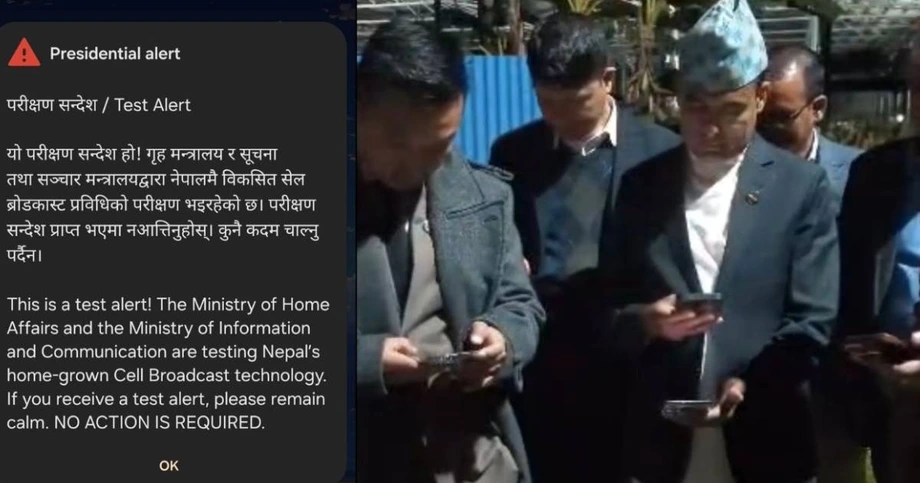
A Test Message at 5:30 PM
At 5:30 PM on Monday, November 23, 2026 (Mangsir 7, 2083), engineers at a Nepal Telecom tower in Balambu, Kathmandu, sent a message that made selected mobile phones ring and vibrate. The alert carried the title परीक्षण सन्देश / TEST ALERT, with text in Nepali and English, and the test notice itself read यो परीक्षण सन्देश हो, meaning this is a test message. It reached 40 to 50 chosen handsets within five to 10 seconds, according to Ram Bahadur KC, spokesperson for the National Disaster Risk Reduction and Management Authority (NDRRMA).
Contents
Two ministers watched the test: Sudhan Gurung, home affairs, and Vikram Timilsina, communication and information technology. The exercise was coordinated by their ministries, the Nepal Telecommunications Authority (NTA) and Nepal Telecom. Authorities asked people who received the alert not to panic or take emergency action, because it was a technical test rather than a real disaster warning. Some phones in the test area could receive the same message more than once.
The system is built for the disasters that shape life in Nepal: floods, landslides, glacial lake outburst floods (GLOFs), earthquakes and severe weather. The trial in Balambu was the first small step in a plan to send warnings for a specific location to every compatible phone in a danger zone, without needing anyone's number or an internet connection.
What Exactly Is Cell Broadcast?
A cell is the patch of ground served by a mobile tower's antennas. Phones in that patch connect to the network through that cell. Cell broadcast uses the same structure to push one message to every compatible handset in the cell at once. The message travels on a separate broadcast channel, not as one text after another.
SMS works differently. A sender needs a list of phone numbers. One thousand recipients mean one thousand addresses and one thousand messages. Cell broadcast selects a place, not a person. The International Telecommunication Union (ITU) says the technology can cover a few phones in a small area or millions across a large region. It needs no app, no data package and no personal details. A phone must be switched on, within network coverage and able to receive the alert. KC said a suitable handset and network can even deliver the message without a SIM card.
Radio stations do not count listeners before they broadcast the news. A station broadcasts to whoever is tuned in. Cell broadcast follows that principle. In Balambu, the test was deliberately limited to a small set of phones. The messages arrived in five to 10 seconds, KC said, and the authority described the first trial as successful on the 2G network. Tests on 3G and 4G networks are next.
Why Five Seconds Can Matter
During a flood or earthquake, many people call at once. Networks jam, and ordinary SMS can slow down. Cell broadcast uses a separate mechanism, so congestion affects it less, KC said. Speed is not the only difference. An SMS can sit unread among dozens of other messages. A cell broadcast alert can appear on the screen automatically, with a sound and vibration built to grab attention. Depending on the handset and alert type, it can sound even when the phone is on silent.
KC said the system can vary warnings by risk level: red for extreme danger, orange for danger and yellow for caution. The message and tone can change with the level. He described the alert as impossible to ignore.
People cannot ignore it. It will not stop ringing until they see the message.
Nepal has used mobile warnings before. The Department of Hydrology and Meteorology signed agreements with private telecom operator Ncell in 2016 and has a similar arrangement with Nepal Telecom. Some people receive flood and weather warnings from the 1155 service during the monsoon. KC pointed to the Rasuwa and Bhotekoshi area, where SMS warnings were sent but some people did not read them. A few minutes can separate a safe evacuation from a disaster.
Who Runs It, and When Will It Be Used?
The NDRRMA is set to run the warning system, while technical agencies will decide when a hazard warrants an alert. The Department of Hydrology and Meteorology will supply flood and weather information. The Department of Environment will handle air pollution, the Department of Mines and Geology will handle earthquakes, and health agencies will handle epidemics. KC said the warning would be a shared responsibility.
All agencies have a joint role in this.
The NDRRMA has drafted a standard operating procedure and will send it for approval. The agency wants the system in use before the next monsoon, but further trials come first. The Balambu exercise was phase one. Three or four more rounds will test longer distances and larger areas. The ministry also asked the public, media outlets and other stakeholders to cooperate with the trials.
- November 23, 2026, 5:30 PM: first technical trial at Balambu in Kathmandu.
- Five to 10 seconds: time for the alert to reach 40 to 50 selected phones.
- Three or four more phases: planned tests over longer distances and wider areas.
- Before the next monsoon: target for putting the system into use.
No public launch date has been set, and the government has not released the full cost of building the system or expanding it nationwide.
The Homegrown Software and the Bill It Avoids
Cell broadcast is not new. Japan, the United States and the United Kingdom are among the countries that use it for emergency alerts. KC said 54 countries operate the technology, and many bought their systems from foreign suppliers. India developed its own. Nepal chose the same route. The NDRRMA set up a task force to study whether the country needed cell broadcast, what foreign software would cost and whether local engineers could build it. The task force has submitted its report.
Buying foreign software would have cost Rs 25 crore to Rs 75 crore, according to the task force study. A system developed in Nepal could avoid that software bill. Running it still costs money. The NDRRMA will need technical staff, computer systems, a cell broadcast center and other infrastructure. The government has not made public how much it has spent on development so far or what a nationwide rollout will cost.
From a Glacier to a Phone
A cell broadcast alert is one link in a longer chain. The United Nations identifies four parts of an effective early warning system: knowledge of where hazards are and who is exposed, the ability to detect and forecast them, a way to reach people in time, and the preparedness to act on the warning. Nepal's new system covers the third part. It does not detect a flood or a landslide by itself. It carries a warning produced by another agency to the phones in the path.
The chain is easy to see in a GLOF. A glacial lake bursts high in the mountains. Someone must detect the flood quickly, estimate where it will travel and when it will arrive, and then send alerts to the settlements downstream. If the detection is slow or the forecast is wrong, the fastest phone alert in the world has little to deliver. The message also has to tell people what to do: where to go, which road is safe and how quickly they must move.
KC said the NDRRMA will issue warnings, while the technical agencies will judge the hazard. A flood warning might begin with the hydrology department. An air pollution alert would involve the environment department. An earthquake alert would involve the mines and geology department. A disease outbreak would involve health authorities.
The Gaps the Alert Cannot Close
Not every phone will ring. KC said the system is expected to work on handsets made after 2013, but it has not been tested across the full range of brands and models in use. Many Nepalis still carry older phones. Others cannot read a written message, speak different languages or may not understand a warning sent only in Nepali and English. Reaching them needs more than a text on a screen.
Cell broadcast also does not confirm who received the alert. The ITU lists the lack of individual delivery confirmation as a limitation. Authorities cannot count the phones that rang or know whether anyone acted. Sirens, radio, local volunteers, SMS and other channels must keep running alongside the new system. The government's own test notice said some users might get the same message more than once, a reminder that broadcast coverage is not the same as a confirmed conversation.
What the 2024 Floods Showed
A recent test came in Ashoj 2081, which fell in September and October 2024, when floods and landslides struck the Kathmandu Valley and other parts of the country. The hydrology department had warned of heavy rain and flood risk. SMS messages went out. Heavy loss of life and property followed anyway. A study published in 2025 in the journal Natural Hazards Research found that warnings alone did not prevent damage because preparation and response were inadequate.
The World Meteorological Organization estimates that a warning 24 hours before a storm or heat wave can cut potential damage by up to 30 percent. That saving depends on people taking protective action. A phone that rings is useful only if its owner knows where to run, which route to take and how to help neighbours who cannot move quickly. Nepal's new system can shorten the time between a warning and a screen. The harder work is shortening the time between a screen and a safe place.
What Comes Next
The NDRRMA plans more technical trials, approval of its operating procedure and a phased expansion into areas with high flood risk. The first test ran on 2G. Tests on 3G and 4G will show whether the system performs as well on newer networks and across different handsets. The government says it will refine the system based on results and feedback from the first phase.
The test at Balambu reached a few dozen phones. A real warning would need to reach every compatible phone in a valley, along a river or on a mountain road, including visitors and migrant workers who have no local phone number registered with any authority. That is the promise of cell broadcast. The measure of its success will come on the day a glacier lake bursts or a river rises, when the gap between the alert and the water decides who gets out.
Key Points
- Nepal tested an indigenously developed Cell Broadcast System at 5:30 PM on November 23, 2026, from a Nepal Telecom tower in Balambu, Kathmandu.
- Alerts reached 40 to 50 selected phones in five to 10 seconds on the 2G network, according to NDRRMA spokesperson Ram Bahadur KC.
- The system sends warnings by geographic cell, without phone numbers, internet or apps, and can cover everyone in a danger zone.
- It is designed for floods, landslides, GLOFs, earthquakes and severe weather, with red, orange and yellow risk levels.
- The NDRRMA aims to use it before the next monsoon, after three or four more test phases and approval of an operating procedure.
- A local system could avoid Rs 25 crore to Rs 75 crore in foreign software costs, though running and expansion costs remain undisclosed.
- Cell broadcast covers only the delivery part of early warning; detection, evacuation plans and confirmed reach remain separate challenges.