A Kitchen Test for a Factory Robot
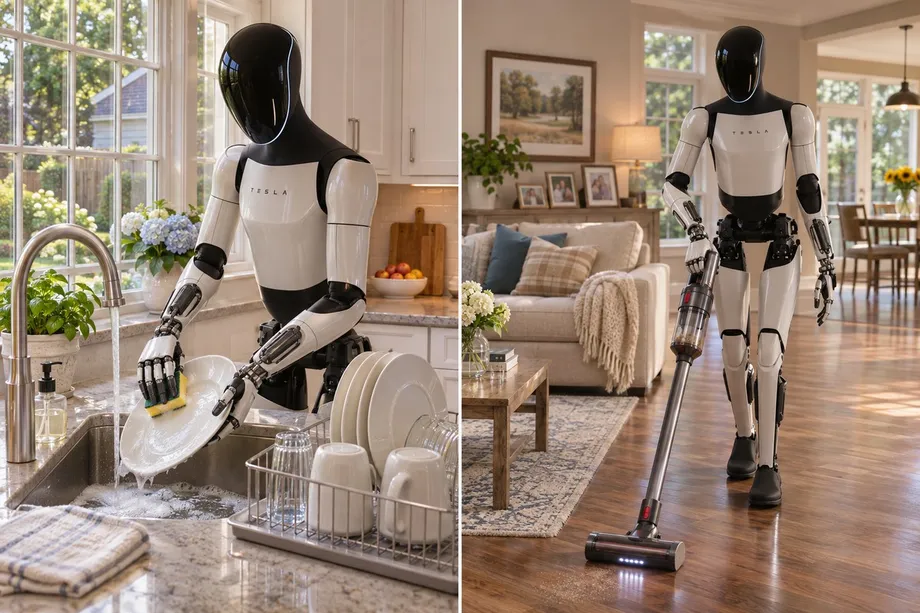
Elon Musk put a household chore on a clock on Nov. 18, saying Optimus could wash dirty dishes, dry them, put them in a cupboard and take out the trash within 12 to 18 months. The Tesla chief executive made the remark at the TomorrowX conference in Austin, joining by video while in Shenzhen for APEC meetings. He also said Tesla planned to publish real world footage within one or two months without hidden operators or task sequences programmed in advance.
Contents
- A Kitchen Test for a Factory Robot
- What the Promise Changes for Households
- Why Hands Are the Hardest Part
- Old Car Lines, New Robot Lines
- The Texas Factory Is Being Built for Millions
- What Brain Will Guide the Robot
- Why the Next Demo Matters More Than the Last Ones
- Who Else Is Racing Into Humanoid Robots
- The Money Behind the Promise
- What Is Still Unknown and What Comes Next
- What to Know
Gavin Baker, managing partner and chief investment officer at Atreides Management, asked Musk when someone could have an Optimus robot at home for trash and dishes. Musk, Tesla's chief executive, answered with a date for what the robot can do, not a date for what customers can buy.
So, I think Optimus will be capable of doing the things you described in about 12 to 18 months.
The word capable matters. Tesla has not announced a home sale price, an order date, a delivery schedule or a safety standard for household use. Musk has earlier referred to a price of US$20,000 to US$30,000, but no public sale has opened. He said the first deliveries to outside companies are expected around the end of 2027, and those first buyers will not be families.
Musk also said no robot currently exists that can carry out those everyday chores. He named the hand and forearm as the biggest technical bottleneck, saying they are harder than the rest of the robot put together. That sets up the central question behind the promise: a robot that moves neatly in a factory is not the same as a robot that can cope with a kitchen that changes every minute.
What the Promise Changes for Households
For a family, the promise is about time and repetition. Dishes, trash and laundry are tasks people often do again and again, and Musk says Optimus could eventually handle them. In Shenzhen, he also described a robot that could mow lawns, cook, act as a child's tutor and serve as a 24 hour bodyguard. He suggested that almost every family would want one or two units. Those comments show the scale of his ambition, but they do not change what can be bought today.
Homes are harder than factories because people move things. A cup may be left beside the sink. A chair may block the path to the trash bin. A pet may cross the floor. A public discussion of Optimus flagged home safety concerns and listed likely early tasks, fine motor skills such as playing the piano, robot training and possible teamwork with Cybercab for deliveries and charging. It also looked at Mars colony uses. No release date was attached to those ideas, and no household safety rules were published.
Musk said the first economic use is more likely in industrial places such as mineral mining, refining and smelting, where work can run 168 hours a week and carry national security and economic value. He estimated that 20 to 30 million robots would be needed to match America's output. A mine or refinery can be designed around repeatable tasks, fixed tools and trained staff. A kitchen is full of wet surfaces, fragile objects, sharp edges and surprises.
Why Hands Are the Hardest Part
Musk's focus on hands is not about appearance. A robot hand needs joints, motors, sensors and software that work together. A degree of freedom means one independent way a joint can move. More degrees of freedom can give a hand more ways to grip, but they also make control harder because the robot must decide which movements matter at each moment.
Generation 2 hands had 11 degrees of freedom in 2023. Tesla showed a new hand with 22 degrees of freedom in November 2024. Generation 3 has 37 joints and a newly designed hand. Those figures describe hardware, not skill. A robot can have many joints and still fail to pick up a glass without crushing it or knocking it over.
Washing dishes combines seeing, judging force, planning order and updating the plan when the scene changes. The robot must recognise a plate, choose a grip, lift it, move around other objects and place it somewhere specific. This is why the industry uses the phrase embodied AI, meaning software that controls a physical body and learns from actions in the real world. Data from real actions matters because a robot cannot learn every home layout from a scripted video.
Old Car Lines, New Robot Lines
Tesla has been turning factory space into robot space. At the Fremont, California plant, the old Model S and Model X assembly area was cleared for Optimus manufacturing. Tesla Manufacturing shared a video of the teardown on July 10 and said the work took 46 days. The final Model S and Model X vehicles came off that line in May. A pilot Optimus line was already running at Fremont, and Tesla stepped up hiring for the robot program during the year.
On the April 22 earnings call, Musk said generation 3 reveal timing was moving closer to production because rivals study and copy earlier designs. Production was expected around late July or August. Tesla said first generation Optimus lines at Fremont were being installed for an eventual capacity of one million robots a year. One construction timeline used Jan. 21, 2026 for generation 3 mass production at Fremont. Tesla's later public sequence puts the old car line retirement in July and first production quality units by October, with early generation 3 output in the third quarter.
Weekly output at Fremont has reached several hundred units, roughly ten times the second quarter level. Tesla has not shipped any machines to outside customers. The robots are being used in the Optimus Academy training program and in Tesla factories to collect data. Musk said on the Oct. 21 call that reaching 20,000 robots a week would take at least a year, maybe a little longer. Space freed by a planned Cybertruck slowdown around mid 2027 is for Cybercab, not Optimus, while hiring continues across the robot's hardware team.
The program's leadership changed in June 2025, when Milan Kovac resigned as Optimus head. Ashok Elluswamy, who leads Tesla's autopilot teams, took over. That change placed a leader known for driverless car software at the head of a robot program that increasingly depends on the same kind of vision and decision systems.
The Texas Factory Is Being Built for Millions
Tesla's dedicated Optimus facility at Giga Texas covers more than 7 million square feet. Groundbreaking took place on March 23, 2026. By Nov. 18, about 65 percent of the main structure was assembled, with the shell expected to close before year end. Initial production is targeted for late 2026, and high volume production is targeted for summer 2027.
The long term target is 10 million generation 4 robots a year at full build out, compared with the one million a year capacity designed for Fremont generation 3 lines. The Texas project has been estimated at up to US$10 billion. Aerial tracker Joe Tegtmeyer observed four reinforced foundations on the southeast side of the site. Their size and position point toward IDRA giga press casting machines, which form large metal parts in dies. In car plants, such machines can replace many smaller pieces with one large part. Using that approach for robot parts would be unusual and could support very high output.
No date was given for delivery of those machines. The construction sequence suggests Tesla is preparing the building and ordering equipment at the same time, rather than waiting for the shell to finish. That matters because the summer 2027 target depends on more than factory space. It depends on machines, suppliers, software, training data and workers arriving together.
What Brain Will Guide the Robot
Tesla is linking Optimus to the same broad AI work used in its vehicles. Release notes for FSD v15 describe an upgraded vision encoder shared by Full Self-Driving, Robotaxi and Optimus. A vision encoder is the part of the software that turns camera footage into information the rest of the system can use. Tesla says this encoder was trained on millions of internet videos. A car uses such information to steer. A robot uses it to decide where to put a hand.
Musk said the newer AI5 chip is headed for Optimus while cars stay on AI4. He has said AI5 offers roughly ten times the computing power of AI4. The chip reached tape out, meaning its design was sent for manufacturing, in April 2026. High volume manufacturing is expected in 2027 from TSMC in Arizona and Samsung in Texas. The chip uses a 2 nanometer process and about 96 GB of memory after design changes for Optimus production needs. Integration into Optimus is expected around April 2027. AI5 is also planned for Tesla's AI training supercomputers, and Musk has said AI6 will be used for Optimus.
Musk said Optimus needs enough local intelligence to keep doing useful work if it loses connection, similar to a car that can drive without cellular or Wi-Fi service. A Grok level conversation would need a network connection. In simple terms, the robot needs a brain in its body for immediate actions and a link to larger models for talk and deeper reasoning.
Why the Next Demo Matters More Than the Last Ones
Optimus has been shown through staged events and short videos since Tesla announced the idea at AI Day on Aug. 19, 2021. Prototypes appeared in 2022, generation 2 arrived in December 2023, and public reactions have often mixed interest with doubt. In January 2024, viewers of a shirt folding video pointed to a gloved hand at the edge of the frame that mirrored the robot, a sign of teleoperation, where a person controls the machine from elsewhere. Videos of generation 2 folding laundry and cooking eggs also drew teleoperation questions. At the 2024 We, Robot event, observers noted backstage human control in interactions with guests.
Elon Musk, Tesla's chief executive, gave his own diagnosis of the problem at the TomorrowX summit. He used a simple kitchen example to explain why a rehearsed demonstration can fail when one object moves.
Like I said, the robot demos that you've seen thus far is like, if you ask, like, go pick up an apple and then you move the table, it won't be able to pick up the apple anymore.
Musk said Tesla would show Optimus only when the demonstration was real enough to represent daily interaction. He described the timing this way:
when we feel it's an authentic demo.
The company first promised an unscripted video on the Oct. 21 earnings call within a month or two. Four weeks later, at TomorrowX, the timing was still described as a month or two. That puts the window roughly between mid December and mid January, but no firm date was given. The Humanoids Summit 2026 is set for Dec. 1 and Dec. 2 in San Mateo, California, with Tesla listed as a key partner and generation 3 slated for a live on stage demonstration. It falls inside the broader two month window, though Tesla has not said the promised footage will appear there.
John Carmack set a harder practical test for a real robot: fetch a box of remote controlled toy cars, unpack it, unscrew the battery compartment screw, install the battery, screw it back and drive the car. Before the latest push, Optimus made public appearances in London on Dec. 13, 2025 and Berlin on Dec. 20, 2025, where it greeted visitors, handed out popcorn and posed for photos. Those appearances showed public interaction, not independent home work. A demo that handles a changed scene would be a different kind of evidence.
Who Else Is Racing Into Humanoid Robots
XPeng said in its third quarter release on Nov. 16 that its next generation humanoid robot was accelerating toward a mass production milestone by year end. The company said the first mass produced units would begin trial work in some XPeng stores in the first quarter of 2027. XPeng spent RMB2.85 billion, or about US$0.43 billion, on research and development in the quarter and lost RMB0.87 billion. Tesla spent US$2.8 billion on research and development in the same quarter, more than six times as much.
Samsung Electronics is preparing in house models named HR and HE for CES in January 2027, with HE carrying more joint degrees of freedom. LG is preparing a model equipped with Nvidia's Isaac GR00T foundation model and Jetson Thor platform for the first quarter of 2027. A foundation model is a large AI model that can be adapted to many tasks. These plans put several dense demonstrations and launch claims into a short period, from the December summit to CES and the first quarter of 2027.
China Securities frames physical AI as the next wave of artificial intelligence, with robots as one of its clearest physical carriers. It notes that general purpose models such as GPT-6 have shown potential in robot control. Apple, OpenAI and Meta have also entered the field, and OpenAI has restructured its standalone robotics team. Zheshang Securities argues that once robot bodies can be made in volume, commercialization will depend on embodied AI and high quality interaction data. That shifts attention from metal and motors toward the software and experience that teach a machine what to do in messy places.
Musk's Shenzhen conversation also touched chips and rivals. He compared Jensen Huang with Michael Jordan in his prime and said it would be a pity for Nvidia to lose such a leader during a winning streak. The remark showed how closely the robot race is tied to AI computing, where chips, models and manufacturing capacity now move together.
The Money Behind the Promise
Optimus has no outside customers and no revenue. Elon Musk wrote on X on Oct. 17 that two Tesla products carry the company's future value. The post gave no rollout date in that reply.
Optimus and Cybercab will be the vast majority of Tesla's value.
Tesla is paying for that bet now. Research and development reached US$6.4 billion in 2025 and US$7.1 billion in the first nine months of 2026, already more than all of 2025. Capital spending is expected to be about US$20 billion in 2026, more than twice the US$8.5 billion spent in 2025, as Tesla builds AI computing capacity and a second Optimus factory in Texas. Consensus forecasts put negative free cash flow at US$9.9 billion in 2027 and US$7.9 billion in 2028. Tesla had US$45.4 billion in cash and investments at Sept. 30, which gives it room to keep spending.
Consensus normalized earnings per share are expected to rise from US$1.66 in 2025 to US$3.24 in 2028. Normalized earnings strip out one time items to show profit on a steadier basis. Even that 2028 figure is below the US$4.07 Tesla earned in 2022. The shares trade at 162 times forward earnings, about 50 percent above the average of 108 times over five years. Forward earnings means profit expected over the next 12 months. XPeng had RMB45.41 billion, or US$6.77 billion, in cash at Sept. 30, close to Tesla's US$45.4 billion, but it also lost RMB0.87 billion, or about US$130 million, in the third quarter.
Musk, Tesla's chief executive, wrote on X on Nov. 22 that he sees Optimus as the company's strongest product. He was replying to a post about shared camera software, and he did not give a rollout date.
Yes. Optimus is awesome. It will be our finest product ever and (I think) the best product of all time of any kind.
What Is Still Unknown and What Comes Next
Several points remain undecided. Tesla has not set a home sale price or start date for orders. It has not published a firm date for the unedited demonstration. It has not named outside customers, published a household safety standard or said when the Texas casting machines will arrive. The company also has not shown a public demonstration in which a task succeeds after the table, or another key object, has moved.
- Dec. 1 and Dec. 2, 2026: Humanoids Summit in San Mateo, with a generation 3 Optimus on stage demonstration slated.
- One or two months from Nov. 18: the window Musk gave for real world Optimus footage, with no firm date.
- Late January 2027: fourth quarter results are expected to bring 2027 capital spending guidance.
- January 2027: Samsung HR and HE models are set to debut at CES.
- First quarter of 2027: XPeng store trials are set to begin, and LG's Nvidia powered model is planned.
- April 2027: AI5 integration into Optimus is expected.
- Summer 2027: high volume Optimus production at Giga Texas is targeted.
- End of 2027: Tesla aims for capacity of up to 20,000 Optimus units a week and outside deliveries.
What to Know
- Musk said Optimus could be capable of dishwashing, cupboard put away and trash taking within 12 to 18 months.
- Tesla has not opened home orders or announced a formal sale price.
- First outside deliveries are expected around the end of 2027 and are aimed at companies, not households.
- Fremont is producing several hundred robots a week, used inside Tesla for training and data collection.
- The Giga Texas Optimus factory is about 65 percent structurally assembled and targets high volume output in summer 2027.
- The next public test is an unedited demonstration without teleoperation, with only a rolling one or two month window given.