Amnesty International Warns of Sweeping Powers Over Online Speech
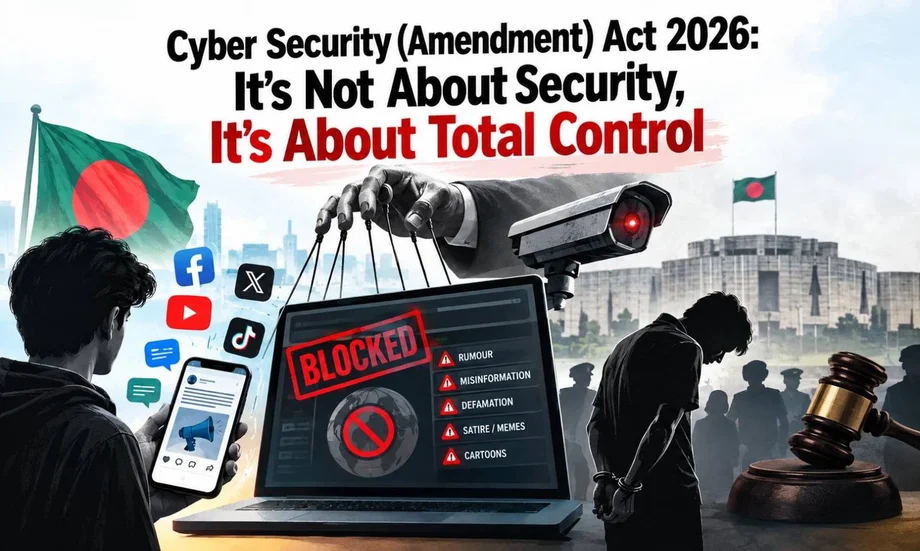
A proposed amendment to Bangladesh's cyber law would give government agencies wide and arbitrary powers to police what people publish, block or share online, Amnesty International has warned, as a government committee reviews a revised draft and rights groups push for the most contested clauses to be dropped. The draft Cyber Protection (Amendment) Act, 2026 would let authorities remove, block or relocate any online content that falls inside a list of broadly worded categories. These include material that "undermines" the integrity and dignity of the country, and content that is "likely to create religious or communal hatred".
Contents
- Amnesty International Warns of Sweeping Powers Over Online Speech
- Humiliation, Dignity and Why Definitions Matter
- A Decade of Cyber Laws, From the ICT Act to the Cyber Protection Act
- What the November Draft Keeps and What It Changes
- 111 People in Ten Months
- Three People Behind the Numbers
- Deepfakes and the Case the Government Makes
- Courts, Not the Executive: What the Roundtable Recommended
- Elections, Bans and a Wider Crackdown
- What Comes Next
- Key Points
The phrase "likely to" sits at the centre of the objection. Authorities would not have to show that harm has happened or is about to. Content that could plausibly undermine security or stir religious feeling would be enough. Amnesty International says such grounds do not qualify as legitimate reasons for restricting freedom of expression under international human rights law, which permits restrictions only when they are set out clearly in law, pursue a legitimate aim, are necessary and are proportionate to the harm they address.
International human rights law is very clear. The right to freedom of expression must remain the rule, and restrictions the exception. Restrictions must be interpreted narrowly and must not be applied in a manner that undermines the essence or practical enjoyment of the right. Any restriction must satisfy the cumulative requirements of legality, legitimate aim, necessity and proportionality.
Smriti Singh, Amnesty International's Regional Director for South Asia, said the provisions fall far short of those requirements and that the vaguely worded text confers overly broad powers on authorities to clamp down on online expression. Bangladesh, she said, should strive to have a cyber law that protects its citizens rather than one that silences them.
The organisation raised its concerns about an earlier version of the proposals in a letter to Bangladesh's Minister of Justice, and says the latest iteration still carries serious human rights problems.
Humiliation, Dignity and Why Definitions Matter
A second group of provisions deals with speech about people rather than about the state. The draft sets out powers to remove, block or relocate content that amounts to defamation, humiliation or bullying. Humiliation is defined as conduct that "injures personal dignity and self-respect with the intention of belittling, ridiculing or showing contempt". Each definition is loose enough, critics say, to leave the line between sharp comment and a criminal offence to the officer handling the complaint.
International human rights law requires restrictions on expression to be precise enough for a person to know in advance what is forbidden. Dignity and self-respect are subjective ideas, and what one reader treats as humiliation another may read as satire or as fair scrutiny of a public official's record. The same problem runs through other terms in the draft, including deception, harm, panic and social unrest, which Amnesty International describes as broad and contested rather than clearly defined serious harms.
Sections 25 and 26 keep the criminal offences of spreading rumours, defamation, bullying and disinformation. Punishments run from a prison term not exceeding two years to five years, depending on the offence, with fines of between 500,000 and 1,000,000 taka. Amnesty International argues that protecting reputation or public order does not justify criminal punishment for expression.
One provision would grant immunity to the chairman and members of the National Cyber Protection Council, and to officers and employees, for acts done in good faith under the act. Good faith is a vague and subjective standard that could shield officials from liability for conduct that breaches human rights.
A Decade of Cyber Laws, From the ICT Act to the Cyber Protection Act
Bangladesh's draft amendment sits on top of nearly two decades of legislation that has repeatedly been turned against journalists, activists and critics, and repeatedly rewritten under pressure. The first tool was the Information and Communication Technology Act of 2006, whose Article 57 punished online content judged defamatory, offensive to religion or harmful to the image of the state. A 2013 amendment raised the maximum sentence to 14 years.
- October 2018: the Digital Security Act carried the same offences into its sections 25, 28, 29 and 31.
- 2021: the writer Mushtaq Ahmed died in police custody after ten months in prison under the Digital Security Act, prompting protests in Bangladesh and abroad.
- 2023: the law minister told parliament that 7,001 cases had been filed under that law.
- 13 September 2023: the Cyber Security Act replaced the Digital Security Act.
- March 2025: the interim government amended the Cyber Security Act and removed nine sections.
- 2025: the interim government issued the Cyber Security Ordinance.
- 12 February 2026: a general election brought the BNP to power.
- 10 April 2026: the Cyber Protection Act 2026 was enacted and later amended on 30 June 2026.
- Mid-September 2026: a first draft amendment was released for public comment.
- 19 October 2026: media figures, legal analysts and civil society representatives called for the most contested clauses to be dropped.
- November 2026: a revised draft was published.
- 18 November 2026: lawyers and rights groups set out their objections at a roundtable in Dhaka.
A CSA handbook published by the International Center for Not-for-Profit Law records what carried over in 2023. Chapter VI of the Cyber Security Act kept 17 of the 18 offences created by the Digital Security Act, and made ten offences bailable that had not been bailable before. Offences ranged from illegal access to critical information infrastructure, punishable by up to six years, to hacking and cyber terrorism, each carrying up to 14 years.
Under the 2023 framework, a National Cyber Security Agency made up of one director general and five directors appointed by the government identifies and designates critical information infrastructure, and the National Cyber Security Council, chaired by the prime minister with 15 other members drawn from ministries, sets direction. Section 8 lets the director general ask the Bangladesh Telecommunications and Regulatory Commission to remove or block data that threatens digital security or hampers the solidarity, financial activities, security, defence, religious values or public discipline of the country, or that incites racial hostility. Sections 40, 41 and 42 give investigation officers powers to take computer systems into custody, collect traffic data and, in defined circumstances, search, seize and arrest without a warrant.
The Centre for Governance Studies, which tracked prosecutions under the earlier law, recorded 1,436 Digital Security Act cases between 8 October 2018 and 25 June 2024. Section 25, publication of information with intent to humiliate or insult, accounted for 269 of them; defamation under Section 29 for 268; and Section 31, on deteriorating law and order, for 168.
What the November Draft Keeps and What It Changes
Public criticism of the September text produced some narrowing. In the revised version, misleading information was removed from the definition of disinformation, and unsupported or unverified information was removed from the definition of rumour. Bullying was narrowed to conduct by one person against another, humiliation now turns on exceeding the limits of official review and constructive criticism, and defamation is tied to the definition in section 499 of the Penal Code. Proposed penalties were also reduced. Defamation carries up to two years in prison and a 500,000 taka fine, humiliation and bullying up to three years and 500,000 taka, and rumour and disinformation up to five years and 1,000,000 taka.
An analysis of the draft places the maximum higher for a new offence. A proposed Section 26A would punish the publication or spread of a rumour or disinformation with up to 10 years in prison and a fine of 4 million taka (about $32,262), or both, and defines a rumour as unverified information that causes or could cause confusion, panic or social instability.
Blocking powers would expand rather than shrink. Under the revised Section 8, the Cyber Protection Agency and law enforcement would be joined by the Ministry of Information and Broadcasting and other government-approved bodies in deciding what to take down, and defamation, humiliation and bullying would be added to the grounds for blocking. The current requirement that the cyber tribunal approve a block or removal within three days, and that content be restored if a court refuses, would be replaced by a review application to the agency, which must decide within 15 days. Officials would have to give reasons within three days of blocking content.
Two clauses in the draft draw particular objections. Section 46(a) requires the cyber tribunal's permission before anyone can be arrested over material published or broadcast in registered media, a protection limited to registered outlets, while bloggers, activists and ordinary users would have none. Section 29(3) would allow an institution's registration or licence to be suspended or cancelled, or its activities banned, and the 15-day notice and right of reply attached to it would apply only to registered media and their operators.
Defamation would become an offence for which police need a warrant, but humiliation, bullying and the rumour and disinformation offences would remain cognisable, meaning arrests can be made without one. A revised Section 41 would drop a plan to let mobile courts and first class magistrates try these cases and keep them before the cyber tribunal, a change that fits the complexity of digital evidence. The proposal to remove the National Human Rights Commission chairman from the National Cyber Security Council and increase government representation remains in place, which critics say would weaken the council's independence.
111 People in Ten Months
The Human Rights Support Society presented its count of cases at a roundtable at the Jatiya Press Club in Dhaka on 18 November. Its study found that at least 111 people across 38 districts faced lawsuits, arrests, detention or violence for exercising their right to freedom of expression in the first 10 months of 2026. Of those, 62 people, or 55.9 percent, faced action for criticising the prime minister, his family, the government or BNP leaders.
The group identified 66 incidents in which laws were misused. They included 36 cases under cyber laws, including the Cyber Security Act, 13 under defamation provisions of the Penal Code, 10 under the Anti-Terrorism Act and 11 general diaries. Twenty-three people faced action for criticising religion or religious figures, 22 for criticising the prime minister, 10 for comments on the July Mass Uprising, seven over news reports and seven over alleged defamation of BNP leaders.
- 66 people were detained: 63 men and three women.
- 47 were shown arrested in formal cases; 19 men were held without any case being filed.
- Four people were physically assaulted and two were beaten to death by non-state actors.
- Eight were dismissed from jobs or expelled from schools and universities.
- Three students under 18 faced accusations over social media posts; two were charged under the Anti-Terrorism Act.
- Of the 84 people whose professions were identified, 25 were journalists; 17 faced cyber law cases, five were sued under Section 500 of the Penal Code and four were arrested.
- BNP leaders and activists filed cases against 14 journalists; 19 of the targeted journalists worked in just three districts, Bhola, Chattogram and Bogura.
- September recorded the most incidents, 22, and February the fewest, two.
Odhikar, a Dhaka rights group, counted at least 18 arrests for expressing views critical of the prime minister, ministers and government representatives between 17 February and 13 November 2026.
Three People Behind the Numbers
Sathi Akhter, a woman entrepreneur, posted a video on 26 October in which she said, "I am now a victim after I voted for the BNP government." She was arrested and said she was taken into custody after speaking publicly about an alleged attack on her business. At a roundtable she described being detained, facing extortion demands, being beaten and threatened after criticising the government on Facebook Live. She was released on bail, the case against her is still active, and padlocks were later thrown at the windows of her showroom and her children's school.
AM Hassan Nasim, a content creator, said police and Detective Branch officers entered his home without a warrant on 17 April, seized his digital devices and took him to the Detective Branch office, where he was questioned about various posts and shared news, beaten and then sent to prison. He now appears in court three times a month and has not had his devices returned.
For Fazana Sithi, a student and activist known for her role in the 2024 student uprising, the harm came from a fake Facebook profile. An investigation found that 133 of 166 videos and posts published by the account between 13 December 2024 and 17 March 2025 were deepfakes made with artificial intelligence, placing her face on videos of two Indian content creators who were dancing. The five most viewed clips had more than 4.1 million views between them, and the account earned money through Facebook Stars.
Those videos were an attempt to damage my reputation.
Sithi said she was harassed and humiliated as a result. She reported the profile many times. Technologists she approached asked for between $100 and $150 to take down the account and the videos, a sum she could not pay, and the account was still active when the investigation was published. Comments on the posts included threats of rape.
Deepfakes and the Case the Government Makes
The government presents the amendment as a response to harm that is already being done, especially by synthetic media. A study identified 72 articles manipulated with artificial intelligence between December 2025 and the 12 February 2026 election, with synthetic images of political figures the most common tactic. The BNP, which won the election, was the most frequent target, appearing in 47 of the cases.
Women in politics faced a particular kind of attack. Analysis of AI content before the vote found pages supporting the Awami League using false images that suggested moral and sexual impropriety about female leaders of the National Citizen Party. After the election, a fact check found AI-generated images and false statements about women candidates for reserved seats. Tanvir Mahabat Abir of the fact-checking group Rumor Scanner said women in public life, above all in politics, are often the target of disinformation.
Political leaders were not the only subjects. Fake videos of Prime Minister Tarique Rahman and his family, including his daughter Zaima Rahman, were used to promote bogus "family cards" in exchange for likes and followers. Of 52 posts examined, 13 featured Zaima. An administrator of one such page said the aim was to gain followers quickly and sell the page, showing that for many creators of synthetic content the lure is platform revenue as much as politics.
Section 25 of the current law already covers extortion, sexual harassment, revenge porn, child sexual abuse material, sextortion and the distribution of content generated or manipulated with AI, with penalties of up to two years, or five years when the victim is a woman or under 18. The draft would add defamation, humiliation and bullying to that section and name AI-generated content explicitly. Reporting on the draft puts the maximum penalty for such offences at five years in prison and a fine of 2 million taka (about $16,131), rising to 10 years and 4 million taka (about $32,262) when the victim is a woman or under 18.
When the ministry added an amendment in June, it said platforms such as Meta would have to remove disputed content within a set time. Officials said the heavier penalties were meant to reduce false videos, audio and images made with AI. Transparency International Bangladesh warned that terms such as rumour and degrading are imprecisely defined and open to selective use, and the Committee to Protect Journalists objected that reporters could face criminal charges for reporting on officials with information judged unverified.
Courts, Not the Executive: What the Roundtable Recommended
Speakers at the November roundtables drew a line between protecting people from online abuse and punishing political criticism. Sibbir Ahmad, an assistant professor of economics at North South University, said restrictions on expression must be clear, necessary and proportionate.
The executive cannot decide what constitutes an offence. That must be decided by a court.
He opposed content blocking without judicial scrutiny and asked for judicial authorisation before phones and other devices are seized, warning that confiscating a journalist's phone can expose confidential sources. Fahim Mashroor of Voice for Reform argued that defamation belongs in civil courts. "Block the content if need be, but don't send me to jail," he said.
Priya Ahsan Chowdhury, a Supreme Court lawyer and adviser to Blast, said the draft keeps vaguely defined offences of rumour, humiliation and misinformation, some of them allowing arrest without a warrant. "Why should anyone spend even a day in jail for this?" she asked. Shorter sentences offer little comfort, she said, when an arrest and a long trial can amount to punishment on their own. She also criticised the removal of judicial scrutiny of content blocking and called for better victim protection, police coordination and forensic capacity to handle online violence against women and children.
Nur Khan Liton, a human rights activist and former member of the National Human Rights Commission and of the commission on enforced disappearances, said successive cyber laws had failed to protect ordinary citizens while shielding those in power from criticism. Recalling a woman whose private photographs and videos were circulated after her phone was stolen, he asked, "If we cannot protect someone's private information, what is the use of this law?" He warned that political aides could file complaints against critics to curry favour with powerful figures, and called for equal legal protection for unregistered bloggers, activists and ordinary citizens, not only for registered media.
Ijajul Islam, executive director of the Human Rights Support Society, presented an 11-point recommendation to the government. The group asked for the contested sections to be aligned with Article 39 of the Constitution and with international human rights charters, for criminal defamation to be dropped in favour of civil remedies, for clearer definitions of misinformation and rumour, and for legal protection against harassment aimed at political satire, cartoons, opinions, criticism of the government and investigative journalism.
The recommendations also called for judicial approval, written show-cause notices and a right of appeal before content is blocked or removed, for expression offences to be bailable, and for court oversight of arrests, searches and the seizure of digital devices. The group wants the National Cyber Security Council made independent and non-partisan, with the National Human Rights Commission chairman restored to it, and compensation and remedies for people illegally arrested. Saima Karim, an assistant human rights officer at the Office of the United Nations High Commissioner for Human Rights in Bangladesh, questioned the removal of the commission's representation on the council.
Shafiqul Alam, editor-in-chief of The Daily Waadaa and a former press secretary to the interim government, said offences tied to expression should not carry prison terms, though civil fines and administrative measures could address defamation and deliberate misinformation. He said criticism is a fundamental right and nobody stands above it, while no one should be free to damage others with deliberate falsehood. Syed Abdal Ahmed, principal information officer at the Press Information Department, acknowledged that the Digital Security Act and the Information and Communication Technology Act had been used to harass people and said the new law should not repeat that. Shahiduzzaman, deputy editor of New Age, argued that elections alone cannot deliver democracy without access to information.
Mir Ahmad Bin Quasem, a Jamaat-e-Islami member of parliament, said business owners were struggling, some unable to pay wages and forced to rent out their shops, and warned that raising such complaints publicly could invite arrest for spreading misinformation. He said he feared arrest himself for criticising the government despite being an elected lawmaker. "Imagine the kind of fear this law could create among ordinary people," he said.
Elections, Bans and a Wider Crackdown
The cyber law debate is unfolding amid a broader contest over speech. Human Rights Watch's World Report 2026 records that the interim government led by Muhammad Yunus took office in 2024 after the overthrow of Sheikh Hasina's Awami League government, promised human rights reforms, and in May 2025 banned the Awami League using new powers under an amendment to the Anti-Terrorism Act, a ban that covered meetings, publications and online speech supporting the party.
Arbitrary detention continued under the interim government. After a clash between Awami League members and student protesters on 8 February 2025, a campaign called Operation Devil Hunt led to at least 8,600 arrests. Violence in the town of Gopalganj on 16 July 2025 killed five people, after which police detained hundreds of alleged Awami League supporters and filed 10 murder cases against more than 8,400 mostly unnamed people. Odhikar reported in October 2025 that at least 40 people had been killed by law enforcement since the interim government took charge, 14 of them allegedly after torture, with almost 8,000 people injured in political violence and 81 killed.
On 17 November 2025, the International Crimes Tribunal sentenced Hasina, and former home minister Asaduzzaman Khan Kamal, to death in absentia for crimes against humanity during the suppression of the 2024 protests. A commission investigating enforced disappearances and extrajudicial killings received more than 1,850 complaints by August 2025, and charges were filed against 28 people in October. Economic pressure feeds the same anger that drove the 2024 uprising: unemployment among people aged 15 to 24 was above 30 percent in 2024, and the World Bank expected extreme poverty to rise to 9.3 percent in 2025, pushing an additional 3 million people into poverty.
What Comes Next
The draft is before a five-member government committee led by Faqir Mahbub Anam, the minister of Posts, Telecommunications and Information Technology, and no date has been given for a parliamentary vote or for the amendment to take effect. Amnesty International has asked the government to withdraw the amendment, keep it out of the legislative process, and comply with its obligations under the International Covenant on Civil and Political Rights, which Bangladesh has ratified.
The law it would change was listed by a Cyber Security Act 2026 entry in a reform tracker with a publication date of 22 April 2026. Rights groups have asked for a wider consultation with human rights organisations, journalists, legal experts, technologists and civil society before the text is finalised, and for the remaining objections to be settled in the open.
Key Points
- Amnesty International says the draft Cyber Protection (Amendment) Act, 2026 would give agencies power to remove, block or relocate online content on vague grounds, including material "likely to" create religious or communal hatred.
- The draft keeps criminal offences for rumours, defamation, bullying and disinformation, with prison terms of two to five years and fines of 500,000 to 1,000,000 taka.
- It would extend blocking powers to the Ministry of Information and Broadcasting and add defamation, humiliation and bullying as grounds, while replacing cyber tribunal approval within three days with a review by the agency.
- It would grant immunity to the National Cyber Protection Council's chairman and members, and to officials, for acts done in good faith.
- Bangladesh has moved from the ICT Act of 2006 to the Digital Security Act of 2018, the Cyber Security Act of 2023, the Cyber Security Ordinance of 2025 and the Cyber Protection Act of 2026, which was enacted on 10 April 2026.
- The Human Rights Support Society recorded 111 people targeted for exercising free expression in 38 districts in the first 10 months of 2026, 62 of them for criticising the prime minister, his family, the government or BNP leaders.
- At least 18 people were arrested for criticising the prime minister, ministers and government representatives between 17 February and 13 November 2026.
- A five-member committee led by minister Faqir Mahbub Anam is reviewing the draft, and no date has been set for a vote.