From a delivery truck to a rocket that lands
Park Soon-young, who heads the reusable launch vehicle program at the Korea AeroSpace Administration, brought a homely comparison to a planetarium hall in Gwacheon on Nov. 26. A launch vehicle, he said, works like a delivery truck: goods reach a customer because a truck carries them, and satellites reach orbit because a rocket lifts them. Everything that follows, from satellite phone links to medical research in weightlessness and data centres in orbit, waits on that first lift.
Contents
- From a delivery truck to a rocket that lands
- Why the fuel changed from kerosene to methane
- A defense agency builds the engine
- The hardware taking shape in Suncheon
- Twenty launches a year by the mid-2030s
- Six uses for a rocket, and a network that needs one
- Lunar landers, robots and a roadmap to 2045
- Money, laws and a trillion won budget
- A race measured in launch pads
- What is still open
- Key Points
"The launch vehicle is the first button that must be fastened for everything that will unfold in space," Park told the first Korea Space Forum Y at the National Gwacheon Science Museum.
The forum was hosted by Dong-A Science, co-organized by the Korea Aerospace Research Institute and the museum, and sponsored by KASA and the Korea Astronomy and Space Science Institute. Park's talk, Future Launch Vehicle Utilization Scenarios, mapped where Korean rockets go after Nuri, the kerosene rocket that gave the country independent access to space.
KASA has already changed course once. In 2025 the agency revised the plan for the next generation launch vehicle so that its first stage lands back on Earth after pushing its payload toward orbit, instead of falling into the sea. Park framed the change as arithmetic rather than ambition. Nuri settled the question of whether Korea can reach space alone. The 2030s need a rocket that flies more often and costs less each time.
"Through Nuri, we have confirmed that Korea can reach space on its own. By the 2030s, we will need a main launch vehicle that can lower launch costs and increase launch frequency," he said.
Why the fuel changed from kerosene to methane
Nuri burns kerosene, which is easy to store at room temperature but breaks down at high temperatures and leaves carbon deposits inside an engine, a process called coking. Deposits build up in cooling channels, eat into performance and force long, costly cleaning between flights. Methane leaves far less carbon behind, cools better and gives more push for its volume. It also avoids the handling problems of liquid hydrogen, which must be kept at about minus 253 degrees Celsius against roughly minus 161 for methane.
"Kerosene is easy to manage and hydrogen performs well but is difficult in terms of cost and storage. Methane has characteristics in between kerosene and liquid hydrogen as a fuel, which makes it advantageous for reusable launch vehicles," said Park Chang-su, head of KARI's next generation launch vehicle development program.
The switch rewrote a program built around Nuri's technology. The original 4th Basic Plan for Space Development Promotion, the top policy document covering 2023 to 2027, described a two stage rocket using a staged combustion engine derived from the kerosene vehicle. An amended version presented at the fourth National Space Committee meeting, presided over by vice chairperson Bang Hyo-choong, a professor at KAIST, replaced that with a methane design. Changing a project that had already passed a preliminary feasibility study took procedure: an attempt through the science ministry's specific evaluation in April 2025 failed to win selection, KASA asked the Ministry of Economy and Finance for a project plan adequacy review in May, and a result was expected that December. KASA's own schedule called for closing the plan change during 2025 and starting preliminary design in 2026.
A defense agency builds the engine
The engine program sits with the military, not the space agency. A consortium led by Hyundai Rotem and Korean Air was selected on Sept. 9, 2025 as preferred negotiator for a project to build a methane engine with 35 tons of thrust for a reusable vehicle launched from the ground. The work is run by the Agency for Defense Development under the Defense Acquisition Program Administration, carries a budget of about 49.1 billion won, runs to 2030 and was to be formalized in a November agreement. Its targets are an engine and reuse systems able to operate 500 kilometers above Earth, with the turbo pump that forces liquid methane and oxidizer into the chamber and the combustor that burns them as the hardest parts. Korean methane engines had reached only 3 tons of thrust before this.
Liquid methane delivers roughly 10% more thrust than kerosene per unit of volume, a margin that matters when tanks and structures are sized. The fuel choice matches the direction of the global market. SpaceX's Starship flies on Raptor 2 engines of 230 tons of thrust each, 33 of them on the booster for 7,600 tons in total, and Blue Origin's New Glenn, along with programs in China and Europe, uses methane as well.
Placing the work under a defense body has unsettled parts of the industry, where some see KASA surrendering leadership in a technology that defines the next decade of launch. KASA had put a similar engine project in its 2024 budget and shelved a plan to move the next generation vehicle to an 80 ton methane engine after criticism that it duplicated the defense effort. A KASA official said the agency would set up a consultative body with the defense program office to develop and share technologies and specifications.
The hardware taking shape in Suncheon
A first stage that comes home needs proof, and assembly has started. KARI and Hanwha Aerospace began final assembly of a reusable launch vehicle technology demonstrator in September at the company's plant in Suncheon, South Jeolla Province. The test vehicle is 12.2 meters tall and weighs 6.4 tons. In 2028 it is to climb 500 meters and settle back on the ground upright. A test launch of the next generation vehicle follows in 2031, an attempt to recover an actual first stage in 2033, and the technology is to be secured by 2035.
Flying down is a different discipline from flying up. Engines must relight in the air to slow the fall, a technique called retro-propulsion, and thrust has to be throttled precisely as propellant drains and the stage grows lighter. Sensors track position, speed and tilt, and the engine has to be swivelled in real time to hit a small patch of ground. SpaceX's Falcon 9 relights its engines up to three times on the way back, changing its path depending on the mission.
"Reigniting an engine in midair is a technology we have not yet attempted. On the ground it is hard to fully simulate the actual flight environment, so it has to be verified through testing," Park Chang-su said.
KARI plans to prove throttle control and precision landing first on a smaller demonstrator running on kerosene at about 8 tons of thrust, then apply the results to the main vehicle. The first stage accounts for roughly 60% to 70% of the cost of building a rocket, and the next generation budget assumes about two flights a year.
If you want to launch 10 times, you have to build 10 rockets, and having the entire industry capable of building 10 is itself a considerable burden. If first-stage recovery succeeds, you can build three or four and get the effect of 10," Park said, adding that without reuse "you simply cannot compete in the launch market anymore.
Twenty launches a year by the mid-2030s
Fleet numbers arrived on Nov. 24, when KASA's 11th Space Development Promotion Working Committee met at the Sejong Marriott Hotel and approved a strategy to reach more than 20 launches a year by the mid-2030s. The plan combines four kinds of vehicle: Nuri, the reusable next generation rocket, small and medium rockets built by private companies, and launchers that burn solid fuel. It rests on an institutional basis for flying Nuri more often, a search for extra launch demand, reliability built through regular flights, and expansion of launch sites and range facilities.
Oh Tae-seok, KASA's administrator, described space as a survival resource rather than a scientific luxury.
"Space is an essential resource for national survival, affecting not only daily life such as communications and navigation but also the economy and security," he told the meeting.
The strategy now goes to the National Space Committee for approval. The same meeting cleared the development plan for Chollian-6, a geostationary satellite that inherits the work of Chollian-2B, launched in 2020. KASA, the Ministry of Climate, Energy and Environment and the Ministry of Oceans and Fisheries run the project jointly; it passed a preliminary feasibility study in August, begins development in 2027 and is to launch in 2033 to track fine dust, ozone, red tides and oil spills. It will carry the first environment and ocean instruments built in Korea for a geostationary satellite.
Nuri carries part of the load while the reusable vehicle is built. Its fifth flight is to release five small cluster satellites, numbers 2 to 6, proving that one rocket can deploy several satellites on a single mission. From 2029 KASA intends to sign bulk contracts for launching public satellites on Nuri, turning occasional flights into a routine service. On the ground, the Naro Space Center is to be modernized and a private launch site opened in 2027.
Six uses for a rocket, and a network that needs one
Park listed six areas where a cheaper, more frequent rocket changes what is possible: ultra-connected communications, Earth observation, space factories, in-orbit services, deep space exploration and space security. Communications is the most concrete. Under the space and aviation industry promotion strategy KASA published in July, the government intends to build a Korean low Earth orbit satellite network, K-LEO, by 2035. Such networks put many satellites a few hundred kilometers up to reach ships, mountain valleys and other places where ground networks thin out.
They also consume rockets without pause, because satellites in low orbit wear out and have to be replaced.
"Low Earth orbit communication satellites must be replaced once they reach the end of their lifespan, so to operate a satellite communication network, we must be able to handle continuous launch demand," Park said.
KARI reads the same demand curve. Park Chang-su said a Korean equivalent of Starlink would create enormous launch demand, and he expects reuse to lift yearly flights to about 10 under a budget written for two.
Lunar landers, robots and a roadmap to 2045
Exploration plans run further out. KASA intends to launch a lunar lander on the next generation vehicle in 2032 and to attempt a Mars landing by 2045. When the reusable design was unveiled in February 2025, the agency said the 2032 lunar mission would use a nonreusable launch system. Park raised a further possibility: Korean humanoid robots joining construction work if the United States builds a base on the Moon.
Nearer missions lean on Nuri. A lunar communications orbiter is planned for 2029 on a Nuri flight paired with an orbital transfer vehicle, a spacecraft that moves a payload from the orbit a rocket reaches to the one it needs. Hanwha Aerospace is building that vehicle, with a demonstration planned for the same year. Two science payloads travel with partners: the K-RadCube radiation satellite on Artemis 2, and a space environment monitor called LUSEM on a US private lunar lander.
The Korea Space Exploration Roadmap, finalized in September 2025, sets goals to 2045 across low Earth orbit and microgravity work, lunar exploration, solar and space science, planetary science and astrophysics, with a stated aim of joining the top five space powers. It is to be revised every five years.
Money, laws and a trillion won budget
KASA's 2026 budget passed 1 trillion won for the first time, a first that its work plan for the year tied to the fourth Nuri flight, in which a private manufacturer led production. The agency's 2026 work plan, released on Dec. 12, 2025, lists the reusable vehicle among seven core tasks alongside support for private launch companies, advanced satellites and aircraft technology. That document set the sequence now in motion: close the project plan change in 2025, begin preliminary design in 2026, secure a main reusable vehicle in the 2030s.
Laws are being rewritten to match. The amended space plan adds a National Aerospace Committee that merges space and aviation policy, an Aerospace Basic Act intended to replace the Space Basic Act as the top law, an Aerospace Industry Promotion Act and an Aerospace Industry Promotion Agency, renamed from the Space Development Promotion Agency. The 2026 work plan adds a Satellite Utilization Promotion Act and a legal basis for considering domestic rockets first when public and defense satellites are launched.
Yoon Young-bin, then KASA's administrator, described what the spending was meant to buy.
"We will raise the reliability of our launch vehicles with the fifth Nuri launch, secure globally competitive technology by starting reusable launch vehicle development, and take a leap toward the five major aerospace powers through expanded strategic investment, including leading the development of advanced air mobility," he said.
A race measured in launch pads
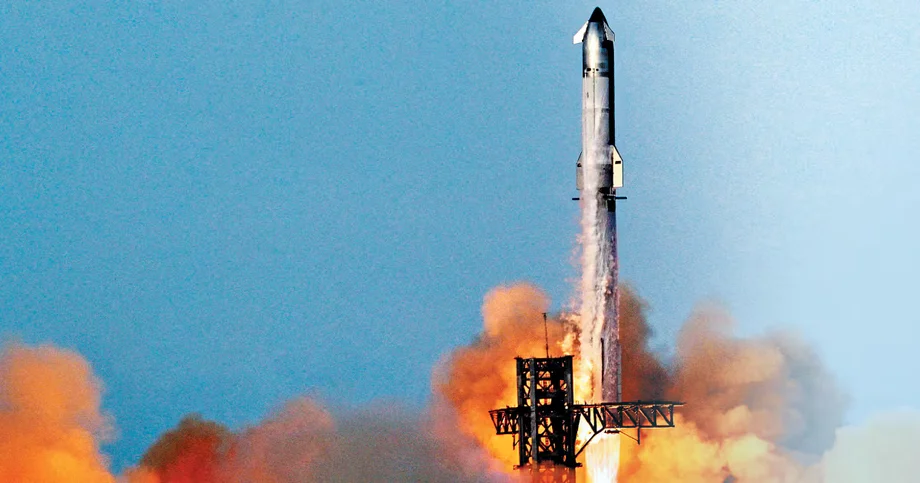
Other governments are working the same sums. SpaceX recovered the upper stage of Starship for the first time on Jan. 14, after 14 orbits over roughly 22 hours, catching it in the launch tower's arms; the booster was lost on that 15th test flight, so a fully reusable vehicle remains a work in progress. Chinese private firms including LandSpace are developing reusable rockets. Japan's ruling party space committee approved proposals on Nov. 24 for an early space agency and stronger range operations, part of a national goal of about 30 launches a year by the early 2030s. The European Space Agency's European Launcher Challenge has the agency buying launch services as a customer to build a market for private European rockets.
Against Japan's 30, Korea's target of more than 20 flights a year by the mid-2030s amounts to about two thirds of a neighbour's planned cadence. Interest is spreading beyond satellite launches, to drug research and materials work in microgravity and to cargo moved through space to distant points on Earth, which would put a premium on bringing hardware back safely.
What is still open
Yoon said in February 2025 that the agency needed to review whether Hanwha Aerospace, already a participant, and other contractors would stay on the next generation project after the switch to a reusable design, or whether it would be reopened to new bidders. The transport strategy endorsed by the working committee has no scheduled date for National Space Committee approval. Chollian-6 development starts in 2027, with launch set for 2033.
Park closed his talk with a question rather than a schedule, asking the audience what they would send if they had about 100 kilograms of room on a rocket. He also asked philosophers and lawyers to take an interest. A country that arrived late to space can learn from the leaders, he said, but finding uses they have not imagined takes imagination.
If you could send about 100 kg into space, what would be the best thing to send?" he said. "I hope you will imagine many new uses and new businesses in space.
Key Points
- KASA redesignated the next generation launch vehicle as a reusable system in 2025, with the first stage landing back on Earth.
- KARI and Hanwha Aerospace began final assembly of a 12.2 meter, 6.4 ton demonstrator in Suncheon in September, with a 500 meter vertical landing test set for 2028.
- A next generation vehicle test launch is planned for 2031, an attempt to recover an actual first stage in 2033, and reuse technology secured by 2035.
- Methane replaced kerosene because it leaves fewer carbon deposits and is easier to store than liquid hydrogen at minus 161 degrees Celsius.
- A 35 ton methane engine project worth about 49.1 billion won runs to 2030 under the Agency for Defense Development, with Hyundai Rotem and Korean Air as preferred negotiator.
- KASA's working committee approved a strategy on Nov. 24 for more than 20 launches a year by the mid-2030s, still awaiting National Space Committee approval.
- The first stage accounts for 60% to 70% of rocket manufacturing cost, and reuse could lift annual flights from two to about 10.
- Planned uses include the K-LEO satellite network by 2035, a lunar lander in 2032 and a Mars landing by 2045.