The Clock Stops at 11:50 pm
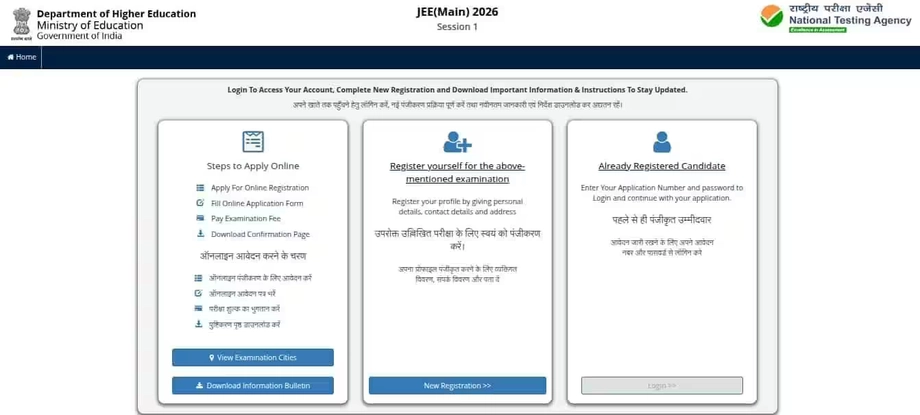
The National Testing Agency closes the late fee registration window for JEE Main 2027 Session 1 at 11:50 pm on Thursday, November 26, 2026. Candidates who have not finished their application can still file it on jeemain.nta.nic.in and complete the payment until that minute, after which the agency will stop accepting new applications for the January examination.
Contents
- The Clock Stops at 11:50 pm
- What the Final Rush Looks Like in Numbers
- How Much Each Candidate Pays, and Who Pays What
- What Changed in the Application Process This Year
- The Correction Window Opens Tomorrow
- Six January Dates and One Computer Based Test
- One Application, One Attempt
- How to Finish the Form Tonight
- What the Deadline Changes for Aspirants
- Key Points
The regular window closed on November 22. Anyone applying after that date had to add a late fee of Rs 500 on top of the examination fee. No further extension has been announced, and the next item on the agency calendar is the correction window, which opens on November 27 for candidates already registered.
Figures released on the final day show 15,84,014 application forms submitted and 14,06,780 candidates who had completed their fee payment. The difference of 1,77,234 is the group the deadline is really about. Their forms sit on the system, but their applications are not complete.
That gap matters because the National Testing Agency treats a saved form and a finished application as two different things. A candidate who has uploaded documents and filled in personal, academic and exam city details but has not paid is not registered for the test. The fee is the step that converts a draft into an application.
What the Final Rush Looks Like in Numbers
The counts moved quickly in the last week. On the evening of November 22, hours before the regular deadline, 15,04,866 forms had been submitted and 13,10,493 candidates had paid, leaving 1,94,373 applications unfinished. By November 25, the totals had reached 15,73,018 forms and 13,96,007 payments, with 1,77,011 still awaiting payment. On November 26, the paid figure stood at 14,06,780.
The steepest climb came in the six days before the regular deadline. On November 16, the agency reported 9,05,144 registrations and 7,04,316 completed payments. Between that day and November 22, the number of candidates who had paid rose by 6,06,177.
- November 16: 9,05,144 registrations, 7,04,316 payments completed
- November 22, 11:50 pm: regular window closes, 15,04,866 forms, 13,10,493 payments
- November 23: late fee of Rs 500 applies, extended window opens
- November 25: 15,73,018 forms, 13,96,007 payments, 1,77,011 awaiting payment
- November 26, 11:50 pm: late fee window closes, 15,84,014 forms, 14,06,780 payments
The pattern is familiar to anyone who has watched an online entrance exam cycle: a large share of applicants finish on the last possible day, and a smaller share never finish at all. For a single session of one examination, close to 16 lakh forms is a scale that pushes the agency to keep issuing reminders on social media rather than waiting for the deadline to pass quietly.
On November 22, the agency used its account on X to push candidates through the final steps before the regular window closed, naming both the form count and the payment count in the same message.
Reminder: Today is the Last Date for JEE (Main) 2027 Session-1 Registration without Late Fee! So far, 15,04,866 registration forms have been submitted, and 13,10,493 candidates have successfully completed the fee payment.
How Much Each Candidate Pays, and Who Pays What
The examination fee is set by category and, for some groups, by gender. General category candidates pay Rs 1,000. Male candidates in the General, Economically Weaker Section and Other Backward Classes groups pay Rs 900, while women in those same groups pay Rs 800. Candidates from the Scheduled Castes, Scheduled Tribes, transgender candidates and candidates with disabilities pay Rs 500.
- General category: Rs 1,000
- General, EWS and OBC male candidates: Rs 900
- General, EWS and OBC female candidates: Rs 800
- SC, ST, transgender and divyang candidates: Rs 500
- Late fee for applications filed between November 23 and November 26: Rs 500 extra
A general category candidate who missed the November 22 deadline therefore pays Rs 1,500 in total, while a candidate in the SC, ST, transgender or divyang group pays Rs 1,000. The late fee is flat, so it adds a fifth to half of the base fee depending on the category, which is why the agency kept repeating that the regular window was the cheaper option.
Payment is accepted online through the methods listed on the application page. The agency has said plainly that submitting a form without paying is not enough, a point worth repeating because roughly 1.77 lakh forms were still unpaid on the morning of the final day.
What Changed in the Application Process This Year
Login for JEE Main 2027 now runs through the Meri Pehchaan platform, and it is compulsory. Candidates sign in with DigiLocker, e-Pramaan or JanParichay credentials instead of a self created username and password. The change ties the application to a verified identity record, which the agency says reduces disputes later in the admission cycle.
The National Testing Agency has also asked candidates to complete Re-KYC through DigiLocker before starting the form, so that the latest personal details are pulled into the application automatically. Its advice on credentials is specific, because a login borrowed from a family member or an agent can create mismatches in identity and biometric records that surface only at the exam centre.
Candidates are advised to log in using their own DigiLocker/JanParichay/e-Pramaan (MeriPehchaan) credentials to avoid discrepancies in identity verification and biometric data at subsequent stages of the application process.
Non Resident Indian candidates have a separate route. Those without an Aadhaar card can register using a valid Indian passport. The agency has also issued guidance on which category to select, since citizenship and Aadhaar status are not the same thing.
Let's simplify which category to select for JEE (Main) 2027 registration. Make sure your application reflects the exact match for your citizenship and Aadhaar status.
Under that guidance, Indian citizens, including NRIs who hold an Aadhaar card, select Indian Nationals. Foreign citizens and Overseas Citizens of India cardholders select Foreign Nationals. NRIs holding an Indian passport but no Aadhaar select the NRIs Having No Aadhaar category.
The Correction Window Opens Tomorrow
Registered candidates get three days to fix mistakes. The correction window runs from November 27 to November 29, 2026, and closes at 11:50 pm on the final day. Only fields the agency has marked as editable can be changed during this period.
The window matters more than it sounds. Details such as the choice of paper, exam city preferences and category selections can affect where a candidate sits and how the merit list treats them. Candidates who paid on the final day will have roughly 24 hours to review their submitted form before the correction facility opens, which is why the agency advises downloading and checking the confirmation page immediately after payment.
No date has been announced for the release of admit cards or for the announcement of results. Candidates will find those on the same portal.
Six January Dates and One Computer Based Test
JEE Main 2027 Session 1 will be held on January 20, 21, 22, 23, 24 and 28, 2027. The examination is conducted in computer based test mode, meaning candidates answer on a screen at a designated centre rather than on paper. The gaps in the schedule allow the agency to run the test in multiple shifts across several days for a candidate pool of more than 15 lakh.
A separate application is needed for Session 2, which is scheduled from April 2 to April 7, 2027. Appearing in both sessions is allowed, and the rules say the best score from the two attempts is used when the final merit list is prepared. That makes Session 2 a second chance rather than a replacement attempt: a strong January performance is not wiped out by a weaker April one.
JEE Main is the gateway to undergraduate engineering programmes at the National Institutes of Technology, the Indian Institutes of Information Technology and other participating institutions. It also serves as the qualifying examination for JEE Advanced, which in turn governs admission to the Indian Institutes of Technology.
One Application, One Attempt
The agency has warned that filing more than one application does not buy a candidate extra attempts in the same session. In its notification, it said a candidate found appearing, or attempting to appear, with multiple application numbers will be treated as having used unfair means.
The warning addresses a specific temptation. Because the form allows candidates to choose exam cities and papers, some applicants have historically filed duplicate forms to widen their options. Under the 2027 rules, a single candidate is expected to hold a single application per session, and duplicate numbers can trigger action against the candidate rather than simply being merged.
Candidates who need help with the form can reach the agency at [email protected], on 011-40759000 or on the toll free number 1800-180-4747.
How to Finish the Form Tonight
The sequence for a fresh applicant is straightforward, though each step has to be completed in order. The portal will not accept a payment until the photograph, signature and documents have been uploaded and the academic details saved.
- Open jeemain.nta.nic.in and select the JEE Main 2027 Session 1 application link
- Choose New Registration if applying for the first time, or log in with the application number and password if already registered
- Sign in through Meri Pehchaan using DigiLocker, e-Pramaan or JanParichay credentials
- Enter personal details, mobile number and email address, then academic details and the choice of paper and exam cities
- Upload the photograph, signature and required documents in the specified format
- Pay the examination fee plus the Rs 500 late fee
- Submit the form and download the confirmation page
Candidates already part way through the process should check whether their payment shows as successful rather than assuming a saved form is an accepted one. The confirmation page is the proof of a completed application and should be kept until the admission season ends.
What the Deadline Changes for Aspirants
For the roughly 1.77 lakh candidates who had submitted but not paid by the final morning, the next few hours decide whether they sit the January examination at all. Missing the window means waiting for Session 2 in April, and paying a fresh fee for that application, because the two sessions are registered separately.
For the 14,06,780 who have completed payment, the immediate tasks are smaller but still dated. The correction window opens on November 27, the exam begins on January 20, and a second application is needed later if they want the April attempt. Each step sits on the same portal, and each has its own closing time of 11:50 pm.
The scale of the numbers also shapes how the agency runs the test. With close to 16 lakh forms for a single session, city allocation and shift planning become the practical constraints, which is why candidates are asked to select exam city preferences carefully and why the schedule spreads across six dates instead of one weekend.
Key Points
- Late fee registration for JEE Main 2027 Session 1 closes on November 26, 2026 at 11:50 pm on jeemain.nta.nic.in
- The regular window ended on November 22; applications filed after that date carry an extra Rs 500
- 15,84,014 forms submitted and 14,06,780 fee payments completed by the final day, leaving 1,77,234 applications unfinished
- Late fee window opened on November 23; on November 22 the counts were 15,04,866 forms and 13,10,493 payments
- Fee is Rs 1,000 for General, Rs 900 for General, EWS and OBC male candidates, Rs 800 for women in those groups and Rs 500 for SC, ST, transgender and divyang candidates
- Login through the Meri Pehchaan platform using DigiLocker, e-Pramaan or JanParichay is compulsory; NRIs without Aadhaar can use an Indian passport
- Correction window runs from November 27 to November 29, 2026, until 11:50 pm
- Session 1 exam dates are January 20, 21, 22, 23, 24 and 28, 2027 in computer based test mode
- Session 2 requires a separate application and is scheduled from April 2 to April 7, 2027; the best score of the two sessions counts for the merit list
- Multiple applications for the same session are treated as unfair means