A new policy builds on years of teacher reform
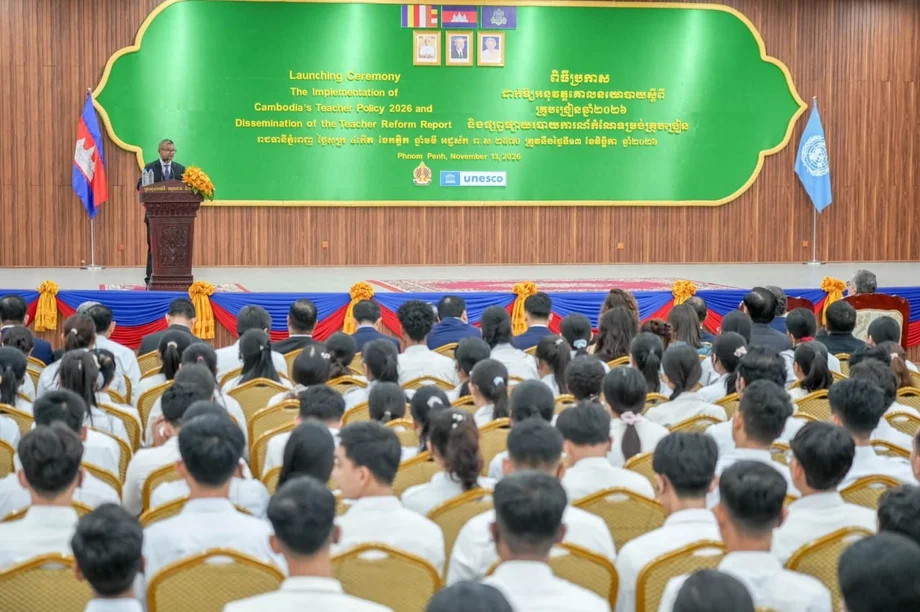
Cambodia's Ministry of Education, Youth and Sport announced the launch of its 2026 Teacher Policy on November 13, 2026, at the National Institute of Education, bringing teacher training, working conditions and career development into the next stage of the country's education reforms.
Contents
- A new policy builds on years of teacher reform
- How the 2013 policy reached a new stage
- Teachers at the centre of the changes
- What $27.02 million supports
- Training that continues throughout a career
- Reading, mathematics and better training facilities
- Planning where teachers are needed
- Digital records, inclusive teaching and AI
- Key Points
Deputy Prime Minister and Education Minister Hang Chuon Naron attended the event alongside UNESCO Director General Khaled El-Enany. The ministry also presented a report on Cambodia's teacher reform journey, connecting the new policy with work already undertaken in training institutions and classrooms.
The launch follows a policy revision process begun in July 2025 and years of cooperation through the Strengthening Teacher Education Programmes in Cambodia, known as STEPCam. Financed by the Global Partnership for Education, the programme has a combined investment of $27.02 million across two phases.
UNESCO's figures give a concrete picture of that earlier work: more than 4,000 teachers received training in early reading, nearly 3,000 received mathematics training, and more than 230,000 students benefited. Eleven provincial teacher training centres received improvements to buildings, equipment and learning facilities.
For teachers, the policy's central concerns reach beyond initial qualifications. Hang Chuon Naron described continuing efforts to improve salaries and working conditions, strengthen professional skills and connect further training with career advancement. For children, the practical aim is better teaching, beginning with the reading and mathematics skills needed for later learning.
The launch announcement gives the policy's broad direction, but does not specify new salary amounts, licensing rules, recruitment targets or implementation deadlines. Those details will determine how its commitments translate into changes for individual teachers and schools.
How the 2013 policy reached a new stage
The Ministry of Education and UNESCO formally began revising Cambodia's 2013 Teacher Policy at a consultation on July 18 and 19, 2025, at the Takeo Regional Teacher Training Centre. Ministry officials, development partners, education specialists, school leaders, teacher educators and classroom teachers participated.
UNESCO's policy revision account describes two connected tasks: updating the national policy and developing a teacher workforce projection model. The first concerns how teachers enter, develop within and are supported by their profession. The second helps planners calculate how many teachers schools will need and where they should work.
The sequence places the 2026 launch within a longer programme of reform:
- 2013: Cambodia published the Teacher Policy that became the basis for the revision.
- 2018 to 2022: STEPCam Phase I supported teacher education, professional development and early learning.
- 2024: STEPCam Phase II began, alongside a reform agenda that includes the Teacher Policy Action Plan 2024-2030 and Strategic Plan for Teacher Education Reform 2024-2030.
- July 18 and 19, 2025: The ministry and UNESCO launched the policy revision and workforce planning process in Takeo.
- November 13, 2026: The ministry announced the 2026 Teacher Policy and presented the teacher reform report.
The 2025 consultation addressed recruitment, career pathways, licensing, working conditions, deployment to underserved areas, inclusive teaching and ethical technology use. These were priorities for the revision process; the launch announcement describes the completed policy more broadly in terms of quality, fairness, effectiveness and lasting professional development.
Teachers at the centre of the changes
Hang Chuon Naron linked teacher reform with the quality of education, describing teachers as central to building Cambodia's skills and future workforce. At the launch, he thanked UNESCO for decades of support and welcomed El-Enany's participation as a sign of continuing cooperation.
Esther Mcfarlane, chief of education at UNESCO's Phnom Penh office, expressed the reasoning behind that approach during the July 2025 consultation:
Teachers are the heartbeat of every education system. No education reform can succeed without placing teachers at the centre.
The reform programme connects preparation before entering a classroom with support throughout a teaching career. A teacher may need stronger subject knowledge at the start, help with a difficult classroom situation later, and further qualifications to take on a new role. Cambodia's approach seeks to connect those stages through a national system rather than leave them as separate training activities.
What $27.02 million supports
STEPCam Phase I operated from 2018 to 2022 with a $14.4 million grant from the Global Partnership for Education. Phase II began in 2024 with a $12.62 million budget through the partnership's System Transformation Grant, for implementation over more than three years.
Phase II accounts for about 47 percent of the combined $27.02 million investment, calculated from the two published budgets. The funding supports a programme covering institutions, teacher development, classroom practice and technology, alongside the policy work.
UNESCO's STEPCam programme overview sets out four components for the second phase:
- Teacher education: improving preparation before teachers enter the profession and strengthening training institutions.
- Teacher professional development: matching teachers' learning needs with suitable opportunities to improve their skills.
- Classroom learning: helping teachers build children's basic skills during the early grades.
- Digital transformation: preparing teachers and teacher educators to use technology effectively and ethically.
The connection between these components matters in everyday practice. A training centre can prepare a teacher, continuing education can help that teacher improve, and classroom mentoring can support the use of new methods with children. Equipment and digital systems provide another part of that support.
Training that continues throughout a career
STEPCam's first phase established a national continuous professional development system with the capacity to serve more than 130,000 teachers and education staff. Continuous professional development, often shortened to CPD, means organised learning after someone has entered the profession.
The figure describes the system's capacity. UNESCO separately identifies completed training and qualification achievements: 67 teacher educators upgraded their qualifications through a new Bachelor of Education programme, while 465 improved their skills in teaching focused on learners and the use of information and communications technology.
The programme also developed Cambodia's first Master of Education programme in Primary Education. Together, these activities address both classroom teachers and the educators responsible for preparing them.
Hang Chuon Naron's launch remarks connected continuing development with career progression and the standing of teachers in society. That gives professional learning a role beyond improving a single lesson: it becomes part of how teachers build their careers and receive recognition for their skills.
Reading, mathematics and better training facilities
More than 4,000 teachers received training in early reading under STEPCam Phase I, using materials centred on children and learning through play. Nearly 3,000 teachers received training in early mathematics. UNESCO says these activities benefited more than 230,000 students.
Early reading and mathematics are the practical foundation of later schooling. A child needs to understand written instructions before tackling many other subjects, while basic number skills support more advanced calculations. The programme's combination of training and mentoring aims to help teachers develop those abilities during the first years of school.
Eleven Provincial Teacher Training Centres received infrastructure and facility upgrades, including Wi-Fi systems, libraries, computers and science laboratories. UNESCO says the improvements benefit more than 240 teacher educators and nearly 1,300 primary school teachers annually.
The facilities and training address different needs. Libraries and laboratories give future teachers resources for learning and practice. Teacher educators need the knowledge and teaching skills to make those resources useful. The programme therefore combines investment in places and equipment with investment in the people who teach there.
Planning where teachers are needed
Cambodia's teacher workforce projection model is intended to help the ministry plan recruitment, management and deployment using education data. A projection model estimates future needs so officials can make staffing decisions before shortages develop.
Nath Bunroeun, secretary of state at the Ministry of Education, used his closing remarks at the July 2025 workshop to call for precise answers grounded in evidence. He connected workforce planning with raising upper secondary completion, improving pupil to teacher ratios and supporting the government's education reforms.
The pupil to teacher ratio compares the number of students with the number of teachers. For planners, it helps show the relationship between staffing and enrolment. The revision process also gave specific attention to sending teachers to underserved areas, bringing location into decisions about staffing needs.
UNESCO's International Institute for Educational Planning and regional offices are providing technical expertise. Cambodia's broader development ambitions, reaching upper middle income status by 2030 and high income status by 2050, form part of the government's reasoning for investing in education and workforce skills.
Digital records, inclusive teaching and AI
STEPCam Phase I upgraded the Human Resource Management Information System, which manages profiles for more than 130,000 education staff. A separate Student Tracking System contains nearly 34,000 student records for monitoring learning outcomes.
The staff system organises information about the education workforce, while the student system follows information about learners. Both support administration and planning, complementing the work on future teacher needs. Their figures describe different groups and functions.
Information and communications technology, or ICT, also features in teacher preparation. At the 2026 launch, Hang Chuon Naron said cooperation with UNESCO had contributed to incorporating ICT and artificial intelligence skills into teacher education, responding to technological change and future educational needs.
The 2025 revision agenda paired technology with ethical use and inclusive teaching. Inclusive teaching means adapting instruction so children with different abilities and needs can participate. In the reform programme, teachers are expected to develop skills in using digital tools while keeping attention on the children they teach.
Phase II carries that work into both teacher education and classroom practice. Its digital component sits alongside professional learning and early grade teaching, keeping technology connected to the wider effort to improve learning.
Key Points
- Cambodia announced its 2026 Teacher Policy on November 13, 2026, at the National Institute of Education.
- The launch followed a revision of the 2013 policy begun with UNESCO in July 2025.
- STEPCam has a combined investment of $27.02 million across two phases financed by the Global Partnership for Education.
- Phase I training in early reading and mathematics benefited more than 230,000 students, according to UNESCO.
- The reform programme connects teacher preparation, continuing professional development, working conditions and career advancement.
- A teacher workforce projection model is being developed to support staffing and deployment decisions.