A Hanoi hospital counts two decades of transplants
On 25 November 2026 the National Institute of Hematology and Blood Transfusion, a specialist hospital in Hanoi, held a ceremony marking 20 years since its first hematopoietic stem cell transplant. By October 2026 the institute had performed 800 such transplants: 377 using the patient's own cells and 423 using cells from a donor, including 150 from donors who matched only half of the patient's tissue markers.
Contents
- A Hanoi hospital counts two decades of transplants
- From one myeloma patient to a national referral centre
- Why HLA matching decides who can be treated
- Half matched donors widen the door
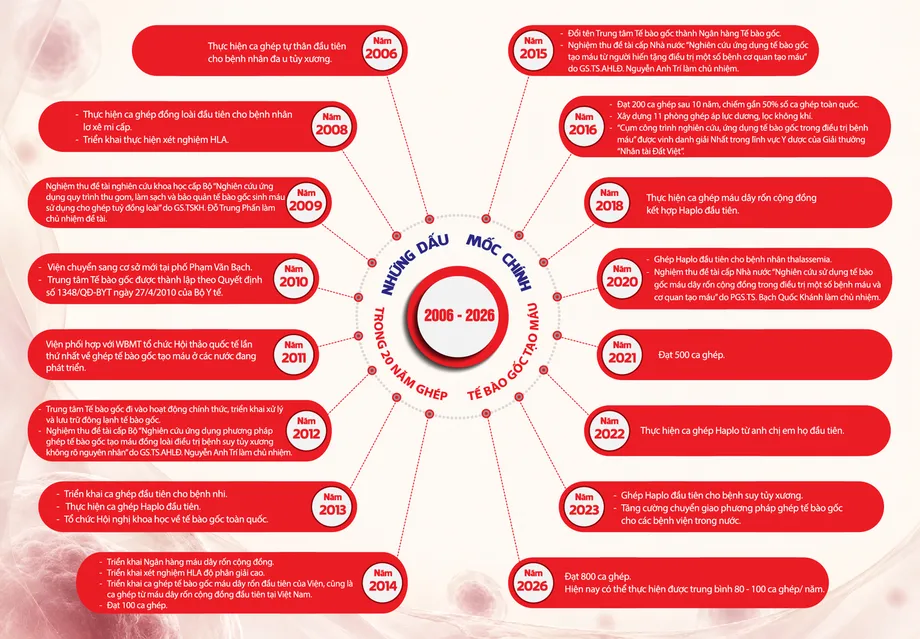
- The programme, milestone by milestone
- What survival looks like now
- A patient who was told she might not see 20
- Costs that keep patients in Vietnam
- From transplants to engineered cells
- What the Ministry of Health wants next
- Key Points
A hematopoietic stem cell transplant replaces a damaged blood factory with healthy starter cells. Doctors collect stem cells either from the patient before very high doses of chemotherapy (an autologous transplant) or from a donor (an allogeneic transplant), freeze and store them, then infuse them after treatment to rebuild red cells, white cells and platelets. The technique is used against blood cancers such as leukemia, lymphoma and multiple myeloma, and against non-cancerous blood disorders including thalassemia and aplastic anaemia.
The numbers trace a clear acceleration. In its first decade the institute, known by its initials NIHBT, performed 200 transplants. The second decade added 600. The programme now runs at about 80 transplants a year, with capacity for 80 to 100, as set out in its timeline of milestones. That makes it one of the busiest stem cell transplant centres in the country.
Dr Nguyen Ha Thanh, the institute's director, described the programme as one of its proudest professional achievements in more than 40 years of work, and said the procedure had moved from a difficult experiment to standard care.
Since the first autologous transplant in 2006 and the first allogeneic transplant in 2008, hematopoietic stem cell transplantation has gradually overcome initial challenges, mastered numerous specialised techniques and evolved into a routine treatment, offering a chance at life to many patients.
From one myeloma patient to a national referral centre
The first transplant took place in November 2006, when Associate Professor Dr Bach Quoc Khanh and the institute's medical team treated a patient with multiple myeloma, a cancer of the plasma cells in the bone marrow. Resources were thin at the time: the team had to build its own staff, study protocols and absorb know how from abroad.
In May 2008 the institute carried out its first allogeneic transplant, using stem cells from a sibling whose HLA markers matched the patient completely. The recipient was a patient with acute leukemia. That same year the institute began running HLA tests, the laboratory work that decides whether a donor and a patient are compatible, and in 2009 it completed a ministry level research project on collecting, cleaning and preserving blood stem cells for matched sibling transplants, led by Professor Do Trung Phan.
Two structural steps followed. In 2010 the institute moved to new premises on Pham Van Bach street and the Ministry of Health created its Stem Cell Centre under Decision 1348/QD-BYT of 27 April 2010. The centre began full operation in 2012, processing and cryopreserving stem cells, the process of cooling them to very low temperatures so they can be stored for years.
Children entered the programme in 2013, the year of the first transplant for a young patient and the first haploidentical transplant, in which a relative who shares only half of the patient's HLA markers serves as donor. In 2016 the institute built 11 positive pressure rooms with filtered air, the sealed spaces where transplant patients live while their immune defences are close to zero.
Why HLA matching decides who can be treated
HLA, short for human leukocyte antigen, is a set of proteins on the surface of cells that the immune system uses to recognise what belongs in the body. A donor whose HLA profile is too different invites a dangerous reaction in both directions: the new immune cells can attack the patient, and the patient's body can reject the graft.
For years the standard was a fully matched sibling, a donor available to only about one patient in four. The institute's answer was to build a public bank of umbilical cord blood, a source that is more forgiving of mismatch because the immune cells in cord blood are immature. It drew on international practice, especially from Japan, and in April 2014 began collecting donated cord blood with Hanoi Obstetrics and Gynecology Hospital, where mothers give the blood left in the placenta and umbilical cord after birth.
In late 2014 and early 2015 the institute performed the first transplant in Vietnam using a unit from a public cord blood bank. The patient, Hoang Thi Thuy Linh, was reported to be in stable health and living a normal life almost 12 years later. The same year brought high resolution HLA testing, the 100th transplant, and a new name for the cell centre, which became the Stem Cell Bank in 2015.
The bank now holds more than 7,000 stem cell units, nearly 4,000 of them from public cord blood donations. Fifty five of those public cord blood units have been used for transplants at the institute, and the bank also coordinates cells for treatment at other hospitals.
Half matched donors widen the door
The haploidentical technique, which needs only a 50 per cent HLA match, allows parents, children, siblings and even cousins to donate. According to the institute, it raises the likelihood of finding a usable donor to between 90 and 100 per cent for patients with a transplant indication, removing one of the largest barriers families face.
Each extension of the technique came with a first case. In 2018 the institute combined a public cord blood unit with a haploidentical donor in one patient. In 2020 it performed its first haploidentical transplant for a patient with thalassemia, an inherited disorder in which the body makes faulty haemoglobin, and completed a state level research project on using public cord blood for blood and blood forming organ diseases, led by Associate Professor Dr Bach Quoc Khanh. A first cousin donor was used in 2022, and a first haploidentical transplant for aplastic anaemia, a condition where the bone marrow stops producing enough blood cells, followed in 2023.
The institute has also carried out cord blood transplants from related and unrelated donors, transplants that combine several stem cell sources, and CD34+ selected transplants, in which laboratory sorting isolates the specific stem cells that rebuild the blood system. Its stem cell and transplant laboratory network has been standardised against international benchmarks.
The programme, milestone by milestone
- 2006: first autologous transplant, for a patient with multiple myeloma.
- 2008: first allogeneic transplant from a fully matched sibling, for a patient with acute leukemia; HLA testing introduced.
- 2010: move to Pham Van Bach street; Stem Cell Centre established on 27 April under Decision 1348/QD-BYT.
- 2012: centre fully operational, with cell processing and frozen storage.
- 2013: first transplant for a child; first haploidentical transplant.
- 2014: public cord blood bank launched with Hanoi Obstetrics and Gynecology Hospital; first cord blood transplant; 100th case.
- 2016: 200th transplant after 10 years, nearly half of all transplants then done in Vietnam; 11 filtered air transplant rooms opened.
- 2018: first combined public cord blood and haploidentical transplant.
- 2020: first haploidentical transplant for thalassemia.
- 2021: 500th transplant.
- 2022: first haploidentical transplant from a cousin.
- 2023: first haploidentical transplant for aplastic anaemia; technique transfer to other hospitals stepped up.
- 2026: 800th transplant reached.
What survival looks like now
Deaths linked to allogeneic transplants have fallen below 5 per cent at the institute. For patients with malignant blood disease who received donor cells, about 70 per cent were alive and free of disease progression five years after the transplant. For patients with non-cancerous blood disorders, overall survival five years after transplant reached about 80 to 90 per cent.
Dr Khanh, who now chairs the Vietnam Hematology and Blood Transfusion Association, put the gains in context by comparing the procedure with chemotherapy alone. He said standard chemotherapy leaves roughly 20 to 30 per cent of patients with malignant blood disease alive beyond five years, while transplantation lifts that share to 50 to 60 per cent.
Standard chemotherapy for malignant blood disease leaves only about 20 to 30 per cent of patients alive after five years, while stem cell transplantation raises that to 50 to 60 per cent, doubling the chance of survival. Stem cell transplantation is therefore the only important lifeline for patients whose disease has relapsed or does not respond to standard chemotherapy.
He also explained why blood cancer is harder to cut out than a solid tumour. A breast or thyroid tumour can be removed by surgery or treated with radiation, he said, while blood cancer behaves like contaminated groundwater, with malignant cells circulating and hiding throughout the body. The transplant itself does not attack the cancer directly. Its job is to rescue the marrow after chemotherapy at the maximum dose, and it lowers the risk that the disease returns.
Drug treatment has moved at the same time. New generations of targeted drugs, which block the specific molecules that drive a cancer cell, have stretched average survival for multiple myeloma to about 10 years, from roughly 3 years in the early years of autologous transplantation and 5 years with the first generation of such drugs. The age limit for transplantation has also been pushed back, and the institute has transplanted a patient aged 60, drawing on stem cells from cord blood and from circulating blood as well as marrow.
A patient who was told she might not see 20
Duong Thi Chien, from Ha Tinh province, was diagnosed with blood cancer in 2007, at the start of her 10th school year. Her family first hid the diagnosis, and she learned of it by overhearing a phone call from her father. She later described the moment.
The tears just kept falling and I fell apart. I was only 15, and all my dreams, my youth, everything seemed to vanish.
For seven years she took Glivec, one of the best targeted drugs available at the time for chronic blood cancer, while travelling to Hanoi for treatment through storms and flooded roads. Her response weakened over time, and in 2014 her doctors proposed a transplant. Her elder brother turned out to be a full HLA match.
The transplant ran for about two and a half months from June 2014. Chien fell from 40 kilograms to 33.5, lost her hair and swelled up. She vomited repeatedly, at one point blood, could not eat for nearly a month and lived on intravenous nutrition. She kept talking herself through it.
Keep going, keep going, your hair will grow back and you will be pretty again. It is fine, as long as I get better.
Her blood counts began to rise 17 days after the cells were infused, a sign that the graft was taking hold. A genetic test then still showed cancer, and a repeat test six months after the transplant came back negative. Chien no longer needs treatment for the disease, has expanded a small business selling textbooks, school supplies and air tickets, and married in early 2021, with fellow transplant patients among her guests.
Costs that keep patients in Vietnam
The institute says the cost of a transplant there is significantly lower than in many countries in the region, though it did not publish a figure. That price difference has changed decisions: patients who had planned to be treated abroad have chosen to have the procedure in Hanoi instead, easing the financial burden on their families.
Keeping advanced treatment inside the country also limits how many patients have to travel for care, and the institute has been transferring transplant techniques to other eligible hospitals so that patients outside Hanoi can be treated closer to home.
Dr Nguyen Ngo Quang, director of the Ministry of Health's Department of Science, Technology and Training, said the procedure demands coordinated work across several fields at once, from clinical hematology and immunology to laboratory testing, cell processing and storage, infection control, intensive care and general nursing.
Hematopoietic stem cell transplantation is a highly specialised technique that requires synchronous coordination across many fields such as clinical hematology, immunology, testing, cell processing and preservation, infection control, resuscitation and comprehensive care.
From transplants to engineered cells
The next step the institute is preparing is CAR-T therapy, in which a patient's own T cells, a type of white blood cell, are genetically modified so they can recognise and kill cancer cells after being returned to the body. Unlike a transplant, which rebuilds the blood system, CAR-T cells hunt the cancer directly.
Dr Khanh said the institute and the Blood Transfusion Hematology Hospital in Ho Chi Minh City are preparing to introduce CAR-T through a technology transfer agreement with the United States National Institutes of Health for manual production of the treatment.
The policy backdrop is a government decision that lists cell therapies, including stem cells and immune cells, among 30 strategic technology products under Decision 21/2026/QD-TTg of the Prime Minister. The institute has said its relatively complete transplant infrastructure gives it a base to host CAR-T work and to act as a centre that supports, trains and transfers cell therapies across Vietnam.
What the Ministry of Health wants next
Deputy Minister of Health Dao Xuan Co used a national scientific conference on hematology and blood transfusion, held at the institute on 26 and 27 November 2026, to set out expectations for the field. The meeting drew nearly 1,700 delegates and 10 international experts from the United States, Australia, Britain, Germany, Denmark and Singapore, and featured more than 100 scientific reports across four plenary sessions, 13 thematic sessions and two sessions for young researchers, alongside 31 exhibition booths and four satellite workshops.
He framed the choice facing Vietnamese medicine as one between importing technology and mastering it.
We are standing before a new stage in the development of world medicine. Precision medicine, gene technology, cell therapy, artificial intelligence and data science are gradually changing the way patients are diagnosed, treated and managed. The question is how we will take part in that process: only receiving the achievements of the world, or gradually becoming masters of technology, able to research, create and contribute knowledge to international medicine? We need to choose the second path.
He pointed to Resolution 57-NQ/TW of the Politburo on breakthroughs in science, technology, innovation and national digital transformation, and Resolution 72-NQ/TW on measures to strengthen protection and care of people's health, as setting new requirements for the health sector. He asked the specialty to invest in molecular biology, genetics, immunology, stem cell transplantation and targeted treatment, and to study the epidemiology, genetic traits and treatment responses of Vietnamese patients so that diagnosis and treatment strategies fit local reality.
His list for the institute and its peers also included a shared national data system for hematology and blood transfusion, a modern and secure national blood supply, and training that narrows the gap in expertise between regions. For the institute itself, the ministry's direction is to keep research, quality and patient safety at the centre, to strengthen the stem cell bank in collection, processing, storage and coordination of cells, and to expand cooperation at home and abroad on the basis of voluntary donation and legal rules. It has also promised to review policies on equipment, medical supplies and essential drug procurement.
Dr Thanh said the institute will keep patients at the centre of its work, with quality and safety as the foundation, and will focus on research, long term follow up after transplant, growth of its stem cell sources, training of a successor generation and wider international cooperation.
Key Points
- The National Institute of Hematology and Blood Transfusion marked 20 years of hematopoietic stem cell transplantation on 25 November 2026.
- It had performed 800 transplants by October 2026: 377 autologous and 423 allogeneic, including 150 haploidentical cases.
- The first decade produced 200 transplants; the second added 600. The programme now handles about 80 cases a year.
- The first transplant was an autologous procedure in November 2006 for multiple myeloma; the first allogeneic transplant, from a fully matched sibling, followed in May 2008.
- Its Stem Cell Bank holds more than 7,000 units, nearly 4,000 of them public cord blood, and 55 public cord blood units have been used for transplants there.
- Half matched donors are available to 90 to 100 per cent of patients with a transplant indication, according to the institute.
- Deaths linked to allogeneic transplants are now below 5 per cent; about 70 per cent of patients with malignant disease are progression free at five years, and 80 to 90 per cent of those with benign disease are alive at five years.
- The institute says its transplant costs are well below those in many regional countries, without giving a figure.
- It is preparing CAR-T therapy through a technology transfer agreement with the United States National Institutes of Health, working with the Blood Transfusion Hematology Hospital in Ho Chi Minh City.
- Cell therapies are listed among 30 strategic technology products under Decision 21/2026/QD-TTg.