A Legal Clash Over Design Rights in Europe
Jaguar Land Rover secured a notable victory on November 20, 2026, when the District Court of The Hague issued an interim ruling barring Chinese automaker BYD from selling its Ti7 SUV within the European Union. The legal dispute centers on allegations that the plug-in hybrid vehicle infringes registered design protections for the Land Rover Defender type L663. While many traditional automotive manufacturers have long expressed frustration regarding design similarities between Western vehicles and newer entrants from China, such disputes rarely make it to a courtroom. The decision sets a precedent for how European intellectual property laws apply to imported vehicles featuring boxy 4x4 aesthetics.
Contents
- A Legal Clash Over Design Rights in Europe
- Analyzing the Visual Parallels and Court Findings
- The Scope of the European Sales and Manufacturing Ban
- Broader Market Context and Concurrent Legal Battles
- The Official Response and Planned Legal Appeals
- Chronology of Key Legal and Commercial Developments
- At a Glance
The Ti7, marketed as the Tai 7 in China where it launched in September 2025, has achieved substantial commercial scale with cumulative global sales surpassing 300,000 units by October 2026. BYD also introduced a battery-electric version of the vehicle in April 2026 and expanded sales to Uzbekistan in October. Despite its overseas popularity, the model had not yet launched in the European Union. BYD representatives informed the Dutch court that the company held no immediate, concrete plans to distribute the vehicle within EU member states. However, the presiding judge concluded that an injunction remained necessary because the company declined to provide binding commitments to stay out of the European market permanently.
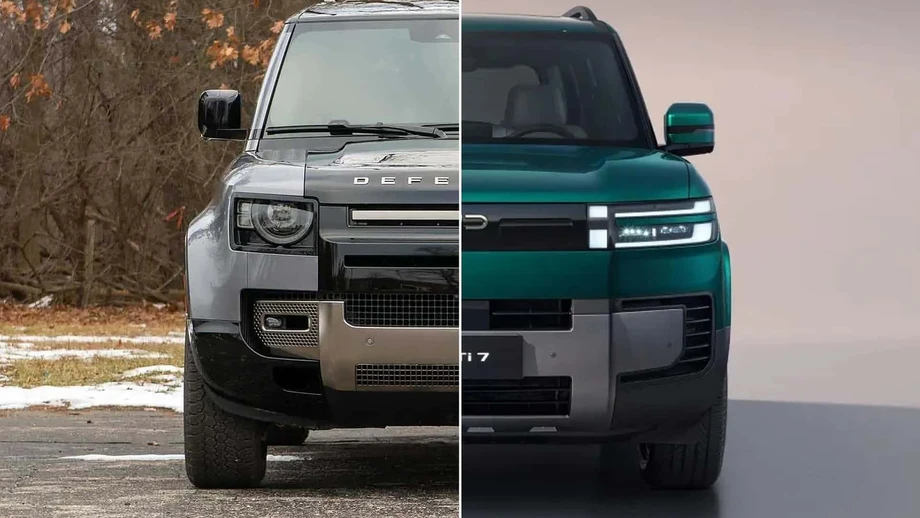
The preliminary relief judge determined that the visual similarities between the two sport utility vehicles were too significant to ignore. During the proceedings, BYD legal counsel argued that the Ti7 possessed distinct styling cues intended to differentiate it from competing models. Attorneys pointed to modifications in the front grille, headlight assemblies, bumper layout, hood contours, side windows, and wheel arches. The court rejected this defense, concluding that these individual alterations failed to alter the overriding visual impression created by the vehicle as a whole.
Analyzing the Visual Parallels and Court Findings
The judicial assessment relied heavily on a registered European Union design that Jaguar Land Rover secured in 2018, one year prior to the public debut of the current-generation Defender. By basing the lawsuit on this earlier registration rather than the final production vehicle, the British carmaker established a protected legal baseline. The court identified several specific elements that defined the protected appearance of the Land Rover Defender, noting that the Ti7 closely replicated these exact stylistic choices.
The ruling highlighted the vehicle proportions, the continuous glasshouse surrounding the cabin, the signature panel integrated behind the rear passenger doors, and the rounded shapes of the wheel arches. The judge also pointed to the rounded shoulders and corners of the bodywork alongside the upright stance and flat roofline. Together, these characteristics formed a recognizable silhouette that the court found the BYD Ti7 had unlawfully emulated. Motoring publications, including the BBC program Top Gear, previously described the vehicle as a Chinese Defender clone, while social media commentators labeled it a lookalike.
Jaguar Land Rover views the Defender as a crucial commercial pillar. The model line serves as the company best-selling vehicle worldwide, recording global sales exceeding 100,000 units in 2025. In the UK market specifically, retail sales reached 29,500 units between July and September 2026, representing a year-on-year increase of more than 4,000 vehicles. Driven by this sustained global demand, the company also initiated local assembly operations for the Defender 110 in India.
The Scope of the European Sales and Manufacturing Ban
The injunction issued by the Dutch court applies broadly across all member states of the European Union. The prohibition covers importing, manufacturing, offering for sale, selling, storing, delivering, and otherwise commercializing the Ti7 model. BYD subsidiaries operating within the EU face strict compliance obligations starting one week after formal service of the judgment. The restriction also impacts industrial plans, legally barring BYD from producing the SUV at its newly constructed manufacturing facility located in Szeged, Hungary, which was scheduled to commence mass production around the end of 2026 or early 2027.
To ensure compliance, the court established significant financial penalties for any violations. Companies found in breach of the injunction face a daily fine of 100,000 euros for every day or partial day that the violation continues. Alternatively, Jaguar Land Rover holds the option to request a penalty of 25,000 euros per individual infringement. The court capped the total cumulative financial penalties at 10 million euros. Legal experts note that this cap represents a maximum limit rather than an indication of damages currently owed by the manufacturer.
The restriction, however, excludes the United Kingdom. The Dutch court declared itself lacking legal jurisdiction over BYD entities operating in Britain. This jurisdictional boundary leaves UK commercial plans entirely unaffected by the ruling. BYD previously opened pre-orders for the seven-seat Ti7 on its British website in July, attaching a starting price of 47,995 pounds. This price point undercuts the starting price of the British-built Defender, which begins at just under 72,000 pounds, by more than 22,000 pounds. Customer deliveries in the UK remain scheduled to begin in January 2027.
Broader Market Context and Concurrent Legal Battles
The influx of affordable sport utility vehicles bearing striking similarities to established Western luxury models has accelerated across European markets. Chery, another major Chinese automotive manufacturer, achieved substantial commercial success with the Jaecoo 7. That compact SUV outperformed its nearest competitor in the UK market by a wide margin after recording over 10,000 purchases. Industry reviewers also noted strong visual parallels between the larger Jaecoo 8 and high-end British luxury vehicles following the commencement of British deliveries in July.
This legal confrontation follows a previous intellectual property victory for Jaguar Land Rover. In 2019, the British manufacturer successfully concluded a three-year court battle against Jiangling Motors Corporation, stopping the sale of a local vehicle that mirrored the Range Rover Evoque. Intellectual property litigation involving automotive design rights in Europe remains relatively uncommon, making the ongoing dispute between the British marque and BYD a significant test case for the industry.
The legal relationship between the two companies involves multiple separate proceedings spanning different Dutch courts. In an earlier separate ruling handled by the same court in The Hague, judges addressed evidence seizure procedures conducted at BYD offices in August. Jaguar Land Rover had previously obtained authorization to seize digital and physical records to investigate whether the Chinese firm reverse-engineered Defender technology. BYD successfully challenged those measures, arguing that the raids constituted an unauthorized fishing expedition.
The court agreed with BYD regarding the evidence handling, ruling that the seized documents were unnecessary for the design infringement claim and ordering Jaguar Land Rover to ensure the seized files were destroyed. The court also barred the British carmaker from enforcing an earlier demand for 500,000 euros in cooperation penalties and ordered Jaguar Land Rover to pay 25,376 euros in procedural costs following a corrected judgment on November 12. Despite that setback regarding evidence collection, the separate November 20 injunction concerning EU design rights remains fully active.
The Official Response and Planned Legal Appeals
Corporate representatives for BYD expressed strong disagreement with the judicial outcome and confirmed intentions to pursue formal appeals. The company maintains that the contested vehicle is the result of original engineering work rather than imitation. In an official corporate statement, a company spokesperson emphasized the independence of their design process:
The BYD Ti 7 is the result of BYD's own independent design work and infringes none of JLR's rights. We will pursue every legal avenue to demonstrate that this decision is incorrect.
Jaguar Land Rover adopted a more measured stance following the release of the judgment, emphasizing its commitment to safeguarding proprietary assets. In a brief statement provided after the ruling, company representatives reiterated their legal strategy:
We protect our intellectual property and take legal action when necessary. Legal proceedings are ongoing and we won't be commenting further at this time.
The preliminary nature of the injunction means the litigation will continue to evolve over the coming months. Under the rules governing summary proceedings in the Netherlands, Jaguar Land Rover must initiate substantive main proceedings within a six-month window. Failure to launch a full trial within this timeframe could cause the interim sales ban to lapse.
Chronology of Key Legal and Commercial Developments
- 2018: Jaguar Land Rover registers the exterior design of the Defender within the European Union.
- September 2019: Jaguar Land Rover officially introduces the Defender 110 to international markets.
- September 2025: BYD launches the Ti7 SUV, known locally as the Tai 7, in China as a plug-in hybrid.
- July 2026: BYD opens pre-order books for the Ti7 on its UK website with an announced starting price of 47,995 pounds.
- August 2026: Bailiffs acting for Jaguar Land Rover seize digital records from BYD offices in the Netherlands.
- November 11 and 12, 2026: The District Court of The Hague orders the destruction of seized records and costs against Jaguar Land Rover.
- November 20, 2026: The District Court of The Hague issues an interim EU-wide sales ban on the Ti7 backed by a 10 million euro penalty cap.
- November 25, 2026: An oral hearing is scheduled at the Rotterdam District Court regarding separate copyright and unfair imitation claims.
- January 2027: Customer deliveries of the Ti7 are scheduled to begin in the United Kingdom.
At a Glance
- The District Court of The Hague issued a preliminary injunction on November 20, 2026, prohibiting BYD from commercializing the Ti7 SUV across the European Union.
- The court ruled that the Ti7 infringes an EU design registration for the Land Rover Defender dating back to 2018.
- The sales ban excludes the United Kingdom because the Dutch court lacked jurisdictional authority over BYD UK, where customer deliveries remain scheduled for January 2027.
- Violations of the EU injunction carry daily penalties of 100,000 euros, capped at a total limit of 10 million euros.
- Jaguar Land Rover must initiate formal main proceedings within six months to prevent the interim injunction from expiring.