Unlocking a Piece of History
Hiroshima Prefecture is offering a rare piece of tangible history to the public by giving away approximately 1,000 roof tiles salvaged from a massive military building that survived the atomic bombing of 1945. The structure, known as the former Hiroshima Army Clothing Depot, stands as one of the largest concrete and brick structures to endure the catastrophic blast without collapsing entirely. Local officials announced the giveaway on November 17, 2026, after safety checks and earthquake resistance work forced a major overhaul of the building's roof. This initiative gives individuals and groups a chance to own a certified relic of the past, provided they agree to strict rules regarding its future use. Long before these tiles became historical artifacts, the depot served a crucial role in military logistics and later as a desperate sanctuary for the injured.
Contents
The Legacy of the Clothing Depot
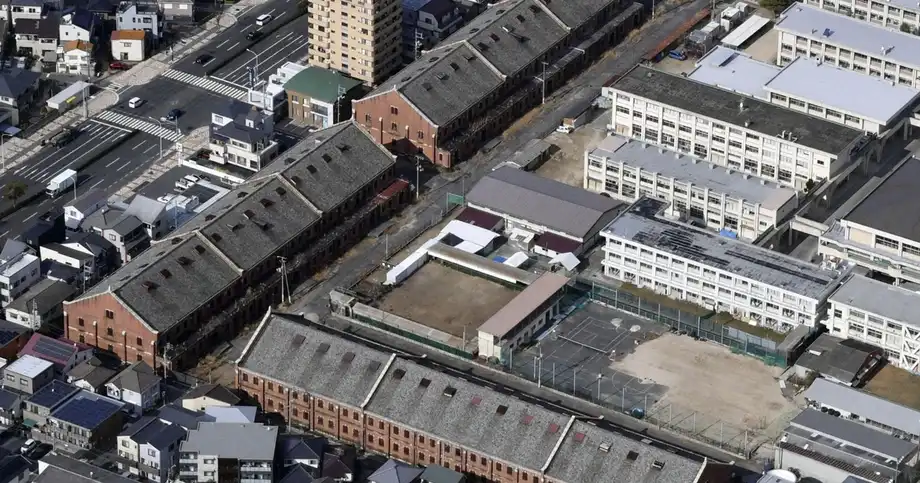
Construction of the sprawling military facility was completed in April 1914 in the Minami Ward of Hiroshima, operating under the Imperial Japanese Army to manufacture and store military uniforms and boots. The complex consists of four large buildings arranged in an L shape, with three structures owned by Hiroshima Prefecture and a fourth managed by the Chugoku Local Finance Bureau of the Finance Ministry, according to the official 旧広島陸軍被服支廠 documentation published by the prefectural government. Each of the three prefecture-owned warehouses measures 91 meters long by 25 meters wide, standing 15 meters high, while the fourth building stretches 105 meters in length. When a uranium bomb was dropped by the U.S. bomber Enola Gay on August 6, 1945, detonating about 2.7 kilometers away from the complex, the massive shockwave rattled the city and killed an estimated 140,000 people by the end of the year. In the immediate aftermath of the destruction, the depot was transformed into a temporary first-aid station where countless wounded victims received emergency treatment. Decades later, on January 19, 2024, the central government formally designated the complex as an important cultural property following a recommendation issued on November 24, 2023, by the Cultural Council of the Agency for Cultural Affairs.
Preservation and the Decision to Share
Earthquake resistance and safety upgrades began in October 2024 to protect the aging structures for future generations, requiring workers to carefully remove and relay roughly 200,000 heavy roof tiles across the four buildings. Officials initially planned to discard about 140,000 tiles that had suffered severe structural degradation over the decades, considering them too damaged to put back onto the restored roof. Local residents and preservation advocates voiced strong opposition to throwing away the historical material, prompting the prefectural government to reverse course and save a select portion of the damaged inventory. Out of the 140,000 degraded tiles, roughly 1,000 units that remain in stable condition despite being unsuited for reuse will now be distributed to the public. The remaining tiles that are too shattered to be preserved safely will be discarded, while approximately 40,000 sound tiles will be reused in the ongoing structural repairs.
Specifications of the Historic Tiles
The roof tiles slated for distribution carry distinct physical traits rooted in regional Japanese craftsmanship from the early twentieth century. These materials belong to the kikumagawara variety, which was manufactured primarily in the former town of Kikuma, an area now integrated into the city of Imabari within Ehime Prefecture in western Japan. Each tile measures approximately 30 centimeters by 28.5 to 30 centimeters, features a thickness of 24 millimeters, and weighs between 2.5 and 3 kilograms. Handling these heavy objects requires care, and local authorities have placed strict geographical and behavioral parameters around visiting the site. Visitors wishing to view the depot are reminded by the prefecture that the surrounding area consists of quiet residential neighborhoods and narrow local living roads. Officials have explicitly urged the public to refrain from entering private property, including parking lots, and to avoid parking on streets or making loud noises that could disrupt local residents.
Application Rules and Distribution Schedule
Residents within Japan who wish to acquire one of the historical tiles must apply through an online electronic application system hosted by the prefectural government. The application window opens on November 24 and runs through January 8, limiting each approved individual or group to a maximum of five tiles. Successful applicants must pick up their allotted items in person on January 28 and January 29 at the Clothing Depot grounds in Hiroshima. Strict conditions govern the acquisition, forbidding any commercial application, resale, political campaigning, or religious utilization of the artifacts. Governor Mika Yokota emphasized that these measures ensure the relics serve strictly educational and commemorative purposes rather than private gain. Similar to how after last year's attacks and subsequent recovery efforts turned the twin cities into enduring global symbols of peace, these physical fragments carry the heavy burden of historical memory.
Global Advocacy and the Path to Peace
Governor Yokota used her regular press conference to connect the preservation of local wartime architecture with broader international diplomacy regarding nuclear disarmament. She announced plans to travel to the United States later in the month to participate in the first Review Conference of the Treaty on the Prohibition of Nuclear Weapons. During her overseas visit, she intends to meet with foreign government officials to build stronger coalitions against atomic proliferation. Local leaders hope that distributing physical pieces of the bombed depot will reinforce the lessons of the past just as educational programs do when survivors share their harrowing personal testimonies of radiation sickness and recovery. No specific schedule has been released yet for future public distributions beyond the January event, meaning these 1,000 tiles represent a singular opportunity for public engagement.
The Essentials
- Hiroshima Prefecture is distributing about 1,000 roof tiles from the former Hiroshima Army Clothing Depot.
- The depot survived the August 6, 1945, atomic bombing and was designated an important cultural property on January 19, 2024.
- Applications open online on November 24 and close on January 8, with distribution scheduled for January 28 and 29.
- Applicants are limited to five tiles each, and commercial resale, political use, or religious use is strictly prohibited.
- Governor Mika Yokota announced the plan during a press conference while preparing to attend a global nuclear weapons treaty conference in the United States.