Trade Negotiations and Tariffs
Thai Prime Minister Anutin Charnvirakul defended the country's recent trade negotiations with the United States, insisting that the government is protecting national interests while warning that failure to finalize an agreement could expose Thai exports to tariffs as high as 50 percent. A tariff is a tax collected by a government on goods coming from other countries, which makes imported products more expensive and can change where people choose to buy things. Speaking on his weekly television programme on November 21, 2026, Prime Minister Anutin Charnvirakul said Thailand maintains a substantial trade surplus with the United States, meaning the country sells more goods to the American market than it buys in return. Government figures show that total trade between the two nations reached $74,484.81 million in 2024, with Thai exports valued at $54,956.21 million and imports valued at $19,528.61 million, according to data from the ministry's report published by the Ministry of Commerce.
Contents
Prime Minister Anutin Charnvirakul rejected criticism that Thailand was making excessive concessions to Washington during the talks, arguing that negotiating with a major trading partner requires flexibility without compromising national interests. He noted that the United States is Thailand's largest export market, with exports valued at about 2.37 trillion baht ($69.81 billion) in 2025 and linked to around 1.25 million jobs, according to the ministry's figures. The prime minister warned that if the agreement fails to take effect, Washington could increase tariffs on Thai products from current levels to 30 percent or 40 percent, or potentially reach 50 percent, pointing to trade tensions between the United States and Canada as an example of the risks involved. Such increases, he argued, would weaken the competitiveness of Thai exports against those of other nations and reduce export earnings.
The Joint Statement and Next Steps
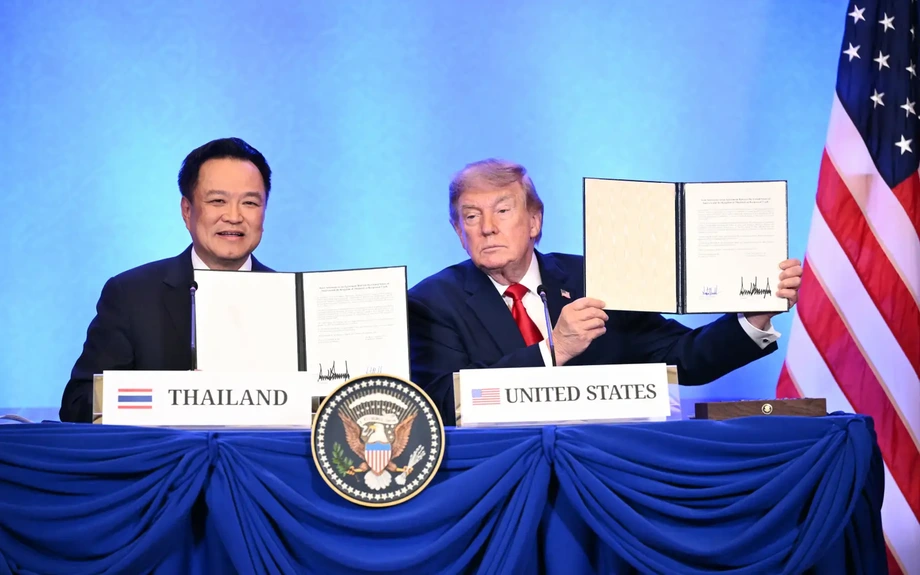
Prime Minister Anutin Charnvirakul and United States President Donald Trump signed a joint statement on November 17, 2026, in Manila, Philippines, confirming that negotiations on the main elements of an Agreement on Reciprocal Trade had reached a substantial conclusion. A joint statement is a formal document signed by leaders to show they agree on broad goals, but it is not yet a legally binding treaty. Both governments must now complete internal legal and domestic procedures before the full agreement can be signed and enter into force. Deputy government spokeswoman Lalida Persvivatana explained that the signing is not yet the formal agreement, noting that Thailand still needs to conduct public consultations and follow required legal procedures. Earlier coverage by this site detailed how Trump and Anutin Sign Thailand–US Trade Statement in Manila to advance proposed tariff cuts and agricultural commitments. The agreement builds on existing bilateral economic frameworks, including the Treaty of Amity and Economic Relations signed in 1966 and the Trade and Investment Framework Agreement signed in 2002.
The United States government previously imposed a tariff rate of 19 percent on imports from Thailand following legal changes involving the International Emergency Economic Powers Act and Section 122 of the Trade Act of 1974, replacing an earlier 36 percent rate announced in April 2025. Thai goods had previously been subject to a 12.5 percent rate under Section 301 due to forced labor concerns. Deputy Prime Minister and Commerce Minister Suphajee Suthumpun met with US Deputy Trade Representative Rick Switzer in Shenzhen, China, to request a reduction in the Section 301 forced labor tariff from 12.5 percent to 10 percent, matching the rate enjoyed by neighboring countries such as Cambodia, Indonesia and Malaysia under their own reciprocal trade agreements.
Market Openings and Agricultural Safeguards
President Donald Trump stated during the Manila signing that Thailand would eliminate all tariffs on United States exports and remove substantial non-tariff barriers affecting American vehicles, medical devices, pharmaceuticals, ethanol and poultry, while purchasing an estimated $2.6 billion in additional United States agricultural products. Non-tariff barriers are rules, regulations or inspection procedures that make it harder to sell foreign goods in a local market, such as product testing requirements or specialized safety certificates. In response to local concerns, Prime Minister Ekkapob Pianpises and other government officials clarified that the joint statement establishes a framework for negotiations rather than an immediate reduction in duties, and that no tariff cuts will take effect until the final agreement is signed and approved by Parliament.
Deputy Prime Minister and Commerce Minister Suphajee Suthumpun assured domestic producers that market liberalisation would not mean opening every sector without restrictions. She explained that imported products would primarily cover goods that Thailand does not produce, cannot manufacture in sufficient quantities, or needs to support food and energy security. For agricultural imports that could compete with local farmers, such as corn, soybeans and pork, the government plans to enforce strict conditions, including requirements to use domestic agricultural output first before allowing imports, alongside possible quota limits and safeguards. The Ministry of Commerce will provide further details on product lists and tariff schedules as the legal review proceeds.
Political Reactions and Domestic Concerns
The trade agreement has drawn sharp scrutiny from political opponents and industry groups within Thailand. Abhisit Vejjajiva, leader of the Democrat Party, criticized the government on November 19, 2026, questioning whether Thailand's concessions on agricultural markets and digital services are worth a relatively small reduction in United States import tariffs. He raised concerns that opening the domestic agricultural market to United States products valued at approximately $2.6 billion annually could directly compete with roughly 10 million Thai farmers and livestock producers. He also pointed out that existing state funds dedicated to helping farmers affected by trade deals have limited financial resources compared with the potential value of competing imports.
Business representatives have offered a mixed assessment of the framework. Visit Limlurcha, vice chairman of the Thai Chamber of Commerce, described the agreement as a strategic opportunity accompanied by structural pressures, urging businesses to upgrade their production standards to meet international requirements. Meanwhile, government officials emphasized that political stability has strengthened the administration's position. Prime Minister Anutin Charnvirakul noted that his government now holds a comfortable parliamentary majority, contrasting with his earlier minority status and enabling the Cabinet to advance major economic legislation and foreign trade strategies more effectively.
Regional Cooperation and Economic Growth
Prime Minister Anutin Charnvirakul also highlighted Thailand's broader regional engagement, including the promotion of the ASEAN Digital Economy Framework Agreement, which aims to establish common standards for digital commerce, consumer protection and cybersecurity across Southeast Asia. The framework addresses online scams, hacking, secure payment systems and penalties for regulatory violations. Economic indicators released around the same time showed that Thailand's economy grew by 2.9 percent in the third quarter of 2026, supported by a significant increase in manufacturing exports and digital infrastructure investments. Earlier coverage by this site explored how Thailand's GDP grows 2.9% as AI investment lifts exports and accelerates factory output.
Government officials have continued to pursue major technology and industrial investments. Prime Minister Anutin Charnvirakul recently met with corporate leaders to discuss expanding digital infrastructure projects, building on previous commitments by multinational technology companies to establish data centers and cloud regions within the country. These infrastructure initiatives are intended to strengthen Thailand's position as a regional hub for advanced technology, complementing ongoing efforts to maintain stable trade partnerships and secure favorable terms with major global economies.
The Essentials
- Prime Minister Anutin Charnvirakul and US President Donald Trump signed a joint statement on November 17, 2026, in Manila, advancing the Agreement on Reciprocal Trade.
- The United States is Thailand's largest export market, with exports valued at about 2.37 trillion baht ($69.81 billion) in 2025 and supporting roughly 1.25 million jobs.
- Thai officials clarified that the joint statement is a framework rather than an immediate reduction in duties, and any tariff changes require full legal review and parliamentary approval.
- Thailand is seeking to reduce its United States import tariff rate from 12.5 percent to 10 percent, while implementing safeguards and quotas to protect domestic agricultural producers.