From minor works to a new level of oversight
Hong Kong plans to bring major building repair projects under a new legal category, requiring advance approval, qualified supervisors and tighter checks on materials. Under proposed amendments to the Buildings Ordinance, some repair offences could carry fines of up to HK$3 million and prison terms of up to three years. A separate proposed offence for construction work that causes or could cause death, injury or property damage could carry a maximum HK$10 million fine and five years in prison.
Contents
- From minor works to a new level of oversight
- Which repair projects would need a permit?
- Who would inspect, supervise and carry out the work?
- What penalties could apply?
- New standards for materials and site safety
- More powers to investigate and remove offenders
- How the proposal reached this stage
- What the changes could mean for owners
- What to Know
The proposals follow the deadly fire at Wang Fuk Court in Tai Po. Many large repair projects currently fall under the second class of minor works, a system that generally requires contractors to notify the authorities but does not require the Buildings Department to approve plans before work begins. The government wants to replace that approach for qualifying projects with permits and advance review.
The changes also seek to separate building inspection from construction supervision, tighten contractor qualifications and give officials stronger powers to investigate suspected breaches. For owners, the reforms could mean added checks on work intended to make buildings safer, alongside higher repair costs and possible delays if qualified professionals and contractors are in short supply.
Which repair projects would need a permit?
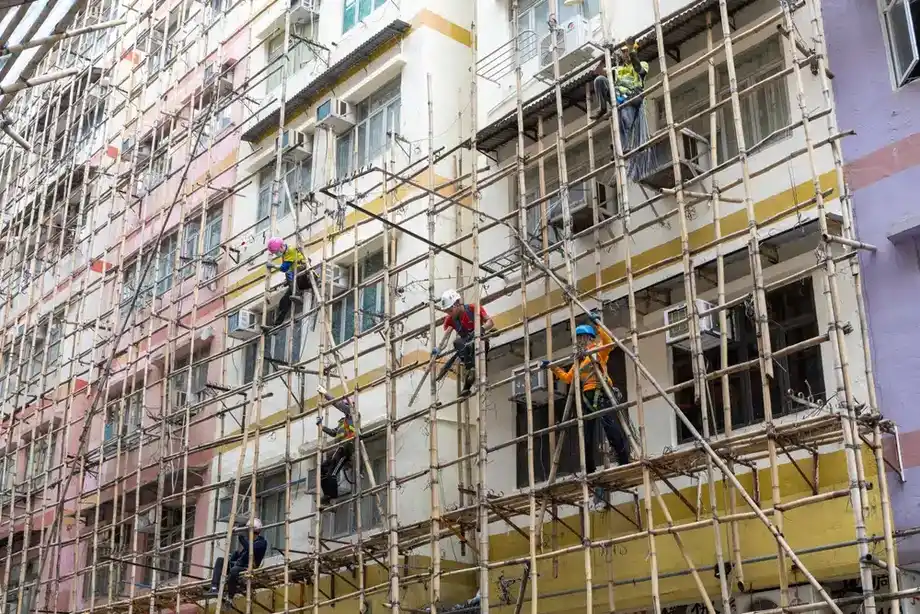
A project would count as major building repair work if it concerns a building of at least four storeys and meets specified conditions for scaffolding. These include scaffolding covering at least four storeys on a building facade, or covering at least four storeys where openings beside an escape staircase lack effective fire protection. Scaffolding that covers an entire internal corner or lightwell would also bring a project within the category.
A lightwell is an open space inside or between parts of a building that lets in light and air. The proposed rules would apply to the scaffolding and repair work around such spaces as well as the outside walls of a building.
Before work starts, an authorised person would have to submit prescribed plans and a supervision plan. The Buildings Department and other relevant departments would review the proposed arrangements and issue a permit only when satisfied. The department is also expected to review every set of plans under the new approach, rather than relying on the current system of spot checks.
The government says the new category reflects recommendations made after the Wang Fuk Court fire. Its government statement said a steering committee chaired by Chief Secretary Chan Kwok-ki held its first meeting on November 16, 2026. The independent committee's report had been released at the end of October, and the Chief Executive had announced a wider programme of building maintenance and renovation reforms.
Who would inspect, supervise and carry out the work?
The proposed system assigns inspection and supervision to different professionals. Registered Inspectors would continue to inspect buildings, while an Authorised Person would take responsibility for supervising the repair work. A Registered Inspector could not also supervise the same project. The stated aim is to reduce conflicts of interest by preventing one professional from checking a building and overseeing the repair contractor on that same job.
The supervisor would have to declare before work begins that they have no conflict of interest with the project's inspection consultant or contractor. A false declaration could bring a maximum fine of HK$3 million, up from HK$1 million, while the maximum prison term would remain three years.
Contractors would also face a change in who can take the job. Only registered general building contractors or contractors registered for first class minor works would be eligible to carry out the covered projects. A contractor that submits statutory documents to the Buildings Department would have to be the contractor actually doing the work. The requirement is intended to curb arrangements in which a company holds the paperwork but passes the whole job on to others.
Development Secretary Bernadette Linn has said the new controls will add a layer of cost. The proposals could also increase demand for Authorised Persons and eligible contractors. If there are too few, owners may face higher prices or longer waits before work can start.
What penalties could apply?
Starting a covered project without a permit would be a new offence, punishable by a maximum fine of HK$2 million and two years in prison. If work departs from approved plans or its supervision plan, the Buildings Department could cancel the permit and stop the project.
Allowing defective materials to be used, breaching prescribed material standards, or seriously departing from approved plans or the supervision plan could carry a maximum fine of HK$3 million and three years in prison. Under current minor works rules, the maximum penalty for using substandard materials is HK$500,000 and 18 months in prison. Reports on the proposals say the government intends to turn standards currently set out in practice notes and administrative guidance into legal requirements, to enable more direct prosecutions and increase penalties.
Registered Inspectors or Authorised Persons who fail to inspect a building in person or supervise work properly could face a maximum fine of HK$750,000 and up to one year in prison. The current maximum fine is HK$250,000, and the proposal would add imprisonment as a possible penalty.
The proposed HK$10 million maximum fine and five year prison term would apply to a broader offence covering construction work that causes, or could cause, death, injury or property damage. The existing maximum for that offence is reported as HK$1 million and three years in prison. This penalty is separate from the proposed penalties specifically set for defective materials and serious departures from plans.
New standards for materials and site safety
The government proposes requiring all construction materials to meet standards set by the Building Authority. Examples include concrete, fire doors, scaffolding materials and materials used to cover windows temporarily during work. Officials would be able to prosecute the use of materials that fail to meet the prescribed standards. The government plans to make standards now issued through practice notes and administrative arrangements legal requirements, allowing more direct prosecutions and higher penalties.
Changes to the Building (Construction) Regulations would also let the Building Authority set requirements for temporary precautions and fire safety during construction. The proposed topics include safe distances between buildings, structural stability, escape routes, protection at building entrances and the conditions for creating an opening in a building during work. The government also proposes empowering the Buildings Department to set requirements for building repair methods and procedures, and to clarify what it means to "take appropriate preventive measures." It plans to put the safety distance for scaffolding into law and revise the scaffolding code of practice to set material requirements for toe boards. An opening of this kind can provide access for construction, but it must be managed so it does not create a danger to residents or workers.
For owners, the rules could mean closer checks on both the products used and the way a work site is arranged while repairs are under way. The proposals do not specify the prices of approved materials or how much extra a typical project might cost. Former legislator Michael Tien has questioned whether contractors would have enough flexibility to use safe alternative products, and urged the government to explain how it would keep specified materials reasonably priced.
More powers to investigate and remove offenders
The Buildings Department would receive stronger investigation powers, including the ability to require people to attend interviews and to search for and seize documents. A person who refuses to cooperate could face a new offence carrying a maximum fine of HK$100,000.
Contractors would have to keep construction supervision records and related documents for at least six years, compared with 12 months under the current requirement. Failing to provide records when required could also bring a maximum fine of HK$100,000.
The proposals would let the Building Authority remove contractors and building professionals from statutory registers if they are found to have committed bribery or bid rigging, without first holding a disciplinary hearing. Those removed could not return to the registers for three years. Tien has argued that three years may be too short and suggested a 10 year exclusion. He has also asked how officials would uncover hidden financial interests if professionals failed to declare them, and called for active investigations or spot checks.
Separate registration measures would allow regulators to impose conditions when renewing the registrations of contractors, authorised signatories or technical directors involved in fatal incidents. One possible condition would prevent a person from holding a core role for a year. Reports on the proposed registration reforms also say criminal and disciplinary records would be among the factors considered in registration renewals.
How the proposal reached this stage
The government's timetable links the independent committee's findings to a broader reform programme and then to changes in law. The key dates given so far are:
End of October 2026: the independent committee's report on the Wang Fuk Court fire was released.
November 16, 2026: the steering committee chaired by Chief Secretary Chan Kwok-ki held its first meeting to oversee implementation of recommendations.
January 2027: the government aims to submit the amendment bill to the Legislative Council.
Mid 2027: the government aims to complete the legislative process and bring the changes into effect.
The Development Bureau is expected to settle the final proposals after considering views from Legislative Council members and other groups. The Legislative Council's Development Affairs Panel is also due to discuss the proposals before the bill is introduced.
What the changes could mean for owners
Advance approval and more detailed supervision could add checks before a major repair starts, while splitting inspection and supervision reduces the chance that the same professional handles both roles. Stronger material rules and longer record keeping would also give officials more tools to check what was used and how a project was managed.
The added requirements could make repair work more expensive. Owners may have to pay for qualified professionals, permit preparation and materials that meet prescribed standards. If contractor or professional capacity is limited, projects could take longer to arrange. No estimate has been given for the added cost to an average household or the time needed for the Buildings Department to assess a typical application.
The government has also proposed changes beyond major repairs, including measures on unauthorised building works, compliance with statutory notices and orders, and illegal residential use of industrial buildings. Those proposals form part of a wider amendment package, while the new permit category and safety controls focus directly on large repair projects.
What to Know
Major repairs to buildings of at least four storeys could require advance approval when scaffolding meets specified coverage conditions.
Authorised Persons would supervise work, while Registered Inspectors would inspect the building, with the two roles separated on each project.
Starting work without a permit could bring a maximum HK$2 million fine and two years in prison. Serious breaches involving materials or plans could carry up to HK$3 million and three years.
The proposed maximum for work that causes or could cause death, injury or property damage is HK$10 million and five years in prison.
The government aims to introduce the bill in January 2027 and bring the changes into force by the middle of that year.