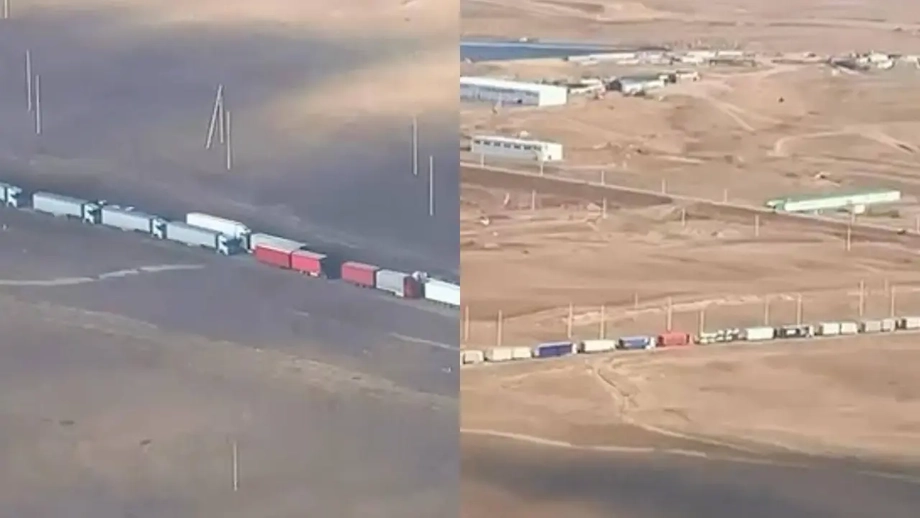
Two very different queue counts, hours apart
Drivers have described a line of trucks stretching 40 kilometres near the B. Konysbayev crossing between Kazakhstan and Uzbekistan, with some saying they faced waits of several days. The congestion is in Kazakhstan's Turkestan Region, at a checkpoint on a busy route for freight moving from China through Central Asia.
Contents
The reported figure of 990 trucks needs a date and place attached to it. Kazakhstan's Turkestan Region State Revenue Department recorded 990 trucks in the area around the checkpoint on November 13. On November 20, at 09:00, its published count was 100 trucks waiting at B. Konysbayev. Uzbekistan's Customs Committee said the two countries' border posts were operating normally and described a line of 100 trucks as usual for the amount of traffic handled there.
The figures refer to different snapshots, so they describe a changing queue rather than a single count taken at the same time. Drivers' estimates of the line's length and waiting time also describe conditions on the road, while official figures count trucks at specified times. An account of conditions on November 13 put the wait at about a day; drivers in later accounts said it could take several days.
The distinction matters to people on the road. A short official queue at one checkpoint at a particular hour does not describe how long trucks may have been waiting farther back or how conditions changed during the day. The reports point to a rush of freight meeting limited space and processing capacity near the border.
How much traffic can the crossing handle?
More than 1,500 trucks pass each day through B. Konysbayev and Uzbekistan's Yallama post, which sits opposite it. That is the combined daily flow through the paired crossings, according to the Uzbek Customs Committee. A queue of 100 trucks is therefore a small share of the number processed in a full day, though it can still mean a long delay for individual drivers if vehicles arrive in a concentrated wave.
Figures for the crossing show how quickly demand has grown. The November average was 1,469 trucks a day, according to Kazakhstan's State Revenue Committee, compared with a designed capacity of 1,000. On November 13, 1,456 trucks crossed in both directions during the day, while 990 were reported near the crossing. The daily total and the number waiting measure different things: one counts vehicles that passed, the other vehicles gathered in the area.
Across the Uzbekistan–Kazakhstan border, the Uzbek Customs Committee said average truck movements rose from 1,165 a day in 2021 to 3,130 a day by November 2026, a 2.7-fold increase. Separately, figures for Uzbekistan's border posts as a whole show that truck traffic rose 70% in three years to more than 5,100 a day. Those totals cover different groups of crossings and should not be treated as counts for B. Konysbayev alone.
For the ten months to October, freight movement at the Kazakhstan–Uzbekistan border was up 16.2% from the same period in 2025. The figures show pressure building over time, while the sharpest queues can occur when a sudden burst of vehicles arrives faster than roads, parking areas and customs posts can handle them.
Why are so many trucks arriving?
A large share of the vehicles shown in online footage were carrying transit cargo, Uzbekistan's Customs Committee said. Transit cargo is freight that crosses a country on its way to another destination, rather than goods being delivered to buyers in that country. Trucks carrying Chinese goods through Kazakhstan and Uzbekistan may continue toward Turkmenistan, Tajikistan and other countries.
Uzbek officials linked rising transit volumes partly to Kazakhstan's Khorgos crossing with China operating around the clock. A separate account of the congestion described a temporary interruption at Khorgos during holidays. It said around 10,000 trucks accumulated there, then as many as 3,000 a day headed into Kazakhstan after traffic resumed. When many vehicles are released into a route at once, downstream crossings and parking areas can struggle to absorb them.
Freight from Russia and Belarus adds to the traffic, according to drivers' accounts. Changes to rail freight are another part of the transport picture: Kazakhstan's national railway company introduced extra requirements for some shipments to Uzbekistan and Afghanistan in wagons belonging to other railway administrations, after Uzbekistan's railway operator called for empty wagons to be returned more quickly. These developments concern different transport systems, but they form part of a wider shift in how cargo moves through the region.
The practical result at the border is that truck arrivals can outpace available holding space. When there is no room in a dedicated parking area, vehicles may line the road while waiting to reach customs. That can prolong drivers' waits and make the crossing approach harder to use for other road traffic.
What is happening to drivers and other road users?
Drivers described spending days in their cabs with limited access to rest, food, showers and toilets. Local residents have brought home cooked meals to truckers in cars, according to an account from the area. The same account described rubbish collecting along the roadside, where trucks had been waiting.
The queue also affects people who are not crossing the border. When heavy trucks occupy a lane, other vehicles may have to pass close to them or move into the opposing lane. That creates a risk of collisions, particularly at night or when dust, rain or poor visibility make it harder to see approaching traffic.
Parking space is one immediate constraint. Global Foot Logistics has been allocated a 10 hectare plot for a vehicle hub. A paved area covering four hectares is in use and can hold 700 trucks. The facility is connected to an electronic queue system, with a screen displaying vehicles whose turn is approaching. Drivers can use their electronic number to know when to move toward the checkpoint instead of gathering on the access road.
The 700 spaces provide some room to hold trucks, but they are limited beside the larger numbers that can accumulate across the wider route. The local official U. Altynbayev said work was continuing to expand the hub after talks with the investor. Drivers have also complained that wet weather makes parts of the site difficult to enter and that facilities are unfinished while parking fees are being charged.
Could a single customs stop shorten delays?
Uzbekistan is discussing a "One Stop" customs arrangement with Kazakhstan and Kyrgyzstan for selected crossings. The idea is to reduce repeated procedures at the same border: instead of undergoing a similar inspection on both sides, a truck could be checked once, with the neighbouring country accepting the result.
Three possible arrangements are being considered. Customs officers from both countries could work in one building; the two sides could divide export and import processing between them; or each country could recognise the other's inspection results. The last option would require the countries to share information and agree on when a second inspection is unnecessary.
Uzbekistan's president provided for the One Stop approach in a decree dated August 27, 2026. On November 11, Customs Committee department head Farhod Olimjonov said officials were working through possible models. The countries have not set a date for launching the system, and agreement with neighbouring governments is still needed.
If adopted, shared procedures could cut repeated checks and make processing more predictable. The proposal is a longer term change, however. It does not itself add parking spaces or increase the number of trucks customs staff can process today.
What has Kazakhstan ordered, and what comes next?
Kazakhstan President Kassym-Jomart Tokayev linked long border queues to the country's aim of becoming a major transport hub. In a message to the public on October 28, he instructed the Transport Ministry to oversee the quality of national and local roads and to complete reconstruction of all road border crossings in 2027.
The order sets a future deadline for upgrading crossing infrastructure. The current pressure at B. Konysbayev is happening before that work is complete. At the same time, the local vehicle hub is being expanded and customs services in Uzbekistan and Kazakhstan say they exchange information to help prevent queues.
For now, the next step in the One Stop talks is not scheduled. Officials have not announced a launch date or said which crossings would be included first. The timing and scale of reconstruction at each checkpoint, and the hub's eventual capacity, will determine how much extra space and processing ability becomes available.
Key dates
August 27, 2026: Uzbekistan's presidential decree provided for the One Stop customs approach.
October 28: Kazakhstan's president ordered reconstruction of all road border crossings to be completed in 2027.
November 11: Uzbek customs official Farhod Olimjonov said possible One Stop models were being discussed; no launch date was set.
November 13: Kazakhstan's State Revenue Committee reported 990 trucks near B. Konysbayev; 1,456 trucks crossed in both directions that day.
November 20, 09:00: The published queue at B. Konysbayev stood at 100 trucks.
The Bottom Line
Drivers reported a 40 kilometre queue and waits of several days near B. Konysbayev.
Kazakhstan recorded 990 trucks near the crossing on November 13 and 100 waiting at 09:00 on November 20.
Truck traffic has risen sharply, while November traffic at the crossing exceeded its designed daily capacity.
A 700 truck parking hub is operating and being expanded; roadside queues create risks for truckers and other drivers.
Uzbekistan, Kazakhstan and Kyrgyzstan are discussing shared customs checks, but no launch date has been announced.