A larger economy comes into statistical view
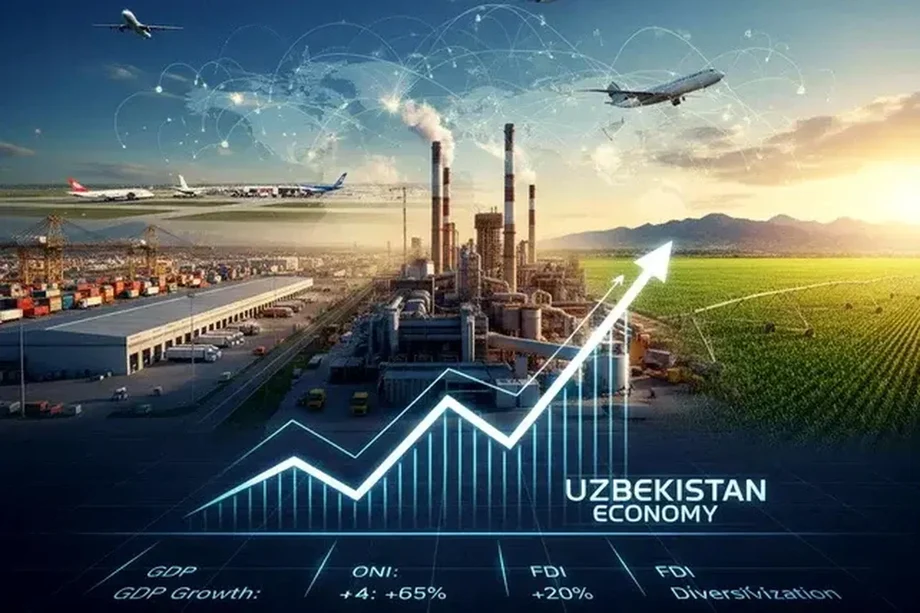
Uzbekistan has raised its estimate of economic output for 2025 by 277.1 trillion soums, or $22 billion, after census results and revised business reporting brought more housing, farmland and commercial activity into the national accounts. The National Statistics Committee now puts nominal gross domestic product at 2,126.8 trillion soums, equivalent to $169 billion, up 15% from 1,849.7 trillion soums, or $147 billion.
Contents
- A larger economy comes into statistical view
- What added 277.1 trillion soums?
- How the revision unfolded
- More residents, and a higher GDP per person
- Housing records gain 298 million square meters
- Why homes contribute to GDP
- The agricultural census redraws the production picture
- Fewer cattle, more fish and a bigger agricultural total
- New reporting changes the measurement of trade
- Earlier years and regions are recalculated
- Business records and public data are next
- Key Points
The committee presented the revised annual and quarterly figures for 2017 through 2025 at a press conference on November 13. Updated enterprise and organization data supplied the largest part of the adjustment, ahead of the agricultural and population censuses.
Real economic growth for 2025 changed much less, rising from 7.7% to 7.8%. Nominal GDP measures production at the prices charged during the year. Real growth adjusts for price changes and compares production with the previous year. Recalculating both years can lift the measured size of the economy substantially while changing its growth rate only slightly.
The revised figures also change the picture of everyday economic life. Housing floor area increased by about 41% in the statistical records. Crop estimates rose, cattle estimates fell, and a new method of calculating trade margins lifted measured trade services by 56.8%.
Zohidjon Ziyayev, deputy chairman of the National Statistics Committee, explained that the adjustment reflected more complete and accurate accounting of economic activity. The review followed United Nations System of National Accounts standards and recommendations from international experts, including the International Monetary Fund.
What added 277.1 trillion soums?
Enterprise and organization data accounted for 160.3 trillion soums, or 57.9%, of the increase. The agricultural census contributed 80.4 trillion soums, or 29%, while the population census contributed 36.4 trillion soums, or 13.1%.
Services supplied the largest increase when the revision is divided by economic activity: 138 trillion soums, almost half the total adjustment. Industry added 52.9 trillion soums, agriculture, forestry and fishing added 44.6 trillion, and construction added 41.6 trillion. Net taxes on products remained unchanged.
The census contributions and sector contributions describe the same revision from different directions. A census identifies where new information came from; the sector breakdown shows which economic activities changed after that information was incorporated.
GDP uses gross value added, meaning the value of production after subtracting goods and services consumed in producing it. For a bakery, that means subtracting inputs such as flour and electricity from its output. This avoids counting the same production repeatedly as it passes between businesses.
How the revision unfolded
The committee's January GDP release, published on January 26, 2026, recorded preliminary GDP of 1,849.7 trillion soums and real growth of 7.7%. It also reported a GDP deflator of 111.9%, indicating an 11.9% rise in the broad price measure used for domestic production.
The review subsequently combined census findings with more detailed company reports. The main dates are:
- January 1, 2026: A new enterprise reporting form took effect and was used for annual reports covering 2025.
- January and February 2026: The population and agricultural census exercise took place.
- September 10, 2026: Presidential Decree No. UP-190 provided the framework for the statistical review.
- November 13: The committee presented the revised figures for 2017 through 2025.
- October 15 through November 30, 2026: A business census was scheduled to identify operating economic units and update business registers.
More residents, and a higher GDP per person
The average population used for the 2025 calculation rose from 37.9 million to 38.7 million. With the GDP total increasing faster than the population estimate, nominal GDP per person rose from 48.8 million to 55 million soums, or from $3,881 to $4,373. Real growth in GDP per person was revised from 5.7% to 5.8%.
GDP per person divides national output by the average population. It gives a useful measure of economic scale relative to population, while household income measures the money people actually receive.
The presidency's census reform statement gives a preliminary permanent population of 39,047,000 and says 810,600 residents missing from current records had their addresses and social status clarified. The permanent population count and the average population for 2025 refer to different population measures.
Local corrections went in both directions. The presidency said Tashkent district had 1.6 times as many residents as previously recorded, while Andijan city had 15.8% fewer. Population estimates also fell in Jizzakh, Namangan, Surkhandarya and Kashkadarya regions. Such changes matter for decisions about where schools, clinics and other public services are needed.
Housing records gain 298 million square meters
The census raised Uzbekistan's estimated housing floor area at the end of 2025 from 734 million to 1.032 billion square meters. The increase of 298 million square meters amounts to about 41%, far larger than the change in the estimated number of residential units, which rose from 7.7 million to 8.1 million.
Census teams recorded homes and additional rooms that existed outside the administrative records previously used for housing statistics. Privately owned housing area rose from 731 million to 991 million square meters.
Average housing area per resident consequently increased from 19.4 to 26.7 square meters. This is a national average calculated by dividing total housing floor area by population; individual households have different amounts of space.
The average total area of an individual house, including living and ancillary rooms, was revised from 105 to 145 square meters. Average apartment size changed by only 1.2 square meters. Courtyards, gardens and land plots are excluded from housing floor area.
Why homes contribute to GDP
The revised housing information affected two parts of the national accounts. Estimated construction undertaken by households for their own use in 2025 rose from 60.5 trillion to 80.7 trillion soums. Estimated housing services from homes occupied by their owners rose from 83.9 trillion to 112.5 trillion soums.
Owner occupied housing services are often called imputed rent. National accounts assign a value to the shelter a home provides its owner, just as they record the housing service supplied by a rented property. The figure is calculated statistically using information such as housing values, maintenance costs and depreciation.
Households continue living in the same homes while the accounts assign a more complete value to those services. Actual rent payments and tax liabilities are separate matters.
Umarjon Obidov, head of the committee's national accounts department, said market valuations of property could affect future estimates of imputed housing services. Further revisions depend on complete regional property values and a review of the methodology with experts. The committee gave no date for that work or for any subsequent GDP revision following the business census.
The agricultural census redraws the production picture
The committee identified about 985,400 hectares of land previously missing from statistical observations, including 789,600 hectares of cropland, 75,300 hectares of orchards, 21,400 hectares of vineyards, 14,100 hectares of greenhouses and 85,000 hectares of fish farming ponds.
The revised area of orchards and vineyards rose from 516,300 to 613,000 hectares. Greenhouse area increased from 8,000 to 22,100 hectares, nearly 2.8 times the earlier estimate. Raspberry cultivation was revised from 119 to 3,281 hectares, showing how large the gaps could be for individual crops.
The updated 2025 production estimates put grain at 11 million tonnes, up 8.6%; vegetables at 14.4 million tonnes, up 5.2%; and melons and gourds at 4.2 million tonnes, up 28.2%. Fruit and berries reached 4.1 million tonnes, an increase of 18.5%, while grapes reached 2.3 million tonnes, up 14.5%.
Crop production value rose from 243 trillion to 290.6 trillion soums, an increase of 19.6%. These revised quantities give agricultural planners a different starting point for assessing food production, land use and the contribution of smaller producers.
Fewer cattle, more fish and a bigger agricultural total
The livestock count moved downward. The census indicated nearly 2.3 million fewer cattle than previously estimated, leading the committee to reduce estimated beef production by 13.1% and milk production by 19.2%.
Fish catches moved sharply upward, from 205,500 to 446,500 tonnes, about 2.2 times the earlier estimate. The committee discussed revisions to physical agricultural production with a technical assistance mission from the Food and Agriculture Organization.
Total output in agriculture, forestry and fishing was revised to 623.5 trillion soums, an increase of 84.6 trillion soums, or 15.7%. The sector's contribution to the GDP revision was smaller, at 44.6 trillion soums, because GDP counts value added after production inputs are deducted.
The combination of higher crop estimates and lower livestock estimates is useful for understanding the review: the new information changed the composition of farming as well as its total measured size. Food supply calculations now begin with more crops, fewer cattle and substantially more fish than the earlier records showed.
New reporting changes the measurement of trade
The enterprise reporting form introduced on January 1, 2026 required businesses to identify the cost of goods purchased for resale separately. The committee could then calculate trade margins using sales revenue, purchase costs and changes in inventories, rather than relying on margins already stated in company reports.
A retailer's economic service is measured through its margin. If a shop buys an item for 80 soums and sells it for 100, the starting margin is 20 soums. Other operating inputs are then taken into account when calculating value added.
The revised method raised estimated trade services output for 2025 from 165.9 trillion to 260.1 trillion soums, an increase of 94.2 trillion soums, or 56.8%. Output is the measure used here; the contribution to GDP is calculated after deducting intermediate consumption.
Expanded coverage also captured 36.5 trillion soums of output from permanent establishments and production offices of foreign companies operating in Uzbekistan. Construction accounted for 24.6 trillion soums, or 67.4%, industry for 6.7 trillion, and services for 5.2 trillion.
Earlier years and regions are recalculated
The revision extends across nine years. Nominal GDP for 2017 rose from 369.6 trillion to 427.6 trillion soums, an increase of 15.7%, while the 2024 estimate rose from 1,535.4 trillion to 1,754.7 trillion soums, up 14.3%. Real growth for 2024 remained 6.7%.
Detailed enterprise, organization and household information supported the 2025 revision. For 2017 through 2024, the committee used previously published aggregate figures and economic trends because comparable detailed records were unavailable. Each year was adjusted according to its economic activity rather than receiving the same percentage increase.
Regional GDP estimates rose everywhere, ranging from 7.6% in Navoi Region to 22.4% in Samarkand Region. Jizzakh and Surkhandarya followed Samarkand among the largest relative revisions, ahead of Tashkent city and Karakalpakstan. The committee attributed the differences to local economic structures and the varying effects of newly captured data.
The committee also published separate quarterly GDP estimates for 2017 through 2025 for the first time. The 2025 figures are 399.7 trillion soums for the first quarter, 534.9 trillion for the second, 560.3 trillion for the third and 631.9 trillion for the fourth. Together, they equal the revised annual total of 2,126.8 trillion soums.
The Denton method, recommended in the IMF Quarterly National Accounts Manual, aligned the quarterly series with annual totals while preserving movements between quarters as far as possible. Constant price figures were also prepared so users can examine changes in production after adjusting for prices.
Business records and public data are next
The presidency said census registration achieved 82.3% online coverage and was completed in 15 days. The results will support continuously updated population and agricultural registers, alongside revisions to 100 indicators concerning social and economic development and 50 concerning agriculture and crop areas.
The business census scheduled for October 15 through November 30 is intended to establish which economic units are operating, their structure and their distribution across sectors. The presidency said many registered small and medium businesses were inactive or had stopped operating.
The presidency's reform statement puts the unobserved economy at 23%, or 246 trillion soums; the committee's January release estimated unobserved gross value added for 2025 at 498 trillion soums, or 26.9% of GDP. The presidency statement gives no reference period or calculation basis for its figures. The January release explains that unobserved activity includes household production and activity estimated indirectly because regular reporting captures it incompletely.
The latest annual revision follows the 2026 economic expansion recorded in January through September. Earlier figures put that period's real growth at 8.3% and GDP at 1,755.5 trillion soums; the subsequent revision announcement cited growth of 8% for the period before recalculation. Annual and quarterly updates will provide the basis for subsequent comparisons.
A National Data Platform is planned for July 1, 2027, bringing government information into a common system with quality and security controls. Plans through 2030 include reducing business reporting requirements by 20%, cutting data processing time by 20% and reducing processing costs by 25%.
The practical objective is to keep business, population, property and agricultural records closer to conditions on the ground. For Uzbekistan, the revised $169 billion GDP total is one result of that work. More precise regional populations, housing areas and production estimates will also shape the information available for public spending and economic planning.
Key Points
- Uzbekistan revised nominal GDP for 2025 to 2,126.8 trillion soums, or $169 billion, an increase of 15%.
- Real GDP growth changed from 7.7% to 7.8% as annual estimates were recalculated.
- Updated enterprise data accounted for 57.9% of the revision, ahead of the agricultural and population censuses.
- Housing floor area rose by about 41% in the records, while crop estimates increased and cattle estimates fell.
- GDP per person rose to 55 million soums, or $4,373, using a revised average population of 38.7 million.
- The committee revised figures for 2017 through 2025 and published separate quarterly estimates across that period.
- A business census and improved property valuations could lead to further statistical updates.