A longer national service programme, with funding still to decide
Malaysia could eventually extend its National Service Training Programme (PLKN) from 45 days to 180 days under a proposal by Deputy Prime Minister Datuk Seri Dr Ahmad Zahid Hamidi, potentially quadrupling the time participants spend in training. His suggestion has opened a debate over how to build discipline without delaying further education or disrupting family responsibilities.
Contents
- A longer national service programme, with funding still to decide
- What would change from the current 45 days?
- How many trainees completed the latest series?
- Parents fear missing the next education intake
- Deferments and university credits enter the debate
- Former trainees disagree on the ideal duration
- Could graduates help during floods and other disasters?
- Job skills and national unity are also part of the plan
- Key Points
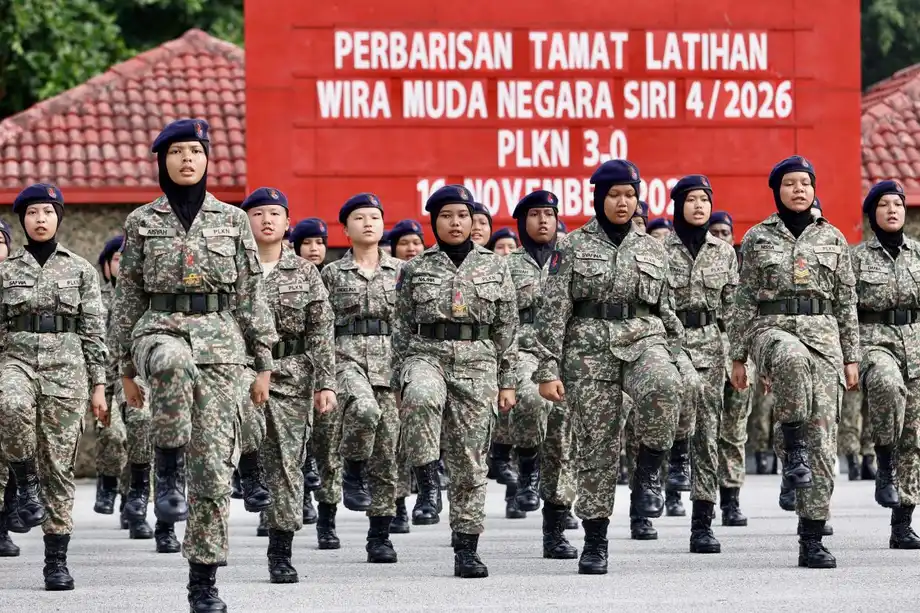
Zahid proposed an initial increase to at least 90 days, followed eventually by 180 days, after the PLKN 3.0 Wira Muda Negara Series 4/2026 closing parade in Bagan Datuk on November 16, 2026. He said the changes could come under future versions of the programme, described as PLKN 4.0 or 5.0, depending on government funding.
The ceremony marked the completion of 45 days of training for 269 participants at Hutan Melintang PLKN Camp, associated with the 503 Territorial Army Regiment. Across eight centres nationwide, 1,899 participants completed the final series of 2026.
Zahid said the present duration was sufficient for now, while arguing that a longer curriculum could give trainees more time to develop resilience and stronger character.
No extension has been finalised, and no implementation date, budget or detailed revised syllabus has been announced. For prospective participants, the central issue is therefore a proposed change rather than an immediate requirement to spend six months in training.
What would change from the current 45 days?
A move to 90 days would double the current commitment, adding 45 days. A move to 180 days would add 135 days, making the programme four times as long. For a school leaver, that could turn a relatively short period between education stages into a commitment occupying much of an academic semester.
Zahid linked the extra time to the curriculum, saying discipline and resilience needed to be developed through training. He also referred to countries where national service lasts up to a year and where participants may later serve in the military, police or civil defence. He said Malaysia could learn from those arrangements without copying them in full.
The proposed progression is:
- Current PLKN 3.0 training: 45 days.
- November 16, 2026: Zahid proposed increasing training to at least 90 days and eventually 180 days.
- Possible future PLKN 4.0 or 5.0: any longer programme would depend on the government's financial capacity.
A longer stay would also mean more days of accommodation, meals, instruction and supervision for each trainee. The government has not put a price on the proposed expansion, leaving funding as a practical condition for any decision.
How many trainees completed the latest series?
The latest series recorded 1,899 graduates against a target intake of 1,860, exceeding the target by 39 people, or about 2.1%. The group included 1,149 male participants and 750 female participants, roughly 61% and 39% respectively.
The detailed completion figures place those participants in Series 4/2026, the final series of the year. Defence Minister Datuk Seri Mohamed Khaled Nordin also cited 1,899 when describing completions for the year. Both statements used the same total and participation target.
Training took place at six National Service Training Branch camps and two RELA training centres. The 269 graduates at Hutan Melintang represented about 14% of the 1,899 participants across the eight centres.
National Service Training Department Deputy Director-General (Training) Brigadier General Samad Igom attended the Bagan Datuk ceremony. The completion numbers show the scale of the latest intake, while the debate over extending training concerns how much time future participants would spend in the programme.
Parents fear missing the next education intake
Melaka Action Group for Parents in Education chairman Mak Chee Kin said the quality, relevance and values of the programme mattered more than its length. His concern focused on school leavers preparing for Form Six, matriculation, foundation, diploma and other programmes leading to further study.
Mak warned that a six month commitment could cause students to miss enrolment deadlines or wait for another intake. He called for clear deferment, exemption or flexible scheduling arrangements so that national service fits around education.
Mak described the purpose of those safeguards in direct terms:
"National service should complement youth development and not become an obstacle to education.
"We want to prepare our young people for the future, not delay their future," he said.
The practical concern is timing. A student may be ready to start a course but unable to attend its opening weeks while still completing training. If the institution admits new students only at particular times, the resulting wait could last longer than the remaining PLKN commitment.
Public responses also raised the position of participants who are married, have children or care for sick parents. Those concerns broaden the discussion beyond students: a longer residential programme would require arrangements for people whose families depend on their daily presence.
Deferments and university credits enter the debate
Former National Service Training Department head Datuk Abdul Hadi Awang Kechil supported extending the programme. He said its modules and duration should comply with the National Service Training Act 2003, as under the earlier national service programme.
Abdul Hadi said the Act already provided for deferments, exemptions and postponements. A deferment allows a participant to complete service later, while an exemption releases someone from the requirement under applicable rules. Parents are seeking clear arrangements that explain how such options would work alongside a longer programme.
Parent-Teacher Association chairman Mohamad Zaki Samsudin proposed another approach: working with local universities so that national service training could count towards a university course or module.
Under a credit transfer arrangement, a university recognises relevant learning completed elsewhere and counts it towards a qualification. Zaki's suggestion would give some training an academic value, although no participating universities, eligible modules or agreement were identified.
Scheduling and academic recognition address different problems. A student could receive credit for training and still need permission to join an education intake on time. Any future scheme would need to account for both the learning completed during PLKN and the calendar of the student's next course.
Former trainees disagree on the ideal duration
Former participants offered different views based on their experiences. Rafiqha Mustaffa, 34, who trained in Manjung, Perak, in 2010, supported a longer period because she believed it would provide more opportunities to learn skills and gain useful experience.
Rafiqha explained why she favoured more time:
"From my experience, the current 45-day period may not be sufficient for participants to benefit fully from the programme.
"A longer period would help expose trainees to new skills and valuable experiences," she said.
Alex Chan, 30, who trained in Gambang, Pahang, in 2014, favoured about two months. He said that would provide sufficient exposure while leaving participants able to continue their studies. Chan also recalled that training helped him understand Malaysia's different cultures and communities.
Leong Chew Ping, 30, who trained in Sipitang, Sabah, in 2014, favoured 60 days or less. He supported the programme's role in developing patriotism but wanted participants to retain opportunities for further study.
Afiqah Zahidi, a mother of two aged 37, preferred 90 days to 180 days. She wanted greater attention to character, personal discipline, leadership, moral values and social responsibility. Together, these responses show that support for PLKN's aims does not necessarily translate into support for six months of training.
Could graduates help during floods and other disasters?
Zahid also proposed exploring ways to involve former PLKN trainees as volunteers during floods and other disasters. He suggested compiling their details so they could be contacted when extra people were needed.
Disaster management committees already operate at national, state and district levels. Former trainees could support those existing arrangements, rather than requiring an entirely separate response structure.
Zahid acknowledged that graduates would follow different education and employment paths, making participation more difficult for some. Describing the possibility of contacting them, he said:
"We can explore ways to engage them as volunteers during disasters, when manpower is needed," he said.
The proposal would give graduates a possible role after camp ends. Its practical design would need to account for their availability, particularly once they enter employment. Zahid presented this as an option for voluntary service, alongside the discussion about extending the initial training period.
Job skills and national unity are also part of the plan
Zahid suggested incorporating technical and vocational education and training into the PLKN curriculum to widen employment pathways. This type of education focuses on practical skills used in particular trades and occupations.
He asked the National Service Training Department to examine the idea. No specific courses, qualifications or training partners were named. The suggestion would broaden the discussion from how long participants stay in camp to what they can take into work afterwards.
Some public responses favoured participation in the Territorial Army, Royal Malaysian Air Force Reserve Force or Royal Malaysian Navy Reserve Force instead of a longer PLKN programme. Those suggestions focused on opportunities for continued service and possible careers after training.
Khaled described PLKN's purpose as building patriotism, national unity and an understanding of each participant's role in protecting national sovereignty. He said the programme was not intended to prepare participants to take up arms.
The defence minister urged participants to carry their experience of Malaysia's racial diversity into further study, employment and other parts of life. Speaking about that diversity, Khaled said:
"Celebrate this diversity. Through diversity, I believe many things can be achieved, including innovation and discoveries," he said.
The debate now centres on how a revised curriculum would use additional time. Longer training, vocational learning, education safeguards and opportunities to volunteer after graduation are distinct proposals that would need to fit into a funded programme.
Key Points
- Zahid proposed extending PLKN from 45 days to at least 90 days and eventually 180 days, subject to government funding.
- No extension, implementation date, detailed revised syllabus or budget has been announced.
- Series 4/2026 recorded 1,899 graduates across eight centres, exceeding its target of 1,860 by 39 participants.
- Parents and former trainees raised concerns about education deadlines, family responsibilities and whether more time would improve results.
- Suggestions include clear deferments, university credit transfers and vocational courses.
- Former trainees could also be considered for voluntary disaster relief work.