A genetic circuit turns a cancer weakness against tumors
Researchers at Zhejiang University have designed a genetic circuit that uses mistakes in cancer cells' protein production to trigger their destruction. Published in Nature on November 4, 2026, the study found that the experimental system, called FAST, caused pronounced tumor regression in mice with colorectal and pancreatic cancer, activated immune defenses and worked more effectively when combined with immune checkpoint treatment.
Contents
- A genetic circuit turns a cancer weakness against tumors
- What happens when a cell reads the wrong letters?
- How the team located the slipping points
- Why cancer cells are more likely to slip
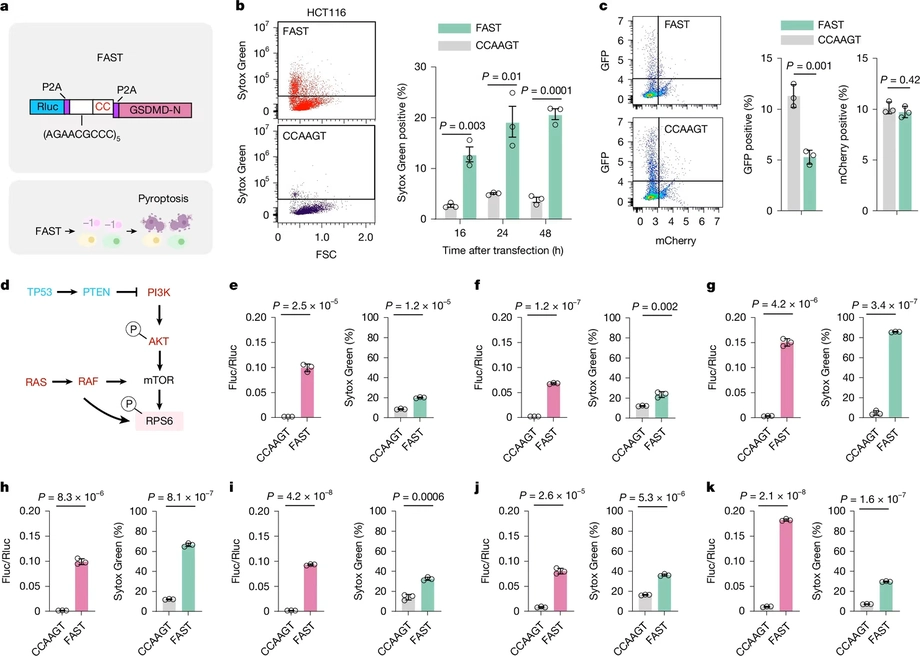
- How FAST turns a reading error into cell death
- What happened in the mouse experiments?
- Why the immune response mattered
- What the safety tests found
- A different basis for selective treatment
- Key Points
The approach targets a particular weakness: at certain genetic sequences, cancer cells' protein making machinery can slip backward by one genetic letter. FAST uses that slip to unlock instructions for producing a protein fragment that punches holes in the cell membrane. Healthy cells generally keep reading in the original position, leaving the destructive instructions inactive.
The Nature research paper, titled "Cancer-selective gene circuits via intrinsic ribosomal frameshifting," lists Qiuyi Wang, Yuanhui Mao and Xiangwei Gao among its authors, with Mao as the corresponding author. The work comes from a Zhejiang University team at Liangzhu Laboratory.
FAST remains an experimental treatment tested in cells and mice. Its central contribution is a way to make a therapeutic gene respond to how a cancer cell operates, rather than requiring a particular cancer mutation. Delivery, differences between human tumors and safety during prolonged expression remain major questions for further research.
What happens when a cell reads the wrong letters?
Cells make proteins by reading instructions carried by messenger RNA, or mRNA. A ribosome, the cell's protein assembly machinery, reads those instructions three genetic letters at a time. Each group, called a codon, specifies an amino acid, one of the building blocks joined together to make a protein.
A frameshift happens when the ribosome changes its reading position. Moving backward by one letter changes how the remaining letters are grouped, potentially producing a very different protein. The study focuses on this backward movement, called a minus one frameshift.
Normal mammalian cells usually maintain their reading position with high accuracy. Frameshifting is described as occurring roughly once in every 100,000 translation events under normal conditions. Viruses, by contrast, commonly use controlled frameshifting to regulate which proteins they produce.
The researchers found that particular pairs of codons, including the six letter sequences AGAACG and ACGAGA, encouraged backward slipping preferentially in cancer cells. Some cancer cells had frameshifting frequencies more than ten times those of normal cells. The size of the difference varied, an important consideration for any therapy built around this behavior.
How the team located the slipping points
The researchers built large libraries of randomized genetic sequences and tested them with a system using two light producing enzymes called luciferases. These reporters helped reveal when a ribosome had moved out of its expected reading frame.
The team also developed a computational method for analyzing ribosome profiling, known as Ribo-seq. This technique maps where ribosomes are working along RNA instructions. It helped locate codon pairs where the machinery paused and became prone to slipping.
Testing included human and mouse cancer cells associated with colorectal, pancreatic, ovarian and liver cancers, as well as melanoma. Normal somatic cells, the ordinary cells that make up body tissues, generally maintained the usual reading frame at the same sequences.
The breadth of the testing matters because the circuit was designed around a shared cell state rather than one mutation. The findings place these particular translation errors across several cancer types, while also leaving tumor variation as a practical issue for future development.
Why cancer cells are more likely to slip
Amino acid shortages and limited supplies of transfer RNA can make ribosomes pause. Transfer RNA, usually shortened to tRNA, carries amino acids to the ribosome so that each can be added at the correct point. When the necessary supplies are unavailable, protein assembly can stall.
Cancer cells also frequently have excessive activity in two growth signaling pathways, mTOR and MAPK. In this study, those pathways helped maintain high phosphorylation of ribosomal protein S6. Phosphorylation means attaching a small chemical group to a protein, which can change how it behaves. The modified S6 protein increased the tendency of paused ribosomes to shift reading frames.
A second safeguard was weakened as well. The ribosome quality control system, including a monitoring mechanism centered on the protein ZNF598, was less effective in the cancer cells. With fewer stalled ribosomes being dealt with properly, frameshifting became more likely.
The researchers also observed reduced restraint from nonsense mediated mRNA decay, a process that removes certain faulty RNA messages. Together, disrupted supplies, persistent growth signals and weaker quality controls allowed alternative reading frames to affect the proteins cancer cells produced.
How FAST turns a reading error into cell death
FAST stands for frameshifting activated synthetic therapeutic circuit. It places the instructions for an active fragment of gasdermin D, called GSDMD-N, just after a sequence that encourages a backward slip. Those instructions are arranged so they can be read correctly in the alternative frame.
A cancer cell that slips into that frame can produce GSDMD-N. The fragment forms pores in the cell membrane, triggering pyroptosis, an inflammatory form of programmed cell death. A normal cell that continues reading in the original frame does not produce the functional destructive fragment through that route.
The study's authors described the circuit's intended action in the paper's abstract:
FAST is activated across diverse cancer cell types, inducing potent and selective pyroptosis, while sparing normal tissues from detectable toxicity.
Experiments growing cancer cells alongside normal epithelial cells supported that selective action: FAST killed cancer cells while leaving the survival of the neighboring normal cells largely unchanged. Epithelial cells form surfaces and linings throughout the body, including those of many organs.
The circuit therefore combines a sensor and an effector in one genetic design. The sensor is the sequence that responds to frameshifting. The effector is the protein fragment that destroys the cell when the reading position changes.
What happened in the mouse experiments?
The team delivered FAST intravenously using adeno associated virus serotype 9, or AAV9. The engineered viral carrier transported the genetic instructions through the body. The experiments included an MC38 colorectal cancer model and KPC mice that develop pancreatic cancer.
Both models showed pronounced tumor regression after treatment. Some mice experienced complete tumor disappearance, and the experiments also found reduced spread of cancer to the liver and lungs. These results extended the work from selective killing in laboratory cultures to treatment inside living animals.
The choice of delivery method is central to the next stage. FAST can act only in cells that receive and express its instructions. A useful reading frame switch must therefore be paired with a carrier that reaches enough tumor cells while keeping exposure elsewhere acceptably safe.
AAV9 supplied that delivery route in these mouse experiments. How efficiently a comparable system would reach different human tumors remains part of the development challenge, especially when tumors vary in their location, structure and frameshifting activity.
Why the immune response mattered
Pyroptosis does more than remove the cell in which it occurs. Dying cells release damage associated molecules that can alert the immune system. In the treated mice, the researchers observed increased antitumor immune activity within the tissue surrounding the cancer.
Tumors showed greater infiltration by CD4 and CD8 T cells producing interferon gamma, a signaling protein involved in immune defense. These findings help explain why the treatment's effects extended beyond directly activating a destructive protein inside individual cells.
Combining FAST with immune checkpoint blockade produced stronger antitumor effects. Checkpoint medicines release molecular brakes that can limit immune attacks on cancer. In these experiments, FAST helped generate an inflammatory response, while checkpoint treatment helped immune cells act against the tumor.
The researchers also tested immune memory. Mice whose colorectal tumors had been cleared after FAST treatment were challenged again with the same type of tumor cells and did not develop new tumors. That result supports a lasting protective immune response against that tumor in the tested mice.
What the safety tests found
Mouse examinations found no obvious cell injury or inflammatory toxicity in major healthy organs, including the heart, liver, kidneys and intestine. Blood measurements used to assess organ function also showed no significant differences from the control group.
Extreme nutrient deprivation did produce a low level of frameshifting activation in normal tissues. The signal fell rapidly after nutrition was restored, and the researchers observed no substantial organ damage under those conditions. This result matters because FAST responds to a biological state that can be influenced by nutrient supply.
Future safety work must address longer exposure, immune reactions to the viral carrier or introduced proteins, and whether stressed healthy tissues could activate the circuit under other conditions. Differences in frameshifting between human tumors could also affect how reliably treatment switches on.
The research remains at the stage of laboratory and animal testing; no date for human trials was given. Establishing a useful human dose, dependable delivery and acceptable safety would require further development before clinical use.
A different basis for selective treatment
Many targeted cancer drugs act on a particular altered protein, while CAR-T treatments engineer immune cells to recognize selected markers. FAST instead responds to how a cell translates genetic instructions into proteins. Its potential reach comes from targeting a shared disruption in cancer cell behavior.
The approach also joins two effects that are often pursued separately: direct tumor cell destruction and stimulation of an immune response. The mouse experiments connected selective pyroptosis, increased immune cell activity, improved results with checkpoint blockade and protection against a later challenge with the same cancer cells.
The study makes its sequencing work traceable through five SRA BioProject accessions: PRJNA1355021, PRJNA1355053, PRJNA1468319, PRJNA1468382 and PRJNA1499311. These cover the listed ribosome profiling, RNA sequencing and transfer RNA sequencing datasets, giving researchers a basis for examining the molecular findings further.
The immediate achievement is a working experimental circuit built around a cancer cell's translation errors. The next task is to determine whether that selectivity can be maintained across the much wider range of tumors and healthy tissue conditions encountered in people.
Key Points
- A Nature study published on November 4, 2026, describes FAST, a genetic circuit activated by particular protein reading errors common in the cancer cells tested.
- The circuit produces an active gasdermin D fragment that forms membrane pores and triggers inflammatory cell death.
- Intravenous AAV9 delivery caused tumor regression in mouse models of colorectal and pancreatic cancer and reduced spread to the liver and lungs.
- FAST increased antitumor immune activity and worked more effectively with immune checkpoint blockade in mice.
- Major healthy organs showed no detectable toxicity in the reported tests, but delivery, human tumor variation and safety during prolonged expression need further study.