Two Titles in Five Tournaments
Aaron Tai and Yap Roy King became Malaysia's first Japan Masters men's doubles champions on November 15, 2026, beating former world champions Takuro Hoki and Yugo Kobayashi 16-21, 21-13, 21-15 at the Kumamoto Prefectural Gymnasium. Their comeback against the Japanese home favourites delivered a second World Tour title in only five tournaments together.
Contents
- Two Titles in Five Tournaments
- A Comeback Against the Home Favourites
- A Difficult Route to the Trophy
- Adaptation and Concentration Made a Difference
- Roy King Reverses Two Losing Records
- How Their Early Results Fit Together
- Prize Money and Malaysia's Olympic Planning
- Roy King Keeps the Focus on Learning
- Key Points
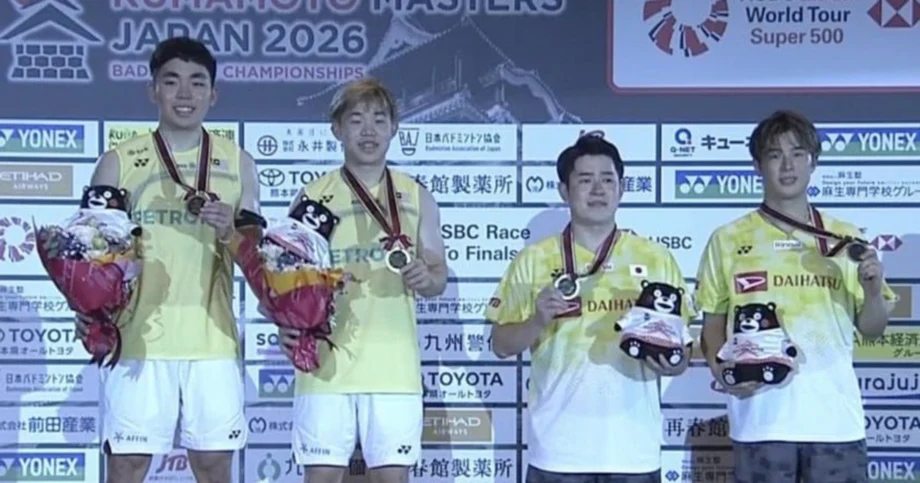
The official tournament podium confirms Aaron and Roy King as gold medallists and Hoki and Kobayashi as silver medallists. China's Wang Chang and Xie Haonan and Denmark's Daniel Lundgaard and Mads Vestergaard took bronze. The men's doubles field comprised 51 entries from 18 countries.
Aaron, 20, and Roy King, 25, earned US$39,500 after a final lasting about 55 minutes. They had already won the Arctic Open in Finland on their debut as a partnership the previous month. In Kumamoto, they added a victory over the 2021 world champions and former world No. 1 pair.
The Malaysians were listed at world No. 57, although No. 56 was also cited for the final, while Hoki and Kobayashi were ranked No. 10. Their success followed victories over several other higher ranked opponents during a tournament in which they reached the final without dropping a game.
The result also gave Malaysia a new place in the event's short history. Since the tournament began in 2023, Pearly Tan and M. Thinaah had been the only Malaysian champions, winning the women's doubles title the previous year. Aaron and Roy King have now added the men's doubles crown.
A Comeback Against the Home Favourites
Hoki and Kobayashi made the stronger start, taking the opening game 21-16 in front of their home crowd. The Malaysians, who had won their four earlier matches in straight games, now needed to win both remaining games to claim the title.
Aaron and Roy King responded with a more assertive second game, increasing the pace and attacking more decisively. They won it 21-13, their widest winning margin of the final, to force a deciding game.
The Japanese pair regained their rhythm early in the third game, and neither side immediately established a lasting advantage. Aaron helped turn the momentum before Roy King followed, with the Malaysians eventually creating enough separation to close out the match 21-15.
Across the three games, Aaron and Roy King scored 58 points to their opponents' 49. Badminton matches are decided by games rather than the combined points total, but those figures show how strongly the Malaysians recovered after losing the opener by five points.
A Difficult Route to the Trophy
Aaron and Roy King's title followed a demanding run through the draw. Their opponents included Japan's world No. 16 pair Kakeru Kumagai and Hiroki Nishi, Malaysian world No. 5 pair Goh Sze Fei and Nur Izzuddin Rumsani, and Chinese Taipei's world No. 15 pair Lee Jhe-Huei and Yang Po-Hsuan.
Against Sze Fei and Izzuddin in the second round, they won 21-14, 21-15 in just 28 minutes. They then beat Lee and Yang 21-16, 21-12 in the quarterfinals, maintaining their run without conceding a game.
Denmark's world No. 13 pair Daniel Lundgaard and Mads Vestergaard provided the semifinal opposition. Aaron and Roy King won 21-18, 21-18 in 38 minutes, taking both games by three points. The Danes had earlier eliminated Malaysia's eighth seeds Man Wei Chong and Tee Kai Wun.
Hoki and Kobayashi reached the final by beating China's Wang Chang and Xie Haonan 21-15, 19-21, 21-17. Both finalists therefore arrived with victories over strong opposition, although the Malaysians had completed their semifinal in two games and the Japanese pair had needed three.
Adaptation and Concentration Made a Difference
National men's doubles coach Chang Kim Wai identified tactical adjustments as a key part of the Malaysians' second round victory over Sze Fei and Izzuddin. His account described a partnership able to respond when its opponents changed their approach.
When Sze Fei-Izzuddin changed their approach in the second, Aaron-Roy King were able to adapt to their game.
Changing tactics in doubles requires both partners to react together. If one player changes the pace or direction of an attack, the other must be ready to cover the space and respond to the next shot. Chang's assessment points to coordination developing quickly between Aaron and Roy King.
Chang also credited their concentration in the semifinal against Lundgaard and Vestergaard. With both games finishing 21-18, a short run of mistakes could have changed the result.
"If they had panicked or lost focus even a little, it would have been difficult to win against the Danes," said Kim Wai.
Those qualities were tested again in the final. After four victories in straight games, Aaron and Roy King had to adjust to losing an opener and then sustain their recovery through a deciding game.
Roy King Reverses Two Losing Records
Roy King's victory over Hoki and Kobayashi carried particular personal significance. He had lost all three of his previous meetings with the Japanese pair while partnering Wan Arif Wan Junaidi. Their most recent encounter had come at the Asian Team Championships in Qingdao in February.
The second round win over Sze Fei and Izzuddin brought another breakthrough. Roy King had lost all four earlier meetings against the senior Malaysian pair when playing alongside Arif. With Aaron, he won in less than half an hour.
The Kumamoto title match was also Aaron and Roy King's third victory together over an opponent ranked in the world's top 10. Before beating No. 5 Sze Fei and Izzuddin and No. 10 Hoki and Kobayashi in Japan, they had defeated Indonesia's No. 7 pair Sabar Karyaman Gutama and Moh Reza Pahlevi Isfahani at the Hylo Open.
For the new partnership, those wins supplied a demanding test across different opponents and tournaments. Their early titles were accompanied by victories against established pairs near the top of the rankings.
How Their Early Results Fit Together
Aaron and Roy King have reached at least the semifinals in three of their five tournaments together. They won two of those events, the Arctic Open and Japan Masters, and reached the semifinals at the Hylo Open in Germany. Their other two appearances ended in the last 16.
That gives them titles in two out of five tournaments, or 40 percent, and places in at least the last four in three out of five, or 60 percent. The figures describe an unusually productive opening stretch, with five events still representing a short competitive history.
The main steps in their progress are:
- February: Roy King, then partnering Wan Arif Wan Junaidi, faced Hoki and Kobayashi at the Asian Team Championships in Qingdao.
- October: Aaron and Roy King won the Arctic Open in Vantaa, Finland, on their tournament debut together, beating Lai Po-Yu and Tsai Fu-Cheng 21-19, 21-19 in the final.
- Later in October: They reached the Hylo Open semifinals and recorded a victory over Sabar and Reza.
- November 15: They won the Japan Masters after recovering from a game down against Hoki and Kobayashi.
- Tuesday: Their next scheduled assignment is the Hong Kong Open.
Prize Money and Malaysia's Olympic Planning
The Japan Masters, a Super 500 event on the international World Tour, offered a total prize fund of US$500,000. The Super 500 label identifies the tournament's category within the tour, which determines its ranking points and competition level.
The official tournament listing confirms the US$500,000 prize fund and dates of November 10-15, 2026.
Aaron and Roy King's US$39,500 prize was more than twice the US$19,000 awarded to Hoki and Kobayashi as runners up. The difference was US$20,500, while the champions' award represented 7.9 percent of the tournament's total prize fund across its events.
The partnership is among the new doubles combinations being tested by the Badminton Association of Malaysia as it prepares for the 2028 Los Angeles Olympics. Two titles and a semifinal appearance make Aaron and Roy King the most successful of those new combinations so far.
In its statement announcing new men's doubles combinations, the Badminton Association of Malaysia said the changes formed part of its long-term plans to deliver Malaysia's first Olympic badminton gold medal at Los Angeles 2028. The decision followed extensive discussions between National Doubles Director of Coaching Rexy Mainaky, men's doubles head coach Herry Iman Pierngadi and BAM Performance Committee Chairman Lee Chong Wei.
"We have to look ahead to 2028. That doesn't mean Aaron and Wooi Yik no longer show promise, but instead we have to look at the number of young players we have," said Rexy.
Rexy said the strategy paired experienced senior players with younger shuttlers to accelerate development and broaden Malaysia's options, reducing reliance on a handful of established pairs while giving younger players more exposure at major international tournaments. Among the combinations announced, Olympic bronze medallist Aaron Chia would partner former World Junior champion Aaron Tai.
BAM's statement listed the China Open, Taipei Open and Korea Masters among upcoming tournaments for the new combinations. It said ranking qualification requirements meant the new pairings would not compete in Japan as initially planned and were instead expected to debut at the Korea Open, Taipei Open and China Open.
"This decision does not mean current permanent pairs are finished," said Rexy.
Rexy also said the approach could extend to women's doubles and mixed doubles if it proved beneficial.
"Why not? We should not be afraid to make changes. It's not just an experiment but a call based on the coach's observations and the players' ability to adapt in both training and competition.
"If this can help players' development and increase the country's chances in the future, then this approach can be used for all doubles departments," said Rexy.
Their immediate calendar continues with the Hong Kong Open beginning Tuesday, leaving only a short interval after Sunday's final. No revised world ranking or Olympic selection decision was announced alongside the Japan Masters result.
Roy King Keeps the Focus on Learning
Roy King responded to the victory by stressing how much work remained. Despite ending his losing run against Hoki and Kobayashi and collecting a second title with Aaron, he kept his assessment measured.
"I think there are still many things we need to learn. We want to take things slowly, step by step," he said after the match.
Aaron and Roy King now head to their next event with experience of winning a final in straight games in Finland and recovering from a game down in Japan. Kumamoto also tested their ability to adapt against familiar Malaysian opponents and maintain concentration against strong international pairs.
Key Points
- Aaron Tai and Yap Roy King won Malaysia's first Japan Masters men's doubles title on November 15, 2026.
- They defeated Takuro Hoki and Yugo Kobayashi 16-21, 21-13, 21-15 in Kumamoto.
- The victory brought their second title in five tournaments together, following their Arctic Open success.
- They won US$39,500 and recorded their third victory together over a pair ranked in the world's top 10.
- The partnership is part of Malaysia's testing of new doubles combinations ahead of the 2028 Los Angeles Olympics.
- Their next scheduled tournament is the Hong Kong Open, beginning Tuesday.