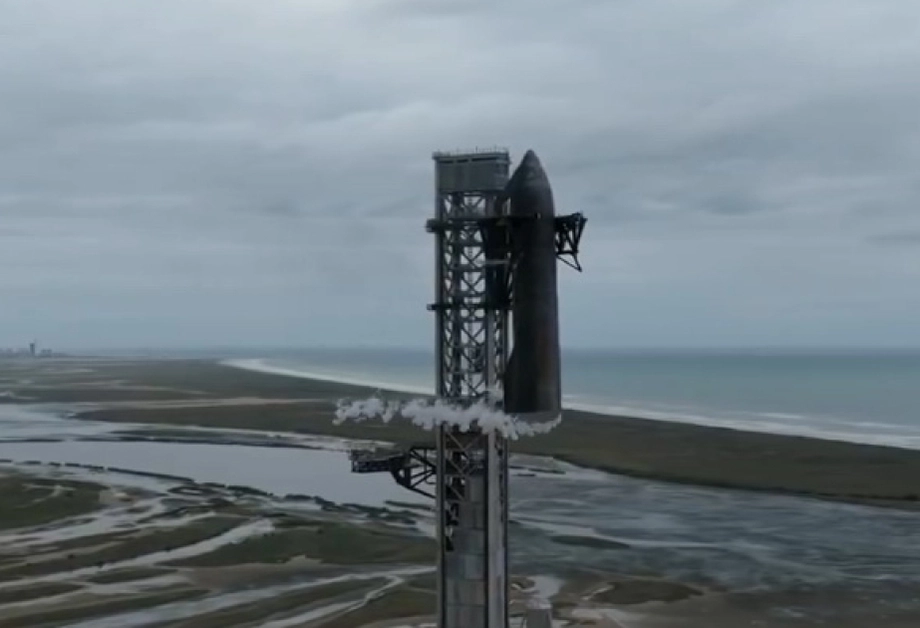
Ship 42 Returns to the Tower After 22.5 Hours
SpaceX caught its Starship spacecraft returning from orbit for the first time on November 14, 2026, bringing the 52 metre vehicle into the mechanical arms of its launch tower at Starbase in South Texas. The catch followed a flight lasting about 22.5 hours, during which the spacecraft circled Earth 14 times and deployed 26 Starlink V3 internet satellites.
Contents
The vehicle, known as Ship 42, reached the tower at 4:20 p.m. EST, or 3:20 p.m. local time in Texas. Its return completed the longest Starship flight yet and gave SpaceX its first recovery of the system's upper stage after an orbital mission.
Flight 15 had a more ambitious goal: catching both the spacecraft and the Super Heavy booster that launched it. The booster recovery was aborted on November 13 after an onboard fuel system alarm. It was diverted toward the Gulf of Mexico and exploded before reaching the water, leaving the mission with a successful spacecraft catch but a lost booster.
SpaceX launch commentator Dan Huot described the spacecraft's return during the company's live webcast:
That was the missing link. That was the holy grail of spaceflight, plummeting through fire to be snatched out of the air by steel. We caught a Starship, and now everything changes.
The catch matters because SpaceX wants to recover and fly both parts of Starship repeatedly. Bringing the spacecraft back to its launch site gives the company a vehicle to inspect and a practical starting point for testing how quickly it can prepare an upper stage for another mission.
What Mechazilla Caught
Starship is the name commonly used for the entire launch system, which has two major parts. Super Heavy is the booster that provides the initial push from the ground. Above it sits the spacecraft, also called Starship or Ship, which continues toward orbit after the booster separates.
Ship 42 stands 171 feet, or about 52 metres, tall. Instead of ending this flight in the sea, it returned to Starbase and settled between two large mechanical arms attached to the launch tower. SpaceX calls the tower Mechazilla and commonly describes the arms as chopsticks.
SpaceX had previously caught Super Heavy boosters on three test flights. Recovering the spacecraft presented a different challenge because it returned from orbit, travelling higher, farther and faster than the booster. Its heat shield had to protect it as it passed back through the atmosphere before the final descent to the tower.
Orbital flight requires enough sideways speed to keep moving around Earth rather than falling straight back down. Returning from that flight means shedding enormous amounts of energy, much of it through intense heating during atmospheric entry. Ship 42 had to survive that journey before the tower could catch it.
From Launch to Capture
Flight 15 began on the evening of November 13 at Starbase. The spacecraft continued its mission after Super Heavy's planned return was abandoned, deployed its satellites and remained in orbit until its descent the following day.
The mission unfolded across two dates, following an earlier orbital test in September:
- September 28, 2026: Flight 14 launched, reached orbit and deployed 26 Starlink V3 satellites during a flight lasting about three hours.
- November 13, 2026: Flight 15 launched from Starbase. Super Heavy diverted toward the Gulf of Mexico after a fuel system alarm.
- During Flight 15: Ship 42 deployed another 26 Starlink V3 satellites and completed 14 orbits around Earth.
- November 14, 2026: Mechazilla caught Ship 42 at 4:20 p.m. EST, roughly 22.5 hours after launch.
The flight lasted about seven and a half times as long as September's three hour mission. It was also the 15th full scale Starship flight test since testing began in 2023, giving SpaceX another set of flight data on the spacecraft's performance through launch, orbit and return.
Why the Booster Did Not Return
Super Heavy's recovery attempt ended when its onboard system detected a fuel system alarm, described during coverage of the flight as a low fuel warning. The booster was directed away from the tower toward an offshore splashdown area in the Gulf of Mexico, where it exploded before reaching the water.
During SpaceX's Flight 15 webcast on November 14, Kate Tice said early indications pointed to a low fuel mass alarm that ended the boostback burn early. Huot clarified that the guidance and navigation control system had worked as intended, triggering an automatic abort after detecting that the booster was out of position for a tower catch.
All 33 engines on Booster 22 fired during ascent, while 32 of the 33 lit for the boostback burn. The booster diverted offshore and its flight termination system triggered about 6.5 minutes after liftoff.
SpaceX said the root cause of the alarm was under investigation. Recovering the booster and spacecraft together therefore remains an unfinished part of the company's plan, even after Ship 42's successful return.
The loss has practical consequences for reuse. A flight that brings back the spacecraft but loses the booster still requires another booster for a later launch. SpaceX's intended operating model depends on recovering both vehicles, checking their condition and preparing them to fly again.
The next test will carry particular interest because Flight 15 showed that the upper stage could complete an orbital mission and reach the tower, while the booster experienced a problem during its recovery sequence. No date for the next launch was given.
Satellites Helped Check the Heat Shield
Ship 42 carried 26 Starlink V3 satellites into low Earth orbit, the region relatively close to Earth where the Starlink internet network operates. SpaceX said all 26 were healthy and beginning to raise their orbits toward their operating altitudes.
Some of those satellites also took images and video of Ship 42's heat shield. SpaceX used those views alongside cameras on the ground to assess the spacecraft before its return. The checks found it in suitable condition for the landing attempt.
In SpaceX's November 13 mission update, Huot said the heat shield team had reviewed data from ground-tracking cameras and cameras aboard some of the satellites. The team confirmed that the heat shield was "in a good posture for a reentry and return to the launch site".
The recovered spacecraft now gives engineers a chance to compare those images and flight measurements with the physical vehicle. SpaceX plans to examine how the heat shield handled atmospheric entry, a central part of making an orbital spacecraft usable more than once.
A successful catch is one step in that work. The inspection and preparation that follow will determine what maintenance Ship 42 needs and provide information for later flights. SpaceX's goal is to make those checks, repairs and repeat launches fast enough to support a much busier launch schedule.
What the Flight Adds to Starlink
Flights 14 and 15 each deployed 26 Starlink V3 satellites, bringing their combined contribution to 52. SpaceX's existing Starlink network already had more than 11,000 satellites in low Earth orbit, making these flights an early addition to a much larger operating system.
SpaceX says a single Starship can carry up to 60 Starlink V3 satellites. Flight 15's load of 26 was about 43 percent of that stated maximum. The company therefore has room to increase the number carried per mission as testing and operations develop.
Starlink is the immediate commercial reason for bringing Starship into regular service. Its satellites provide internet connections, and the business is a major source of profit for SpaceX. Carrying more satellites on each launch would help the company expand that network.
SpaceX has described a future Starlink constellation reaching 100,000 satellites. Musk has also proposed Starmind, a separate concept involving a million spacecraft serving as data centres for artificial intelligence. Those are proposed future networks, while Flight 15 delivered 26 satellites.
Musk's ambition for hundreds or even thousands of Starship launches each year would require a very different pace from the test programme so far. Recovering both stages, inspecting them promptly and flying them again are central to reaching that scale.
NASA's Moon Plans Depend on More Testing
NASA also has a direct interest in Starship's progress. SpaceX is developing a version intended to carry astronauts and cargo between lunar orbit and the Moon's surface, then return them to lunar orbit.
NASA Administrator Jared Isaacman congratulated Musk and the SpaceX team after the catch. In a post on X, he described the achievement in these words:
It was almost magic ... Making more believers by the day,
The lunar schedule described alongside the test calls for Starship and Blue Origin's Blue Moon landing system to undergo testing in low Earth orbit during Artemis III in 2027. Starship is slated to support crewed lunar missions as early as 2028.
Ship 42's return provides experience with operating and recovering the spacecraft, while NASA's programme requires a version capable of carrying out a different mission around the Moon. The planned orbital testing is the next scheduled opportunity described for assessing the landing systems before their intended use on crewed lunar missions.
Air Travel Disruptions and Expansion Plans
Flight 15 also affected aviation. The Hawaii Department of Transportation temporarily paused some flights from the West Coast because of debris risk associated with the launch. The Federal Aviation Administration separately issued a nationwide ground stop because of telecommunications system failures. Both restrictions were later lifted.
In its November 13, 2026 statement on the ground stop, the FAA said the order covered all U.S. airports after communication issues affected multiple Air Route Traffic Control Centers. FAA technicians were investigating the issue, and the agency said the information was preliminary and subject to change.
The two interruptions had different stated causes: debris concerns prompted the Hawaii action, while the federal ground stop concerned telecommunications. For travellers, both could interrupt flight schedules during the same period.
SpaceX is preparing to expand Starship operations to NASA's Kennedy Space Center in Florida and is planning another launch site in Louisiana. Those projects accompany its ambition to move beyond occasional tests toward frequent launches.
At Starbase, the immediate work is more specific: investigate the booster alarm, examine Ship 42 and study the data from its 14 orbits and return. Flight 15 delivered satellites and recovered an orbital spacecraft at the launch tower for the first time. Bringing both stages home on the same mission remains the next major recovery goal.
Key Points
- SpaceX caught Ship 42 at Starbase on November 14, 2026, its first tower capture of a spacecraft returning from orbit.
- Flight 15 lasted about 22.5 hours, completed 14 orbits and deployed 26 Starlink V3 satellites.
- Early indications pointed to a low fuel mass alarm ending Super Heavy's boostback burn early. Its guidance system correctly aborted the catch after detecting that the booster was out of position. The booster diverted toward the Gulf of Mexico and exploded before reaching the water.
- SpaceX said all 26 satellites were healthy and raising their orbits.
- Engineers will examine the recovered spacecraft, including its heat shield, while investigating the booster alarm.
- The lunar schedule calls for landing system tests during Artemis III in 2027, with Starship supporting crewed Moon missions as early as 2028.