A 114-page ruling puts Senate selection under scrutiny
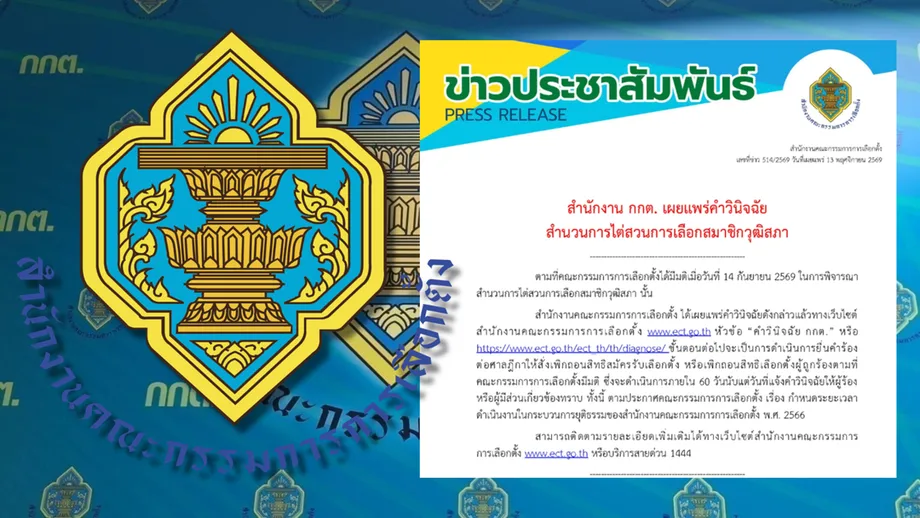
Thailand's Election Commission published its full ruling on alleged collusion in the 2024 Senate selection on November 13, 2026, setting out a case against 77 people, including 26 serving senators. The document makes public the reasoning behind a decision issued on September 14, almost two months earlier.
Contents
- A 114-page ruling puts Senate selection under scrutiny
- Two deadlines govern the next steps
- How the Senate selection worked
- Why political leaders were left outside the referral
- Three witnesses became central to the decision
- A commissioner challenged the majority's approach
- Why 26 seats matter beyond the chamber
- A court decision opens another route for complaints
- A separate dispute concerns which court can act
- Key Points
The 114-page ruling, numbered 1526/2569 and signed by commission chairman Narong Klanwarin, concerns seven allegations involving 427 respondents under the Organic Act on the Acquisition of Senators, B.E. 2561 (2018). The commission voted by majority to seek court action against 77 of them.
The Election Commission's office said it would petition the Supreme Court's Election Cases Division to revoke electoral rights. Its English account described requests to remove both the right to stand for election and the right to vote, while its procedural announcement referred to revoking candidacy rights or voting rights according to the commission's resolutions.
The 26 senators represent 13% of the 200-member chamber. Their position becomes especially consequential if the Supreme Court accepts petitions against them: they would then have to stop performing official duties while awaiting judgment.
The document also explains why the commission declined to pursue allegations against prominent political figures, including Prime Minister Anutin Charnvirakul and Newin Chidchob. Disagreements over witness credibility, financial evidence and the scope of the investigation have kept the controversy open beyond the 77 people facing referral.
Two deadlines govern the next steps
September 14 and November 13 mark different stages of the case. The commission reached its decision in September; the full text became publicly available in November. Thai documents use the Buddhist calendar year 2569, equivalent to 2026.
The commission was required to publish its ruling within 60 days of issuing it. November 13 falls 60 days after September 14 when counting elapsed days from the following day.
A second deadline governs the court petition. Under the commission's 2023 announcement on time limits for its justice procedures, filing must take place within 60 days after the ruling is notified to the complainant or interested parties. The notification date was not disclosed, so an exact filing deadline cannot yet be calculated.
The main events span more than two years:
- May 13, 2024: The commission issued an announcement connected with the Senate selection process.
- June 2024: Candidates took part in the Senate selection.
- September 14, 2026: The commission decided to advance proceedings against 77 people.
- October 2, 2026: Academic analysis examined the decision and its consequences for constitutional institutions.
- November 3, 2026: Commissioners voted 5 to 2 to seek a Constitutional Court ruling over a related question of Supreme Court jurisdiction.
- November 13, 2026: The full Senate collusion ruling was published.
How the Senate selection worked
Thailand's Senate has 200 members selected indirectly through 20 occupational or social groups. Candidates identified themselves with a group and participated in selection among peers at district, provincial and national levels. Ten successful candidates from each group became senators.
Voters therefore did not choose these senators through an ordinary national election. Candidates advanced through successive rounds involving other candidates, making allegations about coordinated voting instructions central to the dispute.
Purawich Watanasukh, a lecturer at Thammasat University's Faculty of Political Science, explained the system and the case in his October 2 analysis. Senate candidates cannot belong to political parties or coordinate their campaigns with them.
The alleged use of voting lists, sometimes described as slates, matters in that setting. A slate tells participants which candidates to support. Investigators examined whether coordination and political assistance breached the rules intended to keep the selection independent of parties.
Why political leaders were left outside the referral
The commission declined to proceed against 21 respondents accused of helping Senate candidates, principally Bhumjaithai Party leaders and executives. For 12 of those respondents, including Anutin, commissioners voted 5 to 2 against proceeding.
Allegations one and two addressed whether political figures had helped candidates win or caused other candidates to lose, under the first and second paragraphs of Section 76 of the 2018 law. The people considered included party executives, members of the House of Representatives, local political figures and other officeholders.
The detailed account of those two allegations identifies 21 respondents, including Anutin and Newin. A broader description of the decision refers to 22 party executives and senior Bhumjaithai figures, with most allegations against them dismissed.
The majority's reasoning focused heavily on the evidence supporting the alleged political assistance. According to the ruling, accusations against the 21 political figures emerged during the work of investigation panel 26, following testimony from three witnesses. The commission questioned why those witnesses had not come forward earlier.
Bhumjaithai and Senate leaders have denied that the party controls the chamber. The decision to pursue individual candidates while declining to advance the political assistance allegations leaves the court referral narrower than the wider political dispute.
Three witnesses became central to the decision
The ruling discussed witnesses identified by the codes 16/26, 21/26 and 22/26. They were identified as former Bhumjaithai MP Ekkarat Changlao, senator Atsadang Sawaengkan and Khajornsak Sriwirat, a former deputy head of the Phayao Provincial Administrative Organisation.
The majority questioned Ekkarat's possible motivation. Its reasoning referred to his expulsion from Bhumjaithai following a Khon Kaen court sentence of more than 11 years in a teachers' savings cooperative embezzlement case. He subsequently joined Kla Tham during a period of political conflict between the parties.
The commission said that history required caution when considering his testimony. It also identified contradictions among the witnesses about promised parliamentary seat allocations connected with alleged cooperation, and whether mobile phones were collected during meetings allegedly used to prepare Senate voting lists.
One witness later wrote to the commission chairman seeking to give a new statement saying that events previously described had never happened. The majority treated that reversal as damaging to the witness's credibility.
The accounts of the ruling do not identify which witness made that reversal. Keeping the three witnesses distinct matters because the majority discussed several different reasons for doubting their evidence.
A commissioner challenged the majority's approach
Commissioner Sitthichote Intaraviset publicly disputed the majority's assessment. He argued that witness testimony, alleged voting instructions and telephone records should have been evaluated together.
His objection concerned how investigators connected different pieces of evidence. A telephone record can show contact between people, while testimony can describe an alleged meeting or instruction. Sitthichote's position was that the commission should assess the combined account when deciding whether to continue the case.
Sitthichote also said a separate vote of 4 to 3 blocked further investigation into parts of the financial trail. That narrow division shows that commissioners disagreed about whether more inquiries into money movements were necessary.
The majority's doubts about witnesses and the dissenting commissioner's demand for a broader assessment explain why publication of the full reasoning matters. Readers can now examine the commission's stated grounds for treating the candidate allegations and the alleged political assistance differently.
The opposition People's Party has said it will pursue further legal and parliamentary action. Opposition chief whip Parit Wacharasindhu has also challenged the idea that proceedings against 77 candidates will settle the controversy.
Why 26 seats matter beyond the chamber
The Senate no longer takes part in choosing the prime minister, but it retains substantial constitutional powers. Constitutional amendments require support from at least one third of senators. The chamber also approves nominees to the Constitutional Court and independent oversight bodies by a simple majority.
Those bodies include the Election Commission, National Anti-Corruption Commission, Ombudsmen, State Audit Commission and National Human Rights Commission. Senate votes therefore help determine who oversees elections, investigates officials and decides major constitutional disputes.
During the investigation, the current Senate approved four of the commission's seven serving members, according to Purawich's analysis. It also approved appointments to other constitutional institutions, including the Constitutional Court.
Four out of seven commissioners is a majority of the election regulator. That appointment relationship is a concrete reason for close public attention to how commissioners explain their votes and handle any relevant personal or institutional connections.
If the Supreme Court accepts petitions against the 26 sitting senators, their required suspension would affect 13% of the chamber. A later finding of wrongdoing could lead to the loss of seats and electoral rights. Appointments previously approved by Senate votes would continue unless addressed through a separate legal process.
A court decision opens another route for complaints
The commission faces scrutiny through a second legal route. Court of Appeal president Witoon Khlongmeekhun ruled that members of the public may bring complaints directly against election officials in the Criminal Court for Corruption and Misconduct Cases.
The decision concerns the seven election commissioners and the commission's secretary general, Sawaeng Boonmee. It conflicts with a decision issued in May by Witoon's predecessor, Mantharee Utchin, which required complaints to pass through the National Anti-Corruption Commission and the Attorney General.
Witoon's ruling explained the public interest at stake in alleged misconduct connected with obtaining a Senate seat:
The commission of corruption and misconduct to gain a position in the Senate amounts to depriving the public of their sovereign power.
For complainants dissatisfied with the handling of the Senate case, the decision creates a route to seek court consideration directly. Their complaints would still require judicial examination of the allegations and evidence.
Parit said this development meant the Senate collusion controversy would not end "easily" with the commission's action against 77 candidates. His party's planned legal and parliamentary efforts extend the dispute beyond the pending electoral rights petitions.
A separate dispute concerns which court can act
On November 3, the Election Commission voted 5 to 2 to petition the Constitutional Court over the Supreme Court's jurisdiction to consider a petition concerning senators' qualifications. At the time that development was reported, the Constitutional Court had yet to receive the commission's petition.
Jurisdiction means a court's legal authority to hear and decide a particular case. This dispute concerns which institution can consider a challenge to senators' qualifications, alongside the commission's planned proceedings over alleged collusion.
Former Constitutional Court judge Charan Pakdeethanakul opposed the proposed approach. He said the commission could not ask the Constitutional Court to review the Supreme Court's authority, citing the constitutional principle that courts exercise judicial power independently and one court cannot interfere with another's exercise of that power.
The immediate procedural steps are the filing of the commission's electoral rights petitions and any Supreme Court decision accepting them. Acceptance would trigger the suspension rule for the sitting senators concerned. The separate jurisdiction petition and possible complaints against election officials could bring further proceedings around the same selection controversy.
Publication has now exposed the reasoning behind the September decision, including the majority's doubts about key witnesses and the dissent over further investigation. The courts will next determine the cases placed before them, while the political dispute continues over whether accountability should extend beyond the candidates selected for referral.
Key Points
- The Election Commission published its 114-page ruling on November 13, 2026, following its September 14 decision.
- The commission plans court action against 77 people, including 26 of Thailand's 200 senators.
- The filing period runs for 60 days from notification of the ruling to complainants or interested parties.
- The commission declined to proceed against 21 respondents accused of political assistance, including Prime Minister Anutin Charnvirakul.
- A dissenting commissioner challenged the evidence assessment and said a 4 to 3 vote blocked further financial inquiries.
- Sitting senators must stop performing their duties if the Supreme Court accepts petitions against them.
- Further disputes concern direct complaints against election officials and the courts' authority over senators' qualifications.