A folding screen joins Pyongyang's electronics showcase
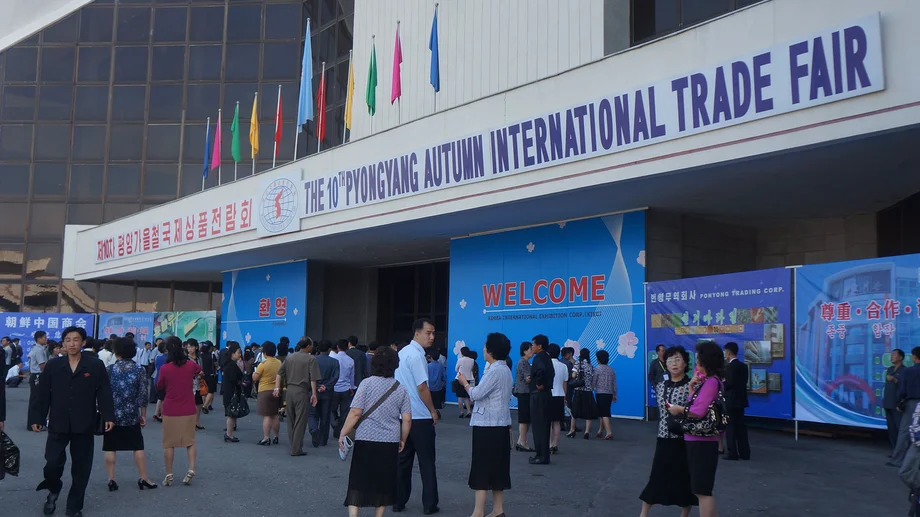
North Korea's Blue Sky Trading Company displayed a smartphone that opens like a book at the 18th Pyongyang Autumn International Trade Fair, held from October 26 to 30, 2026, at the Pyongyang Youth Central Hall. A promotional board identified the device as the Blue Sky 2026, adding a new name to a growing range of folding phones appearing in the country.
Contents
- A folding screen joins Pyongyang's electronics showcase
- What the photographs reveal
- Blue Sky promises another product
- Other folding phones are already on sale
- From leadership sightings to a trade fair booth
- Who makes North Korea's branded phones?
- Modern hardware, restricted connections
- What the display changes
- Key Points
Photographs published on November 13 showed a visitor unfolding and operating the handset, alongside the company's product display. A conventional smartphone, the Blue Sky 9-4, was also exhibited. Together, they presented a broader product range from a company already associated with smartphones, digital televisions and computers.
The display brings together two developments in North Korea's electronics market: local brands are adopting designs familiar elsewhere in Asia, while research into earlier devices points to substantial reliance on overseas manufacturers. Buyers also face a tightly restricted communications environment, even when the hardware resembles premium phones sold abroad.
The Blue Sky 2026's manufacturer, production arrangements, screen size, technical specifications, retail price and date of sale have not been disclosed. The immediate development is its public exhibition, with photographs showing the handset in use and advertising identifying its name.
What the photographs reveal
The Blue Sky 2026 unfolds sideways, creating a wider display than a conventional phone. This format differs from a flip phone, which folds from top to bottom to become smaller when closed. Both designs use a screen that bends at a hinge.
Icons visible on the display included a calendar, clock, camera and music application. Other symbols appeared to represent QR code scanning and voice search. QR codes are patterned squares that a camera can read to retrieve information; voice search lets a user speak a request instead of typing it.
The rear camera housing has an octagonal outline that resembles designs used in Huawei's Mate range, although details of its appearance differ. The handset's booklike format also follows a design approach familiar from Samsung and other international brands.
Stimson Center researcher Martyn Williams identified the device as the Blue Sky 2026 on October 29, during the fair. The product name also appeared in photographs of the promotional board. Blue Sky is the English translation of the Korean brand name, which is also rendered as Pureunhanul or Pureun Haneul.
Blue Sky promises another product
Blue Sky Trading Company has been presented domestically as a producer of smartphones, digital televisions and computers that combine the screen and main components in one unit. Its phones include the Blue Sky 9-3, as well as the 9-4 displayed beside the new foldable.
The company has reportedly been selected several times among North Korea's top 10 information technology companies. Domestic publicity has also described Blue Sky phones as popular among residents, although it gives no sales figures or market share.
Company representative Ri Song-i said the business was directing development work toward artificial intelligence and promised another product at the next fair:
We are currently focusing our efforts on developing AI-powered products, and we will definitely introduce a new product at the next trade fair.
Ri's statement set out a development priority without describing a particular AI function. Artificial intelligence generally refers to software that performs tasks such as recognizing speech or identifying patterns in images. The next trade fair was the company's stated target, but no calendar date or detailed product announcement accompanied the pledge.
Other folding phones are already on sale
North Korea's market already includes folding handsets beyond the Blue Sky brand. Research published in June 2026 identified one model that folds sideways and five that fold vertically. That makes six models in the survey, with flip designs accounting for five of the six.
The Madusan 2222, a phone that opens sideways, has reportedly been offered for about $2,000. Its design has been assessed as likely based on Honor's Magic V2 RSR, a premium handset from the Chinese manufacturer. Another Madusan model, the 1005, resembles the V Flip Pro made by China's Doogee.
The $2,000 figure applies to the Madusan 2222. Blue Sky's newly exhibited phone enters the same broad category of devices, but its commercial position will depend on the price, specifications and availability eventually announced.
The six models identified in June also show that the trade fair display belongs to an existing market trend. North Korean brands have been introducing both compact flip designs and larger phones that open into wider screens, rather than relying on a single folding format.
From leadership sightings to a trade fair booth
Folding phones first attracted wider attention in North Korea through images of senior political figures. In July 2023, a handset that folded vertically was visible on a table as Kim Jong Un observed a test launch of the Hwasong-18 intercontinental ballistic missile.
Kim Yo Jong, his sister and a deputy department director of the ruling Workers' Party, has also been pictured using a foldable believed to belong to Honor's Magic series. Those sightings placed the devices near the leadership before the latest exhibition presented one under the Blue Sky brand.
The sequence traces the move from individual sightings to a more visible range of products:
- July 2023: A folding phone appeared on a table during Kim Jong Un's observation of a Hwasong-18 missile test.
- 2024: Williams published research describing extensive use of Chinese manufacturing arrangements for smartphones sold in North Korea.
- June 2026: Research identified six folding phone models on sale, one opening sideways and five folding vertically.
- July 2026: Williams compared the Blue Sky 9-3 with India's Lava Agni 3.
- October 26 to 30, 2026: Blue Sky exhibited its new foldable at the Pyongyang trade fair.
- November 13, 2026: Published photographs showed the demonstration and Blue Sky 2026 promotional board.
Who makes North Korea's branded phones?
North Korea says its factories can produce hundreds of thousands of mobile phones annually. Williams' research into smartphones sold in the country describes a market in which many devices come from Chinese companies through original equipment manufacturing arrangements, commonly called OEM.
In this business model, one company manufactures a device that another sells under its own brand. The brand seen by the customer and the company operating the factory can therefore be different. A locally branded phone may combine hardware supplied from abroad with software prepared for its destination market.
Williams' July comparison offers a specific example involving Blue Sky. He found that the Blue Sky 9-3 matched the appearance and key specifications of the Agni 3 sold by Indian consumer electronics company Lava. The resemblance extended beyond a shared style to the main advertised technical features.
The comparisons involving Blue Sky, Honor and Doogee place the new exhibition within a wider pattern of overseas connections. For the Blue Sky 2026, the central manufacturing question is where its hardware was designed and built, and what work Blue Sky itself performs before presenting the finished device under its brand.
Modern hardware, restricted connections
North Korean smartphones reportedly use a modified version of Android, the operating system that manages applications and other basic phone functions. The modifications form part of a domestic communications environment with much narrower access than smartphone users have in most countries.
Phones are reported to lack support for foreign SIM cards and ordinary Wi-Fi connections. A SIM card identifies a subscriber to a mobile network. Restrictions on which cards a handset accepts affect the networks on which it can operate.
Residents are described as using a state controlled internal network called Mirae rather than the global internet. An internal network, or intranet, provides access to a limited collection of services within a closed system. Users can have digital services without the open web access associated with smartphones elsewhere.
The Kangsong mobile network reportedly supports fourth generation mobile service, known as 4G. That term describes the cellular technology carrying data. The services reachable through that connection depend on the network's access rules, so faster communications and restricted content can exist together.
What the display changes
Blue Sky's exhibition gives its folding phone a public product identity, a place beside the conventional 9-4 and a demonstration setting where a visitor could handle it. Earlier leadership photographs showed individual devices; the fair placed a foldable within a company's advertised electronics range.
For potential customers, the practical questions concern the finished product: its cost, battery life, screen durability, available applications and repair service. For the manufacturer, Ri's promise makes the next fair the announced occasion for another introduction.
The story now connects three parts of North Korea's phone industry: brands promoting increasingly elaborate hardware, overseas manufacturing relationships documented in earlier products, and domestic networks that tightly limit access. The Blue Sky 2026 brings those parts together in a single handset displayed in Pyongyang.
Key Points
- The Blue Sky 2026 was displayed at the Pyongyang trade fair held from October 26 to 30, 2026.
- The handset opens sideways and appeared alongside the conventional Blue Sky 9-4.
- Its manufacturer, specifications, price and date of sale have not been disclosed.
- Research identified six folding phone models already on sale in North Korea in June 2026.
- Williams' research describes extensive overseas manufacturing links among North Korean smartphone brands.
- Company representative Ri Song-i promised a new product at the next trade fair while describing a focus on AI development.
- North Korean phone users face restricted networks and services despite increasingly modern handset designs.