Higher allowance and new tax bands promise salary relief
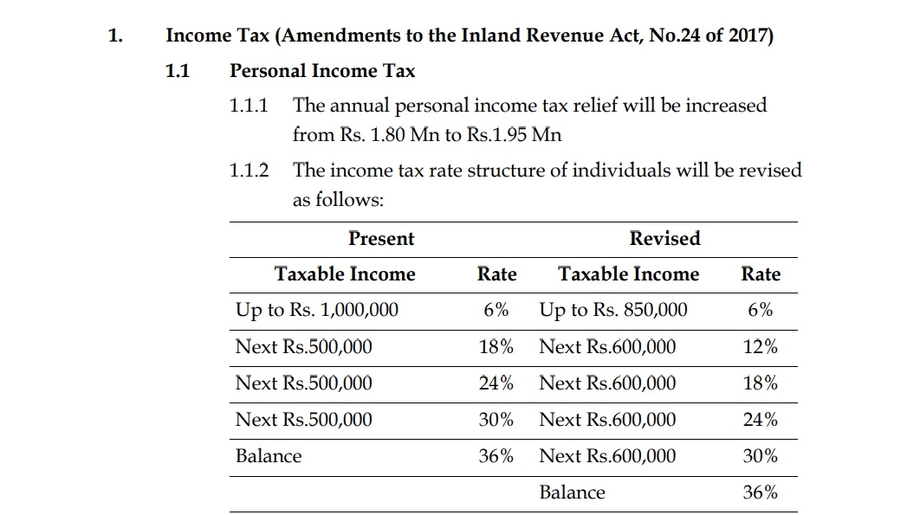
Sri Lanka has proposed raising its annual personal income tax allowance to Rs. 1.95 million from Rs. 1.8 million in the 2027 budget, allowing people earning salaries and allowances of up to Rs. 162,500 a month to pay no income tax on that pay. The current monthly threshold is Rs. 150,000.
Contents
- Higher allowance and new tax bands promise salary relief
- How much more income would be exempt?
- What the proposed tax bands would look like
- Why reaching a higher rate does not tax the whole salary at that rate
- What the changes could mean for individual pay packets
- How the proposal builds on the 2025 changes
- How much revenue would the government give up?
- Tax relief comes as borrowing and debt payments continue
- Key Points
President and Finance Minister Anura Kumara Dissanayake presented the package to Parliament on November 12, 2026. Alongside the higher allowance, it introduces a 12% tax band and changes the amounts of income covered by other rates. The maximum rate stays at 36%, but would begin above annual income of Rs. 5.2 million rather than Rs. 4.3 million.
The government estimates that the revisions would provide additional monthly tax relief of Rs. 750 to Rs. 15,750, depending on income, while reducing government revenue by Rs. 16 billion. For employees, the practical benefit would be smaller deductions from pay. For the Treasury, the package means collecting less revenue while continuing to finance public spending and debt payments.
The amendments to the Inland Revenue Act, No. 24 of 2017, are proposed to take effect on April 1, 2027. They remain subject to the legislative process, so the budget announcement is a proposal rather than an immediate change to payroll deductions.
How much more income would be exempt?
The annual allowance would increase by Rs. 150,000, equivalent to Rs. 12,500 a month. Compared with the existing Rs. 1.8 million allowance, that is an increase of about 8.3%.
A worker receiving Rs. 162,500 every month would earn Rs. 1.95 million over a full year. Under the proposed allowance, that salary would fall entirely within the exempt amount. Someone earning more would have the allowance deducted before the tax bands are applied to the remaining income.
The Rs. 12,500 increase in the monthly allowance is different from the amount saved in tax. For example, a person earning Rs. 162,500 a month currently has Rs. 12,500 above the monthly allowance. At the initial 6% rate, the tax on that amount is Rs. 750. Removing it from taxable income would therefore save Rs. 750 a month.
Employees already earning below Rs. 150,000 a month would remain below the salary tax threshold. The immediate benefit of the higher allowance goes to people who currently pay tax, including those whose earnings would now fall entirely within the expanded exemption.
What the proposed tax bands would look like
The revised system separates the exempt allowance from taxable income. After subtracting the Rs. 1.95 million annual allowance, the remaining income would be divided into bands, with each band taxed at its own rate:
- First Rs. 850,000 of taxable income: 6%.
- Next Rs. 600,000: 12%.
- Next Rs. 600,000: 18%.
- Next Rs. 600,000: 24%.
- Next Rs. 600,000: 30%.
- Remaining taxable income: 36%.
The existing framework applies 6% to the first Rs. 1 million of taxable income, followed by Rs. 500,000 bands taxed at 18%, 24% and 30%. The balance is taxed at 36%.
The proposal therefore makes several changes at once. The first taxable band becomes smaller, falling from Rs. 1 million to Rs. 850,000. A new 12% band follows it, while the subsequent bands expand from Rs. 500,000 to Rs. 600,000, an increase of 20% in their width.
On a monthly equivalent basis, the first proposed taxable band is about Rs. 70,833. Each following Rs. 600,000 annual band equals Rs. 50,000 a month, compared with about Rs. 41,667 under the existing Rs. 500,000 bands.
Why reaching a higher rate does not tax the whole salary at that rate
Sri Lanka uses a progressive personal income tax structure. This means income is taxed in layers: the allowance is exempt, the next portion faces the lowest rate, and higher portions face higher rates. A worker entering the 36% band pays that rate only on income above its starting point.
Under the proposal, the Rs. 1.95 million allowance, the Rs. 850,000 initial taxable band and four Rs. 600,000 bands add up to Rs. 5.2 million. Income above that amount would enter the 36% band. The budget describes the corresponding monthly threshold as approximately Rs. 433,000, compared with approximately Rs. 358,000 now.
The annual starting point for the maximum rate would rise by Rs. 900,000, or about 20.9%, from Rs. 4.3 million. People earning between the old and proposed starting points would consequently have more income taxed below 36%.
A person earning Rs. 5.2 million annually would have Rs. 3.25 million left after the proposed allowance. Applying the five lower bands produces annual tax of Rs. 555,000, equivalent to about 10.7% of total income. The calculation shows how the average share of income paid in tax can be much lower than the highest rate reached.
What the changes could mean for individual pay packets
A worker earning Rs. 200,000 a month, or Rs. 2.4 million annually, would have Rs. 450,000 of taxable income after the proposed allowance. At 6%, annual tax would be Rs. 27,000, equivalent to Rs. 2,250 a month. Under the existing allowance and bands, the equivalent monthly tax is Rs. 3,000, giving a saving of Rs. 750.
A worker earning Rs. 300,000 a month would have annual income of Rs. 3.6 million. Under the proposed structure, annual tax would be Rs. 159,000, or Rs. 13,250 a month. Under the existing structure, annual tax is Rs. 222,000, or Rs. 18,500 a month. The difference is Rs. 5,250 a month.
At annual income of Rs. 5.2 million, the proposed Rs. 555,000 tax bill compares with Rs. 744,000 under the existing framework. The annual saving would be Rs. 189,000, equivalent to Rs. 15,750 a month, matching the upper end of the government's estimated additional relief.
These examples assume the stated income is received evenly through the year and that only the personal allowance and listed tax bands apply. They illustrate the annual tax structure rather than a complete payroll calculation for someone with other income, adjustments or deductions.
How the proposal builds on the 2025 changes
The government raised the annual personal allowance from Rs. 1.2 million to Rs. 1.8 million in 2025. That increased the monthly equivalent from Rs. 100,000 to Rs. 150,000. Dissanayake said the earlier reforms provided monthly relief ranging from Rs. 3,500 to Rs. 20,500 per taxpayer.
The proposed 2027 increase is smaller: Rs. 150,000 annually, compared with the Rs. 600,000 increase introduced in 2025. Taken together, the two changes would lift the annual allowance by Rs. 750,000 from its earlier Rs. 1.2 million level, an increase of 62.5%.
The budget puts the combined monthly relief from the 2025 reforms and proposed 2027 changes at Rs. 4,250 to Rs. 36,250. That combined figure includes relief already introduced in 2025; the additional benefit attributed to the new proposal is Rs. 750 to Rs. 15,750.
The main dates in the tax changes are:
- 2025: The annual personal allowance increased from Rs. 1.2 million to Rs. 1.8 million.
- November 12, 2026: Dissanayake presented the proposed higher allowance and revised bands in the 2027 budget.
- April 1, 2027: Proposed start date for the new amendments, subject to the legislative process.
How much revenue would the government give up?
The Rs. 16 billion revenue reduction attributed to income tax changes is the largest component of a broader package of tax revisions. The budget estimates that the package would reduce government revenue by about Rs. 28.4 billion in 2027.
Income tax changes therefore account for about 56% of that projected net reduction. Removing CESS, another levy, is expected to reduce receipts by Rs. 10 billion, while changes to value added tax, or VAT, are expected to cost Rs. 2.98 billion.
Changes to the Port and Airports Development Levy would reduce revenue by an estimated Rs. 350 million. Abolishing the Tourism Development Levy would remove another Rs. 40 million. A revised Special Commodity Levy is expected to bring in Rs. 950 million, partly offsetting the reductions.
The listed revenue losses total Rs. 29.37 billion. Subtracting the Rs. 950 million expected from the revised commodity levy produces a net reduction of Rs. 28.42 billion, consistent with the rounded Rs. 28.4 billion budget estimate. The package combines tax reductions with an increase in receipts from one levy.
Tax relief comes as borrowing and debt payments continue
Sri Lanka expects to seek $2.08 billion in foreign loans in 2027. Its foreign debt servicing is forecast at $2.98 billion, down from $3.59 billion in 2026 and $3.70 billion in 2025. The decline from 2026 is $610 million, or about 17%.
The country secured a four year, $2.9 billion International Monetary Fund programme in March 2023, after defaulting on its $46 billion foreign debt in April 2022. The current programme is due to end in March 2027, shortly before the proposed tax changes would begin.
Dissanayake told Parliament that the government was examining whether to seek another IMF arrangement after completing the current programme:
We have appointed a committee to study whether we should enter into a new programme.
Government revenue is forecast at 15.8% of gross domestic product in 2027, compared with 16.6% in 2026 and 16.7% in 2025. GDP measures the value of goods and services produced in the economy. The projected decline from 2026 is 0.8 percentage points.
The budget deficit, the gap between government spending and revenue, is forecast to widen to 4.5% of GDP in 2027 from 3.7% in 2026. Tax relief would leave affected households with more money after deductions, while the government plans to collect a smaller share of national output in revenue.
Economic growth also matters for those finances. Sri Lanka recorded growth of 5% in 2025, and the government hopes to achieve the same pace in 2027. The IMF forecasts growth of 3.1% in 2026 amid higher global energy costs. Those projections place the proposed relief within a budget that must also manage borrowing needs and continuing debt payments.
Key Points
- The proposed annual personal income tax allowance rises from Rs. 1.8 million to Rs. 1.95 million, equivalent to Rs. 162,500 a month.
- The revised rates would be 6%, 12%, 18%, 24%, 30% and 36%, applied to successive portions of taxable income.
- The 36% rate would begin above annual income of Rs. 5.2 million, compared with Rs. 4.3 million now.
- The government estimates additional monthly relief of Rs. 750 to Rs. 15,750 and a Rs. 16 billion revenue reduction.
- The proposed start date is April 1, 2027, subject to the legislative process.
- The broader tax package is expected to reduce revenue by about Rs. 28.4 billion in 2027.