Seven years of cameras reveal a refuge under strain
Camera traps at 156 locations in Cambodia's largest mangrove expanse recorded threatened fishing cats, otters, civets and macaques between 2017 and 2023. Yet four threatened species showed declines during those seven years, making Peam Krasop Wildlife Sanctuary and the adjacent Koh Kapik Ramsar site both a vital refuge and a conservation priority.
Contents
- Seven years of cameras reveal a refuge under strain
- Different animals need different parts of the forest
- What the cameras recorded
- Small streams hold rare otter breeding sites
- Wildlife near villages offers a role for communities
- Fish, plants and insects reveal a wider living network
- Sand extraction brings pressure from upstream
- Fishing families depend on the same habitat
- Protection needs to retain mature forests and connected waterways
- Key Points
Researchers from Fishing Cat Ecological Enterprise (FCEE), a private company based in Phnom Penh, found declining trends for endangered long-tailed macaques and large-spotted civets, alongside vulnerable fishing cats and smooth-coated otters. The adaptable common palm civet was the only species showing signs of increase. Critically endangered Sunda pangolins and endangered hairy-nosed otters remained difficult to detect.
The findings point to a practical challenge: protecting trees along the coast alone will leave important wildlife habitats exposed. Paperbark swamps, small streams, mangrove islands and forests on the mainland each support different animals. Some species also spend time near villages, making local communities central to their protection.
A wider biodiversity survey by Fauna & Flora and FCEE identified more than 700 unique species in 2023. Fauna & Flora's Mangrove Biodiversity Survey Report describes the work as Cambodia's most comprehensive mangrove biodiversity survey to date and provides detailed recommendations for protecting the connected habitats.
Pressure also reaches the forest through its waterways. Sand mining reported on the Trapeang Rung River in 2026, near the Koh Kapik protected wetland, has brought warnings about damage to habitats and fishing grounds. Together, the wildlife records and the concerns from fishing communities show why conservation here extends beyond a boundary drawn around mangrove trees.
Different animals need different parts of the forest
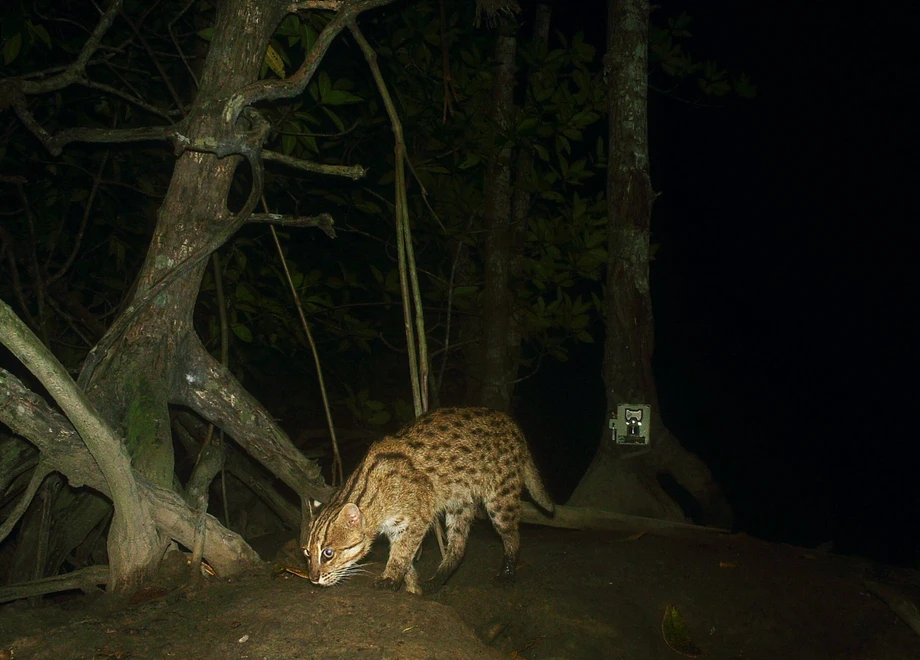
Fishing cats, scientifically known as Prionailurus viverrinus, were recorded in mangrove thickets away from the shore. FCEE's monitoring found that mangrove islands were especially important: only one fishing cat record came from mainland areas. The cats mainly used mangroves that flood intermittently and other flooded mangrove habitats.
Smooth-coated otters occupied a wider network, from coastal mangroves to the Tatai River and its streams. Leopard cats and hairy-nosed otters used mangroves beside rivers, while large-spotted civets appeared in swamp forests dominated by Melaleuca, or paperbark trees.
Vanessa Herranz Muñoz, FCEE director and corresponding author of the study, said conservation needs to cover this full range of habitats. She called for joint action by public authorities, conservation groups and residents:
The Cambodian government, conservation organisations and the local community need to work together to ensure all these habitats are protected from loss or degradation,
The report turns that appeal into specific priorities. Large-spotted civets need mixed mangrove and Melaleuca forests, while hairy-nosed otters depend on small mixed mangrove streams. Evergreen forests on the mainland also support threatened mammals, including Sunda pangolins and dholes.
What the cameras recorded
FCEE began with fishing cats before expanding its work to other mammals and mapping their presence across habitats. The monitoring from 2017 to 2023 provides the longer view of changes in wildlife, while a concentrated survey conducted from July to October 2022 supplied detailed records for the biodiversity report.
That 2022 survey, carried out with the Environment Ministry's Department of Marine and Coastal Zone Management, produced results from 57 cameras over 4,015 camera trap days. A camera trap day represents one camera operating for one day. Thirty-four cameras were in mangroves and 23 in evergreen forest.
The survey recorded 23 mammal species, nine of them threatened: one critically endangered, three endangered and five vulnerable. Other FCEE monitoring earlier in 2022 recorded two additional mammal species. Long-tailed macaques appeared on 86 occasions at 25 cameras, mostly in mangroves, even as the longer monitoring record showed a sharp decline in their photographic capture rate.
The research has developed through several stages:
- 2017: FCEE began monitoring fishing cats and other threatened wildlife in the mangroves and lowland habitats.
- March 2019: Cameras recorded breeding hairy-nosed otters, including two pups.
- May 2022: A mother hairy-nosed otter and a pup were photographed near the Tatai River.
- July to October 2022: The focused camera survey examined biodiversity and the suitability of sanctuary management zones.
- 2023: The broader biodiversity survey documented more than 700 unique species.
- November 2023: FCEE sought continued government cooperation on wetland restoration and fishing cat conservation.
Small streams hold rare otter breeding sites
Hairy-nosed otters, Lutra sumatrana, were photographed beside small mixed mangrove streams near the Tatai River, within the sanctuary's Sustainable Use Zone. FCEE had monitored them there since 2017, with the records of pups in 2019 and 2022 showing that the habitat supports breeding.
The biodiversity report says the species had not been recorded elsewhere within Peam Krasop. It identifies streams on the western bank of the Tatai River and nearby waterways within Tatai Wildlife Sanctuary as likely to support an important share of the local population. It recommends making the Tatai River and its small streams a priority habitat unit for conservation.
Smooth-coated otters used much larger stretches of the wetland. One male, identifiable by a missing hand that researchers considered probably a snare injury, was photographed travelling more than 15 kilometres between mangrove and river habitats. Groups usually contained four to six animals, growing to as many as 18, including young, during the breeding season from April to June.
Sunda pangolin records also crossed habitat boundaries. Cameras found them in semi-evergreen forest in 2022 and lowland mixed mangroves in 2020, while earlier records came from Melaleuca forest. Protecting these animals therefore requires connected forest and wetland areas rather than isolated patches.
Wildlife near villages offers a role for communities
Fishing cats, smooth-coated otters and long-tailed macaques were often photographed near villages. Herranz Muñoz interpreted their presence as an encouraging sign of coexistence between people and wildlife. Hairy-nosed otters, large-spotted civets and Sunda pangolins were more likely to stay away from settlements.
Herranz Muñoz described the camera findings near villages this way:
We found that fishing cats, smooth-coated otters and long-tailed macaques were often photographed not too far from villages, which is great news,
Researchers nevertheless identified conflict between people and wildlife, poaching, fire and urban development as threats. The missing hand of the widely travelling smooth-coated otter offers one concrete example of the injuries animals may face while moving through the landscape.
Local participation matters because animals use places where people live, fish and travel. The report calls for conservation work with stakeholders to preserve and restore mixed mangrove streams, particularly around the Tatai River. For species that avoid settlements, keeping quieter habitat intact is also necessary.
Fish, plants and insects reveal a wider living network
The 2023 biodiversity work documented much more than mammals. Researchers recorded 62 plant species, including true mangroves and associated plants. Seaward mangroves, riverine mangroves and mixed mangroves farther inland had the highest plant species richness, meaning they contained the greatest variety of plants.
An arthropod survey collected 1,235 individuals representing 352 species or morphospecies across approximately 120 families and 17 orders. Arthropods include insects, spiders and other animals with jointed legs. A morphospecies is a group distinguished by its physical features when researchers cannot yet assign a precise species name.
A preliminary survey of fish larvae and juveniles, conducted from June 3 to 7, 2023, found 74 taxa belonging to 53 genera and 31 families. Taxa are biological groups used to classify organisms. The young fish records show how the mangrove waters provide shelter, feeding areas and nursery habitat for estuarine and marine fish, including species important to fisheries.
The report also lists 157 bird species recorded in the protected areas in recent years, including 15 ranging from Near Threatened to Endangered on the International Union for Conservation of Nature Red List. Shorebird flock numbers suggested a decline over roughly two decades, although survey timing, methods and access varied.
Much of the broader survey work took place during the dry season. The report recommends longer and more consistent sampling in both dry and rainy seasons, particularly for arthropods. The records already establish a rich baseline, while seasonal surveys would give managers a fuller picture of how animals use the wetland throughout the year.
Sand extraction brings pressure from upstream
Sand mining resumed on the Trapeang Rung River in June 2026 after a nine-year ban on exports to Singapore. Cambodian trade statistics recorded more than 694,000 metric tons exported from June through September 2026, valued at $3.47 million.
The river flows through four protected areas, and the boundary of the Koh Kapik Ramsar site lies about three kilometres downstream of the mining location. Provincial authorities said they authorized Catalyst Marine and Resources to extract and export the sand.
A conservationist familiar with the area warned that mining could damage seagrass beds, sandy river habitats and surrounding mangroves. Fishing cats and hairy-nosed otters were among the threatened animals identified in the connected estuary. Those concerns concern the same habitat network documented by the biodiversity survey.
Chris Hackney, a senior lecturer at Newcastle University, explained that extracting sand can disrupt places where aquatic animals feed and breed. He said coastal sand mining can also drive saltwater intrusion, changing habitat conditions in favour of species that tolerate salt.
The extent of damage from the resumed operation has not been quantified. Cambodia's Ministry of Mines and Energy, Singapore's Ministry of National Development and the company directors approached for comment had not responded to inquiries described in the November 2026 account.
Fishing families depend on the same habitat
Koh Sralao, a village of about 300 families, relies on crabs, fish and mollusks caught among the estuaries and mangrove roots. Residents said mining operations had blocked access to fishing grounds, while declining catches and rising fuel costs were already squeezing their incomes.
One resident, identified by the pseudonym Pich because of fears of reprisals, said his average daily fishing earnings had fallen from $25 to about $7.50 over a few years. That is a reduction of about 70%. He had worked in a garment factory before returning in September 2026 to care for his sick daughter.
Environmental social scientist Furqan Asif, who lived in Koh Sralao during his doctoral research, found in surveys in 2016 and 2017 that 61% of households had at least one member who had left. He said earlier dredging worsened pressures that were already encouraging migration.
The biodiversity report explains why wildlife protection and household income are connected here. Mangroves shelter young fish, shrimp and crabs, protect coastlines from erosion and storm surges, improve water quality and store carbon. Damage to nursery grounds can affect both the animals living in the forest and the people fishing in its waters.
Protection needs to retain mature forests and connected waterways
Fauna & Flora's report recommends maintaining forest cover and condition, protecting mature mangroves and conducting regular patrols. Older, larger trees contain cavities, hollows and crevices used by wildlife. Breaking mature forest into smaller patches also separates suitable habitats.
Cleared areas of mixed mangrove that have been abandoned should be allowed to regenerate naturally, the report says, because they remain connected to sources of new seedlings. Restoration therefore includes protecting places where the forest can recover by itself, alongside preventing further disturbance.
Cambodia's Environment Ministry recorded an offer of support for mangrove restoration and fishing cat conservation after a meeting with Herranz Muñoz on November 10, 2023. The ministry's meeting statement says Environment Minister Eang Sophalleth backed the work. FCEE sought continued cooperation in Peam Krasop and other target areas, including Kampong Smach, Boeung Chhmar and Stung Treng.
The ministry linked that support to its Chakra strategy, which was scheduled for launch on November 15, 2023. It also described national goals to distribute 1.3 million seedlings annually and increase forest cover to 60% by 2050. The immediate recommendations for Peam Krasop are more specific: retain mature forest, protect regenerating areas, patrol regularly and preserve the streams and adjoining forests used by threatened animals.
Key Points
- Camera monitoring at 156 sites from 2017 to 2023 found declining trends in four threatened mammal species.
- Fishing cats, hairy-nosed otters, civets and pangolins depend on different parts of the connected forest and wetland landscape.
- The 2023 biodiversity survey identified more than 700 unique species, including a rich variety of plants, arthropods and fish.
- Records of hairy-nosed otter pups make streams near the Tatai River a particular conservation priority.
- Sand extraction reported upstream of Koh Kapik in 2026 has prompted concerns about aquatic habitats and fishing livelihoods.
- Recommended action includes protecting mature forests, allowing natural regeneration, regular patrols and cooperation with local communities.