One request can set several phone tasks in motion
OPPO is giving its smartphone software a larger role in handling personal information. Announced on October 13, 2026, ColorOS 17 introduces an Agent Mode that can find travel bookings, rename documents, organise photographs and turn scattered information into an itinerary, presentation or webpage from a single request.
Contents
- One request can set several phone tasks in motion
- How Agent Mode moves beyond answering questions
- Free usage has limits
- What stays on the phone, and what goes to the cloud
- Call protection has specific boundaries
- Photo editing gains instructions and reference images
- Saved links and bookings become connected information
- Camera tools and earbud translation come with language limits
- A new appearance and measured performance gains
- When the update reaches older devices
- Key Points
The update, based on Android 17, brings Manus into OPPO's AI Mind Pilot and initially supports Manus and ChatGPT for agent tasks. ColorOS 17 debuts with the Find X10 series, which was unveiled globally on October 21. Updates for older OPPO devices are scheduled in stages through the first quarter of 2027.
Thailand is among three countries receiving AI Call Guard, alongside India and Indonesia. The feature uses AI running on the phone to flag possible fraud involving synthetic voices and manipulated faces. Other additions include photo editing through ordinary language, saved information grouped into searchable collections, and conversation translation through compatible earbuds.
OPPO's ColorOS 17 announcement also sets out limits that matter to buyers: photo editing has monthly allowances, some information capture tools are unavailable in Europe, and individual features depend on the device and country. Receiving the operating system update and receiving every advertised AI tool can happen at different times.
The central change is practical. A conventional chatbot might explain how to organise a holiday. An AI agent is designed to carry out the smaller jobs involved, such as finding tickets, reading dates, grouping bookings and producing a daily plan. Giving software that ability also makes file permissions, upload approvals and usage allowances part of the everyday experience.
How Agent Mode moves beyond answering questions
AI Mind Pilot previously offered Ask Mode in ColorOS 16, bringing services such as Gemini, Perplexity and ChatGPT together so users could compare answers and receive suggestions informed by saved information in AI Mind Space. Agent Mode adds the ability to act on files and coordinate several steps toward a requested result.
OPPO describes the process in its Manus partnership announcement: the software identifies the user's goal, divides it into smaller tasks, finds relevant information and selects tools to complete the work. Its access to photographs and documents depends on the permissions the user grants.
Kai Tang, OPPO's president of software engineering, described the purpose of the partnership:
Agentic AI marks an important shift from answering questions to helping users get things done.
A travel request illustrates the difference. AI Mind Pilot can locate flight tickets, hotel bookings, restaurant reservations and attraction tickets across supported apps, then combine their contents with information from the internet to create a plan for each day. It can also group documents and rename them according to their contents and dates.
Tao Zhang, Manus cofounder and chief product officer, explained why the companies are putting these tools on phones:
Smartphones are central to people's daily lives and support many of the tasks they handle every day, making them a natural platform for personal AI agents,
Photographs provide another use. A user can ask the agent to find pictures from a particular trip, sort them into albums and prepare a selected image as a video blog cover. Work tasks can draw on existing documents and online information to produce a proposal, portfolio or presentation.
Free usage has limits
AI Mind Pilot includes a limited free allowance. OPPO says users can sign in to a ChatGPT or Manus account after reaching that allowance, with continued access governed by the relevant service and account plan. The company directs users to the app for the applicable terms rather than publishing a single worldwide quota.
A test on a OnePlus 15 offers a concrete example of both the usefulness and the cost of that allowance. Mind Pilot totalled a folder of invoices and renamed the files using a requested naming pattern. Completing the invoice task and creating a travel itinerary consumed 40% of the daily quota in that test.
The allowance in that test was measured in tokens, units used by AI services to count the information they process and generate. A task involving many documents can use more of an allowance than a brief question. OPPO's published terms leave the precise free entitlement dependent on the service, device and region.
Live Alerts allow users to follow Mind Pilot tasks after switching to another app. For someone sorting a large downloads folder, that means progress can remain visible while they continue using the phone. For frequent document work, the available quota and any subscription cost become as relevant as the agent's abilities.
What stays on the phone, and what goes to the cloud
OPPO says local tasks such as finding, organising and renaming files use models running on the device. For those operations, original files stay on the phone and are not shared with Manus. When a task requires external processing, AI Mind Pilot asks for explicit confirmation before uploading or sharing relevant content.
The permission model separates access to local material from permission to send it elsewhere. A user might allow an agent to find a hotel booking on the phone, then face a further approval request if completing the task requires external processing. OPPO says users control what information is accessed, which actions are taken and whether that processing is allowed.
For AI work handled through its Private Computing Cloud, or PCC, OPPO describes encrypted transmission and a protected processing environment designed to prevent access by third parties, including OPPO itself. ColorOS 17 adds a dual encryption mechanism with post-quantum security capabilities to protect information moving between the device and that cloud.
Post-quantum security refers to protections designed for threats from future quantum computers, which could challenge some encryption methods used today. OPPO presents this as part of its cloud security design.
A PCC Transparency Report lets users inspect which AI services were used, when they were accessed and what operations occurred. The report can be viewed on the phone and exported. Together, the approval prompts and activity record give users a way to follow how an agent handles personal material.
Call protection has specific boundaries
AI Call Guard processes warning signals on the device and alerts users to suspicious activity. Its initial availability in Thailand, India and Indonesia makes it one of the update's more geographically focused additions.
OPPO's detailed conditions narrow what the tools currently cover. Synthetic Voice Recognition detects potential risks in incoming call audio, with phone calls and WhatsApp calls among the advertised uses. Supported apps can vary with the device, region and software version.
AI Face Swap Detection currently supports frames containing one person. Scenes containing several people fall outside its supported scope. OPPO also describes the feature as identifying manipulated faces in photographs, while the broader Call Guard announcement presents face swaps as a communications fraud risk.
The alerts are intended to prompt checking when something appears suspicious. OPPO advises users to verify detection results against the actual situation. For a person receiving an urgent request for money, the immediate value is a warning that gives them a reason to pause and check the caller's identity.
Photo editing gains instructions and reference images
AI Photo Agent lets users describe edits in ordinary language, ask for suggestions or provide another picture as a visual reference. Its Style Match feature analyses that reference picture's colours, tone and mood, then applies a similar look to the user's photograph.
OPPO says the system uses six specialised photography models and is designed to preserve details and the original image's character, including its ProXDR display effect. The software can also examine the subject and composition before suggesting adjustments, reducing the need to select every editing control manually.
The feature supports still images only. A request to prepare a cover for a video blog therefore concerns the cover image, while the advertised editing functions apply to photographs.
AI Photo Agent is scheduled to reach countries gradually, with Europe following later. Monthly usage limits vary by country or region, and OPPO's product conditions say additional paid services may apply depending on the market and device.
Saved links and bookings become connected information
AI Mind Space expands the kinds of information users can keep in a personal information hub. Long-doc Capture saves lengthy content for AI summaries, while Link Capture supports saved video links, including YouTube and TikTok.
OPPO calls its automatic grouping feature Memory Collections in the global announcement; the Thailand description uses Smart Collections. Both descriptions centre on organising related saved material into useful groups and summaries. A collection of places, notes and bookings can then be combined with destination maps to help build a personalised trip plan.
AI Mind Suggest brings selected information back into view when it may be useful. Advertised examples include a morning briefing, flight and train cards, travel reminders, updates when a trip changes and music recommendations when headphones are connected.
Regional restrictions affect these functions. Long-doc Capture and Link Capture are unavailable in Europe. Services such as MakeMyTrip train cards, some flight reminders and Spotify recommendations are limited to particular countries and regions. The result is an information hub whose usefulness depends partly on the services supported where the phone is used.
Camera tools and earbud translation come with language limits
OSee brings several visual AI functions into a camera interaction. Pressing the shutter can trigger object recognition, information lookup, menu translation, nutrition analysis or document scanning, depending on the image and supported services.
Its Object Encyclopedia and Nutrition Analysis currently return results in five languages: Simplified Chinese, Traditional Chinese, English, Hindi and Indonesian. Thai is absent from that list, a relevant limit for users in Thailand. Payment code recognition is supported only in India and Indonesia.
AI Live Interpreter translates continuing conversations through compatible earbuds while displaying text on the phone. OPPO's global product conditions require OPPO Enco X4 or later earbuds and set an allowance of 5,000 minutes per month, resetting at the start of each month. That equals 83 hours and 20 minutes.
The Thailand description also names OnePlus Buds Pro 4 with selected OPPO or OnePlus phones. Compatibility therefore needs to be checked for the particular phone and earbuds together. Interpreter processing uses the cloud, and the supported languages are listed in the app.
A new appearance and measured performance gains
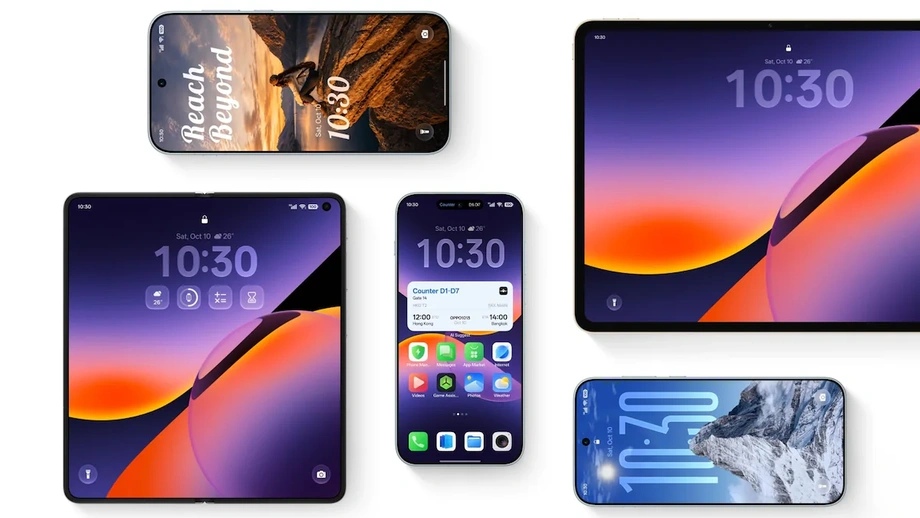
Living Flow Design gives ColorOS 17 more translucent surfaces, continuous animations and controls that visibly compress, stretch and rebound when touched. OPPO divides the design into Luminous Effect, Fluid Motion and Flexible Feedback, covering lighting, movement and responses to touch.
The Unified Rendering Architecture combines previously separate drawing processes into one pipeline. Rendering is the work a phone performs to draw the interface. OPPO says its revised Luminous Rendering Engine cuts that workload by up to 30% and the RAM used for rendering by up to 25% in key scenarios.
The Laminar Flow Engine manages resources across apps in use and those waiting in the background. Against ColorOS 16, OPPO laboratory figures claim 55% better app launch stability, Gallery thumbnails loading up to 50% faster on first launch and around 25% higher app retention. Keeping more apps in memory can let users return to them with less reloading.
OPPO also says a laboratory simulation of six years of use retained more than 90% of initial smoothness with storage 90% full. The figures come from OPPO Lab, with actual performance dependent on hardware, software, network conditions and use.
Use on a OnePlus 15 highlighted a visual tradeoff: transparency and background blur extend across Settings, Clock, Notes and File Manager, while Quick Settings and notifications receive a redesign. Animation speed could be adjusted and transparency reduced through theme settings, although the animations could not be disabled in that test.
When the update reaches older devices
OPPO's published rollout schedule places eligible devices into four broad groups. The order within each group does not determine which model receives the update first, and timing can change by region and carrier.
- October 13, 2026: OPPO announces ColorOS 17 and its Manus collaboration.
- October 21, 2026: The Find X10 series is unveiled globally with ColorOS 17.
- October 2026: The update schedule includes Find N6, Find N5, selected Find X9 and Find X8 models, and selected Reno16 models.
- November 2026: Selected Find N3, Reno15, Reno14, K14, K13x, F33, F31 and F29 devices are listed.
- December 2026: Selected Reno13 and K13 devices, plus Pad 5 and Pad 3 models, are listed.
- January to March 2027: Find N2 Flip, selected Reno12 and F series phones, and Pad SE models are scheduled.
India's more detailed timeline places the Find X10 launch on October 22 and eligible older devices beginning October 29, followed by another group on October 30. OPPO's global page supplies approximate monthly windows rather than one installation date for every market.
OPPO states that its published schedule applies to OPPO devices only, with OnePlus and realme following separate update plans. Some AI functions may arrive through later software updates and require particular hardware, an account or an internet connection. Owners can check their device's software update screen for availability and back up important information before installation.
Key Points
- ColorOS 17 adds Manus and ChatGPT agent tasks to AI Mind Pilot, including file organisation and travel planning.
- OPPO says local file operations keep original content on the phone, with explicit approval required for external processing.
- AI Call Guard initially serves Thailand, India and Indonesia; voice and face detection have specific limits.
- Photo editing, agent tasks and earbud interpretation carry usage allowances or regional conditions.
- OPPO's upgrade schedule runs from October 2026 through the first quarter of 2027, with features varying by device and market.