921 full size robots reshape UBTech's business
UBTech Robotics sold 921 full size humanoid robots in the first half of 2026, lifting revenue from that business to RMB590.3 million from RMB38.2 million a year earlier. The increase of 1,445% made the category the Hong Kong listed company's largest revenue source, accounting for 46.5% of sales, compared with 6.1% in the same period of 2025.
Contents
- 921 full size robots reshape UBTech's business
- Where the revenue growth came from
- What the robot sales figures include
- Higher margins narrow losses
- Factory work advances task by task
- Three product families target different buyers
- Software and industrial data support the push
- Research and acquisitions absorb cash
- Production recovery sets the next timetable
- The dates that matter
- Key Points
The company's interim results announcement, published on August 28, put total revenue for the six months ended June 30 at RMB1.269 billion, up 104.2%. Gross profit rose 160.9% to RMB566.9 million as a greater share of business came from humanoid products and services carrying higher margins.
UBTech still recorded a net loss of RMB338.8 million, although that was 23% smaller than a year earlier. The results show a company generating substantial revenue from robots and industrial solutions while continuing to spend heavily on development, production and deployment.
At an August 30 results briefing, founder, chairman and chief executive Zhou Jian outlined an earlier financial milestone: UBTech would seek positive quarterly earnings before interest, taxes, depreciation and amortisation, or EBITDA, in the fourth quarter of 2026. Its existing target of quarterly break even in the fourth quarter of 2027 remained unchanged.
The immediate test is practical. UBTech must increase deliveries, recover production affected by flooding and collect payments from customers while turning individual factory tasks into longer sequences of useful work.
Where the revenue growth came from
Full size humanoid revenue increased by about RMB552.1 million, accounting for roughly 85% of the group's RMB647.7 million revenue increase. Sales volume in the category rose 1,946.7%, reaching 921 units from approximately 45 a year earlier.
Custom robots and solutions for industries outside education generated about RMB569 million, more than 96% of full size humanoid revenue. Education contributed RMB21.247 million. Enterprise projects therefore supplied almost all the money in the category that is now driving UBTech's growth.
UBTech also gained revenue through an acquisition. Zhejiang Fenglong Electric contributed RMB139.2 million from garden machinery, automotive and hydraulic components after its results entered the group's accounts in April. Excluding that contribution, revenue from UBTech's existing businesses was approximately RMB1.130 billion, up about 81.8%.
Older business lines moved in different directions. Other smart robot products and services fell 18.8% to RMB245.8 million, mainly because education robot revenue declined. Logistics contributed approximately RMB137 million within that category, while education contributed RMB96.726 million. Other smart hardware revenue increased 2.9% to RMB259.4 million.
What the robot sales figures include
UBTech sold 16,123 humanoid robots across all categories, up 268.3%. Of those, 921 were full size embodied intelligent humanoid robots. The remaining 15,202 belonged to categories covering smaller robots and products using remote control or programmed actions.
The company uses a specific definition for the full size category: robots taller than 160 centimetres, with computing capacity of at least 200 trillion operations per second, classified as neither toys nor remotely controlled products. Embodied intelligence means software that uses a physical machine's sensors and movements to act in its surroundings.
UBTech's RMB590.3 million category revenue covers products and services together. Customers buy packages that can include robots, deployment work and solutions for particular tasks. The financial results therefore describe a business built around equipment and its application inside customer operations.
Higher margins narrow losses
UBTech's full size humanoid business generated approximately RMB394 million in gross profit at a margin of 66.8%, up 19.5 percentage points. With 46.5% of group revenue, it supplied about 70% of group gross profit.
Gross profit is the money left after the direct cost of providing products and services. UBTech's group gross margin rose from 35% to 44.7%, meaning it retained about RMB44.70 from each RMB100 of revenue before expenses such as research, administration and selling costs.
Operating loss narrowed 36.4%, from RMB439.1 million to RMB279.1 million. The adjusted EBITDA loss fell 45.9%, from RMB321.8 million to RMB174.1 million. Adjusted EBITDA is a company defined measure that removes certain expenses and accounting items to give another view of operating performance.
Zhou's ambition for positive quarterly EBITDA in late 2026 brings a nearer milestone alongside the 2027 break even target. Net profit includes interest, tax, depreciation and other charges, so readers will need to follow both measures as UBTech reports progress.
Factory work advances task by task
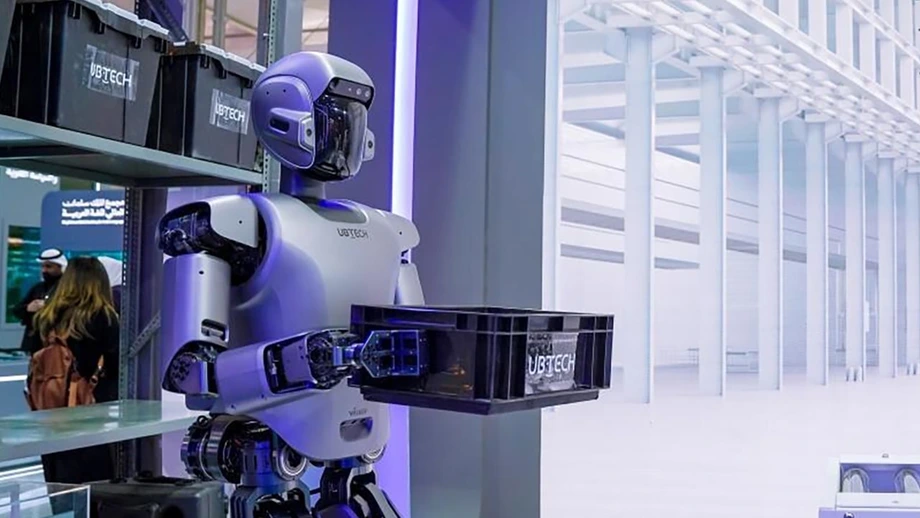
UBTech is concentrating industrial deployments on handling materials, loading and unloading, sorting, and placing goods onto or removing them from pallets. It has validated solutions for sheet metal loading, parcel sorting and sorting items into designated compartments.
Airbus acquired a Walker S2 earlier in 2026 as part of a partnership exploring humanoid robots in aircraft manufacturing. UBTech's customer and partner list also includes BYD, Geely, Foxconn and Honda Trading, spanning automotive production, electronics, aviation and logistics. Projects range from testing and validation to deployments and deliveries.
The company's loading and unloading work uses cameras mounted at the wrist to help robots respond to changing materials and perform precise movements. UBTech reported a 75% success rate in laboratory settings. In simple terms, that is success in about three out of four attempts under those test conditions.
UBTech's ROSA robot software supports industrial handling, including responding when containers tilt substantially. The company has also completed wireless remote operation tests across regions. Remote operation lets a person guide a robot from elsewhere and helps collect examples of how tasks should be performed.
The next operational goal is to connect these skills. UBTech wants several robots to coordinate longer sequences of workstation tasks, including handling bins, assembling components and inspecting quality, rather than completing isolated actions.
Three product families target different buyers
UBTech introduced Cruzr Y1, Walker C1 and the U1 series in June, extending its range across industrial, commercial and companionship applications. Each addresses a different setting, from warehouses to exhibition halls and homes.
Cruzr Y1 is a wheeled robot designed for manufacturing and warehousing. It combines visual perception, movement in multiple directions and software that links instructions to actions. Its intended jobs include moving bins and cartons, sorting mixed materials and loading or unloading equipment.
Walker C1 is a bipedal robot aimed at reception, guided tours, interactive displays, education and research. It has 53 degrees of freedom. A degree of freedom is an independent movement a mechanism can make, such as bending a joint or turning its head.
The U1 series targets commercial and consumer companionship. It has 88 degrees of freedom across the body, including 19 active movements in its facial system. UBTech pairs a facial tendon network with its Resonance-LM model to support expressions and interaction, and says cumulative orders across online and offline channels have exceeded 13,361 units. Delivery timing for that order total was not specified.
UBTech also described a fourth generation industrial humanoid that weighs more than 15% less than its predecessor and has a battery replacement time of two minutes. Those changes address practical demands in factories, where robots must move safely and return to work quickly.
Software and industrial data support the push
UBTech's Thinker technology combines models for understanding surroundings, anticipating physical changes and choosing actions. The company said its Thinker 1.0 foundation model ranked first on nine embodied intelligence leaderboards, while its Thinker-WM world model ranked first on the Libero benchmark during the period.
A world model helps software predict what may happen after an action, such as how an object might move when pushed. Thinker-VLA links visual information, language instructions and physical actions, allowing a robot to connect a request with what its cameras see.
UBTech says Thinker-VLA has been applied across its humanoid range, with inference efficiency improving 176% and storage use falling 60%. It separately reported that GPU memory requirements for the full set of functions running on the robot fell from 64GB to 32GB. Lower computing requirements can reduce the hardware resources needed inside a machine.
The company's physical robot dataset contains about 11 million records, more than 80% from industrial scenarios. Its data infrastructure links collection, labelling, model training and deployment. A simulation platform generates environments and synthetic data so models can be tested before use on physical robots.
BrainNet 2.0 and Co-Agent address coordination between machines. UBTech says they can divide tasks, schedule operations and share information, supporting its attempt to move from individual robots to teams working along a production line.
Research and acquisitions absorb cash
UBTech spent RMB303.1 million on research and development in the first half, up 38.9% and equivalent to 23.9% of revenue. It employed 1,103 research and development staff and expected full year spending of about RMB700 million.
As of June 30, the company held 3,112 granted patents, up 4.2% from the end of 2025. These included 1,857 invention patents and 530 overseas patents.
The acquisition of a 43.01% stake in Shenzhen listed Fenglong, completed in March, made UBTech its controlling shareholder. Beyond adding an existing components business, the purchase supports plans to develop and produce robot components such as servo drives and devices used to grasp or manipulate objects.
UBTech's cash and cash equivalents fell from RMB4.888 billion at the end of 2025 to RMB2.326 billion on June 30. The company attributed much of the decline to an acquisition payment of RMB1.665 billion.
Money tied up in operations also increased. Net receivables, which are amounts owed by customers, reached RMB1.680 billion, up 29% from the end of 2025. Inventory rose from RMB577 million to RMB985 million, about 71%. Collecting those payments and converting stock into deliveries will matter alongside reported revenue growth.
A single customer contributed RMB309 million, approximately 24% of group revenue. UBTech did not identify the customer or detail its purchases. No individual customer accounted for more than 10% of revenue in the comparable period of 2025.
Production recovery sets the next timetable
UBTech has set a 2026 production target of 10,000 full size humanoid robots. It is working with Siemens on digital tools for design and manufacturing, while a joint venture with Chinese GPU developer MetaX aims to develop and produce chips for embodied intelligence.
Zhou said flooding in Guangxi and other factors caused substantial factory stoppages in June and July, delaying deliveries of products including Walker S3 and U1. The company expected its Liuzhou factory to resume mass production gradually from mid to late September through October, with additional capacity arranged in Shenzhen.
Management remained confident about a 2026 revenue target of RMB3.5 billion to RMB4 billion or more. Reaching the RMB3.5 billion to RMB4 billion range would require approximately RMB2.231 billion to RMB2.731 billion in second half revenue, about 1.8 to 2.2 times the first half total.
Zhou said deliveries and revenue recognition over the previous two years had been concentrated in the second half, with an approximate first half to second half ratio of 3:7. For customers, the immediate issue is when ordered machines arrive and become usable. For UBTech, timely production, delivery and revenue recognition underpin its fourth quarter financial ambition.
The dates that matter
UBTech's expansion has combined an acquisition, new product introductions and a production recovery plan. The main dates show how those developments feed into its targets:
- March 2026: UBTech completed its acquisition of a controlling stake in Fenglong.
- April 2026: Fenglong's financial results began entering UBTech's consolidated accounts.
- June 2026: UBTech introduced Cruzr Y1, Walker C1 and the U1 series.
- August 28, 2026: The company released its interim results for the six months ended June 30.
- August 30, 2026: Zhou outlined the effort to achieve positive quarterly EBITDA in the fourth quarter.
- September to October 2026: The company expected Liuzhou production to recover gradually.
- Fourth quarter of 2027: UBTech retained its existing quarterly break even target.
UBTech also plans to release Thinker-WM 2.0 in the second half of 2026 and continue developing its action models and coordination software. Those technical plans accompany a more immediate commercial task: supplying customers at greater scale while reducing losses and collecting cash.
Key Points
- Full size humanoid revenue rose 1,445% to RMB590.3 million, with 921 robots sold.
- Total revenue doubled to RMB1.269 billion, while net loss narrowed to RMB338.8 million.
- The full size humanoid business generated a gross margin of 66.8% and about 70% of group gross profit.
- Industrial and other customised projects supplied more than 96% of full size humanoid revenue.
- UBTech aims to produce 10,000 full size humanoid robots in 2026 while recovering delayed production.
- Management is seeking positive quarterly EBITDA in late 2026 and retains a quarterly break even target for late 2027.
- Rising receivables, inventory and customer concentration make cash collection an important part of the next stage.