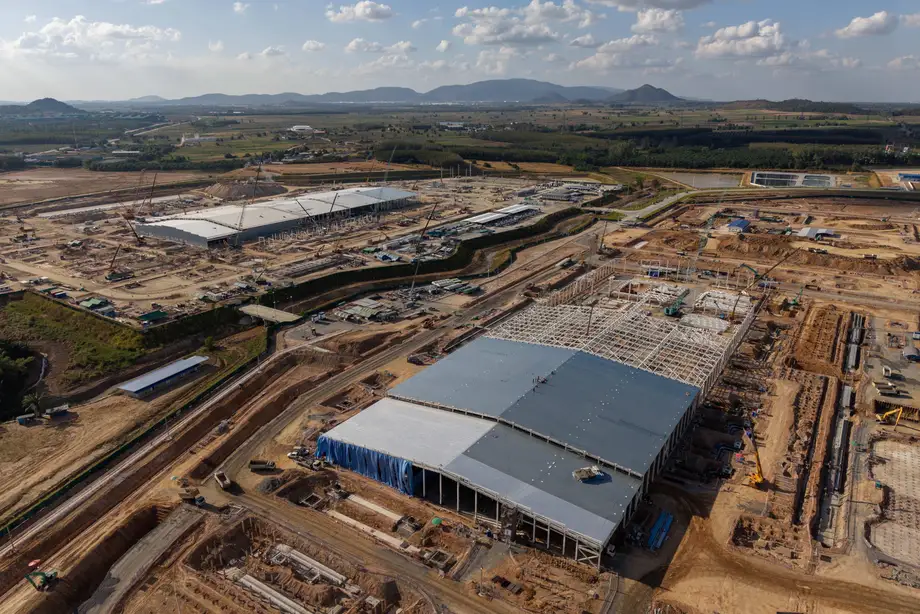
A construction boom meets limits on electricity and water
Thailand suspended construction on 49 data centres and froze approval decisions on 117 planned facilities in September 2026, putting a major digital investment boom on hold while officials develop rules for electricity, water, safety and community protection.
Contents
- A construction boom meets limits on electricity and water
- What triggered the pause?
- How the proposed rules would work
- Seven size groups, with draft boundaries still changing
- Why power requests are getting closer scrutiny
- Water and neighbourhoods become approval issues
- A regional boom puts Thailand's decision in perspective
- A single approval system would replace fragmented oversight
- What happens next for investors and customers?
- Key Points
The scale of the challenge goes beyond building permits. The Energy Ministry estimates that data centre developers have requested about 35 gigawatts of electricity capacity, close to Thailand's national peak demand of 40 gigawatts. Ministry spokesman Pongpol Yodmuangcharoen said applications include inflated or contingent requests, prompting officials to check how much power projects actually need.
Thailand's Board of Investment approved 88 artificial intelligence and data centre projects worth approximately 886 billion baht, about $27 billion, in the first half of 2026. Those investment approvals sit alongside a different decision: whether each development has the permits, utility connections and safeguards needed to proceed.
Danucha Pichayanan, secretary general of the National Economic and Social Development Council, announced the construction pause. The policy response now extends from neighbourhood safety to national grid planning, with proposed rules dividing facilities by electricity demand and making future applicants compete for resources.
For residents, the immediate concerns are practical: whether a facility belongs beside their homes, how backup fuel is stored and whether industrial cooling will put pressure on local water supplies. For developers and cloud customers, the central issue is when projects can proceed under a predictable approval system.
A data centre is a building full of computers that store information and run services, including cloud software and AI. Those computers need continuous electricity and cooling, making each large project a substantial commitment of local resources.
What triggered the pause?
An oil leak in Bangkok's Rama IX area in September drew attention to an unauthorised data centre operating within a residential community. The Bangkok Metropolitan Administration subsequently began investigating 47 data centres across the capital.
The Bangkok investigation covers a different group from the 49 construction projects affected by the national pause. The incident brought site permissions, fuel handling and proximity to homes into a debate previously dominated by investment announcements.
The House Committee on Communications, Telecommunications and Digital Economy and Society also began examining Bangkok's regulatory framework. Proposed national requirements cover town planning, separation from neighbouring buildings, electrical systems, backup fuel storage, safety and environmental protection.
Thailand established a committee of 21 members in September to propose policies and standards, monitor the industry's effects, report to the cabinet and oversee implementation. The national policy committee is chaired by the deputy prime minister.
Finance Minister and Deputy Prime Minister Ekniti Nitithanprapas said the September 4 meeting had received policy direction from the prime minister. Its decision suspended construction and pending permissions until minimum environmental and social standards were clarified.
How the proposed rules would work
Ekniti said a draft framework would go to the cabinet on November 10, 2026. It sets out four minimum areas of assessment: location and land use, electricity and water connections, environmental practices, and economic and social benefits.
The location rules would include conditions for storing fuel used by backup generators. Environmental requirements would follow a Code of Practice, a set of operating rules intended to control how facilities affect their surroundings.
More detailed draft provisions require treatment of blowdown, the water discharged from cooling systems as minerals and other substances accumulate. Exhaust outlets must avoid creating a nuisance for neighbours, and automatic fire suppression must cover the entire facility.
The transition proposals describe eight to 12 months for businesses to adjust; a later description gives existing operators one year to upgrade fire protection, emergency power and environmental measures. Structural requirements would apply to existing facilities when they seek alterations. Projects without permits would have to meet the new requirements in full.
The cabinet outcome, final legal text, identities of the affected projects and whether the September suspension has been lifted are not specified. New applications are expected to reopen in early 2027, rather than on a confirmed reopening date.
Seven size groups, with draft boundaries still changing
The proposed system would divide data centres into seven groups according to electricity demand. A draft prepared for the November cabinet submission lists these ranges:
- Level 1: zero to 0.5 megawatts.
- Level 2: 0.5 to 5 megawatts.
- Level 3: 5 to 10 megawatts.
- Level 4: 10 to 20 megawatts.
- Level 5: 20 to 50 megawatts.
- Level 6: 50 to 200 megawatts.
- Level 7: more than 200 megawatts.
Another description of the board's draft starts the smallest category at 0.5 megawatts to below 1 megawatt, followed by 1 to below 5 megawatts, and uses three subdivisions between 5 and 50 megawatts. The final approved text will determine the boundaries and category names.
The November proposal would allow the four smallest groups to use basic requirements and locate in commercial areas under specified conditions. Larger developments would face stricter conditions reflecting their resource needs and the capacity of the surrounding area.
Officials intend to classify projects using Facility Load, meaning electricity demand across the whole site, including cooling and supporting equipment. IT Load covers the computing equipment itself. A facility can therefore have a higher total electricity requirement than the capacity quoted for its servers.
One gigawatt equals 1,000 megawatts. Keeping those units and measurement methods consistent matters when authorities compare an individual project with the power available in a district or across the country.
Why power requests are getting closer scrutiny
The estimated 35 gigawatts requested by developers amounts to 87.5% of Thailand's 40 gigawatts of peak national electricity demand. The Energy Ministry is checking applications because developers may reserve more capacity than they ultimately use or make requests conditional on projects proceeding.
The draft Power Development Plan 2026 uses 8.8 gigawatts as the baseline for data centre capacity. That is roughly one quarter of the requested 35 gigawatts, a large gap that makes accurate project information essential before utilities commit to new infrastructure.
Christopher Starling, chief strategy officer of JERA Asia, projects that Thailand's energy demand will grow by at least 3% to 4% annually, with data centres, digital infrastructure and AI services among the contributors. JERA has an approximately 12.3% stake in Thailand's Electricity Generating Plc.
Starling explained why developers place such weight on access to dependable electricity:
"We talk a lot about speed to power as being important in terms of being able to move quickly to support Thailand in meeting its data centre needs, while ensuring that the power supply is reliable because data centres operate 24/7. So, the short answer is yes: we see it as a market with a lot of potential," he said.
Energy Minister Akanat Promphan has called for a separate electricity user category with higher tariffs for data centres, citing their demand for power generated from expensive imported gas. That would tie the price operators pay more closely to the cost of supplying them.
The Electricity Generating Authority of Thailand plans to invest about 35 billion baht, approximately $1 billion, in grid upgrades, particularly in the Eastern Economic Corridor. Proposed Grid Code requirements would make operators manage their load fluctuations before drawing on the public network.
Energy planners also intend to use Loss of Load Expectation, or LOLE, to assess reliability. The measure estimates how often electricity demand could exceed available supply, helping planners examine shortages rather than relying only on the amount of spare generating capacity.
A rooftop solar programme targeting one million households would add 5,000 megawatts. Integrating that variable supply with large, continuous industrial loads requires changes to the grid as well as additional generation.
Water and neighbourhoods become approval issues
The Eastern Economic Corridor faces pressure on water as well as electricity. Somnuck Jongmeewasin, research director of the research and advocacy group EEC Watch, identified a particular concern in Chonburi:
"The Khlong Luang Reservoir in Chonburi (in eastern Thailand) is a primary flashpoint," says Somnuck Jongmeewasin.
Somnuck said the reservoir was shallow and under strain while authorities were piping its water to industrial estates. The proposed connection requirements would make local water availability part of project assessment, alongside electricity access.
Community consultation featured at Singapore International Energy Week in October 2026. Allyson Anderson Book, chief sustainability, government affairs and public policy officer at Baker Hughes, described residents being inadequately informed about a data centre installed in her neighbourhood.
Jie-Sheng Tan-Soo, an assistant professor at Singapore's Lee Kuan Yew School of Public Policy, explained why investment totals alone may leave communities dissatisfied:
"While datacentres may create substantial investment and construction activity, they generally generate fewer long-term jobs than many other industries requiring comparable amounts of land, electricity and water," says Jie-Sheng Tan-Soo.
Thailand's proposed economic and social benefit assessment would bring employment, skills development and community effects into the same approval process as land and utility requirements. Those criteria would give authorities a basis for comparing what projects contribute with the resources they need.
A regional boom puts Thailand's decision in perspective
Cushman & Wakefield's Asia Pacific Data Centre H1 2026 Update recorded a development pipeline of 26.5 gigawatts: 4.8 gigawatts under construction and 21.7 gigawatts planned. Southeast Asia accounted for approximately half of the capacity under construction.
Malaysia had 1,039 megawatts under construction and Thailand had 859 megawatts. Together, their 1,898 megawatts represented about 40% of the Asia Pacific construction total. Those figures were published on August 5, before Thailand's September suspension.
Bangkok had 134 megawatts operational and a development pipeline of 2,084 megawatts. Its capacity under construction had risen 148%, showing how quickly utility needs were expanding relative to the existing market.
Johor illustrates the pressures accompanying that growth. Its operational capacity rose from 94 megawatts in 2023 to 1,110 megawatts in 2026, nearly twelve times as much. Wood Mackenzie estimates that data centres already consume 24% of the state's electricity, potentially rising to 40% by 2035.
Singapore restricted new data centres from 2019 to 2022 and subsequently linked approvals to efficiency and sustainability conditions. Johor has announced restrictions on new Tier 1 and Tier 2 facilities, while a project in Indonesia's West Java was halted over missing permits and an incomplete environmental assessment.
Operators are also changing water arrangements. Bridge Data Centres built a reclamation plant and pipe network in Johor, while AirTrunk announced a partnership with Johor Special Water to reuse wastewater. Johor residents protested against another development in February over construction dust and possible effects on water supplies.
A single approval system would replace fragmented oversight
Thailand's Ministry of Digital Economy and Society would develop Dashboard TH-DC to combine project and permission records. It would also lead the Data Center One Stop Service, or DC-OSS, coordinating applications, linking databases and tracking projects.
The need for a shared register is apparent in the national counts. September figures assembled from 16 agencies listed 35 operating projects or companies, approximately 49 under construction and more than 117 awaiting permission or consideration. Ekniti later cited 63 operating facilities, 20 under construction and more than 100 operators submitting proposals. The figures use different descriptions and reference periods; officials have given no reconciliation.
Deputy Digital Economy and Society Minister Nan Boonthida Somchai said future projects would compete for electricity, water and investment incentives according to their economic contribution. Existing construction and facilities awaiting opening would be considered separately from new investment applicants.
A parallel electricity initiative would connect information across the national generating authority, the Provincial Electricity Authority, the Metropolitan Electricity Authority and the Energy Regulatory Commission. Sharing current data would help utilities check requests against actual projects and network conditions.
What happens next for investors and customers?
Google and Alphabet president and chief investment officer Ruth Porat met Prime Minister Anutin Charnvirakul on November 6. According to Prime Minister's Office spokesman Ekkapob Pianpises, Google reaffirmed its commitment to Thailand and discussed possible changes to electricity and water rules.
Anutin also discussed a central permit service using AI throughout the process. The meeting produced no reported new investment amount. Google separately announced $15 billion of investment in Malaysia for 2027 to 2028, showing that regional expansion continues while Thailand works through its framework.
Thailand already hosts substantial cloud infrastructure. Amazon Web Services opened a cloud region in January 2025, Google launched its Bangkok region in January 2026, Microsoft is developing a region, and Alibaba Cloud operates two data centres in the country. A cloud region is a group of facilities serving customers in a particular geographic area.
The main policy milestones show how the focus moved from expansion to resource allocation:
- First half of 2026: the Board of Investment approved 88 AI and data centre projects worth about 886 billion baht.
- August 5: regional construction figures documented Thailand's rapid expansion.
- September 4: the national committee agreed to pause construction and pending permissions while standards were clarified.
- November 6: Google discussed electricity, water and permit rules with the prime minister.
- November 10: Ekniti planned to submit the proposed framework to the cabinet.
- Early 2027: new applications are expected to reopen.
For developers, the emerging system makes location, utility availability and economic benefits central to permission to build. For customers needing additional computing capacity, delivery schedules will depend on projects meeting those conditions. Residents would gain explicit standards covering matters that investment approvals alone leave unresolved, from fuel storage to cooling water discharge.
Key Points
- Thailand paused construction on 49 data centres and approval decisions on 117 planned facilities in September 2026.
- Developers requested an estimated 35 gigawatts of power; the draft national power plan uses an 8.8 gigawatt baseline for the sector.
- Proposed standards cover land use, electricity, water, environmental practices, safety and economic benefits.
- Seven proposed size groups would use total facility electricity demand, with final boundaries subject to approval.
- A shared project database and central application service would coordinate oversight across agencies.
- New applications are expected to reopen in early 2027 under a process linking resources and incentives to economic contribution.