Coal, palm oil and ferroalloy exports face a new document checkpoint
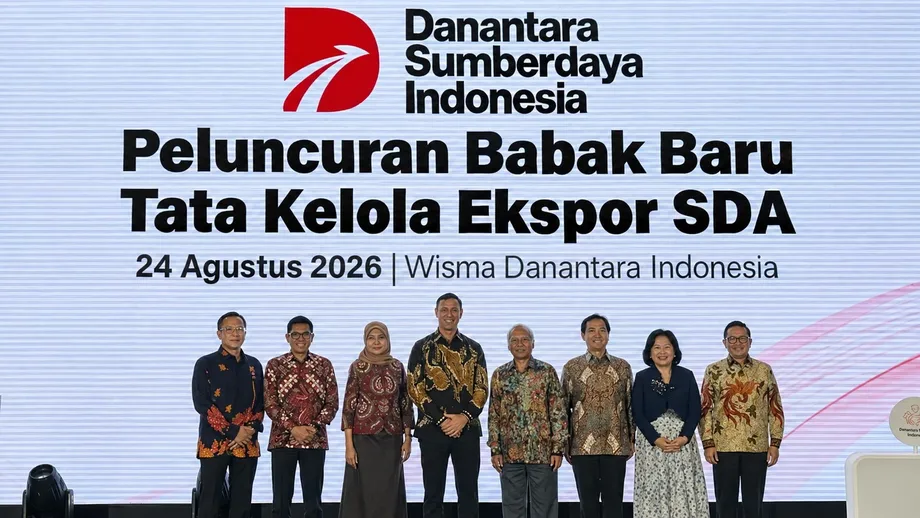
Indonesia will require exports of coal, crude palm oil and ferroalloys to pass through PT Danantara Sumberdaya Indonesia (DSI) from January 1, 2027, using a portal that checks commercial contracts, shipment details and export earnings against government and market data.
Contents
- Coal, palm oil and ferroalloy exports face a new document checkpoint
- What changes, and what stays with exporters?
- The dates companies need to prepare for
- How a shipment will move through NADI
- Why the government wants to connect contracts, cargo and money
- Existing commodity obligations remain in force
- Fee assurances meet concerns about farmers and business costs
- What the trials and capital increase show about readiness
- Palm oil faces scrutiny beyond export paperwork
- Key Points
At a government briefing in Jakarta on November 6, 2026, officials outlined the final preparations: technical guidance on November 15, company registration from December 15 and full operation at the start of January. DSI chief executive Luke Thomas Mahony said the NADI portal would connect existing government systems and market information to support daily transaction reporting.
DSI will act as the sole intermediary for the covered exports, while companies retain their buyers, negotiate their prices and receive payments directly. The company will review documents before and after customs clearance without buying, selling or taking ownership of the goods.
The largest unresolved commercial issue is cost. Deputy Finance Minister Nurkholisoh Ibnu Aman said the mechanism would add no fees or extra activities for exporters. Mahony, speaking the same day, said DSI was still finalizing a payment structure with stakeholders and had not decided the rate.
For exporters, the immediate task is to prepare contracts and company records for a new shared reporting route. For the government, the aim is to connect what a company agrees to sell with what it declares, ships and receives in export earnings. Existing commodity permits and obligations will remain the responsibility of exporters.
What changes, and what stays with exporters?
Coordinating Economic Affairs Minister Airlangga Hartarto described DSI as a single intermediary responsible for examining transaction documents. Trade Minister Budi Santoso said exports would continue to be recorded under each company's name, rather than DSI's name.
Negotiations, pricing, contracts, shipping arrangements and payments will remain directly between exporters and international buyers. DSI's role sits in the document and verification process, with its approval required before a draft Export Declaration, known as a PEB, moves to the customs system.
Customs clearance itself remains under the Directorate General of Customs and Excise (DJBC), working with Indonesia National Single Window (INSW). DSI will examine the commercial information and approve the draft declaration for transmission; Customs will carry out its own validation and issue the Export Service Note, or NPE.
Airlangga said DSI's name would not appear in the PEB data. This preserves the exporting company's identity in the official shipment record even though its documents pass through DSI's portal.
Ferroalloys, one of the three initial commodity groups, are mixtures of iron with other elements used in metal production. The main operational explanations identify coal, crude palm oil and ferroalloys as the covered goods; BP BUMN Deputy Head Aminuddin Ma'ruf also described the mandate more broadly as covering palm oil, iron and steel, and coal.
The dates companies need to prepare for
Government Regulation No. 24 of 2026 took effect on June 1, 2026, when the transition toward the new export framework began. Airlangga said a revision to that regulation was being finalized, with completion targeted for the middle of November.
The preparations stretch across several months, from company funding and system tests to registration and mandatory use:
- May 25, 2026: DSI's authorized capital increased to Rp4 trillion, with paid capital of Rp1 trillion.
- June 1, 2026: Government Regulation No. 24 of 2026 took effect and the transition period began.
- Late September 2026: NADI system trials began.
- November 6, 2026: Officials explained the operating model and remaining preparations in Jakarta.
- November 15, 2026: Technical guidance is scheduled to explain changes and system use to exporters.
- December 15, 2026: Company account registration and administrative document uploads are scheduled to open.
- January 1, 2027: Full implementation is scheduled for the three covered commodity groups.
The November technical session is intended to explain what exporters must submit and how the system will operate. The December registration opening gives businesses a preparation period before the mandatory January launch.
How a shipment will move through NADI
Each exporter must register one company account before uploading its first commercial documents. Those documents can include a signed contract or purchase order, which records what the buyer and seller have agreed.
A commercial contract needs to be uploaded only once after signing. It then becomes the reference for related export declarations, rather than a document that must be uploaded again for every shipment under that agreement.
The exporter next selects the appropriate PEB type, completes the declaration and supplies supporting documents. During the check before clearance, NADI compares the declaration with the commercial documents already uploaded.
DSI reviews the draft PEB and, once it passes, approves its transmission to Customs through CEISA, the Customs digital information system. NADI also connects to S-INSW, the Indonesia National Single Window system used to coordinate trade documentation.
After Customs issues the NPE and the final shipment documents become available, the exporter uploads a Certificate of Analysis, Certificate of Weight and final invoice. The analysis certificate records product characteristics, the weight certificate records the shipment's weight, and the final invoice states the amount charged.
DSI then compares the price, quantity, quality and Harmonized System code with government and market reference data. The Harmonized System, usually shortened to HS, is the international classification used to identify goods in customs records. Exporters will be asked to explain discrepancies found during these checks.
Why the government wants to connect contracts, cargo and money
Budi said the verification process is intended to address underinvoicing, where an export is declared at a value below its actual transaction value. Linking the contract, declaration and final invoice gives officials several records of the same sale to compare.
Quality and quantity matter because a shipment's value depends on more than its headline price. A different product grade or a different weight can change the final amount owed. NADI's review is designed to examine those variables together, using DSI's methodology.
DSI will also check the repatriation of export proceeds, meaning the return of money earned from overseas sales through the required financial channels. Aminuddin said five state banks belonging to the Association of State-Owned Banks, or Himbara, had been appointed to receive foreign exchange earnings from natural resource exports.
The government's stated aims include reducing capital flight, supporting economic growth and rupiah stability, and strengthening Indonesia's position in trade negotiations. Connecting shipment records with export earnings gives the authorities a way to follow a transaction beyond the point when goods leave the country.
Existing commodity obligations remain in force
Crude palm oil exporters must continue meeting Domestic Market Obligation targets. These requirements reserve supplies for the Indonesian market alongside overseas sales.
Coal exporters must still obtain approval for their Work Plans and Budgets, known as RKAB. Ferroalloy exports must continue to carry surveyor reports, known as LS, which provide the required inspection documentation.
Budi said responsibility for fulfilling these conditions stays with exporters. Companies must obtain the necessary Trade Ministry permits before DSI carries out its review through the system.
Nurkholisoh said export documents would pass from NADI into CEISA and that subsequent processing would continue normally. DJBC and DSI had discussed and tested the connection, including Customs' ability to receive and process documents without a change in capacity.
The practical change is therefore concentrated in the route taken by export information. Companies keep their existing commercial relationships and commodity obligations, while a common portal adds DSI's review before documents reach Customs.
Fee assurances meet concerns about farmers and business costs
Nurkholisoh's assurance that exporters would face no additional charges sits alongside Mahony's statement that DSI was finalizing a payment structure. The rate and final structure had not been announced as of the November 6 briefing.
Edi Martono, chairman of the Indonesian Palm Oil Association, known as GAPKI, welcomed electronic reporting through NADI. He said transaction checks could help prevent fraud and unlawful transfer pricing, where prices used in transactions between related businesses breach applicable rules.
Edi also urged caution over any DSI charge, warning that a large fee could burden the palm oil industry and affect prices received by farmers. His concern connects an administrative decision at the export stage with the income of growers supplying the industry.
Arif Perdana Kusumah, chairman of the Indonesian Nickel Industry Forum, known as FINI, welcomed the clarification that DSI would be an intermediary rather than the sole exporter. He said that explanation provided legal certainty and supported business continuity.
Coal producers are preparing for the reporting change after an earlier period of pressure from buyers. Indonesia's coal export decline reached 12% in the first five months of 2025, when shipments totaled 187 million tons as China and India reduced purchases and shifted toward other grades. Maintaining direct negotiations leaves producers responsible for responding to those customer preferences under the new reporting route.
What the trials and capital increase show about readiness
DSI said the NADI trial covered 100 exporting companies representing 50% of commodity export value and processed about 340 transaction contracts; Mahony also described the 100 participating companies as including both exporters and buyers.
The tests involved DSI, Customs and INSW and examined system reliability, connections between platforms and data security. Mahony described an initial group of 50 companies followed by another 50 entering the trial.
Commercial contracts contain sensitive information about prices, customers and sales terms. Mahony said security and confidentiality were priorities in the platform's design. The integration means those records will support checks across several connected government systems.
Aminuddin said DSI's capital increase took effect on May 25. Authorized capital reached Rp4 trillion, while paid capital reached Rp1 trillion, equal to one quarter of the authorized amount. Authorized capital is the amount the company is permitted to issue in shares; paid capital is the amount shareholders have contributed.
Danantara holds 99% through Series B shares. BP BUMN holds the remaining 1% through Series A shares representing the state's special, or golden, share. DSI's 2026 work plan and budget includes the systems and supporting infrastructure needed for its mandate, while a shareholders meeting appointed professional directors and commissioners.
Palm oil faces scrutiny beyond export paperwork
Mahony also discussed DSI's role at the Roundtable on Sustainable Palm Oil's RT2026 gathering. He said the export arrangement was intended to support industry standards, simplify compliance and strengthen international confidence in Indonesian palm oil.
The meeting placed the new export route alongside environmental monitoring and the participation of small farmers. Nusantara Atlas satellite analysis recorded more than 1.9 million hectares burned across Indonesia between January and September 2026.
Dr. David Gaveau, founder of TheTreeMap, presented preliminary monitoring showing 14,500 hectares burned or affected by fire within RSPO certified concessions, approximately 0.8% of the national burned area. RSPO chief executive Joseph D'Cruz urged members to respond to criticism with data and evidence. Describing the organization's approach to scrutiny, he said:
We are not an industry hiding from scrutiny. We are a partnership that monitors ourselves more closely than anyone else monitors us.
Indonesia is home to 77% of the world's RSPO certified smallholders. The gathering recognized 45 independent smallholder groups from Colombia, Indonesia, Malaysia, Peru and Thailand that had completed initial certification.
For palm oil businesses, the two discussions concern different parts of access to buyers: NADI will check export transactions, while sustainability certification addresses production standards. Growers and exporters face both the commercial cost of moving goods overseas and the demands customers place on how those goods are produced.
Key Points
- DSI's NADI portal is scheduled to become mandatory for covered coal, crude palm oil and ferroalloy exports on January 1, 2027.
- Technical guidance is scheduled for November 15, with company registration opening on December 15.
- Exporters retain direct negotiations, contracts, shipments and payments with buyers.
- DSI will review declarations before transmission to Customs and check final shipment details and export proceeds afterward.
- Existing domestic supply obligations, approved coal work plans and ferroalloy surveyor reports remain required.
- The deputy finance minister promised no extra exporter costs, while DSI said its payment structure was still being finalized.
- A revision to Government Regulation No. 24 of 2026 was targeted for completion in the middle of November.