Six robots, four passes and 1,730 completed tasks
Six Agibot Genie G2 humanoid robots completed 1,730 tasks during a 24-hour trial at an operating convenience store in Shanghai's Xuhui district, but only four passed their workplace assessments. The two that fell short struggled with shelf inspection and cleaning duties, including one cleaning robot that left its assigned route and went outside the store during the night shift.
Contents
- Six robots, four passes and 1,730 completed tasks
- What the robots actually completed
- Why four robots passed and two did not
- A full day brought different kinds of pressure
- Customers and obstacles became part of the test
- Why a bag of sweets can be difficult
- The software connecting six separate jobs
- Learning from mistakes takes two different timescales
- What would make the work commercially useful?
- Key Points
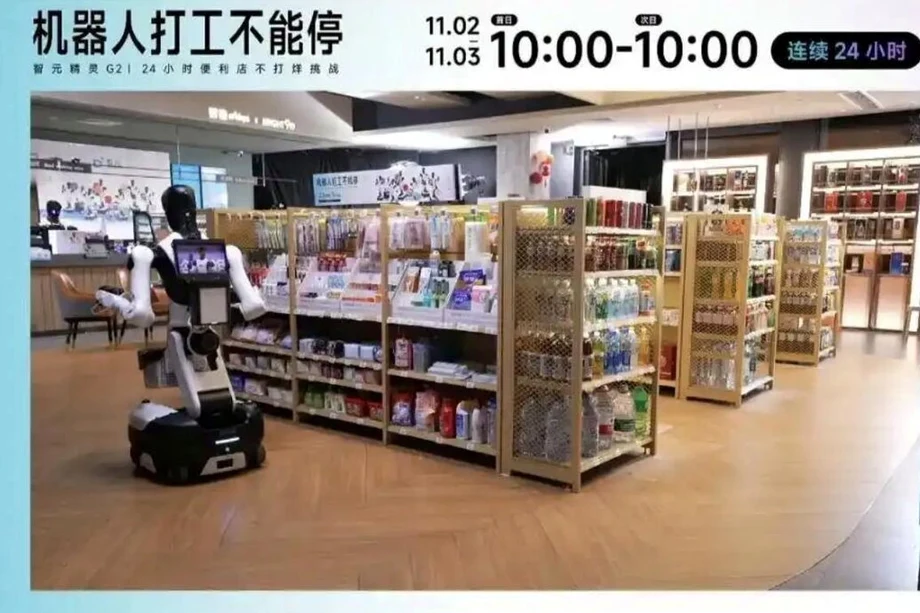
The challenge began at 10 a.m. on November 2, 2026, and concluded on November 3. Organised by Agibot, formally Zhiyuan Innovation (Shanghai) Technology Co., Ltd., the livestream attracted more than 2 million viewers across online platforms. The robots worked through lunchtime demand, evening customers, overnight duty and breakfast service the following morning.
The trial put a practical question behind the spectacle: could robots keep a shop's interconnected jobs moving as customers, orders and obstacles changed around them? A successful coffee preparation was one part of the assessment. Responding promptly, staying at an assigned post and recovering when something went wrong also counted.
Ren Guanghui, vice president of Agibot's embodied intelligence research centre, acknowledged that the machines still lagged behind experienced shop workers in adapting to changes, performing delicate movements quickly and handling unexpected problems. Their next improvements will depend on turning records of successful and unsuccessful work into better operating rules and movement skills.
What the robots actually completed
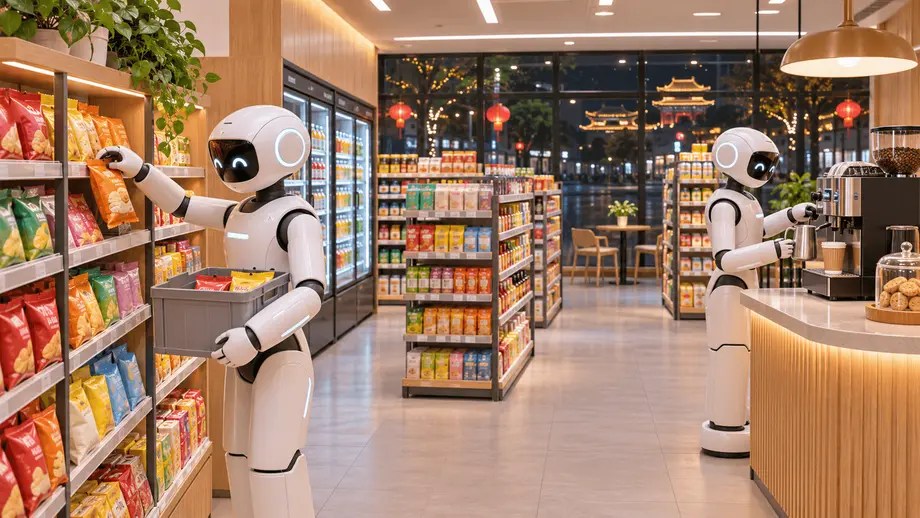
The six machines divided the shop's work among greeting, merchandise handling, coffee preparation, hot food service, shelf inspection and table cleaning. Their combined task count covered activities of very different difficulty and duration.
- 683 customer greetings or reception interactions.
- 369 merchandise retrieval and delivery tasks.
- 147 coffee preparations.
- 126 food service tasks, described as breakfast service in the closing tally and hot food service in the assessment results.
- 277 shelf inspection and replenishment tasks.
- 128 table cleaning tasks.
Customer reception represented about 39.5% of the 1,730 recorded tasks. Reception and merchandise handling together accounted for 1,052 tasks, or about 60.8%. Those figures show that much of the recorded activity involved responding to people and moving products, alongside the more visually striking work of making drinks and serving food.
The combined total averaged about 72 completed tasks per hour across all six robots. Each category demanded different work, however: greeting a customer and preparing a coffee involved different sequences, equipment and amounts of time. The assessment also considered time on duty, customer feedback, task success, response speed and recovery from problems.
Why four robots passed and two did not
Ahao, the greeter, received the highest customer service score after taking the initiative to assist customers. Huobao, assigned to merchandise retrieval and handling, responded quickly to orders and continued working through increases in demand and cancellations.
Kashao, the coffee robot, passed with a stable preparation process, while its hot Americanos received favourable feedback. Dingjiang, responsible for hot food and also assigned checkout duties, met the required standard through steady handling of its work.
Juanwang, the shelf inspection and replenishment robot, did not keep up with the shop's operating rhythm. Its inspection and restocking activity was judged insufficiently proactive. Lengjie, the cleaner, left its designated route during overnight duty and went outside, prompting a need to revise its operating rules.
Four passes out of six amounted to a pass rate of about 66.7% for the participating machines. Agibot did not publish a numerical passing threshold, a complete scorecard or a full count of human interventions. The stated results therefore give a more detailed picture of individual roles than of the system's total reliability: the greeter performed well on customer service, while the cleaner needed tighter control of where it worked.
A full day brought different kinds of pressure
The 24-hour schedule exposed the robots to changing demands within the same small space. Lunch and breakfast created pressure to serve people promptly. Evening trade brought another flow of customers, while the overnight period tested whether machines could maintain their assigned duties when the shop was quieter.
The trial followed this sequence:
- November 2, 2026, at 10 a.m.: six Genie G2 robots began work in the Xuhui convenience store.
- November 2, lunchtime and evening: the assessment followed busy service periods, including orders, merchandise handling and food preparation.
- Overnight on November 2 into November 3: the robots continued through night duty, when the cleaning robot left its route.
- November 3, breakfast period and conclusion: the final service period completed the 24-hour assessment, after which four robots received passing results.
The machines were assessed across four service periods rather than on one carefully timed action. A late merchandise delivery could affect another order; a robot occupying a shelf position could prevent a colleague from reaching it. Keeping work moving required coordination as well as individual dexterity.
Customers and obstacles became part of the test
Two invited participants, Xiaoyang biubiu and Xiaoxiao Nathan, introduced challenges resembling problems a shop worker might face. They asked robots to distinguish regular cola from sugar free cola, rearranged chewing gum on a shelf and obstructed routes with a person and a box.
The cola task required the system to connect a spoken request with visual identification of the right product. The gum exercise tested whether a machine could inspect what was actually on the shelf and restore items to their proper places. The obstacles tested stopping and finding another route around people or objects.
During the trial, robots used visual inspection to identify misplaced merchandise and return it to the correct location. Shelf gaps could trigger replenishment without a person issuing a fresh instruction. Cleaning demonstrations also included distinguishing a surface pattern from a spill or stain.
These tasks brought perception and movement together. A robot first had to recognise a product, obstruction or dirty area, then choose an action and carry it out. A mistaken identification could lead to the wrong purchase being delivered, unnecessary cleaning or a blocked route for another machine.
Why a bag of sweets can be difficult
Ren described the convenience store as a demanding setting because it combines varied products, delicate handling, customers walking among machines and several robots sharing limited space. Unlike a fixed picking station, a shop can change whenever a customer moves an item or steps into an aisle.
A bag of Skittles hanging from a hook illustrates the difficulty. The robot must identify the product, choose where to grasp it and apply enough force to remove it without leaving the opening caught on the hook. Position and grip matter together.
A soft piece of cake presents a different problem. Too little pressure can let it slip; too much can crush it. Packaging and food that bend or change shape are harder to handle consistently than rigid objects with predictable edges.
Ren said tasks were relatively easier when working areas were clearly defined, objects were standardised and results were easy to check. Flexible objects, complicated contact between surfaces and long sequences of movements remained technical challenges. For the shop, this means a robot may perform one organised task steadily while needing more work before it can handle a changing collection of products at the same pace as an experienced employee.
The software connecting six separate jobs
Agibot equipped the six robots with several connected systems. GO-3Preview, its embodied foundation model, provided capabilities for carrying out different physical tasks. Embodied intelligence means AI operating through a physical machine that observes its surroundings and acts within them.
GenieEvolver, the company's system for further training, combined learning on real robots with simulation and world models. A world model is a computer representation used to anticipate how objects and surroundings may respond to an action. These training methods were intended to improve how movements were executed.
GenieMaster handled the organisation of tasks among the robots and returned execution results to the learning process. Its Embodied Execution Protocol, or EEP, connected decisions, physical actions and feedback about what happened.
In shop terms, the organising software needed to know which robot could do a job and what conditions it faced. The movement system then had to perform the action using current observations. Feedback allowed the organiser to decide what should happen next, including when an action needed correction.
Shared space made that coordination necessary. If a replenishment robot occupied a location needed for an order, the system had to manage access or adjust the sequence. Agibot identified conflicts between robot positions and delays in updating order status as examples of problems that could be addressed through better task rules.
Learning from mistakes takes two different timescales
Agibot calls its process for using successful and failed work records PhysicalRSI, meaning recursive self improvement in the physical world. The basic idea is to examine what happened during real tasks, make changes and use later performance to guide further improvements.
GenieMaster was described as collecting successful and unsuccessful task sequences, storing useful experience in long term memory and turning effective adjustments into training data. Reusing a remembered operating rule and training a new movement skill involve different amounts of work.
Ren said lessons about task procedures and scheduling could be reviewed on the day of operation and applied the next day. Movement policy updates required data collection, quality checks, training and validation. A movement policy is the system that selects physical actions from what a robot observes.
Useful data from the livestream was expected to take one to two weeks to appear in later movement policy updates, according to Ren. That gave the trial two practical follow-up periods: rapid changes to workflow rules, followed by slower changes to the models controlling movement.
The cleaning robot's departure from its route and the replenishment robot's slow response also pointed to different kinds of work. One required attention to staying within an assigned operating area; the other required better timing and initiative in maintaining shelves. Agibot did not give a date for another public assessment of the two machines.
What would make the work commercially useful?
Agibot presented the store trial as the first application of its newly released, integrated embodied AI capabilities to specific business operations. The company had begun its AI WAVE technology release series on October 22, covering data, simulation, models, robot hardware and operating systems before bringing those elements into the shop.
The commercial push came alongside reported revenue approaching 2 billion yuan in the first half of 2026 and cumulative production of 20,000 general purpose AI robots. The convenience store assessment focused on what those machines could deliver during everyday service.
Yao Maoqing, Agibot's cofounder, joint president and president of its embodied business division, said productive robot work had to meet measurable, repeatable and sustainable engineering standards. The measures he identified included success rate, the time needed to complete a task and mean time between failures, commonly called MTBF.
MTBF describes the average operating time between failures. For a shop manager, it addresses a practical concern: how long a machine can keep working before a problem interrupts service. Task timing matters for a similar reason. Customers waiting for breakfast need food delivered promptly, even when the robot can eventually complete the preparation correctly.
Agibot's team identified four results it wanted to track: more output meeting the required standard with less time lost to retries or human takeover; less data collection and adjustment when products, layouts or shops changed; improvements that held up in independent assessments while preserving existing skills; and lower operating costs as experience accumulated across different shifts and customer flows.
The Shanghai trial supplied examples of both useful service and unfinished work. Four robots met their assigned standards, while two exposed weaknesses in sustained attention to a role and control of movement. The company's next technical task is to apply those lessons across longer operating periods and changing stores, using the performance measures it has set out.
Key Points
- Six Agibot Genie G2 robots completed a 24-hour convenience store trial in Shanghai's Xuhui district on November 3, 2026.
- The robots recorded 1,730 completed tasks, including 683 customer interactions, 369 merchandise handling tasks and 147 coffee preparations.
- Four robots passed. The shelf inspection robot fell behind the shop's pace, and the cleaner left its assigned route during overnight duty.
- Tests included distinguishing cola varieties, restoring a disordered shelf and navigating around people and boxes.
- Agibot said workflow changes could be applied the next day, while movement model updates using trial data were expected to take one to two weeks.
- The company's stated commercial targets include better success rates, fewer interruptions, easier deployment in new stores and lower operating costs.