Shanghai brings 4,142 overseas exhibitors together
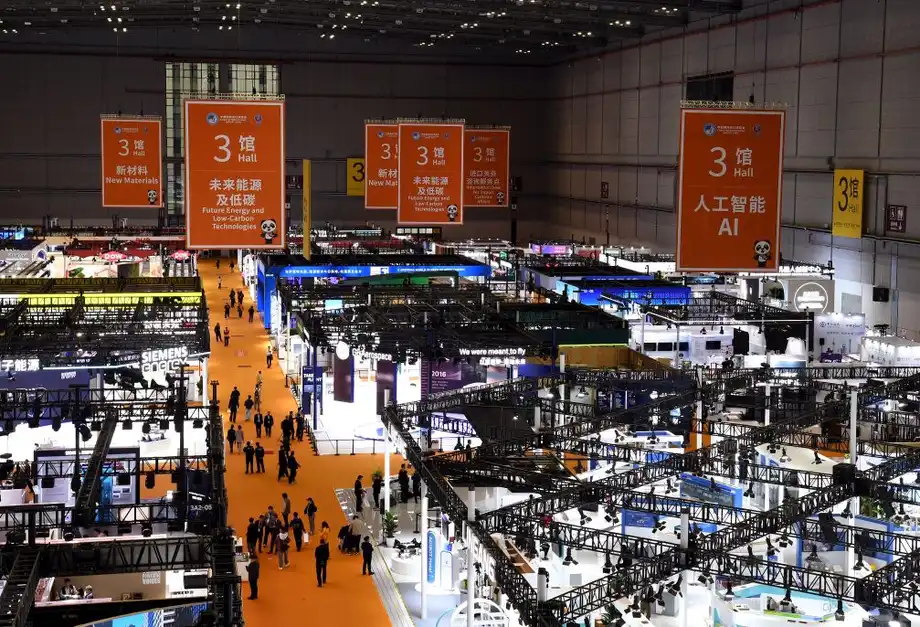
China opened its ninth China International Import Expo in Shanghai on November 5, 2026, bringing together a record 4,142 overseas exhibitors as foreign businesses seek customers, distributors and investment opportunities in the Chinese market. The six day event runs through November 10 at the National Exhibition and Convention Center.
Contents
- Shanghai brings 4,142 overseas exhibitors together
- Participation grows, with newcomers making up nearly half
- What earlier expos have produced
- Thai firms use the expo to test the market
- Medical companies connect exhibits with treatment
- Investment carries the relationship beyond imports
- Consumer brands look for specific customers
- Smaller economies gain space, while services expand
- Customs changes give businesses an earlier start
- Key Points
The gathering includes participants from 162 countries, regions and international organizations. Its total exhibition area has passed 440,000 square meters for the first time, with more than 370,000 square meters devoted to the enterprise exhibition. More than 300 Fortune Global 500 companies and industry leaders are participating, another record.
The opening comes amid concern about China's trade imbalances, putting attention on how much the country buys from abroad as well as how much it sells. China's imports reached 16.7 trillion yuan in the first nine months of 2026, an increase of 22.3 percent and the fastest growth since 2021. A corresponding export total and a figure measuring the reported record imbalance were not given.
A trade surplus occurs when a country exports more than it imports. Faster import growth can narrow that gap if exports grow more slowly, but the balance depends on both sides of the trade ledger. For exhibitors in Shanghai, the immediate task is more concrete: turn meetings and demonstrations into purchases, distribution agreements and business that continues after the stands close.
The expo offers several routes toward that goal. Thai coffee chains are testing flavors and prices, European medical companies are seeking wider use of their technologies, and established consumer brands are looking for their first Chinese customers.
Participation grows, with newcomers making up nearly half
The 4,142 overseas exhibitors compare with 4,108 at the eighth expo in 2025 and 3,617 at the first edition in 2018. That represents an increase of 34 companies, or about 0.8 percent, from last year, and roughly 14.5 percent since the event began.
More than 2,000 companies are exhibiting for the first time, equivalent to over 48 percent of the overseas exhibitor total. Nearly 200 companies and institutions have attended all nine editions. The combination gives the event both a large returning group and a substantial pool of businesses still exploring the market.
Overseas companies come from 148 countries and regions. The broader participation figure of 162 also includes the national exhibition and international organizations. Within the national exhibition, 65 countries and four international organizations are taking part, with Canada and Sri Lanka serving as guests of honor.
American companies occupy more than 50,000 square meters, the largest national corporate exhibition footprint for the eighth consecutive edition. Canadian and New Zealand companies have their largest exhibition areas yet, while Australia's area has expanded by 25 percent from last year.
What earlier expos have produced
The expo's intended transaction value rose from $57.83 billion at its first edition to $83.49 billion at the eighth, an increase of about 44 percent. These figures describe purchasing intentions and agreements announced around the event; completed trade depends on subsequent orders and deliveries.
Several dates show how the exhibition has developed and how preparations now extend beyond its official opening:
- 2018: The first import expo opened, attracting 3,617 overseas exhibitors.
- 2025: The eighth edition drew 4,108 exhibitors and recorded $83.49 billion in intended transactions.
- October 26, 2026: An Italian jewelry exhibitor began a preview in a Shanghai bonded warehouse.
- November 5, 2026: The ninth expo and the Hongqiao International Economic Forum opened.
- November 10, 2026: This year's expo is scheduled to close.
Businesses attending in 2026 are pursuing more than immediate sales. Their plans include clinical use of medical equipment, research partnerships, retail placement and services that help other companies operate across borders.
Thai firms use the expo to test the market
Paijit Viboontanasarn, vice chairman and secretary general of the Thai Chamber of Commerce in China, says some small and medium sized Thai businesses have found customers and partners after attending only one or two editions. The chamber has helped coffee and tea chains establish demonstration outlets where actual sales reveal how consumers respond to prices and flavors.
Paijit described the commercial value of that testing:
"Beyond securing orders, the CIIE allows businesses to test whether their products and business models appeal to Chinese consumers," he said.
Other Thai businesses have discussed placing jewelry in Chinese retail stores. Such arrangements give a supplier access to an existing sales network, rather than requiring it to build its own shops immediately. Paijit wants more Thai companies to develop lasting roles in China's supply and industrial chains, extending their relationships beyond individual product orders.
Romanian businesses are pursuing a similar shift from attending an exhibition to maintaining a local presence. The Romanian business organization taking part has established a Shanghai representative office to provide market entry advice and connect companies with business associations in the Yangtze River Delta. More than 60 Romanian companies and institutions have expressed interest in related activities, including opportunities for wine, mineral water, energy products and vehicle parts.
Medical companies connect exhibits with treatment
The medical exhibition brings together 16 of the world's 20 largest pharmaceutical companies, alongside leading medical imaging and radiotherapy equipment businesses. Across the expo, more than 480 exhibits are making their global, Asian or Chinese debuts, the highest number in its history.
Novo Nordisk, which has attended every edition, points to medicines moving from exhibition displays into the Chinese market. Mike Doustdar, the company's president and chief executive, described that progression:
The CIIE has become an important part of our work in China," said Mike Doustdar. "This is our ninth consecutive year taking part, and many medicines we first presented at the expo have since launched here.
Elekta offers a concrete example involving equipment. A system combining magnetic resonance imaging with radiation treatment made its Asian debut at the first expo and is now used at 17 Chinese medical institutions. Imaging helps clinicians see the area being treated while radiation targets a tumor.
Novartis says more than 60 new medicines and additional approved uses for medicines have received Chinese authorization since it began attending in 2018. This year, it plans its first Chinese exhibition of an investigational treatment in immunology, the field concerned with the body's defenses. Bayer is bringing nearly 30 debut exhibits across prescription medicines, consumer health and crop science.
Investment carries the relationship beyond imports
AstraZeneca announced a $2.5 billion investment in March 2025 to establish its sixth global strategic research and development center in Beijing. A product it introduced at the first expo is now available through more than 7,000 Chinese hospitals. The company's activity illustrates how selling into China can develop alongside research conducted inside the country.
Bayer has six research and innovation centers and four supply centers in China. Its collaboration with Tsinghua University and Peking University has included more than 110 joint research projects. Pfizer's China leadership says its commitment to invest an additional $1 billion in the market has been completed ahead of schedule, with actual investment exceeding the original target.
GE HealthCare has also expanded local operations. A research and innovation center for magnetic resonance systems opened at its Tianjin site in December 2025, followed by the launch of an automated CT detector production line in Beijing in April 2026. The company says more than 1,800 local engineers work across four Chinese research and innovation centers.
Shanghai's figures place those corporate plans in a wider setting. The city received $11.59 billion in foreign investment actually used between January and August 2026, up 6.9 percent from a year earlier. By August, it hosted 1,120 regional headquarters of multinational companies and 675 research and development centers funded by foreign businesses.
Consumer brands look for specific customers
A new global brands display brings together about 100 overseas brands, more than 30 of them with histories exceeding a century. Their sales strategies are often aimed at a particular audience rather than the Chinese consumer market as a whole.
Spanish sparkling wine producer Mestres traces its family winemaking history to 1312. Representative David Aura Font says limited production previously kept its wines out of China. After setting aside stock for the expo, the business hopes to meet sommeliers and restaurant buyers. Its shortest production cycle is four years, while some wines have aged for more than half a century.
Walter's Shoe Care, founded in Canada in 1893, sees China's sneaker culture as an opportunity for its cleaning and care products. British porcelain maker Royal Crown Derby, established in 1750, is displaying tea sets of a kind featured in the television series Downton Abbey. Avalon Dairy, which began in Vancouver in 1906 with six cows, is seeking to expand relationships built through previous expo visits.
Lululemon is attending for the third consecutive year, with China now its second largest market. San Yan Ng, regional president for China and Asia Pacific, described the event's role in connecting the company with people beyond its immediate customer base:
The CIIE is far more than a platform to showcase products," said San Yan Ng. "It also gives us the opportunity to engage in deeper dialogue and build stronger connections with Chinese guests, partners, government stakeholders and friends from all sectors.
Smaller economies gain space, while services expand
Free booth space for the least developed countries has increased by 17 percent this year. Products being promoted include Zambian honey, Rwandan chili peppers and handmade Afghan wool carpets. China has extended zero tariff policies to 63 countries, reducing the import tax burden for goods covered by those arrangements.
The exhibition is also widening beyond physical products. Its six main areas cover technical equipment, consumer goods, food and agriculture, vehicles and smart mobility, medical products, and services, alongside a dedicated innovation incubation area.
Singaporean newcomers in the services section include businesses providing tax, accounting and human resources support. The services exhibition has four dedicated areas covering financial innovation, professional services, exhibitions and cultural tourism, and logistics. These businesses can help suppliers manage the practical work of entering a new market, from moving goods to organizing staff and payments.
The Hongqiao International Economic Forum is running alongside the expo with 23 parallel sessions and seven meetings held in private. Its program includes the first Report on the Development of Exporting to China Capabilities, intended to help countries, especially developing economies, improve their ability to sell into China. The World Openness Report is also scheduled for release for the sixth consecutive year.
Customs changes give businesses an earlier start
Shanghai's preparations include an arrangement allowing exhibits to be shown to potential customers before entering the main venue. On October 26, Italian jewelry company Vetrerie di Empoli's fellow Italian exhibitor, jewelry business Vitifa, began a preview at a bonded warehouse in the Bund Finance Center.
A bonded warehouse holds imported goods under customs supervision before the usual import duties become payable. The jewelry company's representative, Chen Haiyan, said exhibits previously had to remain sealed in storage before the expo. Under this year's arrangement, the business could display them and begin commercial discussions while they remained in bonded status, before transferring them to the main exhibition through a dedicated transport arrangement.
The practical gain is more time with prospective buyers. Together with demonstration shops, retail introductions and professional services, the change shows how the event is being organized around the steps between displaying a product and selling it. Those steps will determine how much of the activity in Shanghai becomes continuing trade after November 10.
Key Points
- The ninth China International Import Expo runs in Shanghai from November 5 to 10, 2026.
- A record 4,142 overseas exhibitors are attending, including more than 2,000 newcomers.
- China's imports reached 16.7 trillion yuan in the first nine months of 2026, up 22.3 percent.
- More than 480 exhibits are making their global, Asian or Chinese debuts.
- Businesses are seeking retail access, medical adoption, research partnerships and investment alongside product orders.
- Free booth space for the least developed countries has increased by 17 percent.