Four goals in 12 minutes turn the final
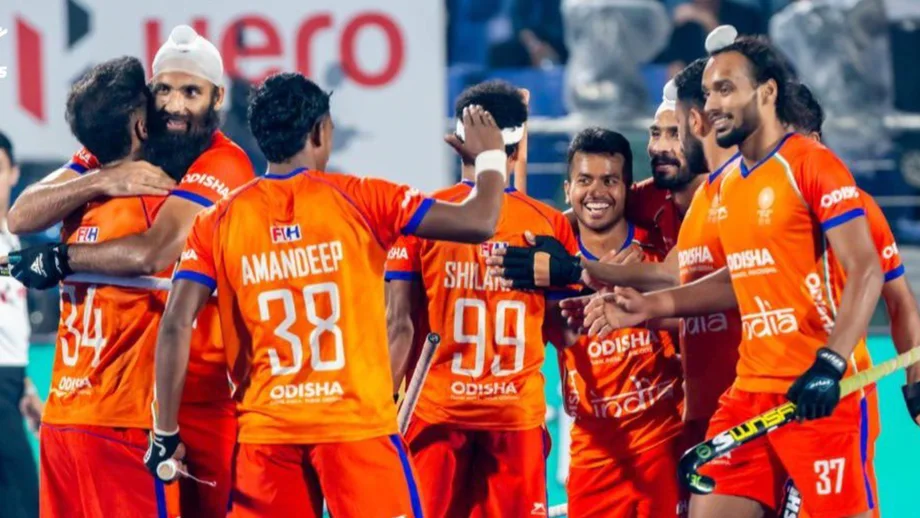
India scored four times between the 42nd and 54th minutes to beat Japan 4-1 in the men's Asian Champions Trophy final on November 5, 2026, securing a record sixth title and a third consecutive championship. Shilanand Lakra began the recovery before Dilpreet Singh, Jugraj Singh and Vivek Sagar Prasad completed it.
Contents
- Four goals in 12 minutes turn the final
- Japan turn an early opening into a lead
- The halftime numbers tell two stories
- Hardik and Nilakanta help change the tempo
- Lakra's equaliser survives Japan's challenge
- Three more goals settle the contest
- Harmanpreet and Fulton explain the response
- A sixth title built on several scorers
- Malaysia recover to claim bronze
- Key Points
Japan had led from the third minute through Kazumasa Matsumoto, leaving India chasing an equaliser for 39 minutes. The hosts finished the tournament unbeaten, with 46 goals in seven matches, yet their most demanding evening required patience before their attack finally found its rhythm.
The final took place at the Olympian Balbir Singh Senior Hockey International Stadium in Mohali. India had beaten Japan by the same 4-1 score in the group stage, but the final followed a much less comfortable route.
India's sixth championship came in the competition's ninth edition. Across their three successive title campaigns, they have recorded 20 wins and one draw, an unbeaten run of 21 matches.
Japan turn an early opening into a lead
Matsumoto struck before India had settled. Receiving the ball on the left, he moved into the shooting circle and fired a reverse hit past Indian goalkeeper Suraj Karkera. The shot squeezed through a narrow opening near the post and gave Japan an immediate reward for their attacking start.
A reverse hit uses the opposite face and edge position of the stick from a conventional forehand stroke. Matsumoto executed it quickly enough to leave India's defence and goalkeeper little time to react.
Japan then combined close marking with aerial passes to escape India's pressure. Their defenders followed individual Indian players tightly, while balls lifted over the first line of opponents helped Japan move forward without repeatedly trying to pass through a crowded midfield.
India created openings through Abhishek Nain, Dilpreet, Sukhjeet Singh and Hardik Singh, but their finishing failed them. The hosts also lost an early video review after an appeal for a push inside the circle was rejected.
The halftime numbers tell two stories
India reached halftime with 52 percent possession and 11 entries into Japan's circle, compared with six for Japan. The hosts had two shots on target to Japan's one. Japan nevertheless held the lead and had earned two penalty corners, while India had earned none.
A circle entry means getting the ball into the marked shooting area around the goal. It measures how often an attack reaches a threatening position, but India's first half showed how much work can still remain once the ball gets there.
Japan's goalkeeper Kisho Kuroda repeatedly stopped India from turning pressure into a goal. His defenders crowded passing routes, stayed close to forwards and made it difficult for India to receive the ball cleanly near goal.
Japan also threatened to extend their advantage. Two penalty corners around the 20th minute tested India's defence, with Amit Rohidas producing an important block against Japan captain Raiki Fujishima. Keeping the deficit to one goal allowed India to pursue the equaliser without having to recover from a larger gap.
Hardik and Nilakanta help change the tempo
Hardik, playing his 200th international match, became central to India's recovery alongside Nilakanta Sharma and Vivek. Their work in midfield helped regain possession and move the ball through Japan's marking with greater purpose after the interval.
India earned their first penalty corner in the 33rd minute. A penalty corner is a set attacking play awarded for certain defensive offences, giving the attacking side a chance to organise a shot while defenders rush out from the goal line. Kuroda stopped Harmanpreet Singh's flick and kept Japan ahead.
Sukhjeet also had an attempt saved, while Harmanpreet struck the post with a reverse effort from a rebound. Japan remained dangerous enough to require attention at the other end, with Shota Yamada unable to turn a third quarter penalty corner into a goal.
India's pressure was becoming more sustained. Hardik and Nilakanta linked moves through midfield, and successive penalty corners in the 42nd minute finally brought the breakthrough.
Lakra's equaliser survives Japan's challenge
Kuroda stopped Harmanpreet's attempt, but India kept the attack alive. Aditya Arjun Lalage reached the loose ball and sent a lifted reverse pass towards Lakra, who finished from close range to make it 1-1.
Japan challenged the goal, arguing that Lalage's aerial pass was dangerous. The video umpire allowed it to stand, and India entered the final quarter level rather than still searching for a response to Matsumoto's early strike.
The equaliser rewarded India's persistence around rebounds. Kuroda had saved the initial attempt, but his defence could not prevent Lalage from finding Lakra with the next pass.
Japan subsequently changed goalkeepers, replacing Kuroda with Takumi Kitagawa. The switch did not halt India's momentum. Six minutes after Lakra scored, the hosts took the lead for the first time.
Three more goals settle the contest
Hardik created the second goal in the 48th minute. After his initial pass was blocked, he recovered possession inside the circle and found Dilpreet. With his back towards goal, the forward controlled the ball and produced the finish that put India 2-1 ahead.
Vivek helped start the move for India's third by intercepting a pass in midfield. The ball reached Sukhjeet, whose attempt led to a penalty corner. Jugraj converted with a powerful drag flick, a technique in which a player pulls the ball along the stick before launching it towards goal.
Jugraj's goal was timed at the 53rd minute in the match descriptions and at the 52nd minute in a published results list. Vivek scored India's fourth in the 54th minute, turning a narrow contest into a decisive victory.
Nilakanta won a loose ball to begin that final scoring move. Lakra's attempt was saved, but Vivek struck the rebound home. Japan earned another penalty corner in the closing seconds and could not reduce the deficit.
The main scoring moments show how quickly the match changed:
- 3rd minute: Matsumoto gives Japan a 1-0 lead.
- 42nd minute: Lakra equalises after Lalage keeps India's attack alive.
- 48th minute: Dilpreet finishes from Hardik's pass to put India ahead.
- 53rd minute: Jugraj converts a penalty corner, with the results list recording the goal a minute earlier.
- 54th minute: Vivek scores India's fourth from a rebound.
Harmanpreet and Fulton explain the response
India captain Harmanpreet said Japan's preparation and close marking had made the first two quarters difficult. He acknowledged missed opportunities and said the midfield needed to do more as India tried to find a way through.
Harmanpreet described the message he gave his teammates:
The message to the team was to believe in ourselves. We knew that if we stick to our plans and structure, goals will come.
India coach Craig Fulton said Japan had played a very good half. He pointed to previous recoveries against Japan and Korea as experiences that helped the players retain confidence while trailing.
Fulton explained India's decision to increase pressure during the second half:
We were not down by three goals. Then we got four goals. We went for full press and full effort in the last two quarters and we knew we could do better.
A full press means pushing players forward to challenge opponents as they try to build an attack. India's midfield recoveries and repeated attempts around the circle gave that approach a concrete reward in the final quarter.
A sixth title built on several scorers
India's previous Asian Champions Trophy titles came in 2011, 2016, 2018, 2023 and 2024. The latest victory means they have won six of nine editions, or two thirds of the championships held.
Harmanpreet finished as the tournament's leading scorer with 10 goals, although he did not score in the final. Dilpreet finished with seven, while Sukhjeet and Lakra contributed five each. Together, those four players scored 27 of India's 46 goals, about 59 percent of the team's total.
India averaged approximately 6.6 goals per match across their seven games. Japan's ability to keep them scoreless until the 42nd minute therefore made the final an unusually stern attacking test.
The final match figures credited India with 22 circle entries and 12 shots at goal, against Japan's seven entries and two shots. India eventually converted that greater attacking volume through a mixture of passing, a penalty corner and alert finishing after saves.
Fulton also linked the tournament to the task of bringing new players into the team while preparing for the Los Angeles Olympics. His reference to the next 18 months placed the focus on a period of preparation in which experienced players and newcomers would need to learn together.
Malaysia recover to claim bronze
Malaysia also came from behind on the final day, beating South Korea 5-2 in the match for bronze. Fitri Saari scored in the second minute, but Geonwoo Park equalised in the fifth and Semin Chun put Korea ahead in the 13th.
Malaysia trailed 2-1 at halftime before Faizal Saari converted a penalty corner in the 34th minute. Abu Kamal Azrai then scored in the 45th and 50th minutes, turning the match firmly in Malaysia's favour.
Captain Marhan Jalil completed the scoring late in the game. Malaysia, who had arrived as Asian Games silver medallists, finished third after losing their semifinal to Japan.
India took the championship, Japan finished second and Malaysia claimed bronze. For the champions, the defining achievement was recovering from an early setback without allowing Japan to turn their long spell in front into victory.
Key Points
- India beat Japan 4-1 to win a record sixth men's Asian Champions Trophy title and their third in succession.
- Matsumoto put Japan ahead in the third minute; India equalised through Lakra in the 42nd.
- Dilpreet, Jugraj and Vivek completed India's comeback with three goals in the final quarter.
- India scored 46 goals in seven matches and finished the tournament unbeaten.
- India's unbeaten run across three title campaigns reached 21 matches, comprising 20 wins and one draw.
- Harmanpreet led the tournament scoring with 10 goals, while Hardik played his 200th international match in the final.
- Malaysia defeated South Korea 5-2 to secure bronze.