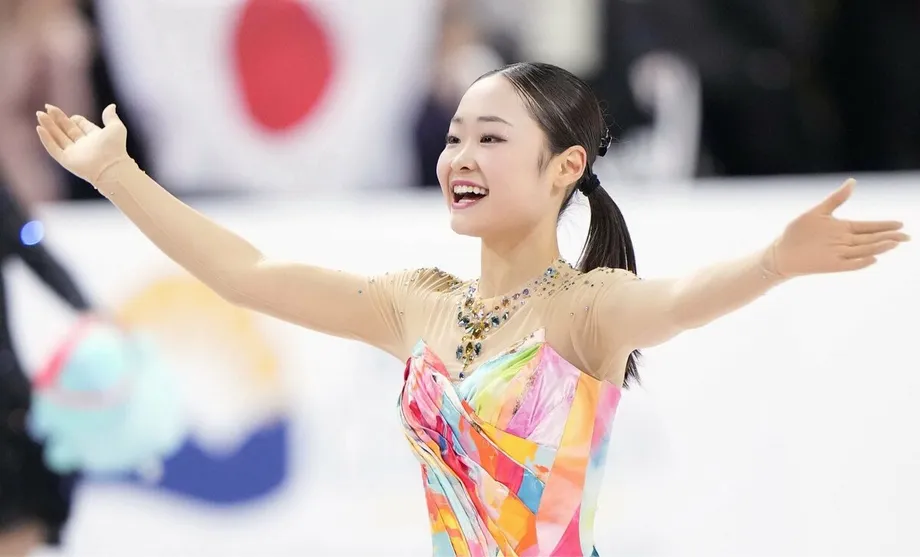
A debut victory built on two commanding performances
Japan's Mao Shimada won her first senior Grand Prix event at Skate Canada International in Kelowna, British Columbia, scoring 235.44 points to set the highest women's total of the season. The four-time reigning world junior champion, who turned 18 on Friday, led both parts of the competition and finished 14.37 points ahead of Estonia's Niina Petrokina.
Contents
Shimada followed Saturday's personal best of 82.11 points in the short program with 153.33 in Sunday's free skate at Prospera Place. Petrokina took silver with 221.07, while Isabeau Levito of the United States earned bronze with 212.22. Japan's Saki Miyake finished fourth on her own Grand Prix debut, scoring 210.09.
The result made Shimada the fourth Japanese woman to win her first Grand Prix Series appearance, following Rika Kihira, Rinka Watanabe and Ami Nakai. It also carried her success from an unbeaten junior career into a competition against established senior skaters.
Her winning performance still left specific work to do. Judges identified an under-rotation on her opening quadruple toe loop and an unclear takeoff edge on a triple flip in a combination. Shimada completed the rest of her elements, including her spins, and said she was happy to finish with a smile.
For Shimada and coach Mie Hamada, the next task is to develop the speed, expression and skating quality expected at senior level. The victory supplied an immediate measure of her scoring strength, while her own assessment focused on how much further the performance could develop.
How the weekend unfolded
Shimada took control in the short program, the shorter opening segment in which skaters must complete a prescribed set of elements. Her 82.11 points established a personal best and gave her first place before the longer free skate.
Sunday's 153.33 points were her best free skate score of the season. Together, the two performances produced a winning total that was also the season's world best. The short program and free skate scores are added together to determine the final standings.
- Friday: Shimada turned 18 ahead of the competition's decisive performances.
- Saturday: She led the short program with a personal best of 82.11 points.
- Sunday: She won the free skate with 153.33 and secured the title with 235.44.
Winning both segments matters because a skater can sometimes claim a title through a strong combined score without placing first in each part. Shimada finished first in both, giving her a victory built across the full competition.
What the jump calls mean
Shimada began her free skate with a quadruple toe loop, a jump requiring four rotations in the air. Judges called it under-rotated, meaning she landed before completing enough of the required rotation to receive full credit for the jump as intended.
Her triple flip in a combination also received an edge warning. A flip is supposed to take off from the inside edge of the skating blade. An unclear edge means the takeoff did not show that required position distinctly enough.
Those technical details help explain why a performance that looks smooth can still lose points. Figure skating rewards both the difficulty of an element and how well it is performed. A demanding jump gives a skater a chance to score heavily, but its landing and takeoff remain subject to close examination.
Shimada avoided a broader breakdown after those calls. She landed her other elements and completed her spins, allowing the program to retain enough strength for the highest free skate score in the field. Her result combined difficult content with consistency across most of the routine.
The margins behind the medals
Petrokina finished closest to Shimada with 221.07 points, but the 14.37-point difference left a substantial gap between gold and silver. Levito's 212.22 put her another 8.85 points behind the Estonian skater.
The contest immediately below the podium was much tighter. Miyake finished just 2.13 points behind Levito, with 210.09. That narrow margin put the Japanese newcomer close to a medal in the final standings, even though she remained fourth after both segments.
Miyake's free skate brought a personal best of 138.14 points. Her total therefore included 71.95 from the short program, calculated by subtracting the free skate score from her final tally. She improved her own scoring benchmark in the longer program without changing her position.
Shimada and Miyake left Kelowna with different achievements from their first Grand Prix appearances. Shimada won the title and set the season's leading total. Miyake finished just outside the medals while recording the best free skate score of her career.
From junior champion to senior contender
Shimada arrived with four consecutive world junior titles, an unusually long record of success before her senior Grand Prix debut. Kelowna gave her an immediate opportunity to carry that competitive record into a different field.
Junior and senior events belong to separate competition categories, with eligibility rules determining when a skater can enter each. Moving into senior competition also brings comparisons with athletes whose skating, performance skills and consistency have developed over more seasons.
Shimada said she wanted to improve her speed and expression to meet senior standards. Speed affects how a skater moves through the program, while expression concerns how movement and performance convey the music. Both sit alongside the jumps and spins that often attract the most attention.
Hamada praised her performance and said the next stage was to develop her skating as a senior. Their assessment put the emphasis on refinement after a successful debut: preserving the technical strength that helped win in Kelowna while building a more complete performance.
Why the Olympic age rule mattered
Shimada was unable to compete at the Milan-Cortina Winter Olympics in February because of the International Skating Union's age rule change adopted in June 2022. Her junior achievements therefore came before she could pursue that Olympic opportunity.
Age eligibility operates separately from a skater's results. Competition rules set the age requirements for entering senior events, so winning junior titles cannot by itself secure access to an Olympic field. Shimada's career illustrates how the timing of those rules can shape an athlete's route through the sport.
Her eighteenth birthday and Grand Prix victory brought that progression into focus in Kelowna. She had already built a lengthy championship record in juniors; now she had won her opening event on the senior Grand Prix circuit. Her stated priorities were the practical details of improving her skating for that level.
Canada's results and the ice dance podium
Madeline Schizas of Oakville, Ontario, was the highest placed Canadian woman, finishing eighth with 177.38 points. Ottawa's Fee Ann Landry finished ninth with 171.18, while Montreal's Sara-Maude Dupuis placed 11th with 158.63.
Schizas described mistakes in both programs but also pointed to her response after the errors. Speaking after the free skate, the Canadian skater contrasted her two performances:
Yesterday was one big error," Schizas said. "I made two big errors today, but this happens and I think I came back and I showed mental strength today and character.
Her comments captured another part of the competition: recovering within a performance after a mistake. A skater must continue through the remaining jumps, spins and skating passages, each of which still contributes to the score.
Britain's Lilah Fear and Lewis Gibson won the ice dance title later Sunday with 201.17 points. France's Evgeniia Lopareva and Geoffrey Brissaud finished second with 192.95, and Americans Caroline Green and Michael Parsons took bronze with 186.02. The British pair's winning margin was 8.22 points.
Key Points
- Mao Shimada won her senior Grand Prix debut at Skate Canada with a season's world best total of 235.44 points.
- She led both segments, scoring 82.11 in the short program and 153.33 in the free skate.
- Niina Petrokina took silver with 221.07, and Isabeau Levito won bronze with 212.22.
- Saki Miyake finished fourth with 210.09, including a personal best free skate of 138.14.
- Shimada became the fourth Japanese woman to win on her Grand Prix Series debut.
- Madeline Schizas was the top Canadian woman in eighth; Britain's Lilah Fear and Lewis Gibson won ice dance.