Twenty laps bring victory, crashes and a championship gain
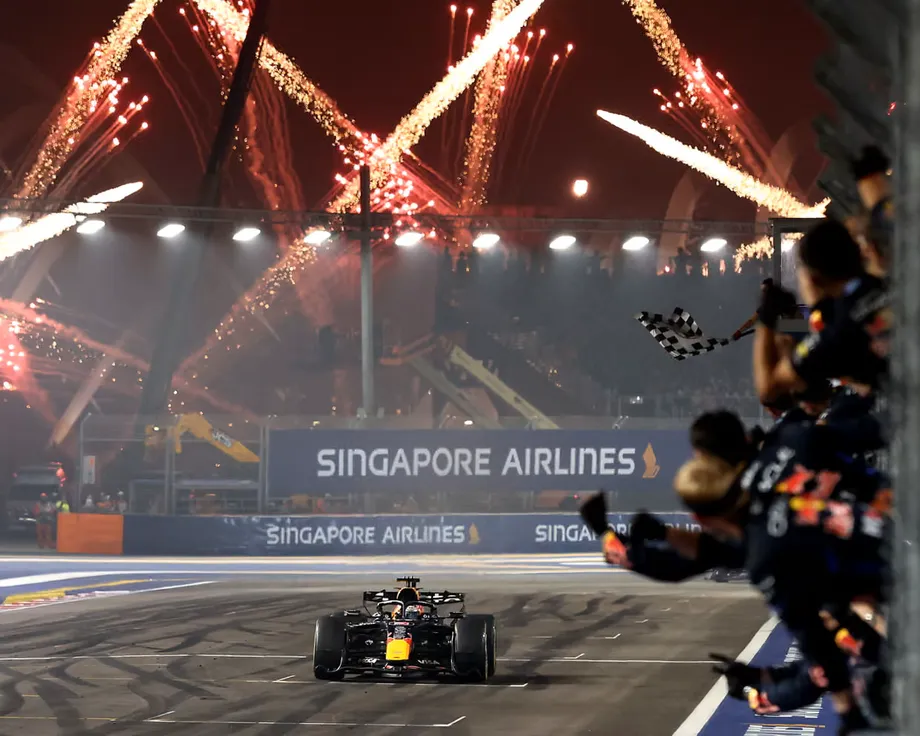
Max Verstappen won Singapore's first Formula 1 Sprint on October 10, 2026, completing 20 laps in 39 minutes 48.162 seconds after heavy rain delayed the start by half an hour. Ferrari's Lewis Hamilton finished 2.591 seconds behind, while Charles Leclerc took third, 16.871 seconds off the lead.
Contents
- Twenty laps bring victory, crashes and a championship gain
- Standing water holds up the start
- Russell's lead lasts less than a lap
- Why the leaders stayed on intermediate tyres
- McLaren's Turn 5 collision costs both drivers
- Antonelli gains as others lose ground
- Nine retirements leave a reduced field
- How the Singapore weekend unfolded
- Key Points
The Red Bull driver lost first place to George Russell at the start, then regained it when the Mercedes driver crashed at the final corner of the opening lap. A late collision between McLaren teammates Lando Norris and Oscar Piastri reshaped the contest behind the Ferraris and left their team with just one point.
Kimi Antonelli, who arrived as championship leader, finished fourth and collected five points while his Mercedes teammate Russell scored none. Liam Lawson finished fifth for Racing Bulls, followed by Haas driver Ollie Bearman, Audi's Nico Hulkenberg and Norris, who recovered to eighth.
Singapore's sixth and final Sprint of the season produced nine retirements from a field of 22 cars, the highest retirement count reported for a Formula 1 Sprint. Piastri appeared 14th in the classification after completing 19 laps, although his race ended following the McLaren collision.
The afternoon rewarded three different skills: Hamilton's preparation for a slippery start, Verstappen's management of tyres on a drying track, and Antonelli's ability to stay clear of trouble. For Russell and McLaren, brief incidents carried a measurable cost in championship points.
Standing water holds up the start
Heavy rain left standing water around Marina Bay, particularly at Turns 2 and 3, where the FIA identified difficult conditions. The Medical Car inspected the circuit before officials postponed the scheduled start.
Drivers eventually completed two formation laps behind the Safety Car before taking a standing start. Everyone began on intermediate tyres, which have grooves to move water away from the contact patch while retaining more rubber against the road than full wet tyres.
The track surface was reported at 44 degrees Celsius, but puddles remained a problem. A hot surface can help water evaporate, while deeper pools still make it difficult for tyres to maintain contact with the road.
Race control's decision put the field into a demanding middle ground: conditions were suitable for racing, yet grip varied around the circuit. Painted lines and wet patches required particular care, and the consequences of a mistake were severe on streets bordered by concrete barriers.
Russell's lead lasts less than a lap
Russell reacted more quickly than Verstappen from the front row and moved ahead through Turn 1. Hamilton made an even larger gain in positions, climbing from sixth to third by passing Norris, Piastri and his Ferrari teammate Leclerc.
Hamilton later explained that he had adjusted his starting procedure after assessing the slippery conditions during the formation lap. His preparation paid off immediately and placed him behind Russell and Verstappen before the opening lap was complete.
Russell then ran wide leaving the final corner, lost control around the painted lines and struck the barriers. His Mercedes rebounded across the road, ending his race and bringing out the Safety Car. Verstappen returned to first place, with Hamilton promoted to second.
The opening sequence also removed several other competitors. Lance Stroll and Sergio Perez collided while braking for Turn 16. Stroll retired immediately; Perez reached the pits but also failed to finish. Isack Hadjar stopped with a power unit problem, while Franco Colapinto's Alpine also came to a halt.
Those stoppages prolonged the interruption. Racing resumed on Lap 7, giving Verstappen a restart to manage and leaving the field with a much shorter stretch of unrestricted racing in which to recover positions.
Why the leaders stayed on intermediate tyres
Verstappen accelerated away at the restart and kept Hamilton behind. As the racing line dried, the challenge changed from finding enough grip in water to preserving tyres designed for damp conditions on increasingly dry asphalt.
Intermediate tyres can become too hot and wear quickly when the road dries. Drivers therefore sought remaining wet patches to help cool them. Leclerc reported that his front tyres were badly worn as the two McLarens moved within reach behind him.
Slick tyres, which have no grooves, offer better grip on a dry surface. Changing to them, however, requires a pit stop and an immediate loss of time. The leaders stayed out because the benefit of fresh slicks had to outweigh that loss over the few laps remaining.
Hamilton reduced Verstappen's advantage late in the race, and the Red Bull driver reported an engine boost problem. Verstappen nevertheless held on to win by 2.591 seconds. Leclerc finished another 14.280 seconds behind Hamilton, leaving Ferrari with two places on the Sprint podium but a substantial gap between its cars.
Verstappen's victory was his first Sprint win of the season. It also gave him a breakthrough at a circuit where he was still seeking a first victory in the full Grand Prix.
McLaren's Turn 5 collision costs both drivers
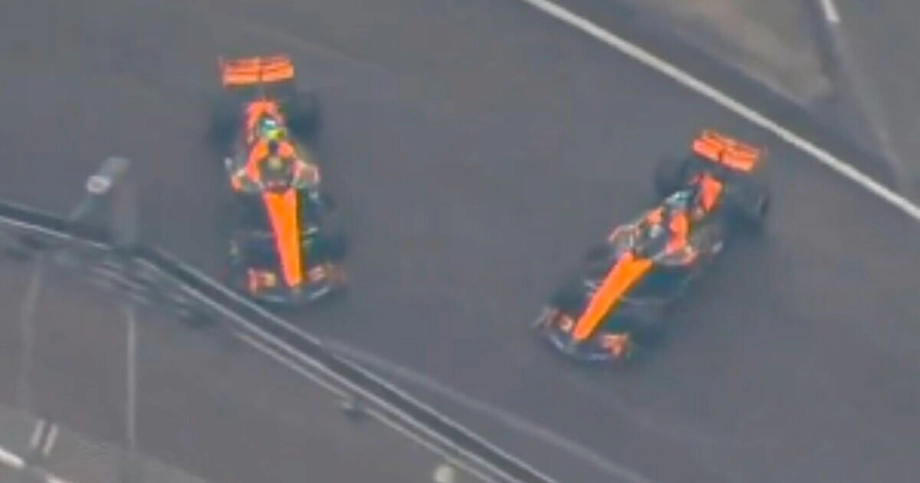
Norris tried to pass Piastri on the inside at Turn 5 in the closing stage. Contact sent both cars into spins, with Piastri striking the wall and Norris continuing far enough to salvage eighth place.
Norris, the reigning world champion, defended his decision to attempt the move. He said he had seen an opening before the space narrowed and explained that the incident would be discussed within McLaren.
It was a big gap, I went for it, I have the right to do that. The rest we go review as a team.
Piastri, whose race ended after 19 laps, described himself as "not that bothered" about losing points in the contest for fourth and fifth. His retirement and Norris's recovery left McLaren with only the single point awarded for eighth.
Stewards subsequently decided that neither driver was wholly responsible and took no further action. That decision settled the sporting penalty question, while McLaren still had its own disagreement to address.
Andrea Stella, McLaren's team principal, said the team had been capable of collecting useful points despite lacking the pace to win. He said the drivers would discuss what happened privately and be reminded that the team's interests came first.
Seeing two McLarens making contact like that is simply not acceptable.
Antonelli gains as others lose ground
Antonelli's fourth place increased his championship advantage over Russell by five points. Sprint points go to the first eight finishers, starting with eight for the winner and dropping by one point per position to a single point for eighth.
Mercedes therefore left the Sprint with a sharply divided result. Russell had briefly led but earned nothing; Antonelli stayed in contention and benefited when the McLarens collided. His fourth place was only 0.367 seconds behind Leclerc at the finish.
Lawson narrowly avoided the McLaren incident and gained two places to finish fifth, earning four points. Bearman took three points in sixth, Hulkenberg earned two in seventh, and Norris collected one.
Ferrari's second and third places produced 13 points, compared with eight for Verstappen's victory and one for McLaren. The comparison shows why the Turn 5 contact mattered beyond the two drivers: teams also compete for a constructors' championship, which combines the points earned by both cars.
Pierre Gasly finished ninth for Alpine, just outside the scoring positions. Esteban Ocon, Fernando Alonso, Carlos Sainz and Racing Bulls rookie Arvid Lindblad completed the group that finished all 20 laps.
Nine retirements leave a reduced field
Alex Albon, Gabriel Bortoleto and Valtteri Bottas were involved in another collision around the Safety Car restart. Bortoleto and Bottas retired, while Albon initially continued before bringing his Williams in for the final time after completing 14 laps.
Those three joined Russell, Stroll, Perez, Hadjar, Colapinto and Piastri among the nine retirements. Thirteen of the 22 starters reached the end of the scheduled distance, meaning more than two fifths of the field failed to finish.
Alpine confirmed that Colapinto's energy store, the battery used by the car's hybrid system, would be replaced with another unit from his existing allocation. The team said the change would bring no penalty.
Stewards also took no further action over Hamilton's alleged yellow flag infringement during the Sprint. Verstappen had already been cleared after a yellow flag review in Friday's Sprint qualifying. The collision involving Albon, Bortoleto and Bottas was referred for review, with no outcome given in the immediate race coverage.
How the Singapore weekend unfolded
Verstappen's Sprint victory formed part of a wider Marina Bay breakthrough. He had taken first place in Friday's Sprint qualifying ahead of Russell, Leclerc and Piastri, then went on to secure his first Singapore pole position for the full Grand Prix later on Saturday.
The weekend's main developments followed this sequence:
- October 9: Verstappen secured Sprint pole and was cleared following a yellow flag review.
- October 10: Heavy rain delayed the Sprint by 30 minutes. Verstappen won after Russell crashed and the McLaren drivers collided.
- Later on October 10: Stewards took no further action over the McLaren collision, and Verstappen secured pole for Sunday's Grand Prix.
- October 11: Verstappen won the full Grand Prix, with Leclerc second and Antonelli third.
Saturday's Grand Prix qualifying schedule was also pushed back by the weather disruption. Hamilton was fastest in the first two qualifying stages but struggled with slides during the final session and qualified third. Antonelli secured fourth.
Verstappen subsequently converted pole into his first Singapore Grand Prix victory, finishing 7.335 seconds ahead of Leclerc over 62 laps. Antonelli's third place on Sunday extended his championship lead over Russell to 102 points, completing a weekend in which avoiding Saturday's trouble had helped strengthen his title position.
Key Points
- Verstappen won the 20 lap Singapore Sprint in 39:48.162, beating Hamilton by 2.591 seconds.
- Leclerc finished third, giving Ferrari 13 Sprint points from its two cars.
- Russell crashed out while leading on the opening lap; championship leader Antonelli finished fourth and earned five points.
- Norris and Piastri collided at Turn 5. Norris recovered to eighth, while Piastri retired after 19 laps.
- Stewards took no further action over the McLaren collision, but team principal Andrea Stella called the contact unacceptable.
- Nine of the 22 starters retired after rain delayed the start and conditions gradually dried.
- Verstappen later secured Grand Prix pole and won Sunday's main race.