More Filipinos found work, while more were still looking
The Philippines added 534,000 employed people in September 2026, bringing the total to 50.32 million, according to Philippine Statistics Authority (PSA) Labor Force Survey figures released on November 6. Yet unemployment also increased, reaching 2.86 million people, because the labor force expanded faster than employment.
Contents
- More Filipinos found work, while more were still looking
- Why the employment count rose while the rate fell
- The dates and comparisons behind the results
- Trade led monthly gains, while hospitality led annual growth
- Construction losses weighed on employment
- Fewer workers wanted more work, but millions still did
- Young people accounted for much of the labor force expansion
- Services dominated, but employment took several forms
- DOLE points to job matching and training
- Key Points
The unemployment rate rose to 5.4% from 5.3% in August and 3.8% in September 2025. Employment increased by 721,000 compared with a year earlier, while the number of unemployed people grew by about 900,000, using the published totals of 2.86 million and 1.96 million.
Underemployment moved in a more encouraging direction. The share of employed people wanting additional work or longer hours fell to 11%, covering 5.56 million workers. Even so, the number remained slightly above the approximately 5.52 million recorded a year earlier.
National Statistician and Civil Registrar General Claire Dennis S. Mapa presented a picture of an expanding labor market with uneven results. Hotels, restaurants and related businesses gained workers, while construction lost employment as public building activity slowed and material costs increased.
The figures matter for households in different ways. More people were earning through work, but a larger number were seeking jobs, and millions who already had work still wanted more. The central issue was whether the growth in employment could keep pace with the number of people entering or returning to the labor market.
Why the employment count rose while the rate fell
The labor force reached 53.19 million in September, up from 52.56 million in August and 51.56 million in September 2025. It includes people aged 15 and above who are employed or unemployed.
The labor force participation rate rose to 64.5% from 64% in August, returning to the same rate recorded a year earlier. In simple terms, about 65 out of every 100 people aged 15 and above were participating in the labor market.
The employment rate measures employed people as a share of that labor force. September's 94.6% rate was below August's 94.7% and the 96.2% recorded a year earlier, even though the number of employed people increased. The group being measured had grown faster than the number who had work.
Over the year, the labor force expanded by approximately 1.63 million, while employment rose by 721,000. That means the net employment increase was about 44% of the net labor force increase. Mapa also cited 1.61 million additional labor market participants in his remarks, alongside the published totals showing an increase of 1.63 million.
These are changes in population totals between survey periods. People move into work, leave jobs and enter or leave the labor force, so the figures describe the balance of those movements.
The dates and comparisons behind the results
The PSA collected September's Labor Force Survey data from September 8 to 28, 2026. The results were presented at a briefing on Friday, November 6, with the Department of Labor and Employment (DOLE) also commenting that day.
The monthly and annual comparisons show different parts of the story. August provides the nearest comparison, while September 2025 shows how employment changed over a full year.
- September 2025: Employment stood at 49.60 million, unemployment at 1.96 million and the labor force at 51.56 million.
- August 2026: Employment reached 49.79 million, unemployment totaled 2.77 million and the labor force stood at 52.56 million.
- September 8 to 28, 2026: The PSA collected the latest survey data.
- September 2026 results: Employment reached 50.32 million, unemployment totaled 2.86 million and the labor force expanded to 53.19 million.
- November 6, 2026: The results were presented publicly, and DOLE outlined its employment support programs.
Compared with August, the unemployed population increased by about 90,000. Compared with September 2025, the unemployment rate rose by 1.6 percentage points, a much larger movement than the monthly increase of 0.1 percentage point.
Trade led monthly gains, while hospitality led annual growth
Wholesale and retail trade, including the repair of motor vehicles and motorcycles, recorded the largest employment increase between August and September, adding 546,000 workers. Accommodation and food service activities followed with 449,000.
Other large monthly gains came from public administration and defense, including compulsory social security, with 314,000 additional workers; manufacturing, with 311,000; and fishing and aquaculture, with 276,000.
Accommodation and food services led the annual comparison, adding 834,000 workers from September 2025. Transportation and storage gained 254,000, other service activities added 174,000, agriculture and forestry increased by 139,000, and public administration and defense, including compulsory social security, added 117,000.
The annual increase in accommodation and food services alone exceeded the net employment increase of 721,000 across the economy. Losses elsewhere reduced the final total, showing how strong growth in one area can sit alongside weakness in another.
Trade provides another example of why the comparison period matters. Despite its gain of 546,000 workers from August, employment in wholesale and retail trade and vehicle repair was still 101,000 below September 2025. Transportation and storage gained workers over the year but lost 170,000 between August and September.
Construction losses weighed on employment
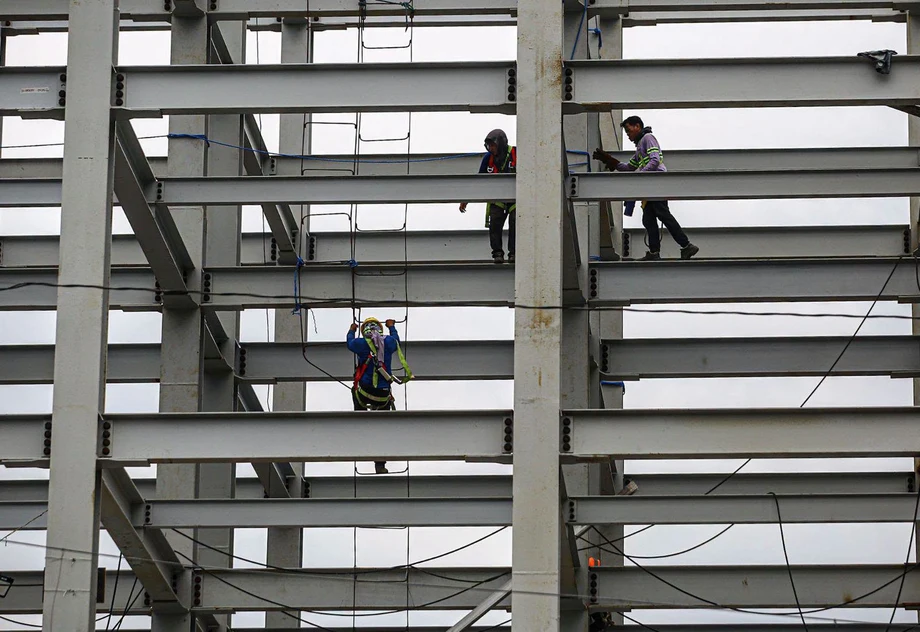
Construction recorded the largest employment decline in both comparisons. Its workforce fell by 416,000 from August and by 271,000 from September 2025, leaving about 4.70 million employed in the sector.
Mapa attributed the decline to slower public construction and higher building material costs. He identified construction of buildings as a particular area of weakness, with employment down by about 329,000.
Mapa, the PSA's national statistician, described the slowdown at the briefing:
Construction activities really went down, particularly public construction.
He said material costs rose by about 5.5%, with higher costs affecting work such as home repairs and maintenance. For construction workers, weaker activity meant fewer employment opportunities even as several service industries expanded.
Other annual losses included 163,000 workers in arts, entertainment and recreation; 105,000 in information and communication; and 85,000 in professional, scientific and technical activities. Employment among contact center information clerks, an occupation that includes work in business process outsourcing, fell by 289,000 over the year.
Between August and September, agriculture and forestry lost 269,000 workers, administrative and support services lost 245,000, and professional, scientific and technical activities lost 154,000. These declines helped offset the large monthly increases in trade, hospitality, manufacturing and fishing.
Fewer workers wanted more work, but millions still did
Underemployment measures employed people who want additional hours in their present job, another job, or a new job with longer hours. September's rate of 11% meant roughly one in nine employed people wanted more work.
The August baseline was cited as 11.9% in the PSA figures accompanying the release, although an alternative published figure put it at 11.1%. The September 2025 rate was 11.1%, making the annual decline just 0.1 percentage point.
The annual comparison also shows why both the rate and the number matter. Underemployment fell as a share of employment, but the number of affected workers increased from approximately 5.52 million to 5.56 million, a rise of about 40,000. The employed population had grown in the meantime.
Among September's underemployed workers, 61.4% worked fewer than 40 hours a week, including those who did no work during the reference period. Applying that share to 5.56 million gives approximately 3.41 million people.
The remaining 38.6%, approximately 2.15 million people, worked at least 40 hours but still wanted additional work. A full working week could therefore coexist with a desire for more earning opportunities.
Across all employed people, average weekly working hours rose to 40.1 from 39.2 in August, while remaining below the 40.5 recorded a year earlier. About 102,000 people worked exactly one hour during the reference week, compared with 59,000 in August and 22,000 in September 2025. Working hours give readers another measure of the amount of work behind the employment total.
Young people accounted for much of the labor force expansion
Filipinos aged 15 to 24 accounted for 988,000 of the additional labor force participants compared with September 2025. That was about 61% of the total net increase of 1.63 million.
Participation among this age group rose to 34.1%, compared with 32.7% in August and 31.6% a year earlier. Youth employment reached 6.23 million, while about 715,000 young workers were underemployed, equivalent to an underemployment rate of 11.5%.
Mapa also identified increases of 451,000 labor force participants aged 35 to 44 and 433,000 aged 45 to 54. Those increases, together with the youth figure, exceed the net national rise because changes across the other age groups also affect the total.
Mapa said men accounted for more of the additional participants than women compared with a year earlier. His remarks described a labor force expansion involving several age groups, with young people making the largest contribution.
For young jobseekers, the combination of rising participation and rising national unemployment points to greater competition for openings. The youth underemployment figure also shows that obtaining work did not end the search for more hours for hundreds of thousands of young workers.
Services dominated, but employment took several forms
Services accounted for 62.2% of employment in September, followed by agriculture at 20.7% and industry at 17.1%. The distribution helps explain why gains in shops, restaurants, hotels and transport carried substantial weight in the national figures.
Within the more detailed industry groups, wholesale and retail trade and vehicle repair employed 19.9% of workers, agriculture and forestry accounted for 17.9%, and construction represented 9.3%.
Wage and salary workers made up 63% of employed people. Those working for themselves without paid employees accounted for 28.1%, unpaid family workers represented 7.3%, and employers in family farms or businesses made up 1.5%.
Among wage and salary workers, 78% worked in private establishments, equivalent to 49.1% of all employed people. Government offices and corporations controlled by the government employed 15% of wage and salary workers, or 9.5% of all employed people.
The employment total therefore covered several ways of working: earning a salary, running a small business alone, employing others or helping in a family enterprise without pay. Underemployment and working hours add detail about how much work those arrangements provided.
DOLE points to job matching and training
DOLE highlighted the annual rise from approximately 49.6 million employed people to 50.32 million. It cited JobStart Philippines, job fairs and skills training among its programs to expand employment opportunities and help applicants secure work.
Job fairs bring employers and applicants together, while skills training helps people build qualifications for available positions. Those services address practical parts of a job search, including finding openings and meeting employers' requirements.
DOLE gave no new timetable or placement target in the November 6 account of its response. The immediate challenge shown by September's figures was the scale of demand for work: 2.86 million unemployed people, alongside 5.56 million employed people seeking additional work or longer hours.
September delivered more employment and a lower underemployment rate, but the labor force grew faster than the number in work. Construction losses and the large arrival of younger participants help explain why the increase of 534,000 employed people from August came with a higher unemployment rate.
Key Points
- Employment reached 50.32 million in September 2026, up by 534,000 from August and 721,000 from a year earlier.
- Unemployment rose to 5.4%, affecting 2.86 million people, compared with 2.77 million in August.
- The labor force expanded to 53.19 million, with participation at 64.5%.
- Underemployment fell to 11%, although 5.56 million employed people still wanted additional work or longer hours.
- Trade led monthly employment gains, while accommodation and food services recorded the largest annual increase.
- Construction employment fell by 416,000 from August and 271,000 from September 2025.
- People aged 15 to 24 accounted for 988,000 of the additional labor force participants over the year.
- DOLE cited JobStart Philippines, job fairs and skills training as parts of its employment response.