Oil talks widen as Manila builds an emergency buffer
The Philippines is discussing oil storage with Saudi Arabia and six other countries as it prepares its first government storage tank in Bataan for completion by the end of 2027. The initial tank would hold 1 million barrels, roughly two days of national petroleum demand, while funding to buy the fuel for the new facility has yet to be secured.
Contents
- Oil talks widen as Manila builds an emergency buffer
- What the reserve numbers mean
- Bataan construction has funding, but filling it does not
- How foreign storage deals could work
- Saudi interest extends beyond the Philippines
- Japan and ASEAN offer another route to supplies
- A proposed law would support a larger buffer
- El Nino adds pressure to the oil crisis
- More generating capacity, with different deadlines
- The dates shaping the next steps
- Key Points
Energy Secretary Sharon Garin outlined the international talks at Singapore International Energy Week on October 28. Potential partners include Russia, the United States, Japan, Kuwait, the United Arab Emirates and Australia, alongside Saudi Arabia.
The effort brings together three plans: a national emergency reserve, foreign oil stored inside the Philippines, and regional arrangements that would give participating countries access to supplies during a shortage. Each could help a country of 114 million people that depends heavily on imported petroleum.
Manila is responding to supply disruption following US and Israeli strikes on Iran in February, while preparing for another strain on energy supplies. Garin expects El Nino to reduce hydropower and solar generation in the first half of 2027, requiring more electricity from plants using diesel and gas.
The immediate challenge is turning storage capacity and diplomatic discussions into fuel that the Philippines can access when needed. Philippine National Oil Company officials told senators that the P8 billion allocated for the initial reserve project covers facilities, with no allocation yet for the fuel inventory. International storage partnerships are among the options being considered while the government seeks that funding.
What the reserve numbers mean
Garin said current Philippine fuel inventories amount to 55 days of consumption, compared with a minimum requirement of 15 days for petroleum products. She also said the government already holds 1 million barrels in private facilities.
The existing government stocks and the planned Bataan tank are separate: one is oil already held in privately operated storage; the other is new government storage capacity. A strategic petroleum reserve is fuel kept for emergencies, such as a disruption that prevents normal deliveries from arriving.
Government demand figures cited for May put daily petroleum consumption at about 78 million liters, or 490,600 barrels. At that rate, 1 million barrels represents approximately 2.04 days of demand. A reserve covering 60 days would require about 29.4 million barrels, nearly 30 times the initial tank's capacity.
Garin described the intended expansion and the government's target:
We start with 1 million (barrels) and scale it up over the years with the objective of reaching 60 days,
She said the planned volume would be divided equally between crude oil and finished fuels. Finished products, such as diesel, can be supplied to users after distribution. Crude oil first needs to be processed in a refinery, making refining capacity another part of emergency planning.
Bataan construction has funding, but filling it does not
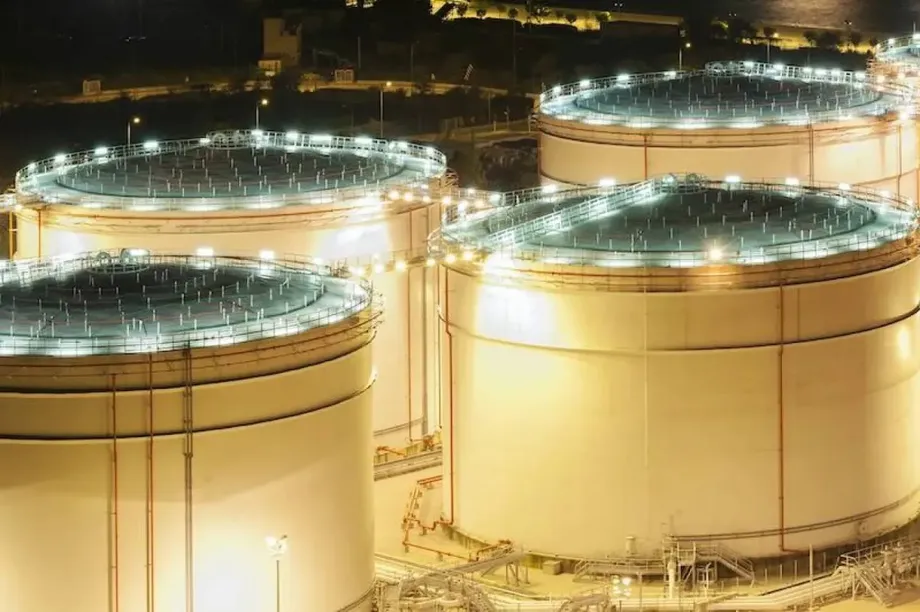
PNOC Deputy Manager Antonio Buenviaje told the Senate energy committee that land development had begun for the reserve. The first tank, with capacity for 1 million barrels, is expected to be completed by the end of 2027, with six tanks planned by 2028.
Buenviaje explained to senators what the P8 billion allocation would cover:
For the PNOC facility, sir, the initial project is only the facility. We do not have a budget. We only asked for P8 billion for these facilities. We do not have a budget for the fuel, the inventory that will be put in these facilities,
PNOC is considering temporary storage partnerships with international companies, including Saudi Aramco, while awaiting government funding for inventory. Foreign companies could use the planned facilities to hold their supplies, while the government continues pursuing its own fuel purchases.
The construction timetable therefore sits alongside a separate financing task. The total capacity of all six planned tanks and a deadline for reaching the full 60 days of reserves were not specified.
How foreign storage deals could work
Garin described several possible arrangements for countries and companies interested in storing oil in the Philippines. Partners could build their own tanks and hold their own inventories, or lease tanks built in the Philippines.
Another option would allow a partner to store oil without a storage charge, with the Philippines paying for the fuel when it uses it. Garin presented these options as ways to improve access to supplies without requiring the government to pay every cost at the outset.
The Department of Energy is also encouraging companies to build refineries in the country. That would connect the storage proposal with the ability to turn crude into products needed by transport, businesses and power plants.
Garin said regional stockpiles could complement the national reserve, with priority access for the Philippines during a shortage. The precise access rights, prices and obligations would depend on the arrangements eventually agreed with partners.
Saudi interest extends beyond the Philippines
Saudi Arabia is exploring overseas storage locations following attacks on its ports and oil facilities. During the week of Garin's Singapore remarks, it announced a preliminary agreement to store Saudi crude in Singapore's underground rock caverns from 2027.
The Philippine discussions form part of that wider search for places to keep oil closer to Asian customers. Storing supplies outside an area affected by conflict can shorten the distance between available stocks and buyers when normal shipping is interrupted.
Saudi Arabia and the UAE had already expressed willingness to cooperate on stronger oil stockpiling in Asia during regional ministerial discussions earlier in October. Japan's State Minister of Economy, Trade and Industry Kei Takagi described their position after the fourth Asia Zero Emission Community Ministerial Meeting.
Takagi, speaking through an English translation, said:
Both countries from the Middle East expressed their willingness to cooperate on strengthening oil stockpiling capacity in Asia, and we confirm that we will further deepen our cooperation to strengthen energy security,
The proposed Saudi and UAE contributions were not specified as oil supplies, storage facilities or financing. Their stated willingness to cooperate is the starting point for further negotiations.
Japan and ASEAN offer another route to supplies
The Philippines and Japan are pursuing a proposed regional stockpiling arrangement alongside Manila's national reserve. A May 28 joint statement by the Philippine Department of Energy and Japan's Ministry of Economy, Trade and Industry set out cooperation under the Partnership on Wide Energy and Resources Resilience Asia, known as POWERR Asia.
Japan's ministry said a roadmap for a regional joint stockpiling system would be developed through the Economic Research Institute for ASEAN and East Asia. The proposed arrangement remains under development.
Rino Abad, director of the Department of Energy's Oil Industry Management Bureau, described another mechanism to senators: a reservation fee that would secure priority access to fuel held elsewhere. He said Japan was prepared to offer access to fuel volumes under such a system. Japan would participate as a partner to Southeast Asian countries.
The Philippines also participates in the ASEAN Petroleum Security Agreement, which provides for members to assist a country facing supply distress. Together, these efforts seek to give Manila access to emergency supplies beyond what it can immediately buy and store itself.
International Energy Agency Executive Director Fatih Birol welcomed the Philippine stockpiling effort, describing its basic purpose:
It is important that the countries put some oil or products aside to be used on the rainy days,
A proposed law would support a larger buffer
Abad told senators that the government's broader aspiration is a 90-day supply: 30 days maintained by oil companies, supplemented by 60 days in the state reserve. Garin's 60-day objective concerns the planned reserve, while Abad's 90-day figure combines commercial requirements and government holdings.
Oil companies currently must maintain at least 15 days of petroleum products and seven days of liquefied petroleum gas, or LPG. Abad proposed increasing those requirements to 30 days for liquid fuels and 15 days for LPG, which is widely used for cooking.
Proposed amendments to the Oil Deregulation Law would provide greater certainty over funding and define the responsibilities of the Department of Energy and PNOC. The measures remained at Senate committee level after multiple hearings following the outbreak of the Iran conflict.
For consumers, larger inventories would give suppliers more time to respond when deliveries are delayed. The current 55 days of reported inventories, the proposed commercial minimums and the future state reserve describe different parts of that supply buffer.
El Nino adds pressure to the oil crisis
Garin said the Philippines expects hydropower generation to fall by about 60% and solar output by 20% in the first half of 2027 because of El Nino. These are projected changes in each source's output. The government plans to increase generation from diesel and gas plants to replace the missing electricity.
Hydropower depends on water flowing through turbines, so reduced water availability can cut generation. Garin gave no detailed explanation for the projected solar decline. The forecasts nevertheless mean energy planners are preparing for less electricity from both sources at the same time.
Garin warned that the weather pressure could extend into the Philippine summer:
If El Nino finishes in April, that's the time that summer starts for us. So this would be a prolonged pressure for us, which started with the oil crisis in the Middle East,
Greater use of diesel and gas plants would tie electricity supply more closely to fuel availability during that period. The reserve initiative is therefore relevant to transport and industry as well as the effort to keep power available.
More generating capacity, with different deadlines
The Philippines plans 2 gigawatts of new coal power capacity over five years, alongside 8 gigawatts of additional renewable capacity by 2028. A gigawatt equals 1,000 megawatts. The planned renewable additions are four times the coal additions by generating capacity, although actual electricity production depends on how often plants operate.
Garin said rising demand and the country's island geography shape those choices. She described the government's priority as securing dependable energy while continuing to pursue cleaner sources.
The Philippines and Japan also signed a memorandum of cooperation on preparations for nuclear power at the October regional ministerial meeting. The agreement would create a joint working group for technical exchanges and implementation, taking effect after both countries complete domestic procedures and exchange written notifications.
The Philippine Energy Plan targets at least 1,200 megawatts of nuclear capacity by 2032, rising to 2,400 megawatts by 2045 and 4,800 megawatts by 2050. Those dates place nuclear development beyond the immediate preparations for 2027. The Philippines and Singapore have also signed a letter of intent to explore an electricity connection between the two countries.
The dates shaping the next steps
The storage initiative has advanced through national planning, regional discussions and negotiations with potential suppliers. Its main milestones stretch from the May cooperation statement to construction targets in 2027 and 2028.
- May 28: Philippine and Japanese energy authorities issued a joint statement advancing cooperation under POWERR Asia.
- October 8, 2026: Regional discussions brought expressions of Saudi and UAE willingness to cooperate on Asian oil stockpiling, alongside a Philippine agreement with Japan on nuclear preparations.
- October 27 and 28, 2026: Garin outlined possible foreign storage arrangements and international talks during Singapore International Energy Week.
- First half of 2027: The Philippines expects reduced hydropower and solar output and plans greater use of diesel and gas generation.
- End of 2027: PNOC expects completion of the initial tank in Bataan.
- 2028: Six reserve tanks are planned, while the government also targets 8 gigawatts of additional renewable capacity.
The next practical steps are securing fuel funding, advancing the proposed legal changes and agreeing terms with storage partners. Those decisions will determine how much emergency oil is available and how the Philippines can obtain it during a disruption.
Key Points
- The Philippines is discussing oil storage with Saudi Arabia, Russia, the United States, Japan, Kuwait, the UAE and Australia.
- The first government reserve tank in Bataan is expected by the end of 2027, with capacity for 1 million barrels.
- The P8 billion allocation covers facilities; funding for fuel inventory has yet to be secured.
- One million barrels equals about two days of petroleum demand at the May consumption rate.
- Japan and ASEAN cooperation could provide additional access to emergency supplies.
- Expected losses in hydropower and solar generation are adding urgency to preparations for 2027.