Court protection arrives days before the cinema launch
The Bombay High Court has granted interim copyright protection to Ramayana: Part 1, ordering action against unauthorised recordings, uploads and streams ahead of its worldwide cinema release on November 5, 2026. Justice Madhav Jamdar issued the order on November 2 after Godpower Media Private Limited raised concerns about piracy following alleged leaks from private trailer previews.
Contents
- Court protection arrives days before the cinema launch
- Why Godpower sought an urgent order
- What the judge ordered
- How action against unknown uploaders will work
- What the booking figures show
- Cinema chains see demand across several days
- Premium formats and regional versions widen the audience
- A large opening is forecast, with a festive test to follow
- The film, its partners and the dates ahead
- Key Points
The company told the court that the first film cost about Rs 2,000 crore to make and that the two films together carry a budget of Rs 4,000 crore. Its lawsuit seeks protection for the film and creative material including its script, characters, footage, lyrics and sound recordings.
The order also creates a process for tackling pirated links and mirror websites, which reproduce material at another web address. Godpower must identify offending URLs in writing to internet service providers and digital platforms, which must then block access or remove the content promptly.
The legal action comes as advance booking figures show substantial demand for the film starring Ranbir Kapoor, Sai Pallavi and Yash. At 8 a.m. on November 3, the reported booking total stood at Rs 72.91 crore across 18.56 lakh tickets. Excluding blocked seats, the figures were Rs 57.97 crore and 14.79 lakh tickets.
Why Godpower sought an urgent order
Godpower Media approached the court through law firm Anand and Naik, saying it holds the film's copyright and rights to commercially distribute and use it in India and overseas territories. The company said it had acquired the relevant domestic and territorial intellectual property rights.
The immediate concern was an alleged security breach at screenings restricted to invited guests. According to the company's submission, attendees had to sign confidentiality agreements, yet footage from both trailers was secretly recorded and circulated online.
Those alleged leaks gave the request for protection a concrete starting point: material had already escaped controlled screenings, and the full cinema release was only days away. Godpower asked the court to intervene before further unauthorised copies could spread.
What the judge ordered
Justice Madhav Jamdar accepted that the company had an initial basis for fearing further infringement. In his observation, the judge described the risk of the film or extracts being shared without permission:
Prima facie, the plaintiff (Godpower) has real and well-founded apprehension that the film or parts of it will be recorded and uploaded, streamed, or communicated to the public on various platforms.
Prima facie means that the information before the court supports an initial conclusion. The court granted a dynamic ad interim injunction, a temporary order designed to respond to infringing material appearing at new online locations while the lawsuit continues.
The court's actual order was not available for review, so the injunction's exact scope, the parties it addresses and its response requirements could not be checked against the description here.
The restrictions cover unauthorised recording, hosting, streaming and distribution. Alongside the film itself, Godpower's request covers the creative elements used to make it, allowing the company to seek action over leaked extracts as well as complete copies.
The next hearing is scheduled for December 16, with interim protection continuing until then. The proceedings therefore extend beyond the opening weekend and into the film's early theatrical run.
How action against unknown uploaders will work
The lawsuit includes unidentified defendants described as John Doe parties, alongside about 34 companies. John Doe is a legal label for people or organisations whose identities are not yet known. It lets a court address threatened conduct even when the person behind an account or website has not been identified.
For this film, the order sets out a practical sequence. Godpower identifies a URL carrying an unauthorised copy or clip, sends written notice to the relevant platform or internet provider, and the recipient must act promptly to remove the material or prevent access.
Mirror websites are included because a pirated copy can reappear at a different address after the first link is blocked. The dynamic element allows the response to follow those new locations.
Lawyers representing Google LLC and other social media intermediaries did not oppose the interim relief. They told the court that they would act promptly after receiving notice of offending links. No fixed deadline measured in hours was specified in the account of the order.
What the booking figures show
By November 3, advance sales were taking place across roughly 700 cities, with bookings recorded against 59,822 shows. The reported Rs 72.91 crore total included blocked seats, while the figure excluding them was Rs 57.97 crore.
Blocked seats are seats held back from ordinary public sale in a booking system. Separating them gives readers a clearer view of the sales figures. The gap between the two reported amounts is Rs 14.94 crore, or about 20.5% of the larger total. The corresponding ticket gap is 3.77 lakh.
The figures also showed bookings increasing by Rs 1.42 crore between 6 a.m. and 8 a.m. on November 3. Hindi led demand, while interest was growing in the Kannada and Telugu versions. The film is also scheduled for release in Tamil and Malayalam.
Advance bookings measure purchases before audiences attend the scheduled shows. The opening day box office will be measured separately once screenings begin, with gross collections representing ticket revenue before applicable taxes are deducted and net collections representing revenue after those taxes.
Cinema chains see demand across several days
PVR INOX reported more than four lakh tickets booked across its circuit for the extended opening weekend from Thursday through Monday. Kamal Gianchandani, the company's chief business planning and strategy executive, expected the chain to reach one million tickets by Wednesday night, before the Thursday release.
Gianchandani described the early response in these terms:
The response to Ramayana has been truly exceptional, with advance bookings already crossing 4 lakh tickets across the PVR INOX circuit.
The circuit's figures cover several days of screenings, giving exhibitors an indication of demand beyond the first day. Its target of one million tickets would be 2.5 times the four lakh threshold already crossed.
In a separate statement to the press, Sanjeev Kumar Bijli, Executive Director of PVR INOX Limited, said advance bookings had crossed 2.5 lakh tickets across the PVR INOX circuit. He described the response as "very encouraging" and said the release fell during a six-day festive window, when families traditionally come together and cinema becomes part of the celebrations.
Cinépolis India managing director Devang Sampat also described strong sales across the chain, linking the release to its milestone of reaching 500 screens in India. MovieMax chief development officer Sanjay Dalia said its advance bookings had received an encouraging response within 48 hours of opening. Rajhans Cinemas chief executive Kuldeep Singh expressed optimism about the film attracting audiences across age groups.
Premium formats and regional versions widen the audience
BookMyShow's chief operating officer for cinemas, Ashish Saksena, cited demand for dubbed versions as well as IMAX and 3D screenings. Those formats offer different presentation options, while the five language release gives viewers more choice about how they watch the film.
District chief executive Rahul Ganjoo said four lakh people had expressed interest through Hype, a feature that lets users register excitement about a title. Delhi, Mumbai, Bengaluru, Kolkata, Visakhapatnam, Chennai, Pune, Jaipur, Ahmedabad and Hyderabad were among the leading cities.
Ganjoo linked that interest to the story's familiarity across households:
This is a story many of us first heard at home, so it makes sense to see that excitement build before the first show has even begun.
Hype measures expressions of interest, while the cinema booking totals count reserved tickets. Together, the figures describe two stages of audience activity: people indicating that they want to see the film and people choosing a show and booking seats.
A large opening is forecast, with a festive test to follow
Exhibitor Akshaye Rathi projected that Ramayana could exceed Rs 60 crore in Hindi net collections and potentially reach Rs 100 crore in gross collections across all languages nationwide on its opening day. Those are forecasts ahead of the release.
Rathi identified a specific challenge in the calendar. In the days before Diwali, shopping, preparations and social commitments can compete with cinema visits. He expected attendance to strengthen from November 9 onward if audiences responded positively to the film.
The production cost described to the court puts those expectations in context. A Rs 100 crore opening day gross would equal 5% of the stated Rs 2,000 crore budget for Part 1. Producers receive only a portion of cinema ticket revenue because taxes, exhibitors and distributors also take shares, while income can also come from other commercial rights.
The commercial test therefore stretches beyond a single large opening. Repeat attendance, sales after the holiday preparations and demand across languages will shape the theatrical run as the copyright order remains in force.
The film, its partners and the dates ahead
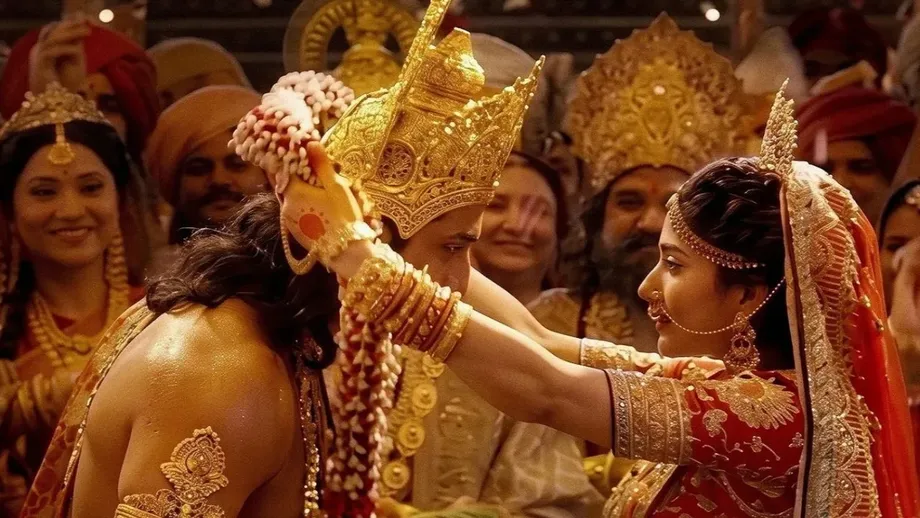
Nitesh Tiwari directs the adaptation, with Ranbir Kapoor playing Rama, Sai Pallavi as Sita, Yash as Ravana, Sunny Deol as Hanuman and Ravie Dubey as Lakshman. The first instalment is also referred to as Ramayana: Rise of a Legend.
Namit Malhotra's Prime Focus Studios is producing the project in collaboration with visual effects studio DNEG and Yash's Monster Mind Creations. Sony Pictures is handling international distribution outside India, while Dharma Productions is distributing the film in Hindi speaking markets.
The sequel's release timing is unsettled, with Diwali 2028 and Diwali 2027 both cited as planned windows. The immediate schedule for Part 1 and the court proceedings is more specific:
- November 2, 2026: Justice Madhav Jamdar grants interim copyright protection.
- November 3, 2026: The morning booking update records Rs 72.91 crore including blocked seats and Rs 57.97 crore excluding them.
- November 5, 2026: Part 1 is scheduled to open in cinemas worldwide.
- November 9, 2026 onward: Rathi expects a stronger period for attendance after Diwali, depending on audience response.
- December 16, 2026: The copyright lawsuit returns to court for its next hearing.
For Godpower, the next operational step is to identify and notify platforms about infringing links. For cinemas, the focus shifts from advance interest to attendance across the opening weekend and the festive period that follows.
Key Points
- The Bombay High Court has temporarily barred unauthorised recording, uploading, hosting and streaming of Ramayana: Part 1.
- The court's actual order was not available to check the injunction's exact scope, addressees or response requirements.
- Godpower Media sought protection after alleging that footage from two private trailer previews had leaked online.
- Platforms and internet providers must act promptly on written notices identifying infringing URLs and mirror websites.
- Reported advance bookings reached Rs 57.97 crore excluding blocked seats by 8 a.m. on November 3.
- The film opens worldwide on November 5, 2026, in five languages.
- The court's next hearing is December 16, with interim protection continuing until then.