112,417 registrations put domestic production support on the agenda
Vehicles made in China accounted for 43.5% of new passenger electric vehicle registrations in South Korea from January through September 2026, bringing them within 5.2 percentage points of vehicles made domestically. The shift is driving a push across party lines to add finished electric cars to a production tax credit that the government's August 3 tax reform proposal left out.
Contents
- 112,417 registrations put domestic production support on the agenda
- What the market figures show
- Tesla and BYD show the scale of the change
- Why batteries qualify while finished cars do not
- Why lawmakers want existing factories covered
- A buyer subsidy and a factory credit reach different people
- Japan provides a model for direct factory support
- Technology and suppliers are also part of the package
- November reviews could lead to a December vote
- Key Points
Figures compiled by the Korea Automobile & Mobility Association and the Korea Automobile Importers & Distributors Association show 112,417 registrations of Chinese-made passenger EVs during the nine months, compared with 51,535 a year earlier. That is an increase of about 118%, or roughly 2.2 times the previous total.
Vehicles produced in South Korea held 48.7% of the market, down from 54.9%. Chinese-made vehicles rose from 35.1% to 43.5%. The gap between the two therefore narrowed from 19.8 percentage points to 5.2 points in one year.
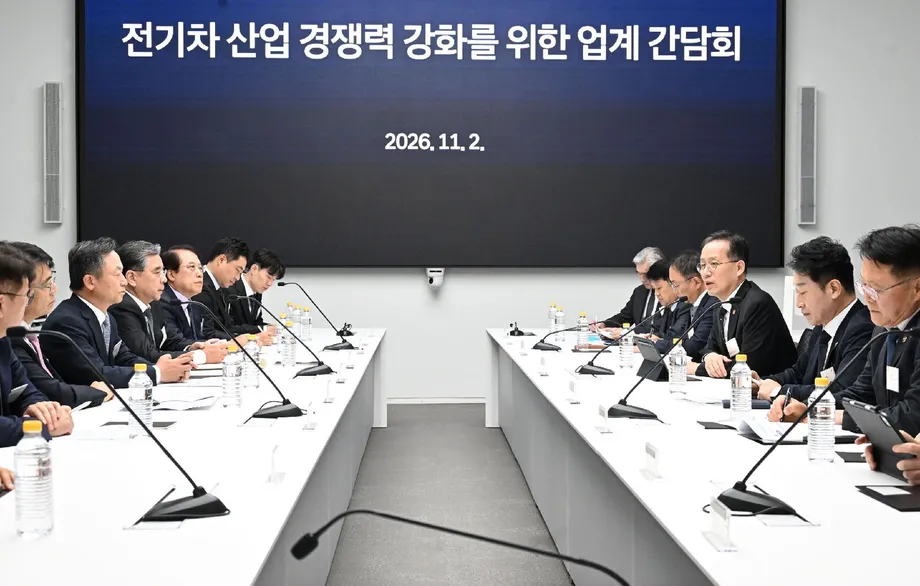
Deputy Prime Minister and Finance and Economy Minister Lee Hyeong-il signaled willingness to consider support during a November 2 visit to Hyundai Motor and Kia's research center in Hwaseong, Gyeonggi Province. He met Hyundai Motor Group Executive Chairman Euisun Chung and representatives of the EV, autonomous driving and parts industries.
Lee described the government's intended role in the parliamentary debate:
"The government will actively participate in the National Assembly's discussions on the EV tax credit and pursue in-depth deliberations," he said.
The immediate decision is whether South Korea should help companies through the taxes they pay on domestic production, alongside the assistance already available to people buying electric cars.
What the market figures show
South Korea registered 258,284 new passenger EVs during January through September. Imports accounted for 132,438 vehicles, or 51.3%, leaving domestically produced vehicles with 48.7%. The import total includes vehicles manufactured in China and other countries.
Chinese-made passenger EVs represented about 84.9% of those imports, calculated from 112,417 registrations out of 132,438. Their share of the entire passenger EV market was 43.5%. A published figure of 53.5% also appeared alongside the same vehicle count, but dividing 112,417 by the stated market total of 258,284 gives 43.5%.
Production location is central to these figures. The Chinese-made category includes Tesla vehicles manufactured at the company's Shanghai factory, as well as vehicles from Chinese brands. The Tesla Model Y and Model 3 sold in South Korea are produced in Shanghai.
The longer trend also concerns the industry. Across passenger and commercial EVs together, the domestic production share fell from 75% in 2022 to 57.2% in 2025. That broader measure covers a different group of vehicles from the passenger figures for the first nine months of 2026.
Tesla and BYD show the scale of the change
The Korea Automobile Importers & Distributors Association's passenger registration statistics list 89,148 Tesla registrations for January through September 2026, compared with 43,612 during the same period in 2025. That is a rise of about 104.4%, with 45,536 additional vehicles registered.
BYD registrations reached 20,137, up from 2,967. The increase of 17,170 vehicles made its total almost 6.8 times the figure a year earlier. Zeekr, another Chinese brand entering the market, recorded 49 registrations.
Tesla's nine month total also exceeded its full year 2025 registrations of 59,916 by about 49%. The Model Y was just 1,810 vehicles behind the Kia Sorento in the sales comparison cited during the debate, showing how competition from Shanghai production extends beyond the EV category into the wider passenger vehicle market.
KAIDA says its statistics use Ministry of Land, Infrastructure and Transport registration records and cover imported passenger cars from association members. It updates the previous month's figures on the 10th of each month. Its brand table counts registrations by brand; the manufacturing location figures describe where vehicles were built.
Why batteries qualify while finished cars do not
The government's August 3 tax reform proposal named six sectors for the Domestic Production Tax Credit: solar power, wind power, secondary batteries, semiconductors, core materials and artificial intelligence robot components. Secondary batteries are rechargeable batteries, including those used to power electric cars.
A production tax credit reduces the tax a business owes according to the eligible goods it manufactures and sells domestically. Its purpose is to reward actual production, rather than only spending on research or new factory equipment.
Finished EVs were excluded from the proposal. The government initially favored supporting key components and materials, including batteries, and pointed to existing vehicle purchase subsidies and tax benefits. It also considered the domestic EV production base sufficiently established.
Automakers want assistance that reaches vehicle factories directly. When a battery supplier receives a production credit, a carmaker buying those batteries benefits financially if the supplier passes some of the saving through in its prices. A credit for finished vehicles would reduce the eligible carmaker's own tax bill.
The production credit is scheduled to take effect in 2027, with the first application to corporate tax filings in 2028. Specific credit amounts are to be set by presidential decree, taking production costs and selling prices into account.
Why lawmakers want existing factories covered
Twenty-four amendments to the Restriction of Special Taxation Act have been introduced in the 22nd National Assembly to bring EVs or other future vehicles into the production credit. Eleven were sponsored by members of the committee responsible for finance and economy policy, including eight sponsored by members of its tax subcommittee. Seven additional proposals followed the government's August tax plan.
One amendment, introduced on October 16 by 19 lawmakers, included Yoon Hu-deok of the Democratic Party of Korea and Yoon Han-hong of the People Power Party. It would add EVs as a seventh eligible sector and expand the credit cap.
Some proposals use a base credit of 4 million won per EV. A September bill introduced by Democratic Party lawmaker Lee Eon-ju included that amount. Other changes would adjust how accumulated factory investment is used to calculate the credit limit, giving existing facilities more room to receive support.
Democratic Party lawmaker Moon Jin-seog argued that assistance should cover cars produced at existing plants, without requiring fresh investment in equipment:
"To genuinely strengthen competitiveness, EVs should be eligible for the domestic production tax credit regardless of whether capital investment in facilities has been made," Moon said.
That design would make output from factories already operating a central part of the program. Lawmakers and industry representatives say domestic plants compete both with imported vehicles and with overseas factories seeking the next production assignment or investment.
A buyer subsidy and a factory credit reach different people
South Korea currently offers consumers a conversion subsidy of up to 1 million won when they replace an eligible vehicle powered by an internal combustion engine with an EV. That payment supports the purchase decision. A production tax credit would instead lower the tax bill of a qualifying manufacturer.
Industry representatives argue that helping buyers and supporting domestic production serve different purposes. Their concern is that demand for electric cars can rise while a growing share of the vehicles is supplied by factories abroad.
The government must also consider the combined cost of purchase subsidies, vehicle tax relief and production credits. Questions under review include overlapping incentives, fiscal costs and the rules for choosing eligible industries. Extending the program to finished cars could lead other sectors to seek similar treatment.
EV eligibility, the final credit amount, its cap and the treatment of existing factories remain undecided. The proposed 4 million won credit is a legislative option, while the conversion subsidy is an existing benefit subject to eligibility conditions.
Japan provides a model for direct factory support
Japan is a benchmark for Korean industry proposals because its Strategic Sector Domestic Production Promotion Tax Regime, introduced in 2024, includes finished vehicles. It provides a tax credit of 400,000 yen for each qualifying electric or hydrogen vehicle produced and sold domestically, and 200,000 yen for a kei class electric vehicle or a plug-in hybrid.
The Japanese program runs for 10 years, with the deduction capped at 40% of corporate tax liability. That limit matters because the amount available per vehicle and the amount a company can actually use against its tax bill are separate parts of the policy.
South Korean industry representatives favor domestic production support partly because the country depends heavily on exports. They argue that large increases in import tariffs could bring trade friction affecting businesses that sell abroad.
Kim Pil-soo, a professor in Daelim University's Department of Future Automotive Engineering, has called for support during domestic vehicle production and for EVs to be included in the credit. Lawmakers including People Power Party members Ahn Sang-hun and Bae Jun-young have similarly argued that South Korea needs a response as other major economies use tariffs, subsidies and tax incentives to support their auto industries.
Technology and suppliers are also part of the package
Lee's November 2 visit went beyond tax policy. Industry participants requested broader help for parts suppliers shifting to future vehicles, a legal framework for battery leasing and more specialist staff at an agency dedicated to autonomous vehicles.
Battery leasing would allow the use of a battery under a separate payment arrangement, rather than requiring the customer to buy it together with the vehicle. The industry is seeking a legal basis for such programs.
The government plans to announce an EV industry competitiveness package in November, including improvements in autonomous driving technology and expanded research and development on core parts and technologies. Lee said companies would need to reach the technological level of global leaders by 2028 or 2029 to survive.
Gwangju provides a concrete testing program. Vehicles inspected ahead of the Hwaseong roundtable were intended for deployment in the city's autonomous driving demonstration in November. The program is expected to use 200 vehicles by the end of 2026 and reach a cumulative 3,000 by 2027.
Automakers, parts manufacturers and battery suppliers are all affected by decisions about where vehicles are produced. Industry representatives warn that losing domestic production assignments could reduce orders and employment across that chain, making the location of future investment a central concern in the tax debate.
November reviews could lead to a December vote
The National Assembly's tax subcommittee is expected to examine EV eligibility during its November tax law deliberations. An agreement would then need to pass the full finance and economy committee and the Legislation and Judiciary Committee before reaching a plenary vote, potentially in December.
The debate has developed through several legislative and government steps:
- August 3, 2026: The government announced a tax reform proposal covering six production sectors and excluding finished EVs.
- September: Lee Eon-ju introduced a proposal with a base credit of 4 million won per EV.
- October 16: A group of 19 lawmakers proposed adding EVs to the production credit and expanding its cap.
- October 22: Lee told a parliamentary audit that EV production support was under review following discussions involving other ministries and the presidential office.
- November 2: Lee met Euisun Chung and industry representatives in Hwaseong and pledged active participation in parliamentary discussions.
- November and December: Tax subcommittee reviews are expected in November, with a possible plenary vote in December if committee reviews proceed smoothly.
The parliamentary decision will determine whether finished EVs join batteries and other strategic products in the production credit. The separate competitiveness package is expected to address the technology and supplier concerns raised alongside the request for tax relief.
Key Points
- Chinese-made passenger EV registrations reached 112,417 in January through September 2026, up about 118% from a year earlier.
- Their market share reached 43.5%, while the share of domestically produced passenger EVs fell to 48.7%.
- KAIDA recorded 89,148 Tesla registrations and 20,137 BYD registrations during the nine months.
- The government's proposed production credit covers six sectors, including batteries, but excludes finished EVs.
- Twenty-four legislative proposals seek eligibility for EVs or other future vehicles; some propose a base credit of 4 million won per EV.
- November tax reviews could lead to a December vote, while the government also prepares an EV competitiveness package.