Gold drops to Rs 272,000 per tola
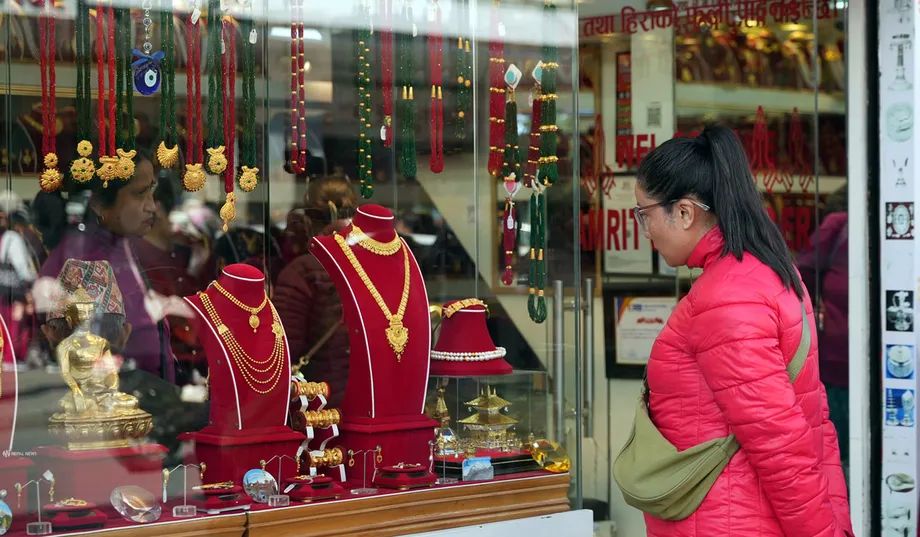
Nepal's gold price fell by Rs 11,500 per tola over two trading sessions, reaching Rs 272,000 on Sunday as a sharp retreat in international prices reached the domestic market. The Federation of Nepal Gold and Silver Dealers' Association set Sunday's rate Rs 8,300 below Friday's price of Rs 280,300.
Contents
Friday had already brought a decline of Rs 3,200 from Thursday's Rs 283,500. Together, the two reductions lowered the domestic price by about 4.1%. For someone buying one tola, the quoted gold cost was Rs 11,500 less on Sunday than on Thursday.
Silver also became cheaper. Its price fell by Rs 175 per tola, from Rs 3,825 on Friday to Rs 3,650 on Sunday, a decline of about 4.6%.
The federation attributed Nepal's decline to the steep fall in the international market. Gold abroad had slipped below $3,900 per troy ounce on Friday, while the price indication available on Sunday was about $3,876. Regular international gold trading was closed on Sunday, so that figure reflected the latest available market indication.
The retreat comes after a much higher peak. International gold reached $5,595 per ounce in January, while Nepal's reported record was Rs 339,000 per tola on Magh 15 last year, a date in the Nepali calendar. Sunday's domestic price was Rs 67,000, or about 19.8%, below that local record.
How the price changed
Nepal's latest decline unfolded across the last two trading sessions. Sunday is the first trading day of the local week, making Friday the relevant previous trading session for the comparison.
- Thursday: Gold stood at Rs 283,500 per tola.
- Friday: Gold fell by Rs 3,200 to Rs 280,300 per tola. Silver traded at Rs 3,825 per tola.
- Sunday: Gold fell by another Rs 8,300 to Rs 272,000 per tola. Silver dropped by Rs 175 to Rs 3,650.
Sunday's gold reduction was more than twice Friday's in rupee terms. It accounted for roughly 72% of the combined Rs 11,500 decline, showing how much the adjustment accelerated in the latest session.
The federation also quoted gold at Rs 233,195 per 10 grams and silver at Rs 3,130 per 10 grams. A tola is a traditional weight of approximately 11.66 grams. Buyers comparing prices need to check the unit because Nepal's domestic quotations commonly use tolas, while international gold prices use troy ounces, each weighing about 31.1 grams.
A global retreat from January's peak
International gold's fall to about $3,876 per ounce puts it roughly 30.7% below January's $5,595 high. Gold was also heading for a second consecutive monthly decline in October, extending the retreat beyond a single difficult trading day.
Nepal's fall from its reported record, about 19.8%, is smaller than the international decline from January's peak. Those comparisons use different record dates and different currencies. Domestic prices also reflect the dollar exchange rate, import taxes and local pricing arrangements.
The latest selling pressure has been linked to three connected developments: expectations for US interest rates, rising oil prices and losses in technology shares. Each affects a different part of the decision to hold gold, from the income available on other investments to the immediate need for cash.
Gold can attract buyers during political or financial uncertainty. At the same time, its price responds to borrowing costs and investor sales. During this decline, those pressures have outweighed demand from buyers seeking protection against instability.
Why US interest rates matter in Nepal
The US Federal Reserve kept its policy interest rate unchanged on October 28, with the target range at 3.75% to 4%. It described the American economy as expanding at a solid pace while inflation remained elevated.
Stronger than expected economic growth and faster inflation in September have encouraged expectations that interest rates could rise. Gold is sensitive to that possibility because it pays no regular interest. A bank deposit earns interest, and a government bond can provide an agreed income, while a gold holder generally relies on a higher resale price to make a gain.
Higher returns on interest bearing investments can make gold less attractive. Economists call this an opportunity cost: choosing gold means giving up the income that another investment might provide. When that forgone income grows, some investors become less willing to hold the metal.
Giovanni Staunovo, an analyst at Swiss bank UBS, identified strong US growth figures and rising crude oil prices as major pressures on gold. The Federal Reserve had not decided to raise rates again; investors were adjusting to the possibility of tighter policy.
For Nepal, the connection runs through the international gold price. A change in expectations about US monetary policy can prompt global investors to buy or sell gold, moving the benchmark that helps shape domestic quotations.
How expensive oil can weigh on gold
Middle East tensions and concern about disruption to oil shipments through the Strait of Hormuz have supported crude prices. Oil was heading for a fourth consecutive monthly increase in October.
More expensive oil can raise transport and manufacturing costs. Businesses may pass some of those costs to customers, adding to inflation. Central banks trying to control rising prices may then delay interest rate cuts or consider increasing rates.
Gold is therefore facing competing forces. Political tension can encourage purchases by people seeking a store of value, while the inflation pressure associated with expensive energy can strengthen expectations for higher interest rates. The balance between those forces changes as investors reassess the economy.
Staunovo's explanation places the recent oil increase alongside strong US growth as a reason gold has struggled. The dollar, government bond yields, central bank purchases and changes in investor demand also influence the price.
Why falling shares can pull gold down too
US technology shares came under heavy selling pressure on Friday as investors questioned whether companies spending large sums on artificial intelligence would generate the profits expected of them. Gold fell alongside shares, despite its familiar role as a place to move money during uncertainty.
One possible link is the need to raise cash quickly. An investor who borrows money to buy shares may have to provide extra cash or collateral when those shares lose value. That demand is called a margin call.
An investor facing such a demand may sell another asset, including gold, to meet it. Gold can therefore come under pressure during a wider market selloff even when investors remain worried about economic or political risks.
Analysts linked some of Friday's gold selling to this need for cash. The amount sold specifically to meet margin calls was not available. The broader picture combines pressure from interest rate expectations with the immediate funding needs of investors dealing with losses elsewhere.
Silver and platinum join the decline
International silver fell 6.5% on Friday to $49 per ounce, moving below $50 for the first time since November 2025. Platinum declined 4.2% to $1,425 per ounce.
Silver and platinum are used extensively in industrial production as well as being held as precious metals. Expectations about factory activity and industrial demand can therefore influence their prices alongside the financial forces affecting gold.
Nepal's silver decline of about 4.6% was larger than Sunday's gold decline of roughly 3%. The figures show both metals becoming cheaper locally, although the size of the adjustment differed.
Gold also has a distinct source of demand: central banks hold it as part of their international reserves. Their purchases can provide support during a decline, while investment flows can move prices quickly in either direction.
What buyers face next
Nepali buyers preparing to purchase gold now face a lower quoted price than they did on Thursday. Someone selling the same weight faces a lower benchmark value. For a purchase involving several tolas, the Rs 11,500 reduction per tola makes a substantial difference to the metal cost.
The next local price adjustment will depend partly on how international trading develops after the weekend. The dollar exchange rate and Nepal's import taxes and pricing arrangements will also matter, so a given percentage change abroad may produce a different percentage change locally.
Persistently high US inflation and expectations of higher interest rates could keep gold under pressure. Weaker economic growth, signals of rate cuts or renewed demand for assets viewed as a store of value could encourage buying.
Staunovo suggested that gold could reach $5,000 per ounce or more in 2027 if conditions allowed the Federal Reserve to cut rates. His projection depends on lower rates and stronger investor demand. Expectations that central banks might buy more gold below $4,000 per ounce also offer a possible source of support, although the scale of those purchases is uncertain.
Nepal's latest price reduction gives buyers immediate relief, but the forces behind it remain active. US inflation, oil prices and investor demand will help determine whether the next trading sessions extend the fall or bring a recovery.
Key Points
- Nepal's gold price reached Rs 272,000 per tola on Sunday, down Rs 8,300 from Friday.
- The combined decline from Thursday was Rs 11,500 per tola, or about 4.1%.
- Silver fell Rs 175 to Rs 3,650 per tola on Sunday.
- Gold was Rs 67,000 below Nepal's reported record of Rs 339,000 per tola.
- The latest international indication was about $3,876 per ounce, roughly 30.7% below January's peak.
- US interest rate expectations, rising oil prices and selling linked to stock market losses have weighed on gold.
- Future prices depend on global trading, monetary policy, investor demand and Nepal's local pricing factors.