A 54 km railway moves into its biggest construction phase
Ho Chi Minh City's planned Ben Thanh–Can Gio railway is moving into simultaneous construction across its main stations, tunnels and bridges, with up to 10,000 workers, engineers and technical staff expected during peak periods. VinSpeed, the investor, is targeting trial operations in the fourth quarter of 2028 and commercial service in 2029.
Contents
- A 54 km railway moves into its biggest construction phase
- Where the railway will run
- Ben Thanh station changes a central city park
- A large tunnel beneath the port area
- Bridges carry most of the route south
- Three casting yards will supply 1,300 girders
- Land handover sets the pace
- City leaders seek outside expertise and local skills
- Faster access meets Can Gio's wider transformation
- Key Points
The 54.062 km railway is designed for a maximum speed of 350 km/h. VinSpeed projects a journey of about 13 minutes between central Ho Chi Minh City and Can Gio, with trains running every five minutes. Its construction plan combines a deep underground station near Ben Thanh Market, a tunnel bored by a machine 13 metres in diameter, and a major crossing of the Soai Rap River.
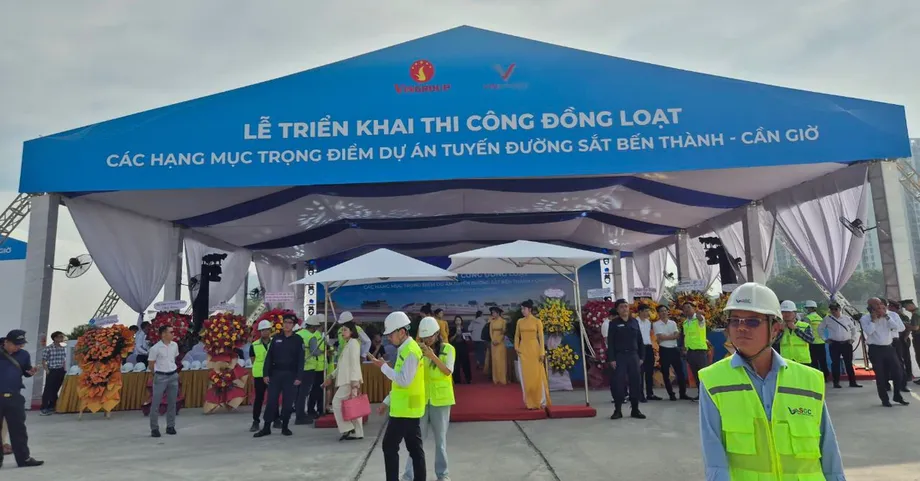
VinSpeed and the Vinhomes–SGC main contractor consortium launched the expanded construction programme on October 30, 2026, following a groundbreaking ceremony on December 19, 2025. Preparatory work has included geological surveys, access roads, site preparation and deep foundations at several locations.
The next major deadline comes before any train testing: local authorities are expected to hand over all land needed for the project in the fourth quarter of 2026. Vingroup deputy general director Tran Van Anh has asked the city to accelerate compensation, clearance and handover so contractors can work continuously along the route.
Where the railway will run
The approved route begins at September 23 Park in Ben Thanh ward and ends at a site covering 39 hectares beside the Can Gio coastal urban development. It passes through nine wards and communes: Ben Thanh, Khanh Hoi, Xom Chieu, Tan Thuan, Tan My, Nha Be, Binh Khanh, An Thoi Dong and Can Gio.
The central section will run underground before the railway moves onto elevated structures for most of its journey south. The design provides two tracks, electric traction and a rail gauge of 1,435 mm, meaning the distance between the two rails is 1.435 metres.
Preliminary investment is about VND102.43 trillion, excluding nearly VND12.8 trillion for land clearance financed by the city budget. Together, those amounts come to roughly VND115.23 trillion, with clearance accounting for about 11% of that combined figure. The distinction matters because the construction investment and the city's land expenditure are separate parts of delivering the railway.
Ben Thanh station changes a central city park
Ben Thanh underground station is designed to be 565.85 metres long, with a foundation excavation about 34 metres deep. It will connect with the existing Ben Thanh station on Metro Line 1, giving passengers a transfer between the new southern railway and the city's first operating metro corridor.
The Department of Construction says the new station will occupy more than 1.1 hectares at September 23 Park. The Sen Hong stage is being dismantled, and part of the park will be fenced off for construction. The stage opened in 2013 and stopped operating in 2019; the commercial area beneath it has also closed.
The station is planned together with surrounding underground space for transport, shops and technical infrastructure. Coordinating those works is intended to reduce repeated road excavation. Landscaping is expected to be restored after construction, returning the surface area to public use.
The transfer builds on the opening of Metro Line 1 in December 2024. That line stretches 19.7 km from Ben Thanh to Suoi Tien. At 54.062 km, the Can Gio railway would be about 2.7 times as long, extending the reach of rail from the central interchange toward the coast.
A large tunnel beneath the port area
At the Saigon Port area, contractors are preparing a tunnel section measuring 2,019.45 metres for excavation using a tunnel boring machine, or TBM. The planned machine has a diameter of 13 metres. A TBM cuts through the ground from inside the tunnel, allowing much of the excavation to take place below the surface.
The bored section will connect with a tunnel measuring 321.7 metres built by the cut and cover method, followed by a U-shaped open section measuring 266 metres. Cut and cover means excavating from the surface, building the tunnel structure and covering it again. The open section provides a transition between enclosed underground infrastructure and the railway beyond it.
The three specified sections total about 2.61 km. They form part of the railway's central underground works, alongside the station and connecting structures. Coordinating these different construction methods is one of the project's major engineering tasks.
Bridges carry most of the route south
The main Can Gio railway bridge will cross the Soai Rap River with a main span of 360 metres. Its design combines a steel truss with cables supported by two towers shaped like the letter A. The approach bridges at the two ends will have a combined length of about 4.4 km.
The main span is the distance between the principal supports across the river. The approaches carry the tracks toward and away from that crossing, making them a substantial construction project in their own right.
Foundation work has already taken place at the main Can Gio bridge, the Can Gio depot and bridges at Dan Xay, An Nghia, Rach Ran, Rach La and Song Cha. Other work locations include bridge sites around kilometres 5, 11 and 26 of the route.
The expanded programme adds construction fronts at Rach Dia and Ong Doi bridges, the Can Gio bridge approaches and other elevated sections where land has been handed over. Progress therefore depends on several work sites moving together, rather than on a single continuous construction front.
Three casting yards will supply 1,300 girders
VinSpeed plans to produce about 1,300 complete bridge spans using precast, prestressed concrete box girders over roughly 15 months. Three casting yards have been established, and the first test girder has been successfully cast at Yard No. 1.
A box girder is a large structural beam with a hollow interior that supports the tracks above it. Prestressing puts the concrete under controlled compression, helping it carry heavy loads. Casting these components in dedicated yards allows repeated production under more consistent conditions before they are transported into position.
Each yard is expected to produce an average of one to two spans per day. Across all three yards, that gives a planned combined production rate of three to six spans daily. Delivering 1,300 spans over 15 months requires about 87 spans per month on average, although actual output will depend on production schedules, concrete preparation and installation needs.
The investor has ordered moulds measuring 32 metres and transport and launching equipment rated for loads of 900 tonnes. Launching equipment places the heavy girders onto their supports. VinSpeed expects this approach to reduce work performed directly along the alignment while helping control construction time and quality.
Land handover sets the pace
Tran Van Anh, speaking for the investor, said Vingroup and companies within its business network would concentrate financial resources, personnel, technology and equipment on meeting the schedule. She also asked Ho Chi Minh City to speed up compensation and provide cleared sites so work could proceed without interruption.
For residents and businesses occupying land required by the route, the immediate process is compensation and clearance. For contractors, completed handover opens space for foundations, equipment access and permanent structures. A large workforce can operate across the route only when enough sites are available.
The announced schedule brings several construction and operating milestones into a relatively short period:
- December 19, 2025: The project held its groundbreaking ceremony.
- October 24, 2026: VinSpeed announced plans to expand simultaneous construction.
- October 30, 2026: VinSpeed and Vinhomes–SGC launched work across key sections.
- Fourth quarter of 2026: Local authorities are expected to complete land handover.
- Fourth quarter of 2028: Construction completion and trial operations are targeted.
- 2029: Commercial operation is planned, with December 2029 identified in the earlier construction announcement.
The latest construction update gives 2029 as the commercial service target without specifying a month. Ticket prices, operating hours and passenger capacity have not been announced.
City leaders seek outside expertise and local skills
Hoang Nguyen Dinh, vice chairman of the Ho Chi Minh City People's Committee, described the railway as a major transport project with demanding technical requirements. He called on VinSpeed to choose capable contractors, work with leading international railway technology companies and draw on experience in large bridges and urban tunnels.
The city has proposed a council of domestic and international experts and senior advisers to review technical work and recommend solutions. Areas identified for expert attention include electricity supply, signalling and automated train control.
Those systems must function together. Power equipment supplies the trains, signalling manages their movement, and automated controls help regulate speed and safe spacing. A planned departure every five minutes makes reliable coordination central to the operating plan.
City leaders also want domestic contractors involved and technology transferred to Vietnamese teams. That would give local staff the knowledge needed to operate, inspect and maintain the railway after construction. Dinh called for delivery on schedule while meeting quality, safety, legal and environmental requirements.
Faster access meets Can Gio's wider transformation
Can Gio is the destination of a much broader programme of coastal development. The railway's endpoint beside the coastal urban project places it directly within that expansion, rather than simply connecting two existing city centres.
A journey of about 13 minutes could make visits and some regular trips between central Ho Chi Minh City and Can Gio easier. With a departure every five minutes, the proposed timetable would offer up to 12 departures an hour if that frequency is maintained. Passengers would still need time to reach stations, transfer and travel onward from the terminal.
City officials expect better access to support tourism, services and investment in the southern area. The connection to Metro Line 1 would also allow some passengers to make a larger share of their journey by rail, depending on their starting point and destination.
The expansion comes amid concern about Can Gio's coastal building boom and the mangroves that help protect the city from flooding and erosion. Researcher Marie Arnaud, of the French Sustainable Development Institute and based at Sorbonne University, has warned that roads and other infrastructure can disrupt the water flows that sustain mangrove habitats.
Environmental protection is therefore a practical concern for the railway and surrounding development. Bridges, approaches and construction sites need to be delivered alongside the environmental requirements cited by the investor and city leaders. The railway's transport benefits and Can Gio's protection from coastal hazards both matter to the communities the project is intended to serve.
Key Points
- The 54.062 km Ben Thanh–Can Gio railway targets trials in late 2028 and commercial service in 2029.
- VinSpeed projects a journey of about 13 minutes and trains every five minutes.
- Peak construction staffing is expected to reach about 10,000 people.
- Major works include a deep Ben Thanh station, a tunnel bored by a machine 13 metres in diameter and a bridge over the Soai Rap River.
- Three casting yards are planned to produce about 1,300 concrete bridge spans over 15 months.
- Full land handover is targeted for the fourth quarter of 2026.
- Preliminary investment and separate city funded clearance costs total roughly VND115.23 trillion.