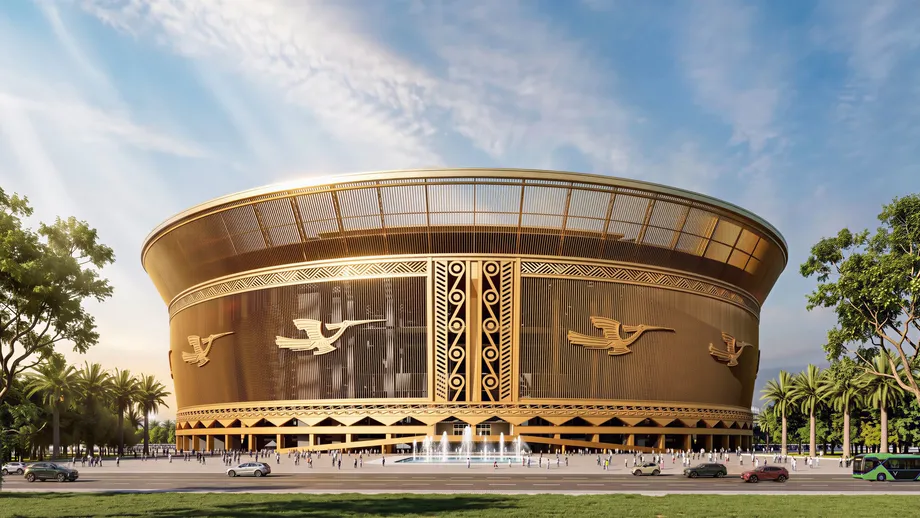
A 19-month deadline for a stadium built for 135,000
Hanoi's VinFast - Trong Dong Stadium is targeting an opening on July 31, 2027, roughly 19 months after construction began on December 19, 2025. The planned venue covers about 73.3 hectares and would seat 135,000 people, exceeding the approximately 132,000 seats at India's Narendra Modi Stadium by 3,000, or about 2.3%.
Contents
- A 19-month deadline for a stadium built for 135,000
- What the construction schedule actually requires
- How builders plan to lift the enormous roof
- Thousands of workers keep construction moving
- A venue designed around Vietnamese imagery
- Legends Global prepares the stadium for business
- A much larger sports district surrounds the stadium
- How the deadline compares with other major stadiums
- The Bottom Line
The ambition reaches beyond its proposed capacity. The stadium is designed with an automatically retractable roof, architecture inspired by Vietnam's Dong Son bronze drums and Lac bird imagery, and systems intended to manage security and the movement of enormous crowds. Vingroup, the developer, has also brought in international venue operator Legends Global to prepare the business and staffing needed to run it.
By mid-October 2026, the lifting tower framework needed for roof construction was about 60% complete, according to contractor technical officer Nguyen Dinh Duyet. All four grandstand blocks were being built simultaneously, with some sections reaching the concrete roof slab above the third level.
The next major task is overhead: assembling and raising a steel roof system estimated at 66,000 tonnes, supported by principal columns nearly 80 metres high. Its construction schedule brings together heavy lifting, concrete work, roof machinery, electrical systems and preparations for spectators within a tightly compressed period.
For Hanoi, the practical objective is a venue capable of staging major sports competitions, concerts and cultural events. Delivering that experience requires both a finished building and an organisation ready to operate it, which explains why recruitment and operational preparations are already under way while construction continues.
What the construction schedule actually requires
Nguyen Phu Quan, director of the stadium construction project management board, has set out three main targets: finish the basic structure in December 2026, complete construction items in May 2027 and open in July 2027. The operating partnership gives the more precise opening date of July 31.
The distinction between those stages matters. Finishing the basic structure means completing the main framework of the building. Roof installation, electrical and mechanical equipment, the playing surface and other technical components then have to come together before the venue receives spectators.
The announced sequence includes the following milestones:
- December 19, 2025: construction begins.
- Mid-October 2026: the lifting tower framework reaches about 60% completion.
- November 2026: the lifting support system is scheduled for completion and trial operation.
- December 2026: the basic structure is due to be completed, alongside preparations and installation work for the first major roof section.
- March 2027: contractor Dai Dung Group aims to have the roof structure substantially complete.
- May 2027: the project management board targets completion of construction items; the retractable roof is also scheduled for completion that month.
- July 31, 2027: the planned opening date.
Duyet, a technical officer at Dai Dung Group, said the company's assigned work began in June 2026 and carried a commitment to finish within 10 months. Its March target for substantial roof completion comes before the May target for the finished retractable roof, leaving further work on the complete system.
How builders plan to lift the enormous roof
The roof is one of the project's most demanding engineering tasks. Steel arch modules weighing hundreds of tonnes will be assembled at ground level, raised by hydraulic jacking equipment and secured in their designed positions high above the stands.
A hydraulic jack uses pressurised fluid to move a heavy load. At this scale, multiple lifting points must work together so that a large steel section rises in a controlled manner. Temporary towers support the installation process before the roof is secured and temporary supports are removed.
Duyet said the project expected to complete the support columns, lifting columns, jacking equipment and around 40,000 tonnes of steelwork for Zone 1 in December 2026. Compared with the stated 66,000 tonnes for the entire roof steel system, that first zone represents about 61% of the total mass.
The site has deployed cranes with lifting capacities of 1,800 tonnes, 1,250 tonnes and 800 tonnes. Large columns had reached their base connection level by mid-October, with welding and preparations for further concrete pours continuing. Contractors planned to work with foreign partners on lifting the first roof section in December.
The stadium is described as approximately 408 metres in diameter. Its nearly 80-metre principal columns will carry loads from the roof through steel bearings and down into the foundations. Those bearings are the connections that receive and transfer the roof's weight.
Thousands of workers keep construction moving
About 16,000 workers are assigned to the stadium and nearby supporting works, according to project information. The workforce rises to nearly 20,000 when other areas of the sports complex are included. Work is organised across three shifts and four crews to maintain activity through the day and night.
The simultaneous construction of grandstands A, B, C and D illustrates that approach. Teams are working on seating floors, internal rooms, steel assembly and lifting equipment at the same time, rather than waiting for one whole part of the stadium to finish before starting another.
Vincons ironworker Trinh Duy Nhat described teams working three shifts to meet the deadline and said the building's daily changes had made him eager to see it completed. Duyet also described the timetable as exceptionally demanding during his career in construction.
The project management board says safety arrangements include guardrails, warning signs and safety harnesses for work at height, separation of electrical areas and continuing supervision by contractor and project specialists. Equipment undergoes inspection and periodic checks, while lifting and suspended systems are subject to load testing before operation.
Those measures address concrete hazards on this site: people working high above ground, heavy steel sections moving through the air and several construction activities taking place close to one another. The same coordination needed to maintain the schedule is also needed to keep those operations safely separated.
A venue designed around Vietnamese imagery
The circular stadium draws its architectural identity from the Dong Son bronze drum, with Lac bird motifs incorporated into the exterior. The design places recognisable Vietnamese cultural imagery around a venue intended to attract an international audience.
The automatically retractable roof is central to that plan. A roof that opens and closes allows the venue to adjust its enclosure for different events and weather conditions, while adding a substantial mechanical system to the structure above the stands.
Vingroup says the playing surface is being designed for events in accordance with FIFA standards. The plans also include artificial intelligence, real time security management and systems for monitoring and coordinating crowd movement. Green construction and sustainable operation are stated priorities.
Other proposed technical features include stadium-wide 5G connectivity and a modular pitch system intended to switch between a football surface and a concert floor in six to 10 hours. The final technical specifications and a detailed programme of opening events have not been announced.
For spectators, the most immediate operational issue will be moving through a building serving as many as 135,000 people. Crowd monitoring is intended to help staff identify where people are gathering and coordinate their movement, making venue operations an essential part of the design.
Legends Global prepares the stadium for business
Vingroup signed its strategic operating partnership with Legends Global in October 2026. The agreement covers attracting international events, managing the venue and its facilities, coordinating suppliers and running services at the site.
Nguyen Viet Quang, Vingroup's vice chairman and chief executive, described the company's ambition for the stadium:
"With its world-leading scale, contemporary architecture featuring Vietnamese symbols, automatic retractable roof and playing surface designed to accommodate events in accordance with FIFA standards, we expect to work with Legends Global to turn the venue into a hub for the world's premier sporting, cultural and entertainment events," he said.
Legends Global reports a portfolio of more than 450 venues, over 20,000 major events and more than 165 million visitors annually. Its role in Hanoi includes developing the skills of Vingroup's venue management specialists, alongside preparations for opening.
Peter Loxton, Legends Global's chief operating officer for Asia Pacific and the Middle East, described the staffing approach behind the agreement:
"Our long-term exclusive partnership with Vingroup will enable Legends Global to combine global expertise with local talent to develop Vietnam's capabilities in venue management," he said.
The partnership also covers exclusive stadium, arena and live event services for Vingroup in Vietnam. A Legends Global venue specialist has arrived in Hanoi to oversee technical preparations and work before opening, while recruitment for the stadium's operations team is under way.
That work connects the construction project to its eventual use. A finished roof and seating bowl provide the physical venue; suppliers, trained staff, event bookings and coordinated services determine how it functions when athletes, performers and spectators arrive.
A much larger sports district surrounds the stadium
The stadium is located in Thuong Phuc commune and forms the centrepiece of the Hung Vuong International Sports Complex within Hanoi International Sports City. The wider development has been described as covering more than 9,171 hectares, with estimated investment of up to VND925.65 trillion, or about $35.18 billion.
Those figures refer to the surrounding development, while the stadium itself occupies approximately 73.3 hectares. Keeping the two scales separate helps explain the project: the main stadium is one major component within a much broader planned sports and services district.
Other planned sports venues include an Olympic stadium with 40,000 seats, Hanoi Sport Arena with 12,000, an Aquatic Center with 10,000 and a velodrome accommodating about 4,000 to 5,000 spectators. Together, those four facilities would provide another 66,000 to 67,000 seats.
The district is also planned to contain training grounds, hotels, shopping centres, hospitals, parks, theatres, and cultural and culinary villages. These facilities would serve athletes and visitors beyond the hours they spend inside an event venue.
A boulevard 120 metres wide is being developed beside the stadium to connect National Highway 21C with the Phap Van - Cau Gie expressway. That connection forms part of the access infrastructure for a district expected to receive large numbers of people for major events.
How the deadline compares with other major stadiums
VinFast - Trong Dong's roughly 19-month construction target is much shorter than the schedules of several prominent stadium projects. India's Narendra Modi Stadium was rebuilt between 2015 and 2020 and opened in 2021, with a capacity of approximately 132,000.
Beijing's National Stadium took about four and a half years to build, from late 2003 to June 2008, and had a maximum capacity of around 91,000. London's new Wembley took about five years, from 2002 until its opening in 2007, and seats 90,000.
Real Madrid's Santiago Bernabeu was originally built over more than three years, from 1944 to 1947. Successive upgrades have since changed the stadium, which now accommodates approximately 80,000 spectators.
The Hanoi plan combines a larger proposed seating capacity with a shorter target schedule than those examples. Its construction strategy relies on simultaneous work across the stands, continuous shifts and early assembly of the equipment needed to raise the roof.
At 135,000 seats, the proposed venue would also have three times the capacity of a 45,000-seat stadium and about 50% more seats than Wembley's 90,000. That scale is the attraction for major event organisers and the central operating challenge for the team preparing to run it.
The Bottom Line
- VinFast - Trong Dong Stadium targets an opening on July 31, 2027, about 19 months after construction began.
- The planned 135,000 seats would exceed Narendra Modi Stadium's approximately 132,000 by 3,000.
- The basic structure is scheduled for completion in December 2026, with construction items due to finish in May 2027.
- The roof steel system is estimated at 66,000 tonnes, with principal columns nearly 80 metres high.
- About 16,000 workers are assigned to the stadium and supporting works, rising to nearly 20,000 across the wider complex.
- Legends Global will help attract events, manage operations and train venue staff under its partnership with Vingroup.
- The surrounding development includes four other major sports venues, visitor facilities and a new road connection.