Diesel rises 20 sen as subsidised fuel prices stay fixed
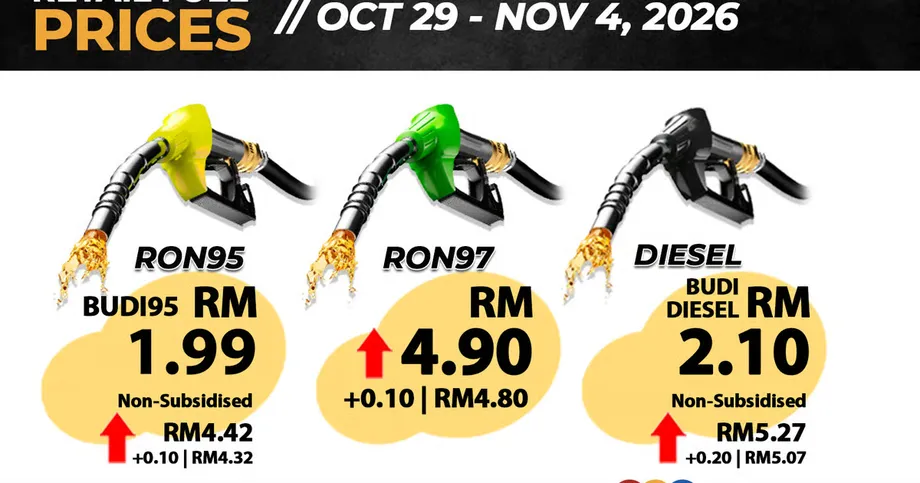
Malaysia's unsubsidised diesel price will rise to RM5.27 per litre for October 29 to November 4, 2026, while RON95 and RON97 petrol will each increase by 10 sen. The Finance Ministry said targeted subsidies would continue, keeping prices unchanged for eligible motorists and businesses despite renewed pressure in international energy markets.
Contents
- Diesel rises 20 sen as subsidised fuel prices stay fixed
- What motorists and businesses will pay
- Why international pressure is reaching the pumps
- How Malaysia sets its weekly prices
- A partial reversal of the previous week's falls
- What the subsidy gap means for buyers
- Eligibility still matters at the pump
- RM40 billion planned for fuel support
- Key Points
Unsubsidised RON95 will cost RM4.42 per litre, up from RM4.32, while RON97 will rise from RM4.80 to RM4.90. Diesel's increase from RM5.07 to RM5.27 is twice the petrol increase in sen per litre, although the percentage changes differ because the starting prices are different.
Eligible buyers will continue paying RM1.99 per litre for RON95 under BUDI95 and RM2.10 for diesel under the BUDI Diesel initiative. Petrol supplied through the Subsidised Petrol Control System, known as SKPS, remains RM2.05 per litre. Diesel under the Subsidised Diesel Control System, or SKDS, stays at RM2.15.
The announcement leaves Malaysia with a widening gap between market prices and the prices paid through targeted subsidy programmes. For a motorist buying 40 litres of unsubsidised RON95, the weekly increase adds RM4 to the bill. A buyer purchasing 40 litres at the BUDI95 price continues to pay RM79.60.
The Finance Ministry also pointed to a substantial public spending commitment. Referring to Budget 2027, it said fuel subsidies were expected to cost around RM40 billion next year, helping protect household purchasing power and support economic activity while global petroleum prices remain unsettled.
What motorists and businesses will pay
The prices effective from October 29 cover three categories that will rise and four subsidised categories that remain unchanged. One sen is one hundredth of a ringgit, so a 10 sen increase means an additional RM0.10 for every litre purchased.
- Unsubsidised RON95: RM4.42 per litre, up 10 sen from RM4.32.
- RON97: RM4.90 per litre, up 10 sen from RM4.80.
- Unsubsidised diesel: RM5.27 per litre, up 20 sen from RM5.07.
- BUDI95 petrol: unchanged at RM1.99 per litre.
- SKPS petrol: unchanged at RM2.05 per litre.
- BUDI Diesel: unchanged at RM2.10 per litre.
- SKDS diesel: unchanged at RM2.15 per litre.
Diesel's increase is about 3.9%, compared with approximately 2.3% for unsubsidised RON95 and 2.1% for RON97. A business purchasing 100 litres of diesel at the unsubsidised rate will pay RM527, an increase of RM20 from the preceding week.
Approved transport and logistics fleets buying through SKDS face a different calculation: 100 litres still costs RM215. Their price remains fixed even as the market price rises. The same principle applies to eligible users of the petrol subsidy programmes, whose purchasing costs depend on their scheme rather than the general market rate.
Why international pressure is reaching the pumps
The Finance Ministry linked the latest adjustment to movements in crude oil and refined fuel markets. Brent crude rose during the preceding week as concerns grew about possible supply disruption in West Asia, before easing somewhat near the end of the pricing calculation period.
Brent is an international benchmark for crude oil, the raw material that refineries turn into petrol, diesel and other fuels. Pump prices also depend on the markets for those finished products. Diesel and petrol can therefore move by different amounts even when both originate from crude oil.
Singapore's refined diesel prices increased during the period, while petrol price movements were mixed. Stocks of some petroleum products in Singapore also declined, although supplies from Northeast Asia were expected to remain stable. Those developments help explain why the diesel increase was larger than the petrol increases.
The ministry cited conflict in West Asia and threats to energy infrastructure and shipping routes as continuing sources of concern. Damage to production or refining facilities can reduce supply, while disruption along shipping routes can make deliveries slower or more expensive. The ministry expected world petroleum prices to remain uncertain over the medium term.
How Malaysia sets its weekly prices
The Department of Statistics Malaysia's weekly fuel price dataset, sourced from the Finance Ministry, explains that retail fuel prices have generally been set weekly under the Automatic Pricing Mechanism since April 2017. There was a brief period of monthly announcements at the end of 2018.
The mechanism, usually shortened to APM, allows retail prices to be adjusted as international fuel costs change. Weekly pricing uses a calculation period, so the price announced for motorists reflects movements across that period rather than a single oil market quotation.
Fuel price announcements moved from Fridays to Wednesdays on March 3, 2021. The current weekly cycle runs from Thursday through the following Wednesday, making October 29 to November 4 the next pricing period after October 22 to 28.
The OpenDOSM entry is dated as of October 22, 2026, with its last update recorded late on October 21. It provides the official historical framework for understanding the changes; the October 29 prices come from the latest Finance Ministry announcement.
A partial reversal of the previous week's falls
The latest increases follow a week of falling market prices. On October 22, unsubsidised RON95 and RON97 each fell by 30 sen, while diesel declined by 10 sen. The new petrol increases recover only part of those reductions, while diesel returns to a price seen earlier in October.
The recent sequence shows how differently the products have moved:
- October 8: Unsubsidised RON95 cost RM4.67 per litre, RON97 RM5.15 and diesel RM5.27.
- October 15: Prices fell to RM4.62 for unsubsidised RON95, RM5.10 for RON97 and RM5.17 for diesel.
- October 22: Prices fell again, to RM4.32, RM4.80 and RM5.07 respectively.
- October 29: Unsubsidised RON95 rises to RM4.42, RON97 to RM4.90 and diesel to RM5.27, effective through November 4.
Compared with October 8, both petrol grades will still be 25 sen cheaper per litre. Diesel will be back at exactly the same price. Motorists buying unsubsidised petrol therefore retain some of the benefit of the earlier reductions, while diesel buyers lose the savings accumulated over the two preceding weekly cuts.
What the subsidy gap means for buyers
BUDI95 users will pay RM2.43 less per litre than buyers paying the unsubsidised RON95 price of RM4.42. On a purchase of 40 litres, that is a difference of RM97.20: RM79.60 under BUDI95 against RM176.80 at the market price.
The diesel gap is larger. At RM5.27 per litre, the unsubsidised rate is RM3.17 above the BUDI Diesel rate and RM3.12 above the SKDS rate. A purchase of 100 litres costs RM527 at the market price, compared with RM210 under BUDI Diesel or RM215 under SKDS.
Malaysia's current pricing structure follows several policy changes. The official dataset records the removal of general diesel subsidies in Peninsular Malaysia on June 10, 2024, when the retail price jumped from RM2.15 to RM3.35 per litre. Weekly diesel prices were then listed separately for Peninsular Malaysia and East Malaysia.
For petrol, the dataset records a change on September 30, 2025: general market RON95 rose to RM2.60, eligible BUDI95 users received a RM1.99 price, and qualifying commercial vehicles retained the RM2.05 rate. The latest announcement continues the separation between market pricing and targeted support.
Eligibility still matters at the pump
Drivers must consider both the fuel grade and the rules governing access to it. Malaysia introduced foreign card restrictions at automated pumps on April 1, 2026, targeting RON95 transactions while allowing foreign cards to continue being used for RON97.
The April measures allowed foreign card payments for RON95 at station counters, where staff could check the purchase. Foreign registered vehicles remained barred from buying RON95 regardless of payment method. For motorists crossing from Singapore, RON97 remained the relevant petrol option.
The latest price notice gives the rates through November 4 but does not specify a current monthly BUDI95 allowance. OpenDOSM's description records a limit of 300 litres when the scheme began in September 2025, while a current fuel price guide describes 200 litres. The allowance therefore needs to be checked against the scheme's current official terms before drivers calculate a full month's subsidised purchases.
RM40 billion planned for fuel support
The Finance Ministry said the government would continue protecting the public and businesses from global uncertainty through targeted Budi Madani subsidies. Its estimate for next year places the cost of that protection at around RM40 billion.
The ministry set out the commitment in its statement:
"As announced in the 2027 budget, the government expects to spend RM40 billion on fuel subsidies next year to support economic growth and safeguard the people's livelihoods," it said.
For eligible households, unchanged subsidised prices mean the latest market increase does not immediately raise the price of qualifying fuel purchases. For businesses buying at market rates, the increase adds directly to refuelling costs. Keeping approved transport fleets on fixed prices also shields those fuel purchases from this week's adjustment.
The pricing period ends on November 4. Until then, the practical outcome is a rise for unsubsidised buyers, stable rates for qualifying subsidy recipients and a continuing public spending commitment to maintain that protection.
Key Points
- From October 29 to November 4, 2026, unsubsidised RON95 costs RM4.42 per litre and RON97 costs RM4.90, both up 10 sen.
- Unsubsidised diesel rises 20 sen to RM5.27 per litre, returning to its October 8 price.
- BUDI95 remains RM1.99 per litre, while BUDI Diesel stays at RM2.10.
- SKPS petrol remains RM2.05 per litre and SKDS diesel remains RM2.15.
- The Finance Ministry cited international supply concerns and higher Singapore refined diesel prices.
- The government expects fuel subsidies to cost around RM40 billion in 2027.