AI lifts ByteDance founder to a record fortune
ByteDance founder Zhang Yiming has reclaimed the top spot on the 2026 Hurun China Rich List with an estimated fortune of 670 billion yuan, about US$99.7 billion, after artificial intelligence helped lift his wealth by 200 billion yuan in a year.
Contents
- AI lifts ByteDance founder to a record fortune
- How Doubao helped change ByteDance's value
- DeepSeek leads 263 newcomers
- Robotics and chips create another wave of wealth
- Batteries and industrial groups hold their ground
- Consumer fortunes fall as property retreats
- A larger list, with gains concentrated at the top
- Women account for a growing share
- How the top spot changed hands
- Key Points
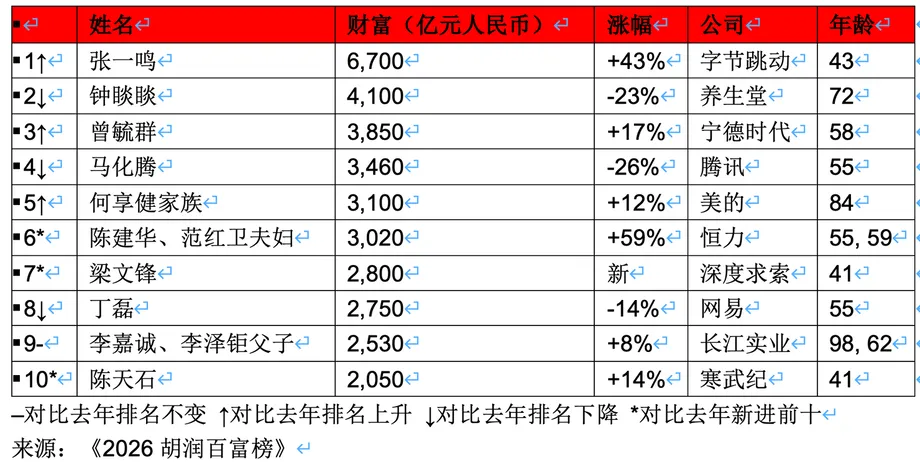
The Hurun Research Institute released the ranking on October 27, using wealth estimates as of September 1, 2026. Zhang, 43, became China's richest person for the second time, setting a record for the wealth held by the person at the top of the list.
Nongfu Spring founder Zhong Shanshan, 72, slipped to second place with 410 billion yuan after losing 120 billion yuan. CATL chairman Zeng Yuqun, also known as Robin Zeng, ranked third with 385 billion yuan, helped by demand for batteries used in electric vehicles and energy storage.
Zhang's gain of roughly 43% captures the biggest shift in this year's ranking: entrepreneurs connected to AI, semiconductors and robotics accumulated wealth rapidly, while many fortunes tied to consumer spending and property declined.
Rupert Hoogewerf, chairman of Hurun Report, attributed Zhang's increase almost entirely to artificial intelligence. Describing the source of that gain, he said:
almost all of it on the back of AI
Across the ranking, 1,529 entrepreneurs had estimated personal wealth of at least 5 billion yuan, a record number and 95 more than last year. Their combined wealth reached 32 trillion yuan, up 7%, or 2.1 trillion yuan.
Zhang's increase alone was equivalent to about 9.5% of that combined annual rise. The comparison shows how much of the movement came from a small group of exceptionally large fortunes.
How Doubao helped change ByteDance's value
ByteDance owns the short video platforms Douyin and TikTok, but its expanding AI business was central to this year's increase in Zhang's estimated wealth. Hurun put the company's valuation at 3.3 trillion yuan, with products including its Doubao assistant helping drive that figure.
Hoogewerf described Doubao as China's most used AI assistant. Such assistants respond to requests in ordinary language, helping people write, answer questions and complete digital tasks. Their commercial value depends partly on whether people and businesses keep using them and paying for related services.
ByteDance had already moved further into software development with its AI coding agent launch in November 2025. Its cloud business, Volcano Engine, introduced Doubao Seed Code at an introductory price of 9.9 yuan for the first month, followed by a standard monthly fee of 40 yuan.
The coding product was designed to generate software, fix bugs, write tests and reorganise existing code. It extended ByteDance's AI push beyond general conversation into work that developers might use regularly.
A company valuation is an estimate of what the business is worth. When that estimate rises, the estimated value of a founder's ownership rises with it. Zhang's fortune therefore reflects the value assigned to his business holdings, rather than an equivalent amount of cash received during the year.
DeepSeek leads 263 newcomers
DeepSeek founder Liang Wenfeng made the strongest debut among the ranking's 263 newcomers. The 41 year old entered in seventh place with estimated wealth of 280 billion yuan, about US$41.7 billion.
DeepSeek's open source AI models helped bring the company global attention. Open source models make important parts of an AI system available for others to inspect, adapt or use, allowing developers beyond the original company to build on the technology.
Three other DeepSeek entrepreneurs, Zheng Dawei, Li Huan and Chen Zhe, also joined the ranking. Their appearance shows how a growing company's valuation can create substantial estimated fortunes for several people with ownership stakes.
Zhipu, also known as Z.AI, contributed two prominent newcomers: Liu Debing, with 39.5 billion yuan, and Tang Jie, with 27.5 billion yuan. MiniMax founder Yan Junjie entered with 22.5 billion yuan.
More than 160 people on the list derived their wealth from AI, roughly one in every 10 entrants. Their businesses span different parts of the industry, from models that generate answers and content to the computing hardware needed to run them.
Robotics and chips create another wave of wealth
Unitree founder Wang Xingxing was the second richest newcomer, entering in 78th place with 69.5 billion yuan. His company develops robots, including machines shaped to perform tasks using movements similar to those of people.
Unitree completed a stock market listing in August. Its market value briefly reached 440 billion yuan on its first trading day, taking Wang's estimated wealth above 130 billion yuan before it fell back to the level used in the ranking.
That movement illustrates how quickly fortunes tied to company shares can change. A market value is calculated from the price investors are willing to pay for shares. A sharp change in that price can move an owner's estimated wealth by billions without any sale of the owner's stake.
Nearly 80 entrepreneurs on the list obtained their wealth from robotics. DJI founder Wang Tao remained the wealthiest in that category, with 110 billion yuan. Other newcomers included people behind AgiBot, Agibot rival AI² Robotics, Linkerbot and Galaxea AI.
Cambricon chairman Chen Tianshi entered the top 10 for the first time, ranking tenth with 205 billion yuan, up 25 billion yuan. His company's AI chips serve the computing needs behind the wider expansion in AI.
Wang Zhiyong of display panel manufacturer HKC was the third richest newcomer, with 64.5 billion yuan. Together, the new entries show that the gains extended beyond familiar chatbot brands into hardware and manufacturing.
Batteries and industrial groups hold their ground
CATL's Zeng increased his wealth by 55 billion yuan, or about 17%, and moved up one place to third. The battery maker's market value reached 1.7 trillion yuan as electric vehicles and energy storage supported demand. Five people connected to CATL appeared on the list.
Hengli's Chen Jianhua and Fan Hongwei entered the top 10 for the first time with combined wealth of 302 billion yuan. Their fortune rose by 112 billion yuan, or 59%, placing them sixth.
Hengli's businesses include chemical fibres, refining and shipbuilding. Its rise provides an industrial counterpart to the AI story: some of the largest gains came from businesses producing physical materials and equipment.
Midea founder He Xiangjian and his family ranked fifth with 310 billion yuan, an increase of 32 billion yuan. Li Ka-shing and his eldest son, Victor Li, held ninth place with a combined 253 billion yuan, up 18 billion yuan.
The Lin Congji family behind King Slide Systems recorded a wealth increase of 104 billion yuan. Hurun identified semiconductors, AI computing, robotics and new energy among the strongest areas during the year.
Consumer fortunes fall as property retreats
Zhong's fall from first place reflected a decline in the share price of vaccine maker Wantai Biological, even as Nongfu Spring's packaged drinking water business remained steady. His estimated wealth was still 70 billion yuan above its level two years earlier.
Tencent founder Ma Huateng ranked fourth with 346 billion yuan after a decline of 119 billion yuan, or 26%. The company's games, advertising and financial technology businesses remained steady, while a pullback in Hong Kong share valuations weighed on his fortune.
Xiaomi chairman Lei Jun recorded the largest annual wealth decline, losing 157 billion yuan. Hurun described his fortune as having roughly halved, to about US$25.1 billion.
Other declines reached across consumer businesses. PDD founder Huang Zheng lost 112 billion yuan and ranked eleventh with 202 billion yuan. Pop Mart founder Wang Ning and his family lost 94.5 billion yuan. Dongpeng Beverage's Lin Muqin and Lin Yupeng lost 43 billion yuan, leaving them with 48 billion yuan.
Property showed an especially sharp change. Hoogewerf said that, for the first time, no mainland Chinese property developer remained among the 100 richest people. Hong Kong families owning property were the remaining property names near the top.
China reported economic growth of 4.5% from a year earlier in the July to September quarter, against an annual target of 4.5% to 5%. Strong exports supported growth, while weak domestic demand and the prolonged property downturn weighed on spending.
The ranking's rising total wealth therefore sits alongside substantial losses. Hurun counted 911 entrepreneurs whose fortunes fell or stayed unchanged, including 167 who dropped out of the ranking.
A larger list, with gains concentrated at the top
Hurun's 1,529 entrants exceeded the previous record of 1,460 set in 2021. The number worth at least 10 billion yuan rose by 69 to 819, while the group worth at least 100 billion yuan increased by two to 43.
The 10 entrepreneurs or family groups with the largest wealth gains, including newcomers, accounted for more than half of the list's combined 2.1 trillion yuan increase. That means a relatively small group contributed more than 1.05 trillion yuan of the rise.
China's number of billionaires measured in US dollars increased by 155 to 1,176, according to Hurun. That was 176 more than the US total used in its comparison, but still nine below China's 2021 peak of 1,185.
The dollar billionaire count and the full ranking use different entry thresholds. The full list starts at 5 billion yuan, about US$740 million, so it includes people whose estimated wealth is below US$1 billion.
Women account for a growing share
Women represented 23.2% of the people on the 2026 list, an increase of 0.8 percentage points from the previous year. More than 70% of the women listed were classified as having built their own fortunes rather than inherited them.
Lens Technology founder Zhou Qunfei led the women's ranking with estimated wealth of 127 billion yuan. Her position adds another manufacturing business to a list whose largest headlines centred on AI.
The increase took women's share up from 22.4% a year earlier. Women still accounted for fewer than one quarter of entrants, even as their representation grew.
How the top spot changed hands
Zhang's return continues several years of changes between the ByteDance founder and Zhong. The amounts attached to their leading positions have also risen sharply.
- 2021: Zhong Shanshan first took the top spot with 390 billion yuan.
- 2022 and 2023: Zhong retained first place.
- 2024: Zhang Yiming became China's richest person with 350 billion yuan.
- 2025: Zhong returned to first place with 530 billion yuan.
- September 1, 2026: Hurun's valuation cutoff for the latest ranking.
- October 27, 2026: The institute published its 28th annual list, placing Zhang first with 670 billion yuan.
Zhang's latest fortune was 320 billion yuan above the amount that put him first in 2024, an increase of about 91% over two years. He led Zhong by 260 billion yuan in the latest ranking.
Hurun has published the list annually since 1999. It said it crosschecked information with entrepreneurs, regulators, industry specialists and others, while acknowledging limits to its estimates. The September cutoff means the figures represent a snapshot rather than the value of every holding on publication day.
Key Points
- Zhang Yiming ranked first with 670 billion yuan, up 200 billion yuan, as ByteDance's AI expansion lifted its estimated value.
- Zhong Shanshan fell to second with 410 billion yuan; CATL's Zeng Yuqun ranked third with 385 billion yuan.
- DeepSeek founder Liang Wenfeng entered in seventh place with 280 billion yuan, leading 263 newcomers.
- More than 160 entrants derived wealth from AI, while nearly 80 were connected to robotics.
- The list included a record 1,529 entrepreneurs with combined wealth of 32 trillion yuan, up 7%.
- Women accounted for 23.2% of entrants, led by Lens Technology founder Zhou Qunfei.
- Consumer fortunes faced losses, and no mainland property developer remained in the top 100.