A China sales slump forces a rethink
Volvo Cars plans six cars tailored to China and another 2,500 job cuts after reporting a third quarter operating loss of 5.6 billion Swedish kronor, as chief executive Håkan Samuelsson said selling cars developed for Western markets was becoming unworkable in China.
Contents
- A China sales slump forces a rethink
- Why Chinese customers are moving away
- Six local models and a larger role for Geely
- The financial damage goes beyond lost sales
- What the cuts mean for workers and factories
- US tariffs add a second source of pressure
- Europe offers support, with a production constraint
- A timetable stretching through 2030
- Lower costs must meet a different product strategy
- Key Points
The Swedish manufacturer, controlled by Zhejiang Geely Holding, said on October 23, 2026, that its China revenue had fallen almost 50% from a year earlier. Its shares fell nearly 26%, reaching their lowest level since listing, as investors confronted losses, weaker cash flow and another round of restructuring.
Volvo's third quarter results put group revenue at SEK 66.9 billion, down from SEK 86.4 billion a year earlier. The company had earned an operating profit of SEK 6.4 billion in the corresponding quarter of 2025.
Samuelsson, Volvo Cars' president and CEO, described a fundamental change in what Chinese customers want and where competitive cars must be developed.
The possibility to sell Western-developed cars in China is more or less gone,
Volvo's response reaches beyond changing prices or adding equipment. It will give regional teams more authority, use more technology from Geely and develop software in China. The first two of the six planned China models are scheduled to be revealed and enter production around the middle of 2027.
The pressure also reaches Sweden, where 2,000 of the planned job reductions will fall. Volvo expects the full financial benefit of its additional SEK 5 billion savings programme by the end of 2027, while warning that conditions in China will remain difficult for the next two years.
Why Chinese customers are moving away
Chinese manufacturers have become stronger competitors in the premium market, combining aggressive prices with technology developed around local preferences. Volvo said established premium brands faced intense competition from new Chinese alternatives and severe pressure on prices.
Greater China deliveries fell 40.6% to 20,284 vehicles during the quarter, compared with a 10.7% decline in global deliveries to 141,609. Another published tally put Greater China retail sales at about 19,900. Both figures describe a contraction far steeper than the company's global decline.
Samuelsson said Chinese consumers were turning toward domestic alternatives. He also expected no substantial recovery in China's market for premium cars powered by combustion engines during the following 12 months.
Software is central to Volvo's response. Infotainment covers the screens, entertainment, navigation and connected services people use inside a car. Advanced driver assistance systems, or ADAS, help with tasks such as maintaining distance from another vehicle or staying within a lane. These functions are increasingly part of the product customers compare, alongside comfort, design and performance.
Samuelsson said Volvo needed regionally adapted cars, competitive costs, shared platforms with Geely and key software developed in China. A platform is the underlying engineering base that can support several models, allowing manufacturers to share expensive components and development work.
His argument changes the role of Volvo's Chinese business. Local teams would have more influence over what gets built, rather than mainly selling vehicles designed around priorities set elsewhere.
Six local models and a larger role for Geely
Volvo's official plan calls for six new cars tailored to China, with the first two developed through closer cooperation with Geely. They will use a Chinese technology stack, meaning the collection of software and computing systems that supports the vehicle's digital functions, together with the latest driver assistance technology.
The wider product programme consists of 13 new cars through the end of 2030: six for China and seven for Western markets. Volvo plans three reveals in 2027, comprising the two China models and one car aimed at Europe.
Geely's role extends to shared suppliers and common hardware, helping Volvo spread development and purchasing costs across more vehicles. Samuelsson described the relationship with its controlling shareholder as a "huge advantage" in developing cars suited to Chinese customers.
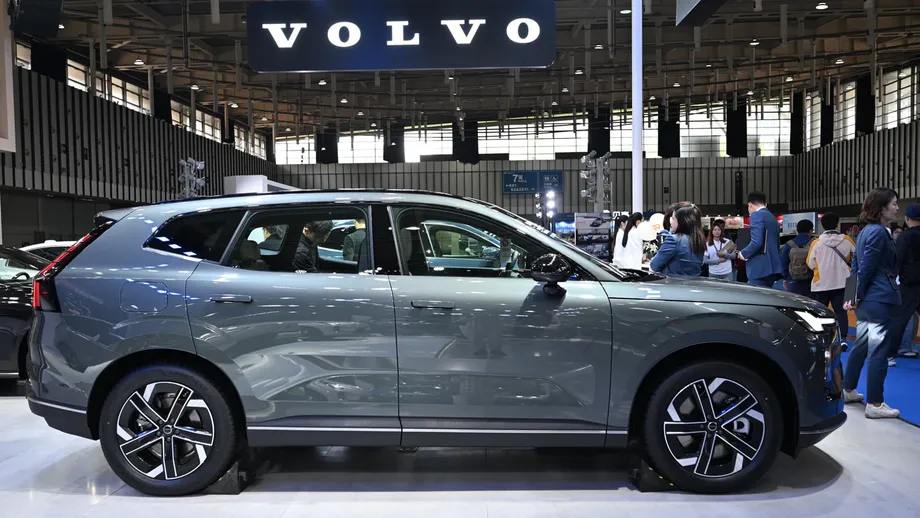
The XC70 already illustrates the direction of travel. Sold initially in China, it uses Geely's SMA architecture and combines a plug in hybrid power system with a stated electric range of 200 kilometres. Volvo also plans an eventual European introduction. The range figure describes travel on battery power before the combustion engine is needed; actual distance varies with driving conditions.
Volvo has not named the first two models in the new six car programme or provided their prices. The immediate promise is a different development approach: local software, closer cooperation with Geely and greater authority for the Chinese organisation.
The financial damage goes beyond lost sales
Group revenue fell SEK 19.5 billion from the same quarter of 2025, a decline of about 22.6%. Operating income deteriorated by SEK 12 billion, moving from a SEK 6.4 billion profit to a SEK 5.6 billion loss.
Volvo's operating margin was negative 8.4%, compared with positive 7.4% a year earlier. An operating margin shows how much operating profit or loss a company records for each unit of revenue. At negative 8.4%, Volvo lost roughly SEK 8.40 at the operating level for every SEK 100 of sales.
The adjusted operating result was also negative. Excluding income from joint ventures and associates, along with items affecting comparability, Volvo recorded a SEK 3.7 billion loss and a negative 5.6% margin. This measure removes specified accounting items to give another view of trading performance.
Free cash flow fell to negative SEK 8.9 billion from negative SEK 4.3 billion a year earlier. The cash outflow therefore increased by SEK 4.6 billion. Free cash flow measures money generated by operations after investment spending, making it especially relevant when a manufacturer is funding new vehicles while sales are falling.
Basic earnings per share dropped to negative SEK 1.63 from positive SEK 1.75. Volvo also withdrew its full year sales and cash flow guidance, leaving investors without those short term targets as the restructuring proceeds.
What the cuts mean for workers and factories
Volvo plans to remove approximately 2,500 positions globally, representing around 6% of its workforce. Sweden accounts for 2,000 positions, or four out of every five planned reductions.
The company said it would achieve the reductions by ending consultant contracts, allowing positions to disappear through natural staff departures and offering targeted exit packages. These measures follow an earlier restructuring involving around 3,000 job cuts.
Samuelsson linked the smaller central organisation to the decision to give regions more control. If regional teams take on more responsibility, headquarters will need fewer resources to direct the same work.
The additional SEK 5 billion savings target covers indirect spending and variable costs. Indirect spending includes expenses such as administration, while variable costs change with the number of cars produced. Volvo expects its indirect spending to be almost 25% below the 2024 level once the measures take full effect at the end of 2027.
Manufacturing will also change. Volvo plans to concentrate on five dedicated Volvo plants globally and is exploring assembly of multiple brands with Geely at its Chengdu and Ghent factories. Those shared assembly arrangements are still under consideration.
In Shanghai, Volvo will combine two offices by moving its sales operation to its local headquarters in Jiading. The company will also adjust factory staffing to production volumes, reduce research and development costs, and increase the use of common suppliers and hardware with Geely.
US tariffs add a second source of pressure
The United States compounded Volvo's difficulties through tariffs and the removal of consumer incentives for electrified cars. Tariffs raise the cost of bringing vehicles into a market, while the loss of purchase incentives can make the final price harder for customers to afford. Both can squeeze the manufacturer's margin.
US legislative changes also caused a negative SEK 1.1 billion revaluation of Volvo's CAFE credits. These credits are connected to Corporate Average Fuel Economy rules, which regulate the average fuel efficiency of manufacturers' vehicle fleets.
Volvo's quarterly result included another SEK 0.9 billion negative effect from recognising Polestar's losses for the second quarter of 2026, as well as adverse raw material developments.
Volvo is reorganising its US business into four regions to speed decisions and improve sales. It is also accelerating production of versions of the XC90 and XC60 with longer electric range that use plug in hybrid systems. European deliveries are planned to start in 2026, with US deliveries following.
XC60 production is scheduled to begin in Charleston in the first quarter of 2027. A second new vehicle with multiple powertrain options is planned for local production by the end of the decade. Producing closer to customers is part of Volvo's broader shift toward separate regional strategies.
Europe offers support, with a production constraint
Europe was the more resilient part of Volvo's business. Fully electric cars accounted for 45% of its European sales in the quarter, and the company said the EX60 had attracted more than 50,000 European orders.
Volvo expects the EX60 to become one of its most profitable models. Production, however, has increased more slowly than planned because of new industrial technology, including cell-to-body construction, which integrates battery cells into the vehicle structure. The company said output was steadily improving.
A further fully electric model planned for 2027 will target a larger European market at a lower price, with first customer deliveries scheduled after the summer. Volvo expects it to support both electric vehicle sales and margins.
Globally, fully electric vehicles represented 32% of quarterly sales, up from 22% a year earlier, a rise of 10 percentage points. Electrified vehicles, including plug in hybrids, reached 53%, compared with 46% in the corresponding quarter of 2025.
The figures show why Volvo is pursuing different product mixes by region. Europe provides a strong market for its fully electric cars, while the Chinese strategy places greater weight on locally developed technology and the US plan includes expanded production of plug in hybrids.
A timetable stretching through 2030
Volvo's restructuring and product programme will unfold over several years. The company says it has passed its investment peak and reduced investment levels by approximately 30% compared with 2024, while continuing to fund the regional vehicle launches.
The main announced milestones are:
- October 23, 2026: Volvo announces its third quarter loss, additional SEK 5 billion savings target and approximately 2,500 job reductions.
- First quarter of 2027: XC60 production is scheduled to begin in Charleston.
- Middle of 2027: The first two of six new cars tailored to China are scheduled for reveal and production.
- After summer 2027: First deliveries are planned for the new fully electric car targeting a lower priced European segment.
- No later than October 1, 2027: Former Skoda chief Klaus Zellmer is due to succeed Samuelsson as CEO.
- End of 2027: The additional savings programme is expected to deliver its full financial effect.
- End of 2030: Volvo plans to have introduced 13 new cars across its regional product programme.
Samuelsson returned to lead Volvo in April 2025 after previously serving as CEO until 2022. The timetable means his successor will take charge while the savings programme and product overhaul are still being implemented.
Lower costs must meet a different product strategy
Volvo is trying to solve two connected problems: its current cost base is too large for weaker sales, and its existing vehicles face stronger competition in China. Cutting overheads addresses the first problem. Developing cars around Chinese software, suppliers and customer preferences addresses the second.
Samuelsson set out the immediate financial objective in the company's results statement.
However, in the short term, with severely challenged volumes, we need to reinforce our turnaround plan with additional decisive actions, lowering our break-even point and improving cash flows to make us more resilient.
A lower break-even point means Volvo would need to sell fewer cars to cover its costs. Shared components, reduced administration and a smaller investment budget are intended to help achieve that. The new regional models are intended to make those sales more competitive.
For employees, the immediate consequence is another round of job reductions. For customers, the coming changes mean a Volvo sold in China may rely on different underlying technology from one sold in Europe. For the company, the critical task is to bring those products to market while containing the cash losses already visible in its quarterly accounts.
Key Points
- Volvo reported a third quarter operating loss of SEK 5.6 billion on revenue of SEK 66.9 billion.
- China revenue fell almost 50% from a year earlier as local competition and pricing pressure intensified.
- The company plans six new cars tailored to China, with the first two scheduled for reveal and production around the middle of 2027.
- Approximately 2,500 jobs will be removed globally, including 2,000 in Sweden, under an additional SEK 5 billion savings programme.
- US tariffs, reduced purchase incentives and accounting charges added to the pressure on earnings.
- Volvo expects the full financial benefit of the new savings measures by the end of 2027 and plans 13 new cars through 2030.